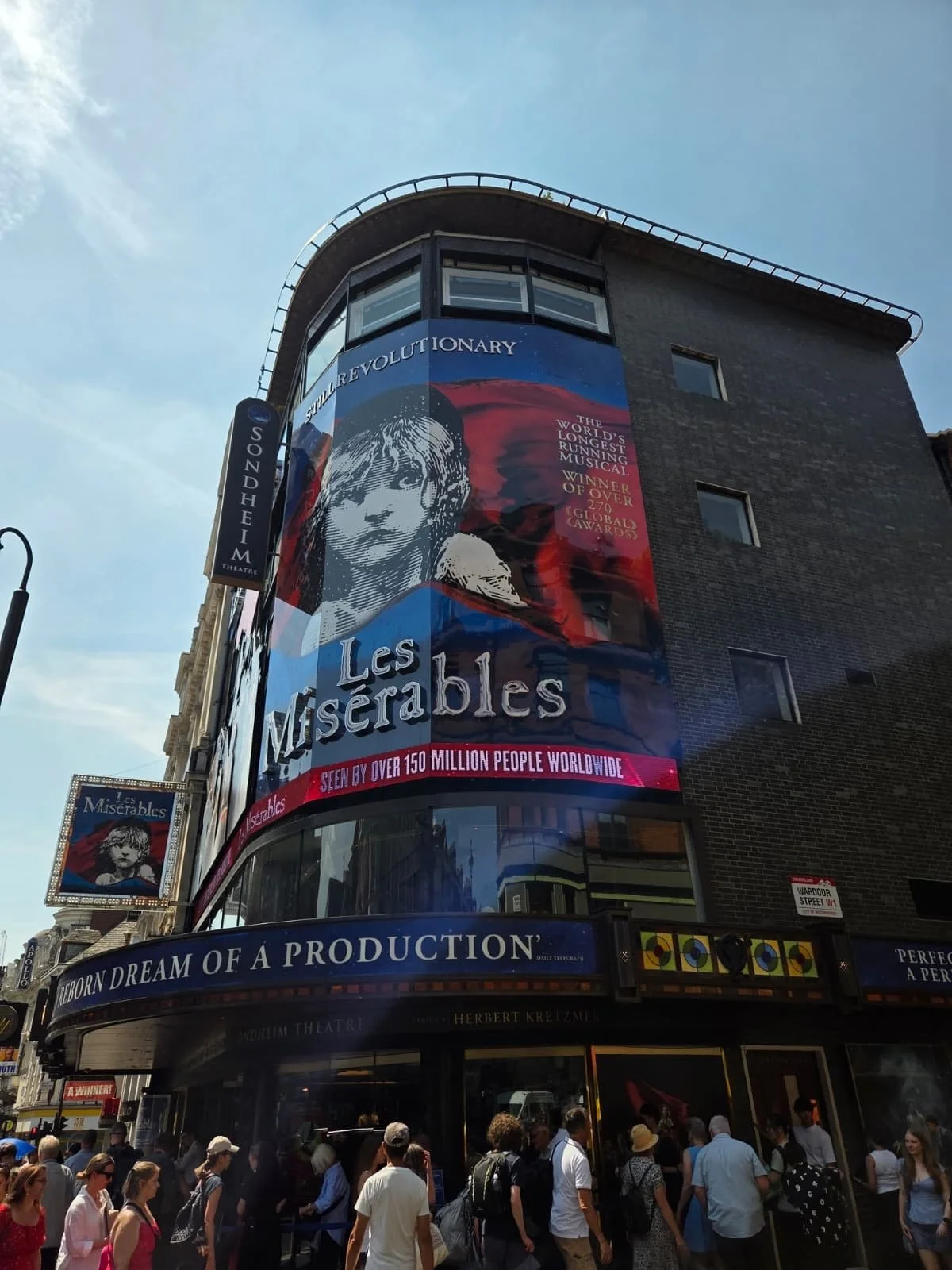
Some stories change when they're adapted. Les Misérables simply changes how it tells the story.
When I first arrived in London, a few days before the program started, accompanied by my family, I had agreed to see Les Misérables, the musical in the West End, with my mom. I knew I would see it again the following week, but when I met with someone who hadn’t had the chance to read or experience the story, I wanted to say yes. I wanted to experience the musical with my mom just as enthusiastically as she did, especially after telling her snippets of many rants while I was reading the novel and hearing about her dream of seeing the show in London. And I don't regret seeing it with her, or seeing it again a week later with my class. The performance is so heartbreaking, brilliant, and exemplary, and if I had a chance to see it again tomorrow, I would.
For anyone unfamiliar, Les Misérables is a musical adaptation of Victor Hugo's 1862 novel. Originally created in French by Alain Boublil and Claude-Michel Schönberg before being adapted into English by Herbert Kretzmer, it has become one of the longest-running musicals in the world. Somehow, it transforms one of literature's longest novels into a performance of just under three hours without losing the emotional heart of Hugo's story.
The first time I saw the musical, I was simply trying to take it all in. The second time, after another week spent immersed in literature and history, I found myself watching less as an audience member and more as a reader asking the question, “How do you turn a 1400-page novel into a three-hour musical without losing its heart?”
Surprisingly, the answer is remarkably well. Herbert Kretzmer took the challenge of writing the English version and did not miss a beat, producing one of the longest-running musicals in the world.
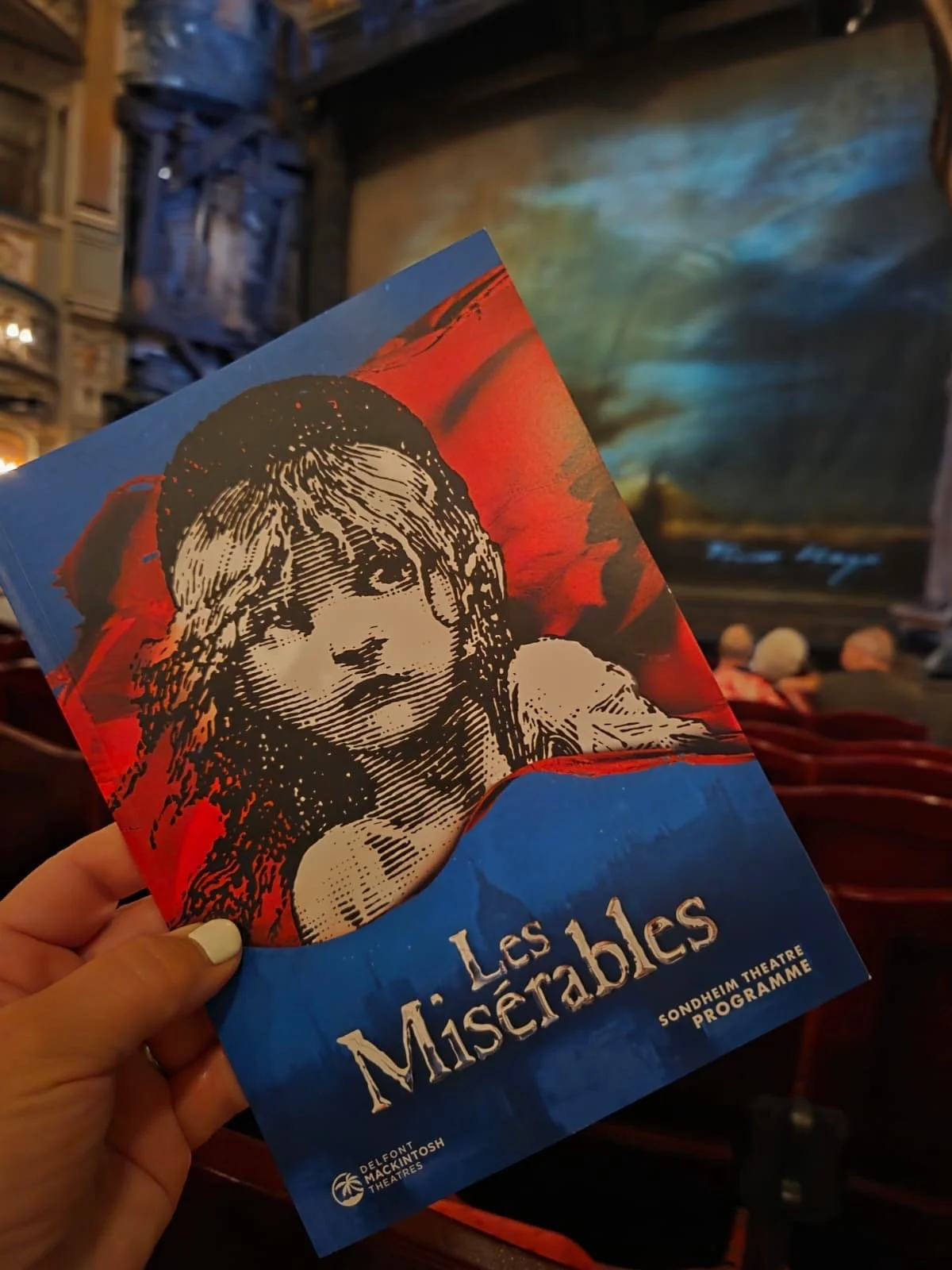
Anyone who's read Hugo's novel knows that Les Misérables isn't just a story. The book is also a history book, a philosophy book, a political essay, and occasionally a very detailed lecture on topics you never expected to read hundreds of pages about. The musical trims almost all of that. Gone are Hugo’s lengthy digressions on Waterloo, the Paris sewers, convent life, Parisian slang, and countless philosophical reflections. I wondered whether cutting so much would make the story feel incomplete or leave noticeable holes in the narrative. Instead, it creates a cohesive story, taking the audience through the same emotional journey as reading the novel.
One of the things that amazed me most was the pacing. Fantine's heartbreaking story seems to fly by. Jean Valjean's transformation happens in what feels like moments. Cossette grows from child to young woman almost immediately. Marius appears out of nowhere. The musical makes you forget that Hugo once spent dozens of pages talking about the Paris sewers. If you've read the novel, it almost feels as though someone is skipping chapters. The musical crams the first four parts of the novel, roughly the first thousand pages, into a single act, leaving the last part of the book to act two. However, rather than it feeling rushed, it felt natural and remarkably intentional. And that’s the astonishing feat of the adaptation.
One thing I noticed far more during my second viewing was that Les Misérables rarely stops the narrative for a "musical number." There wasn’t a spectacle made out of the dancing, and the songs were the dialogue. "Who Am I?" is a powerful solo where Jean Valjean's entire moral crisis is compressed into a few minutes. "Stars" isn't simply Javert singing beautifully. It's his worldview. "One Day More" somehow manages to bring every storyline together while moving each one forward simultaneously. By the time "Empty Chairs at Empty Tables" arrives, the audience hardly needs dialogue to understand grief. We've lived alongside these characters long enough that the music carries the weight for us. Reading Hugo beforehand made these songs even richer. I found myself recognizing themes from the novel hiding inside lyrics I had completely missed the first time I listened. I will admit that the musical, without the context of the book, is difficult to follow if you don’t pay attention, and would leave someone feeling lost at times.
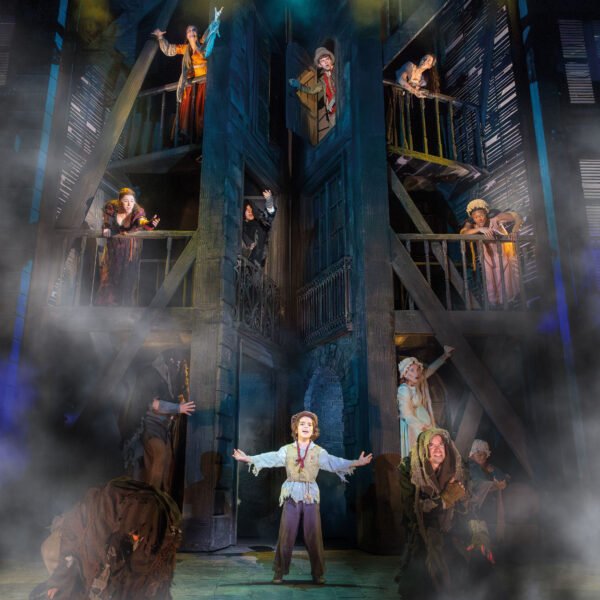
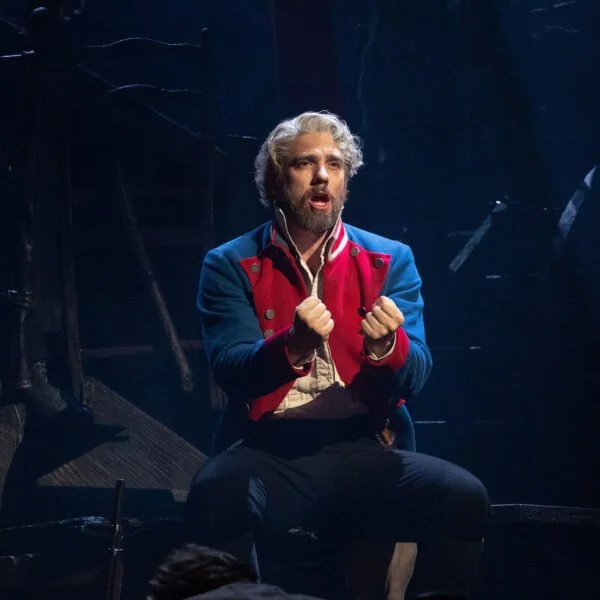
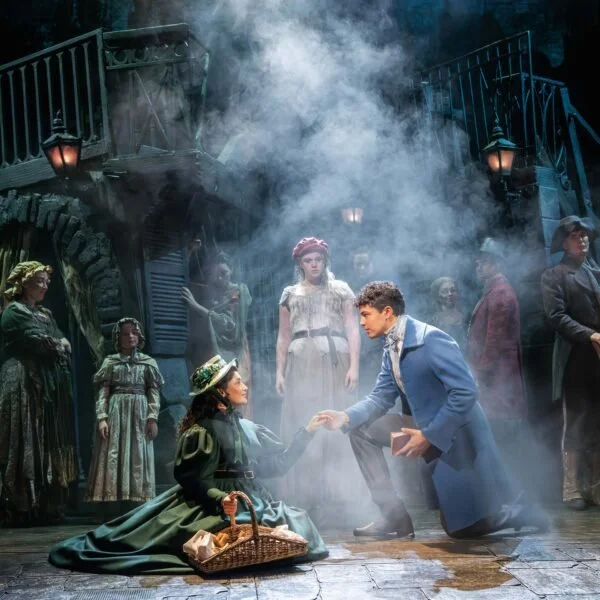
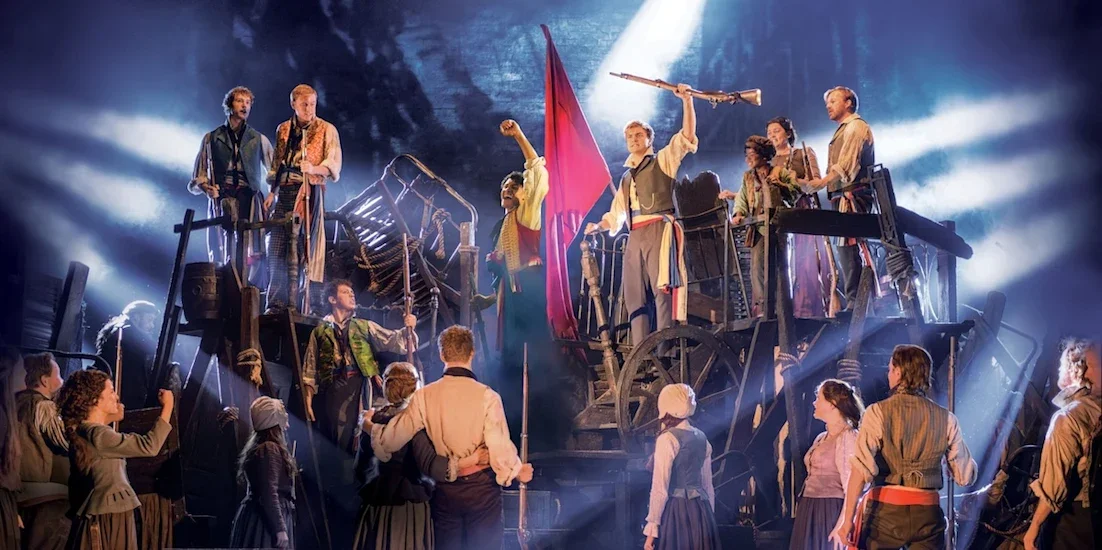
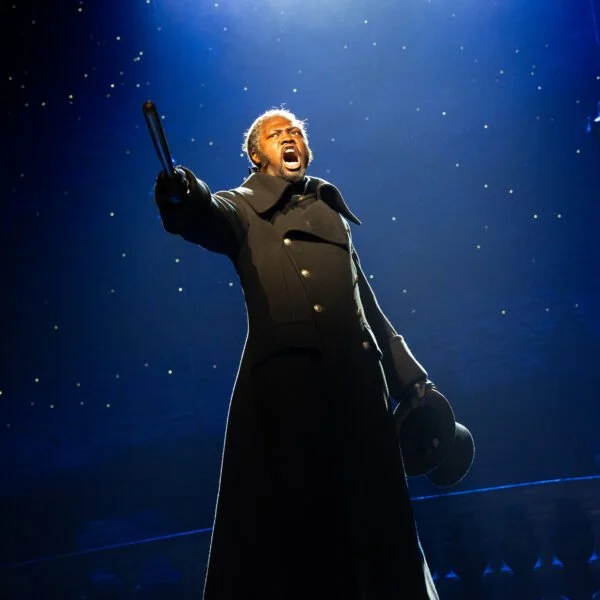
Photos from the London Les Misérables Website Gallery
This blog wouldn’t be a blog by me without a little critique regarding the technical components and casting.
Before diving into the technical side of the production, I have to give credit to the casting because it was phenomenal. One of the things I appreciated most after reading the novel was how closely many of the actors matched the mental images I had formed while reading. The Thenardiers were exactly as I had pictured them: chaotic, over-the-top, and somehow both hilarious and completely unlikable at the same time. Fantine was another standout. From her blonde hair to her delicate frame, she looked remarkably close to the image I had built in my head while reading Hugo's descriptions, making her tragic story even more believable. Beyond appearances, the vocal talent across the entire cast was incredible. Every principal had a distinct sound that suited their character perfectly, from Jean Valjean's warmth and power to Javert's commanding presence. What impressed me most was the range across the ensemble. There wasn't a weak voice on stage, and each performer brought something unique to the score.
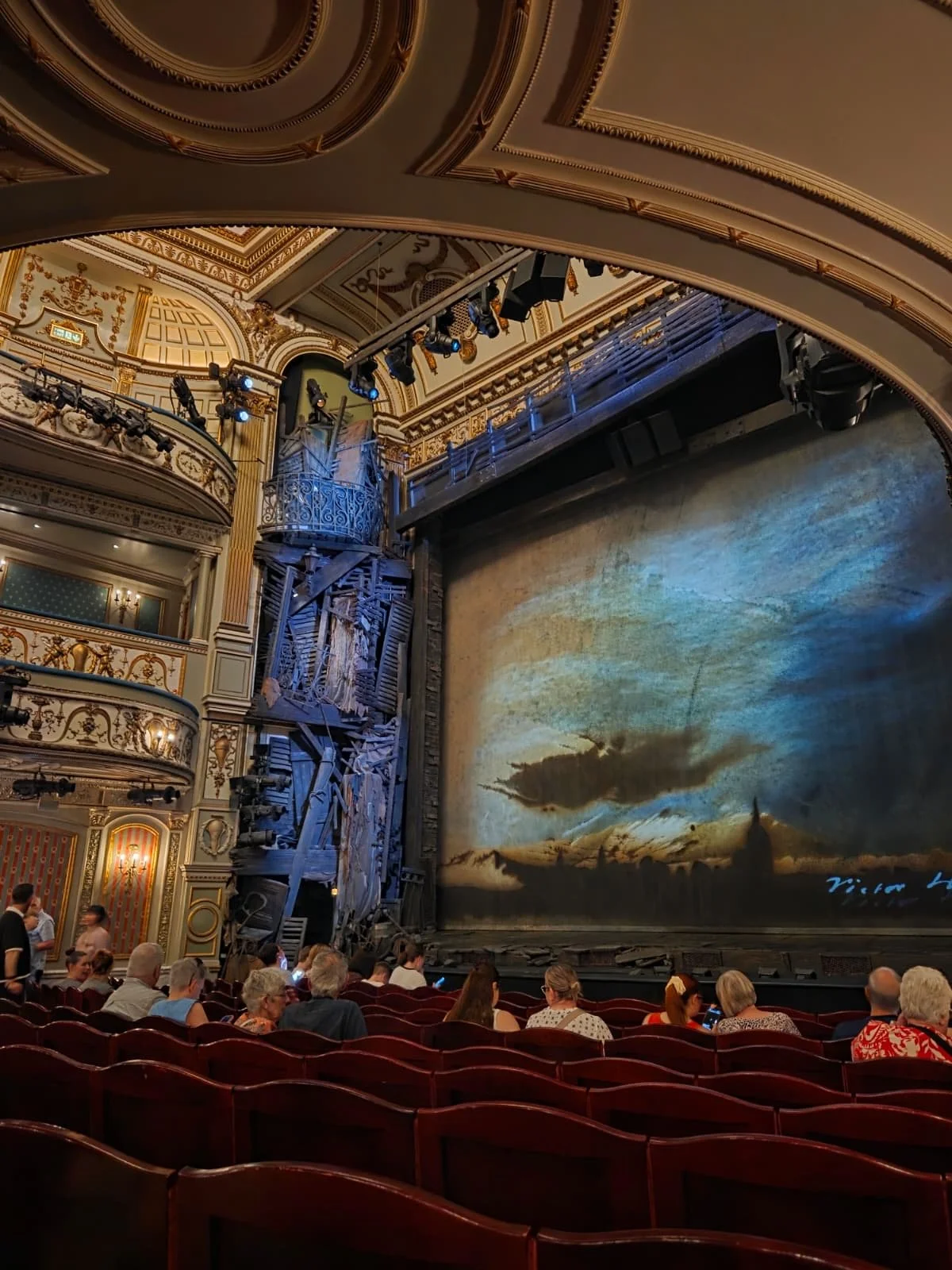
On the technical side, starting with the set, it was absolutely breathtaking. Every moving piece fits together like an enormous puzzle. I couldn’t help thinking of all the planning that must have gone into the design while sitting there, because not only does it have to fit and be reusable on stage throughout the show, but it also has to fit in a probably small backstage space, considering that the theater is in a crammed part of London. On top of the architecture that went into the design, the set was so beautifully detailed in scenes like the barricade or the Thenardiers’ inn. I liked the use of a side vom for additional acting levels on stage left as it added depth. And the lower exit that went below the stage on stage right was also a clever way of utilizing the space in the theatre.
Accompanying the scenic elements was the soundscape. The sound in the show was probably my favorite technical element. From the dripping of water coming from around you during the sewers to the subtle birds chirping in the square, the sound enveloped you completely, making you feel like you were actually there. Together, the sound and scenery brought the “scabrous seepings from the walls, dripping ceilings, blackness” of the Paris sewers described in the novel to fruition. The sound transported you into the world onstage much like Hugo's words transported you into the world on the page. Combined with the orchestra, it created an experience that felt completely immersive. Even more impressive was hearing musical motifs weave in and out of different songs, connecting characters and ideas long before the story explicitly did. Those recurring themes became little musical "Easter eggs." Once I noticed them, I couldn't stop listening for them.
Other miscellaneous elements I applauded were the pyrotechnics and Javert’s flight. During the show, there were pyrotechnics of sparks from Jean Valjean’s gun and off the top of the proscenium during the barricade scene. I thought that these were nice elements to add. I only wish that there were more sparks throughout the barricade scene, and not just the two in one corner. And when Javert takes flight off the bridge when he jumps, I applaud it not for having that additional element but for the smoothness of it. To have an actor fly on stage, they have to be clipped into a rigging system. During this scene, you could tell that he doesn’t get clipped in until he is on the bridge because he crosses downstage sporadically, and if he were to be clipped in during that, the rope would get caught in the lights and would disable the actor from flying due to danger risks. All in all, I applaud this because I love it when something takes you off guard in a show like this, where you don’t see him getting clipped in, so you aren’t expecting it.
Not every technical choice completely worked for me.
Some lighting moments were so dark that characters blended into the background (particularly during Javert's final scene), making it harder to focus on the emotional center of the moment. I don’t think that the light of the exit signs should be the lights drawing my attention more than the stage lights because the green “exits” were brighter than what was on the stage. I understand that the designer was intending for the lights to convey similar themes to the novel, but you shouldn’t have to strain your eyes to make out what was happening on stage. Towards the end of the performance in Act 2, the entirety of the dim lighting throughout the show was thrown off, with the scene in the wedding ball being the brightest and most light-filled scene, almost as if a separate designer had designed only this scene. I did enjoy how there was a consistent “beam of death” light to symbolize when a character passed away. I thought it was a clever way to understand each monumental death. My last comment regarding the lights includes the barricade, which was well designed and communicated the chaos/battle of the scene; however, I thought that it was quite inconsistent with some of the lights matching the sound and music, but some were out of place.
I walked away simply thinking that the costumes served their purpose in communicating the period, social classes, and relationships. Cossette’s costume as a kid in the Thenardier’s house showed that her relationship with the family was not a loving situation, as it juxtaposed Eponine’s gorgeous, clean, and wealthy-looking costume. My only qualm with the costumes throughout the show was that I thought that Jean Valjean’s soldier disguise stuck out like a sore thumb, not because of the other costumes, but because of how the costume itself looked like it was a last-minute addition and a less detailed costume in comparison to all the costumes in the show. Bringing it back to the wedding scene, I thought that the costumes brought such a huge contrast to the rest of the show, but it worked because it portrayed the happy moment. But even those moments didn't diminish the overall achievement of the production. If anything, they reminded me just how many artistic decisions have to come together successfully for a show of this scale to work. What makes this experience even more meaningful is when it happened.
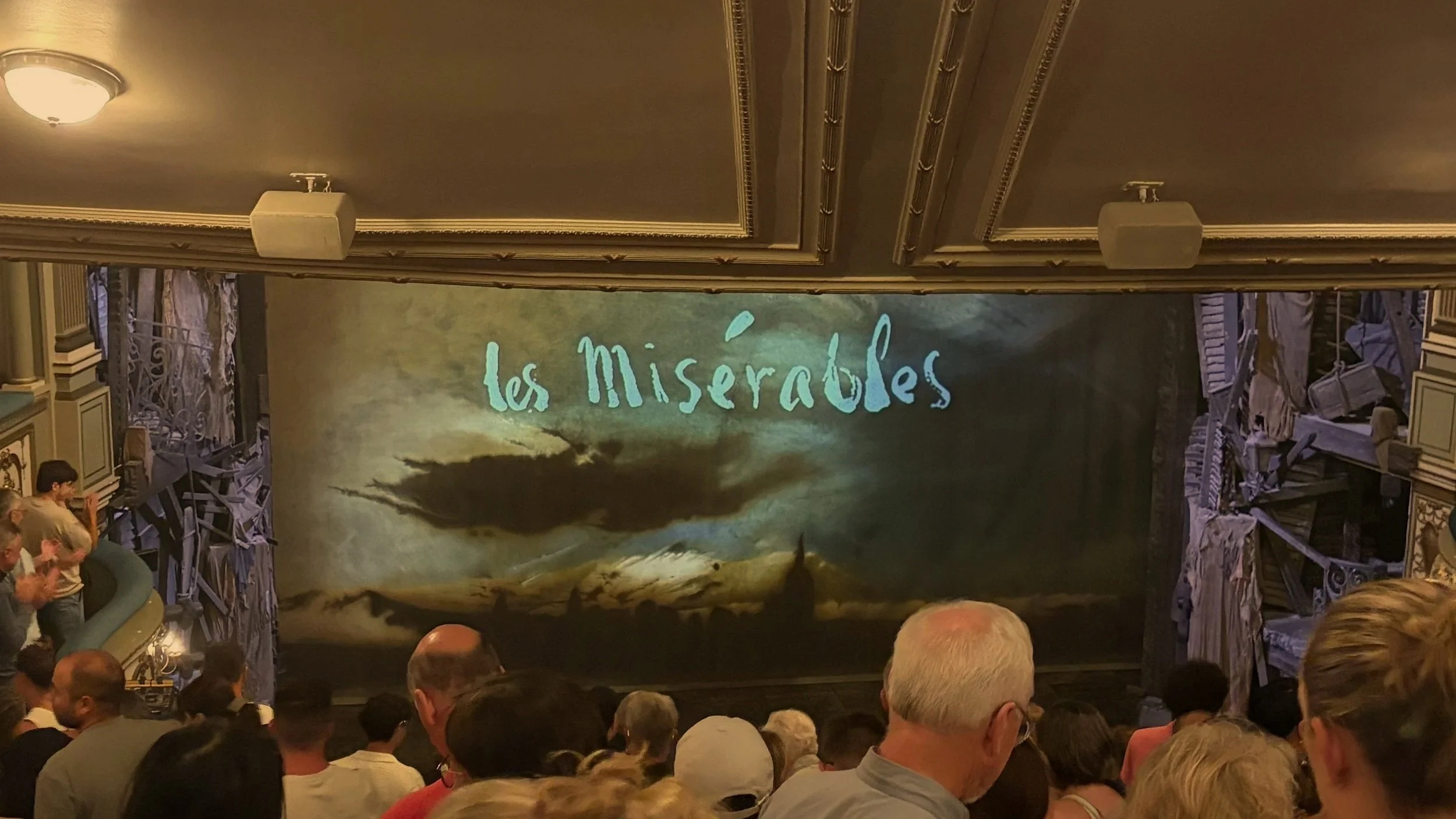
Our class hasn't even begun unpacking Les Misérables together. During our first week in London, we've been exploring Dickens' world through A Tale of Two Cities, walking the same streets that inspired his novel while discussing revolution, justice, and the relationship between England and France. Watching Les Misérables in the middle of that journey felt like standing on a bridge between the two novels. Dickens asks us to think about revolution through England's eyes. Hugo asks us to experience it from within France. Soon we'll leave London and begin tracing Jean Valjean's footsteps through Paris. When we do, I know I'll be reading the novel differently than I did the first time. And I have a feeling that, somewhere in the back of my mind, I'll still be hearing, "Do you hear the people sing?"

.