Not to be cliché, but being a young person right now is hard. It sucks pretty bad. There are lots and lots of cool things about living in the 21st century, but when you add up the countless recessions, global democratic backsliding, a major pandemic, and the entirety of the internet, it doesn’t look very good. In the last ten years, there has been a rise in protests and civil unrest in response to various injustices. The BLM protests in June 2020, for example, were among the largest and most sustained civil demonstrations the world has seen in decades. However, the re-election of Trump and the rise of right-wing populism have clearly demonstrated that the pendulum is swinging the other way. At this point, when I read the news, I can barely tell if I’m reading an Onion headline or not. Now, some of this increased support for the right is for (more or less) valid reasons. Many became upset with the rising cost of living, thinking that lower taxes might improve their financial situation. Others became upset with the purity culture perpetuated by the left, or the idea that one mistake meant you could no longer truly be a part of the cause. And others still likely fell victim to the rapid rise in right-wing content being pushed by social media algorithms online.

Figure out which one is real challenge

Le Pen arriving at court to appeal her conviction. It didn’t work.
This is not just true of the United States. In France, while there is certainly more variation, a rightward shift is currently happening. This is for reasons similar to those in the US: the right is consolidating power and appealing to ‘ordinary people’ while the left remains fragmented and focused on infighting. In fact, in the 2027 French presidential election, Marine Le Pen, the leader of the far-right French National Rally party, is predicted to win. This is despite the fact that just last March, Le Pen was convicted of embezzling EU funds. A criminal president? Sounds familiar to me. Regardless, Le Pen and the National Rally have been gaining public support due to strong anti-immigration sentiment and economic anxieties.
In class, we read a fascinating excerpt from The Other Paris by Lucy Sante. When contextualizing Parisian activism, she says, “In a sense, the revolution that began in Paris in 1789 never really ended.” She explains that this applies to the current day, with the city still continuing “to serve as a theater for every sort of demonstration and strike” even as “[France’s] social problems have been exported to the banlieues and the provinces.” With the rise of Le Pen and the National Rally, however, it really doesn't feel like that's true.
On the other hand, Sante's argument is exactly the sentiment one feels when reading about the Friends of the ABC in Hugo’s Les Misérables. These students are idealistic and want a better future for themselves and the people of France, so much so that they are willing to put their lives on the line. Yet, ironically, the 1832 students’ revolution barely left a dent in France's revolutionary history. Most of its current notoriety stems from its inclusion in Les Misérables. Hugo even titles a chapter about them “A Group That Came Close to Becoming Historic.”
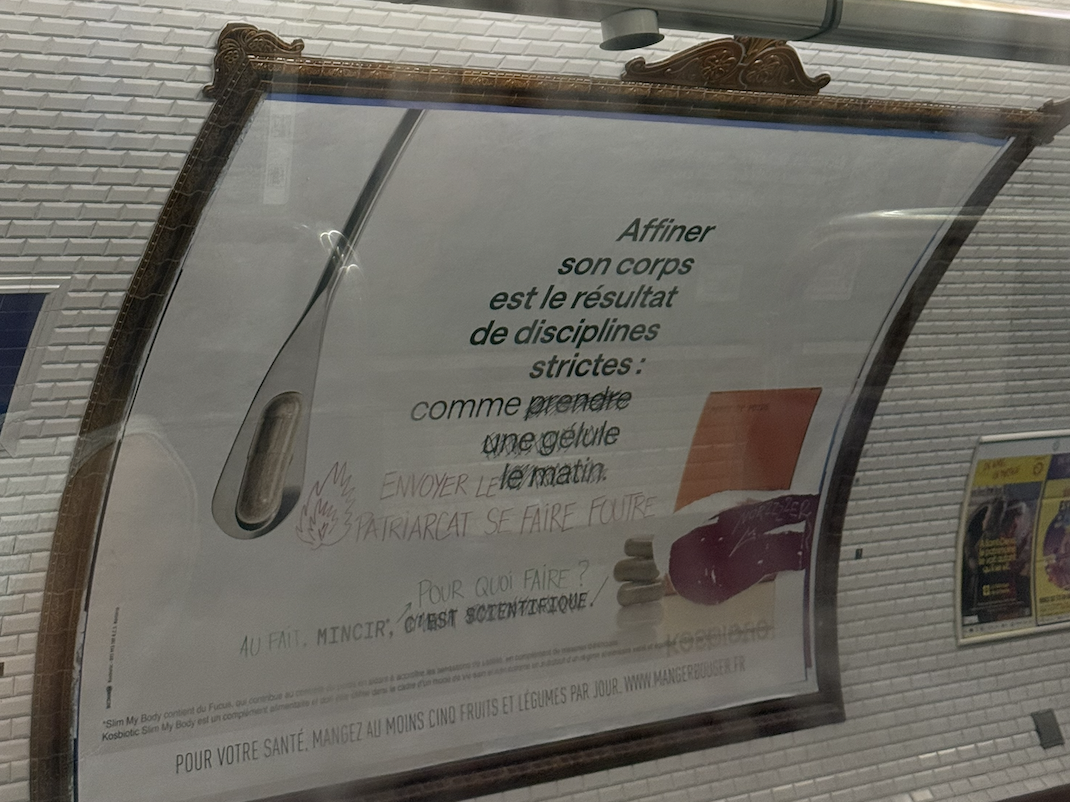
One day, while I was on the subway, I saw an advertisement for weight-loss pills. It was defaced with graffiti - pretty normal in Paris. My train was delayed at the station, so I decided to translate what it said.
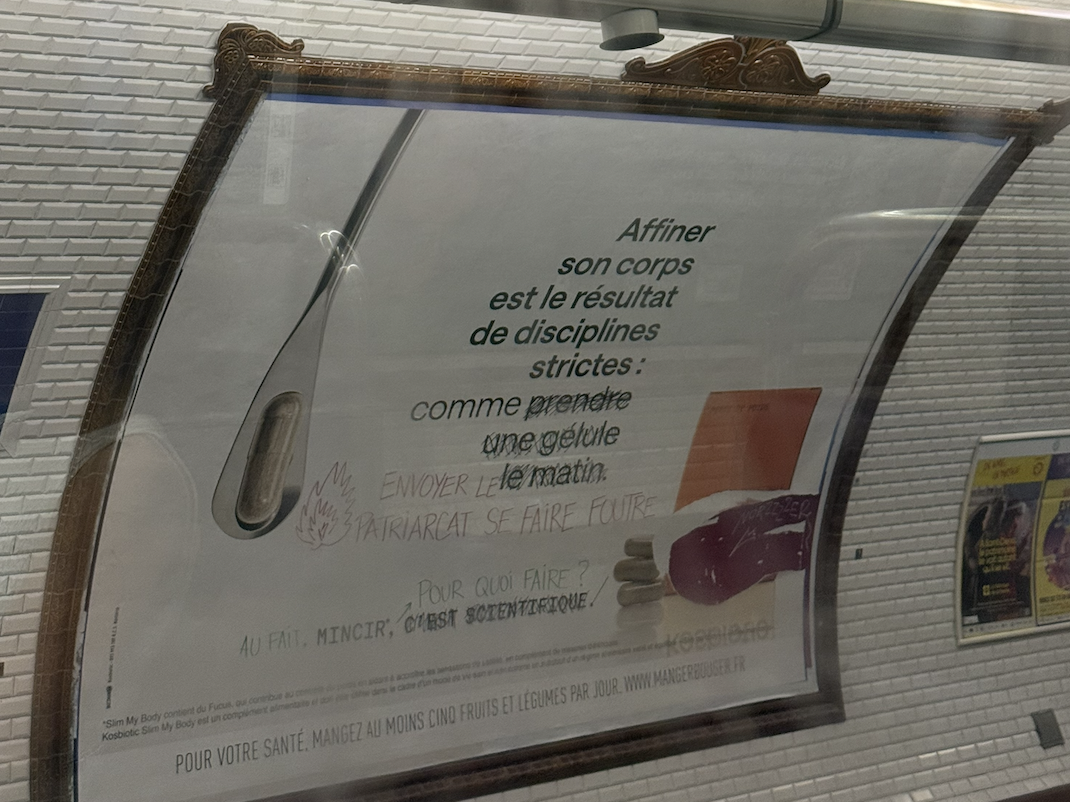
The ad’s original text says, “Getting in shape is the result of strict discipline - like taking a pill in the morning. Losing weight is a science.” The second half is crossed out, with the addition of “Fuck the patriarchy. By the way, why bother losing weight?”
When I saw it, I couldn’t help but smile. This was the kind of revolutionary spirit that Sante was talking about, the kind of spirit that the Friends of the ABC had. Sure, it isn’t a grand political statement about the human condition. But it is a bold public statement against what is, in my opinion, a gross attempt to profit from an insecurity that was falsely constructed by the patriarchy and forced onto women.
While this ad was the first defaced ad I saw, as the Baader-Meinhof phenomenon tends to work, once I noticed one, I saw them everywhere. For the first time in a long time, I felt a little bit of hope. Not because I think that graffiti on subway ads is the way to affect lasting political change. I mean, the person who crossed out that ad will be forgotten even faster than the student revolutionaries were. Instead, it was the concept that some people are always going to scribble in the margins, whether or not history is watching. To get any reminder that there are still good people out there, people who care just like you care, feels amazing. So, while I’m not sure we can still consider Paris a revolutionary city any more than any other city in the world, I do want to thank it for letting me gain some new perspective. And it was all because of a subway ad.