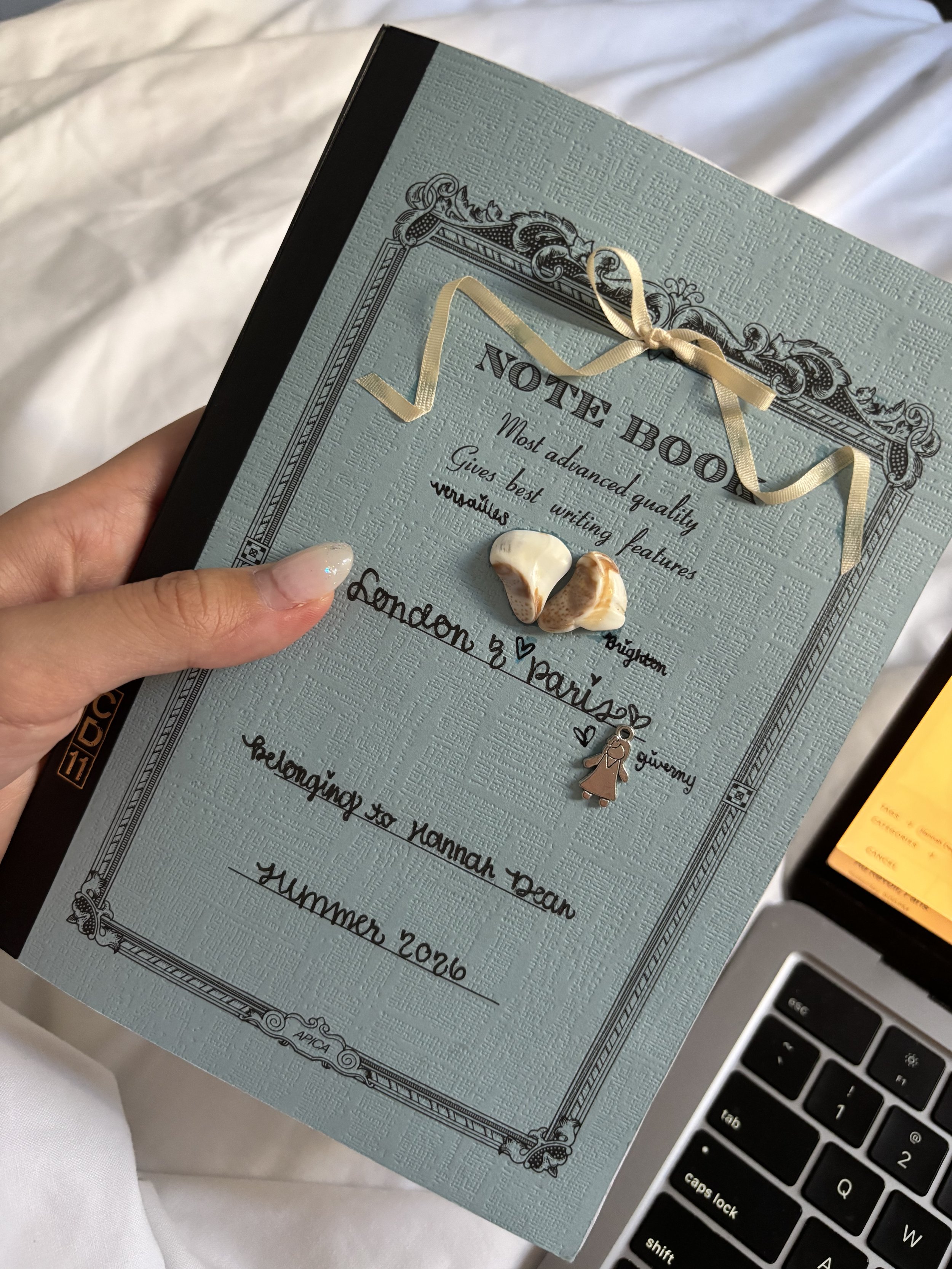
As the class bookpacked through London and Paris, I scrapbookpacked my fair share of the two cities. I have an utter fear of forgetting things important to me—my memories are precious to me, and I used to hold on to every single scrap of paper or useless receipt to protect them. But it crept a bit too close to hoarding, so now I create travel scrapbooks to recall my memories to life.
I honestly do not know what to write in this blog…Andrew asked me to include more of my personal voice, so I will try to share all of my thoughts these past couple of weeks regarding our class—though I’m sure it will be messy and tangled (like my hair!).
When I was a child, I had a perfect photographic memory. I retain these old memories, still clear, like a camera. Even now, there are certain days or events where this photographic memory will reactivate, and I’ll remember exactly what I was wearing, when, who said what, et cetera. But it is faultier and less accessible than in my childhood.
I also learned a love for reading when I was young. I was scared of growing up, and thought that trading the colorful illustrations of my picture books for greyish pages of black text meant just that. So I stayed away from books, until my second grade teacher told my mom I had to read more. She did a book club with me, with a hard book—we read The Odyssey. I found that in the blank spaces between each word, and in the half-seconds of darkness when I closed my eyes, my mind painted beautiful pictures of adventure. And so I fell in love with reading, especially the classics.
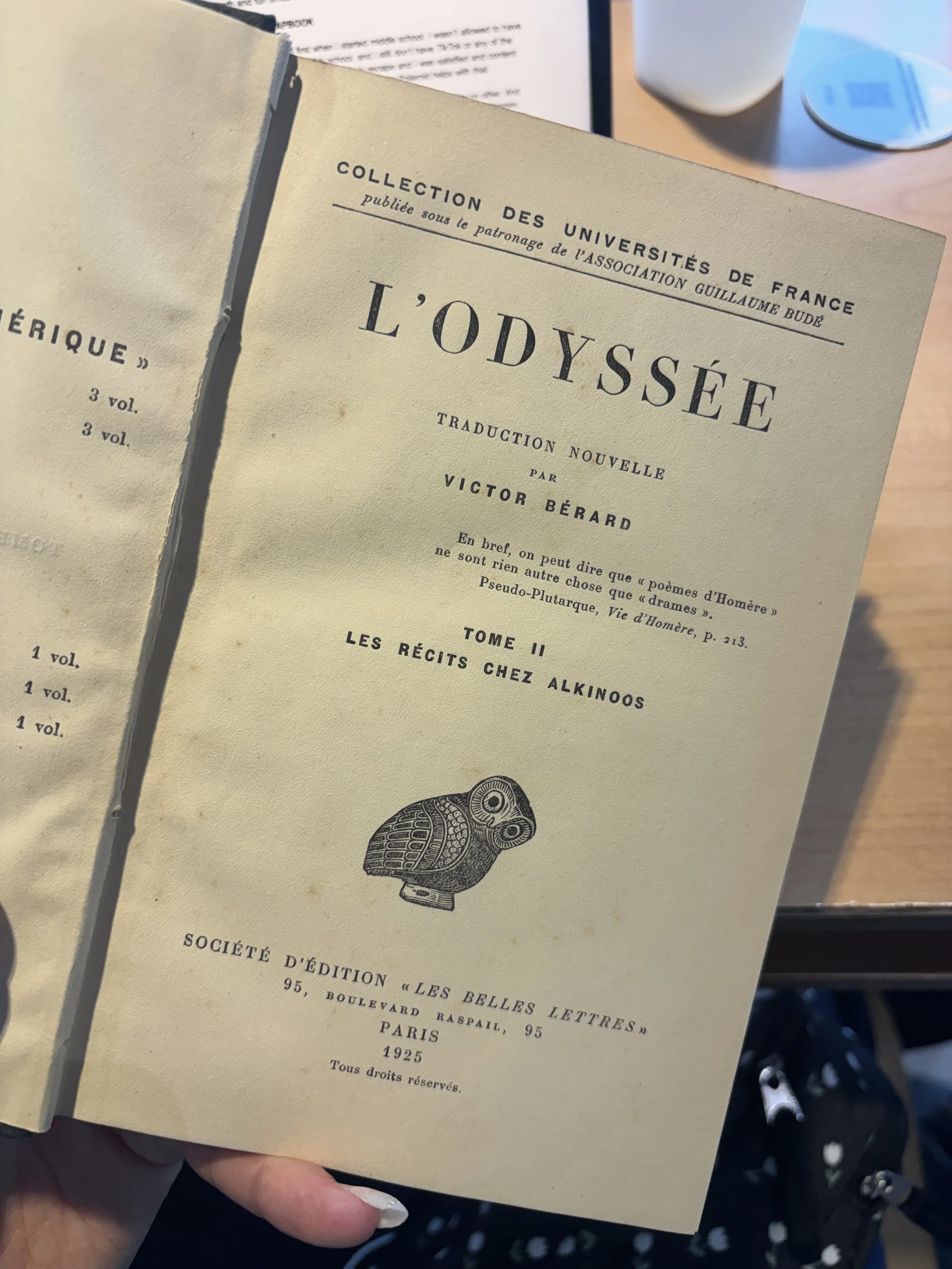
A 1925 copy of L’Odyssée I picked up in the 9e, at the antiquarian bookshop Andrew found in the back of Passage Jouffroy.
Thus, reading two classic pieces of literature—both important cultural texts, and visiting the sites each character once traversed (and most likely the authors), was an absolute dream of a class for me.
But my memory isn’t what it used to be, it’s slower and dimmer now. It’s the fatal flaw of technology: excessive digital consumption being tied to a cognitive decline. And so I dutifully kept my scrapbook, marking down monuments both of the history we learned in class as well as of personal growth and fun times with friends.
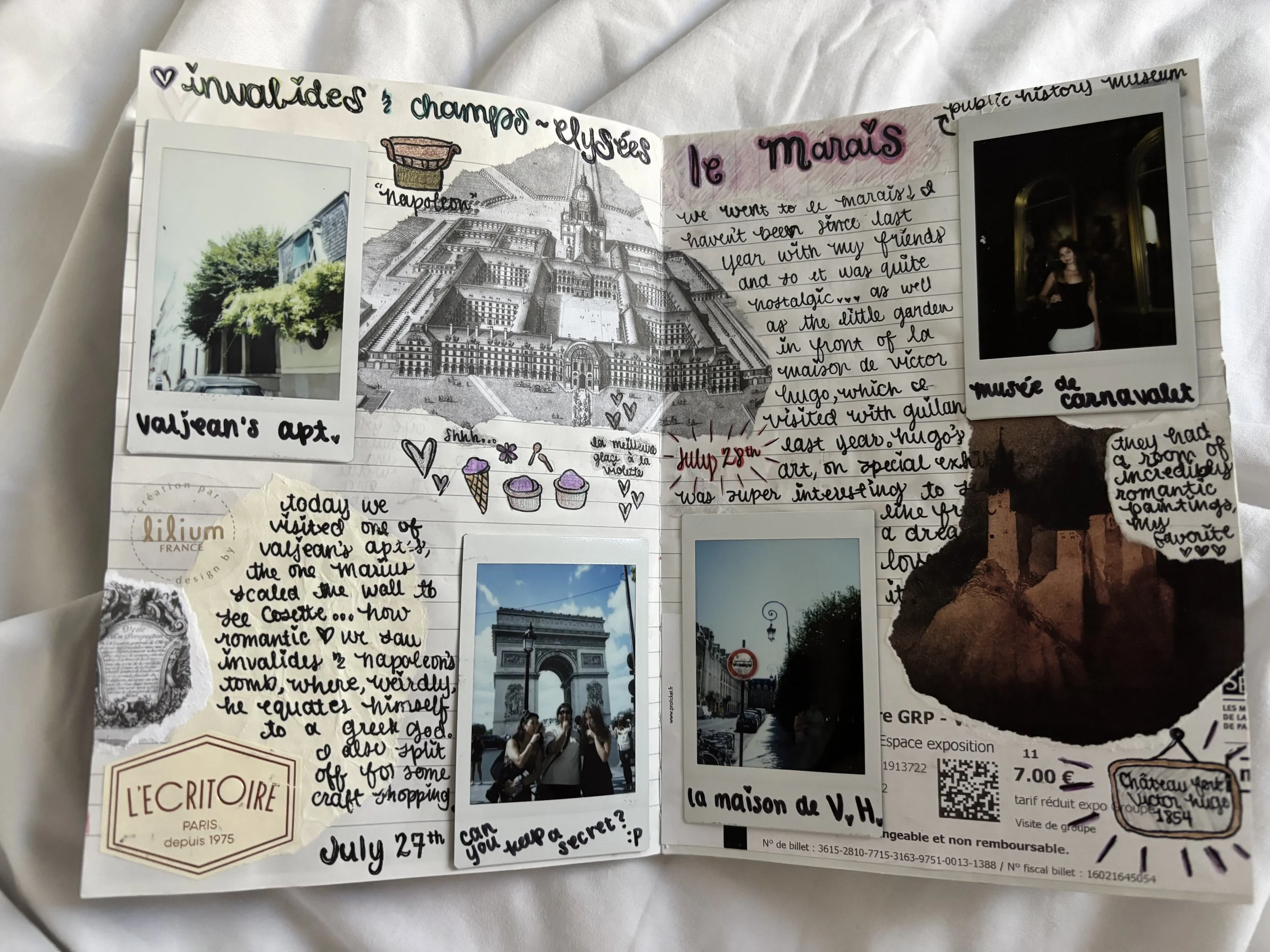
I raised without a phone, given my first when I started middle school. I wasn’t allowed to have Instagram until I was a sophomore in high school, and I still don’t have TikTok or any of the other social media apps. Back then, I used books to escape and I was satisfied and content with that. Now, even my photo gallery is overwhelming—my Polaroid helps with that.
But the dopamine hits I learned online were, as much as I hate to admit it, like no other. And even as my memory fades, I still vividly remember how happy I was before I had Instagram. And I’m not saying it’s the Internet’s fault that I always feel alone, I certainly felt that way even when I only had books. But even though my feed is bunnies and recipes and romantic Disney scenes, I struggle to feel alive as I once did. I feel like a zombie, and I feel my creativity leaving me. I want to be intelligent, but I don’t know how to be when I forget everything eventually. Especially when artificial intelligence will always beat me to the point.
As someone who wants to be a writer, all of these ideas are unnerving to me. The entirety of this class, I have wondered: if Victor Hugo grew up in our generation, would he be able to write Les Misérables again? If Hugo had social media, and text messaging, would his brain still find a way to imagine 1400 pages?
Hoping to pursue creative writing, I constantly wonder if I am still capable of doing so. Has the blue light I have exposed myself to severed the neurons necessary to paint such vivid images, am I now reduced to fuzzy Monets?
There’s a whole trope about girls being drained, or tired, and it being romanticized. There’s plenty of internet art of petite girls with long, droopy lashes and big doe eyes with purple circles and hair flowing as they drape themselves over the edge of their beds. Captions liken the art subjects to the artists themselves, some even as simple as: “me.” I know you’ve seen it, and if you haven’t, I know you can find it. I know sadness, and grief, and depression have always existed. It just feels so much easier to succumb to it now.
And so even when I don’t have time, when it feels like homework, I make time to scrapbook the things we have learned and the places we have visited. The hobby keeps my eyes off the screen for the time being, and helps me retain my precious memories. I have a certain love, as well, for untouched classic literature, or old-fashioned cartography—and was fascinated with Professor’s ability to do so as he taught us how to map old maps onto new.
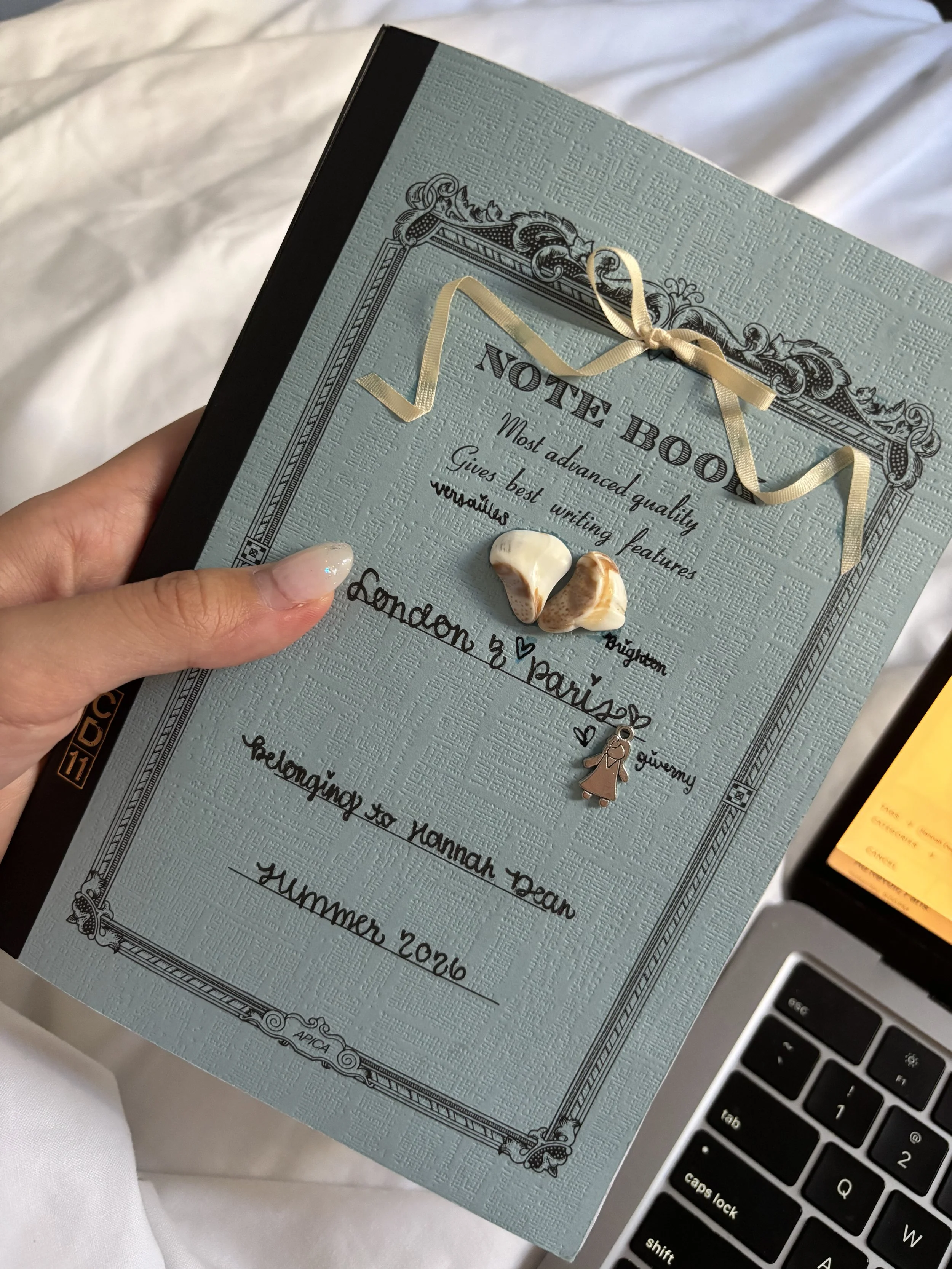
The cover of my travel journal.
As we followed Andrew’s mapping of Les Misérables, walking the same boulevards and avenues Valjean and Cosette once did, I feel a sense of déja-vu for a life that wasn’t my own—one fictitious, that never existed.
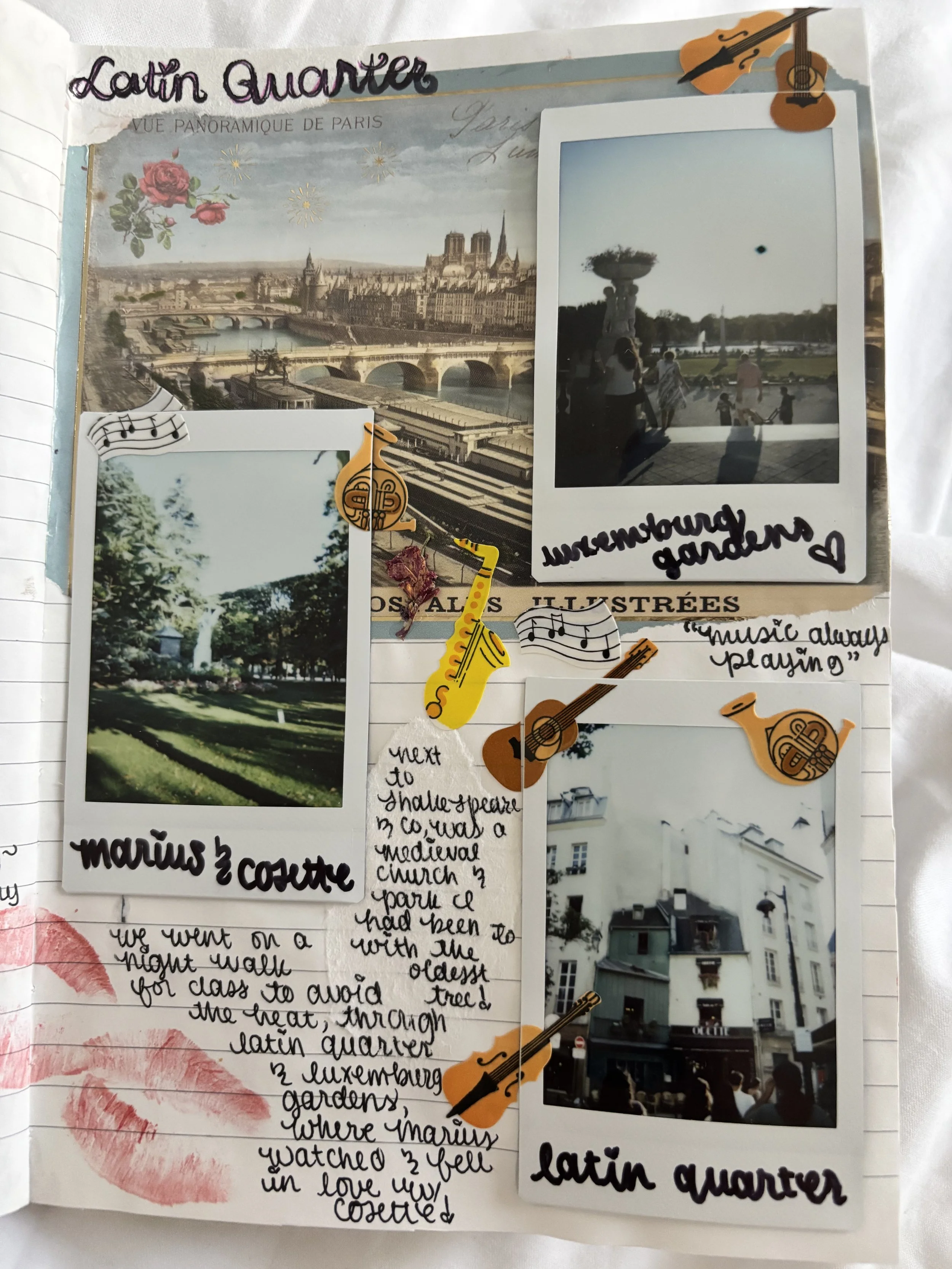
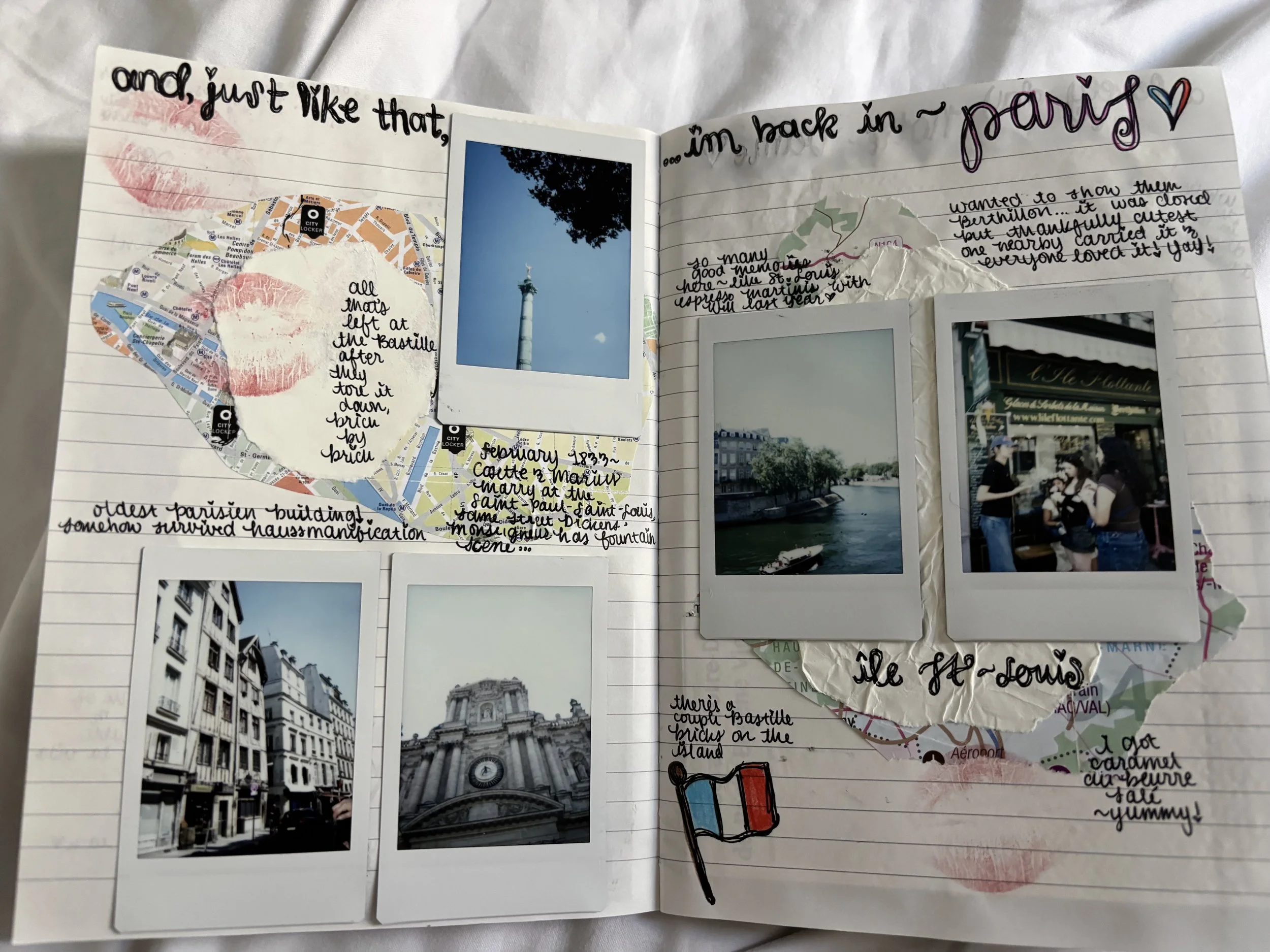
Another part of Cosette’s story that we walked.
I briefly touched on this idea in my first blog, where I explained why I so enjoy collecting antiquarian books, vintage vanity pieces, and old-fashioned clothing—as I love imagining the lives of the people who first touched these treasures, however many hundreds of years ago.
Would I have been friends with Hugo if I had the chance of meeting him? Would he have liked me? Could I have been a writer? Did Hugo know someone who passed the same way Javert did? Were his characters truly just political or social arguments, or did they honor lives he once knew? There’s this constant, unfamiliar déja-vu of narratives that aren’t my own as we bookpack. I have so many questions and no answers. But Paris also reminds me of a déja-vu of my own.
When I was about 15, my family started visiting Paris. And last year, I had the privilege of spending two months here—one in Paris, one in the south of France—first for a class, second to see family.
While in Paris, I stayed in the 9e arrondissement. A couple days ago, our class excursion took place just a couple blocks away from my old studio when we visited Galeries Lafayette and Palais Garnier, both places I came to love last summer.
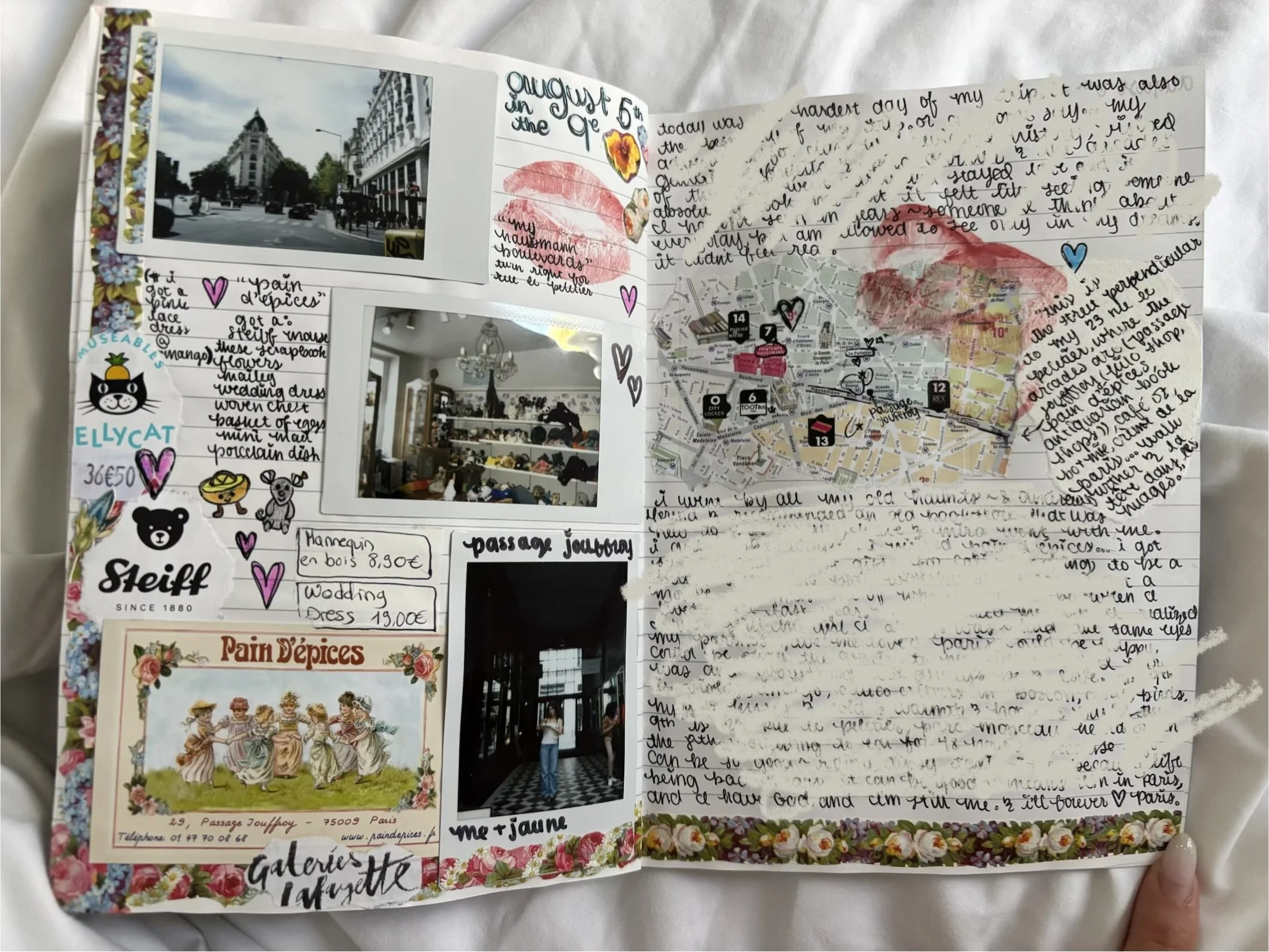
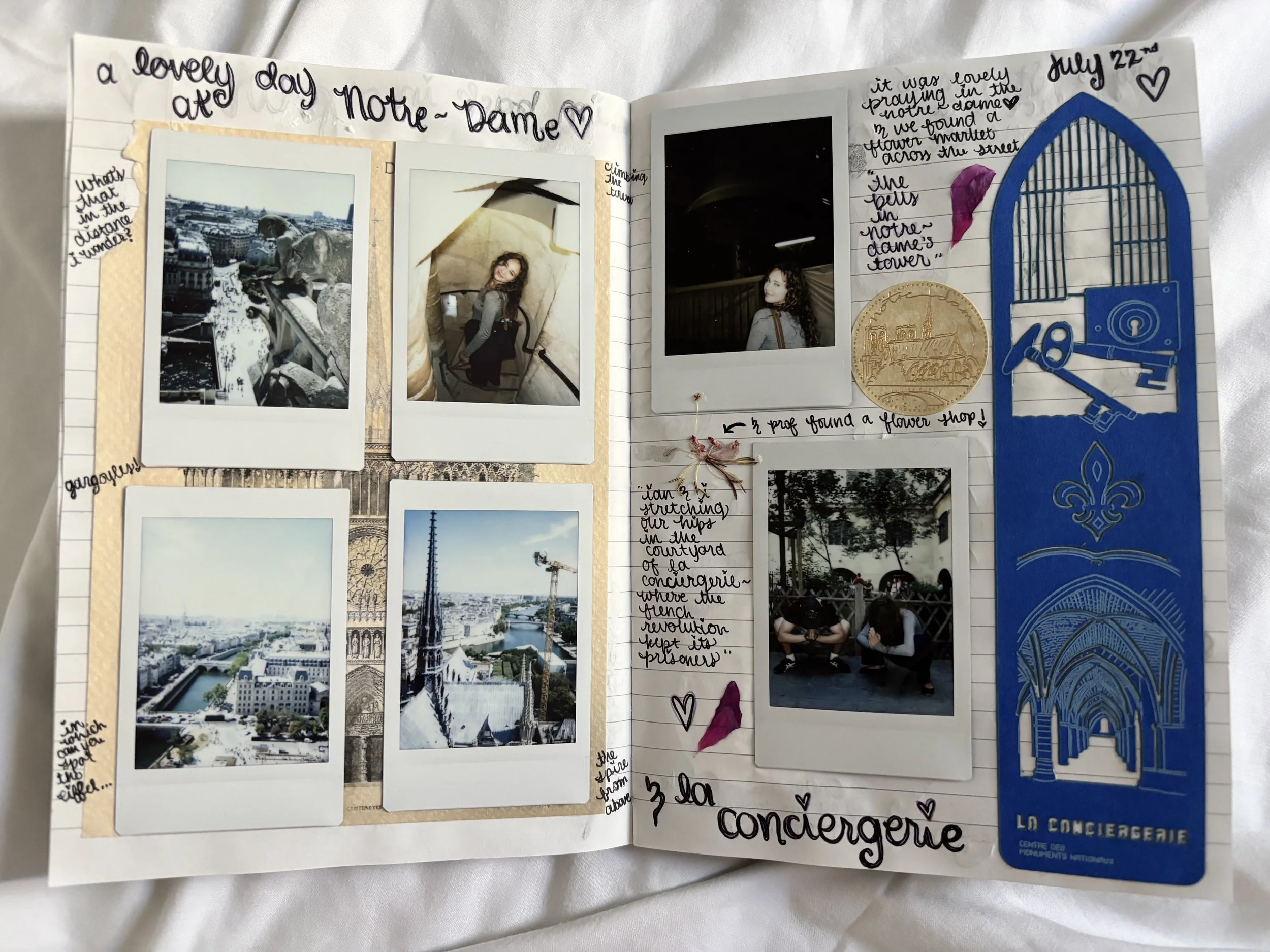
My pages after we visited the 9e.
I spent the rest of the day flâneuring my old stomping grounds. It was simultaneously the hardest and best day of this trip. It felt like seeing someone I haven’t seen in years, someone I once loved, whom I think about everyday, but am allowed to see only in my dreams before I wake and remember all is lost. So dramatic, right?! I just don’t know how else to explain it. Now that my memory isn’t so sharp, it’s become such a physical attribute—I see or smell or feel something an old me knew and suddenly I remember all these other versions of myself.
I had a hard time making friends or at least it felt that way. I was in love with someone who had become a person I didn’t know anymore. Sometimes I was selfish without realizing it. I ate too much and cried too little. Walking along Boulevard Haussmann and then down Rue Drouot and Rue le Peletier, these memories activated again.
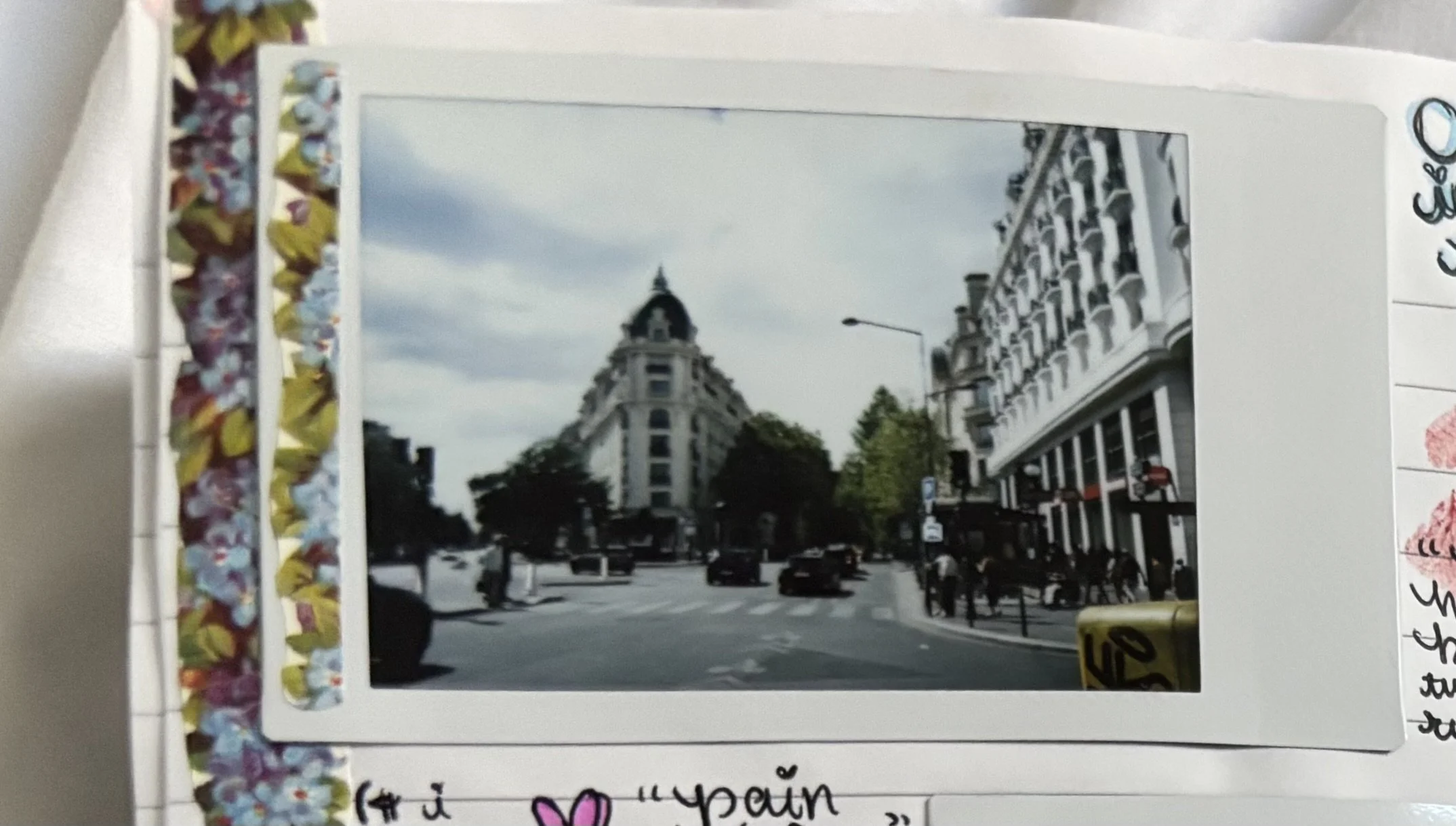
Boulevard Haussmann.
I realized that in exploring other narratives, my own felt lighter. I turned back to books and my love for reading after last year’s class, which gave me the desire to apply for this class. I found myself—and didn’t—in fictional characters like Sydney Carton, Cosette, Valjean, and Javert. And through all of the struggles I put myself through in the past, I realized I was still the girl I always had been, the same realization the Bishop’s kindness allowed Valjean.
I found this experience to be similar to Jean Valjean’s. He tried to create a new life for himself, be a better person and start anew. But Javert was a constant reminder of who he was escaping, the harder person the criminal justice system had once forced him to become.
Valjean was honest about his flaws during the Champmathieu Affair, trading his well-to-do life he built where he helped many others for a harder one where he could protect Cosette. I’m sure Cosette remembered his kindness and their love when she and her future family walked through the same streets she and Valjean once ran through under the cover of darkness.
Professor asked us in class if we experienced the magic and romance of Paris. How much more magical does it get than stepping into a book, and making my own memories appear on the pages of my scrapbook? This class made me want to bookpack all of my other favorite books too. I wonder if the magic and romance we feel today is anything similar to what Hugo once felt.
This blog has been long and rambling, and is my attempt at an answer to Andrew’s question about how I felt about the characters of our books. I think I focused on English and French history in my other blogs because I had answers, rather than questions. And I think for most of this trip I was so caught up in understanding our characters’ narratives and recreating their treks across Paris that I had forgotten my own. I still have so many questions that will go unanswered: were the students caricatures he knew or invented? Was the zig-zag through Paris a stroll he once took with a lover or a friend, or was it something he plotted from his desk while looking at a map—something totally unrelated? Did Javert remind him of something or someone from a church he had once visited—and was that the person that made him question his faith? Was Valjean the one who restored it, or did that figure only make him question it more?
Scrapbookpacking has been a way for me to remember my own, Andrew’s, Hugo’s, Valjean’s, Fantine’s, and Cosette’s memories. I love learning about other people from the smallest of observations they make, from their memories, their experiences and forgivenesses.
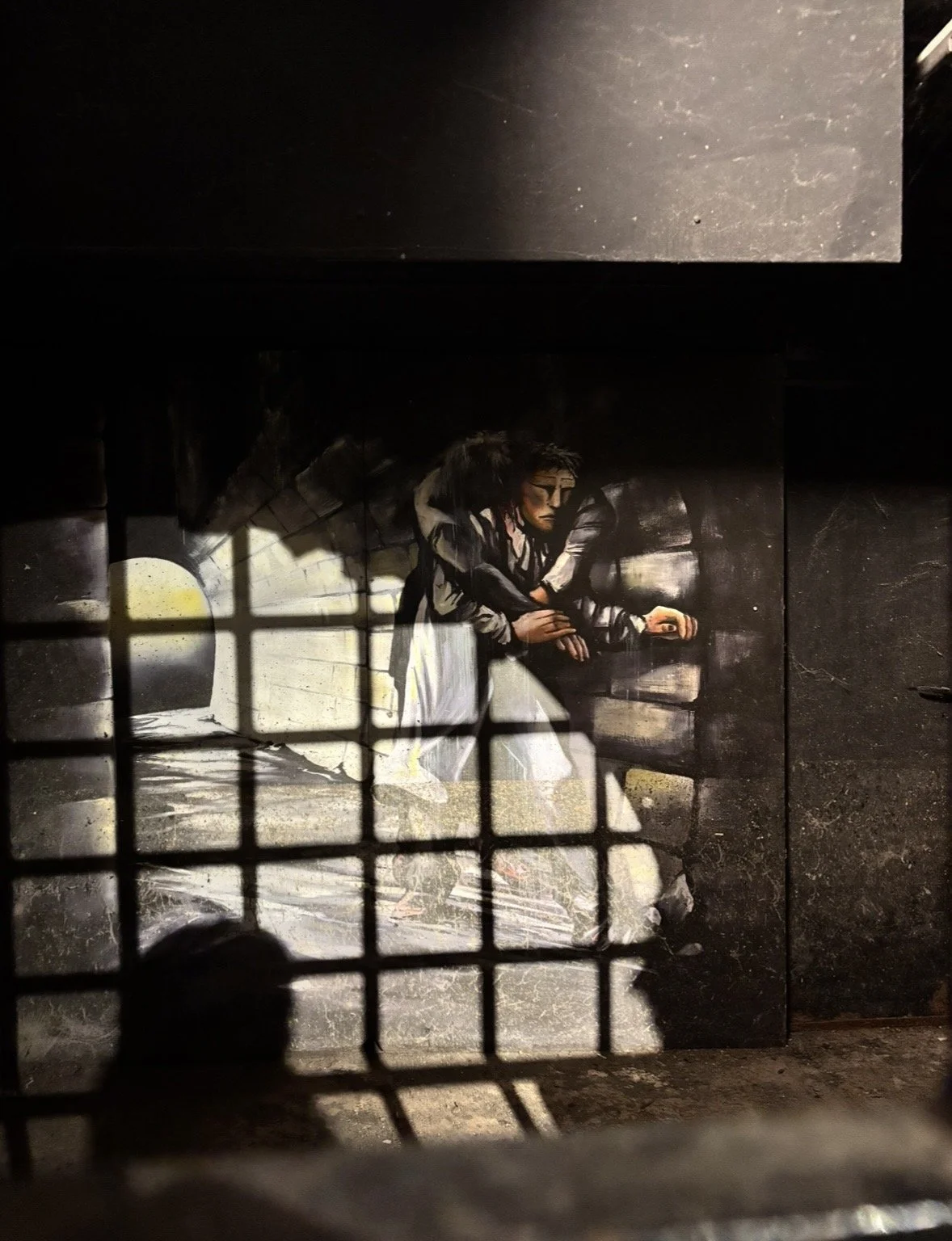
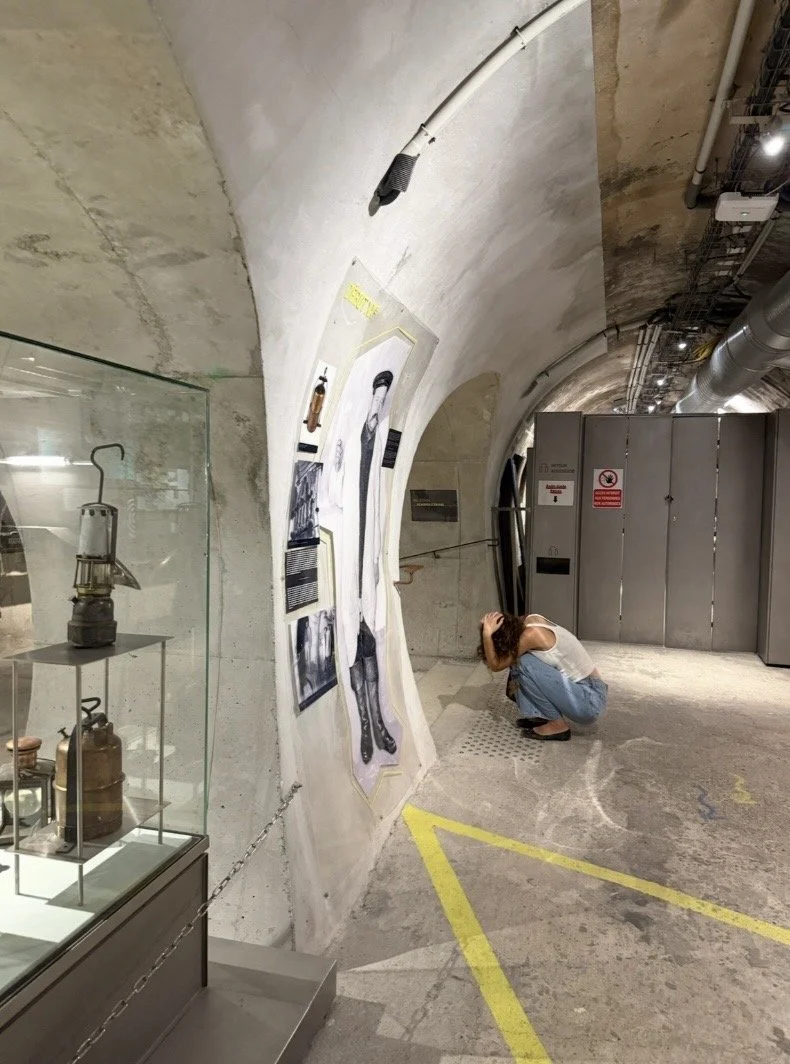
Valjean’s experience vs. mine in the Parisian sewers.