I have never been able to do a great British accent. I mean, I’ve never been able to do any accents, period. I grew up in the San Fernando Valley, home to “Valley Girl” accent fame, so I’m quite easily clocked as Californian. When our class moved to London, we all started mimicking British accents and learning some phrases for fun. Our professor, Andrew, taught us “Bless your cotton socks!” A guy at a house party taught me “Say no more” (or in text parlance, SNM). From television, we picked up “Oh my days!” and “What’s all this then?” If a random person walked past us on the street, they would be more than justified to roll their eyes and scoff at our attempts at using British parlance. It was, to say the least, annoying, but selfishly, it's also quite fun.
To me, accents have always been an indicator of geographical difference and nothing more. In the US, for example, we have plenty of different regional accents - a Bostonian will sound different from a New Yorker, and a Texan can sound different depending on what city in Texas they’re from. But aside from the southern drawl and odd miscommunications about what to call soda (not pop), accents essentially told you one thing: where a person was from. When I got to London, I was shocked to find out that it wasn’t the case here.
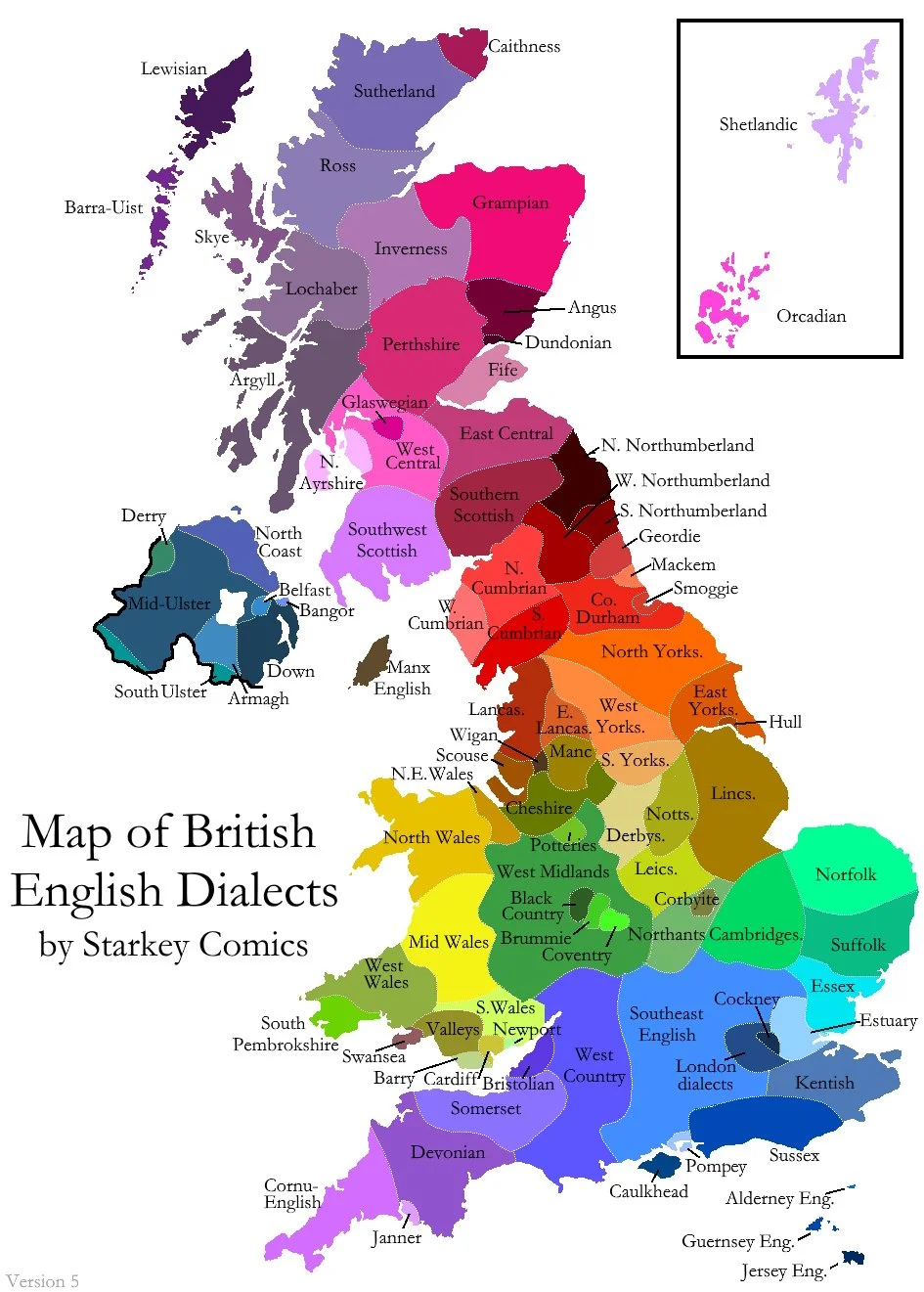
Map of different British accents
I have always been vaguely aware that there are different British accents. Posh accents are usually for those who are wealthy, Scouse accents are for those from the northern parts of England, and Cockney… well, I know it exists. My roommate at USC is from Glasgow, born and raised, and she doesn’t sound anything like any of the people I’ve met in London, because even though Scotland is in the UK, it has its own regional accents and slang. Yet, my awareness of these different accents was quite surface-level. Then, in a seminar one day, we were talking about class and identity, and Andrew revealed something I would have never believed otherwise.
“I can tell if someone went to private school just by the way they speak,” he claimed. "This is just one example of how engrained class has been in British society."
Externally, I nodded, but internally, I thought this was probably hyperbole. You know, accents may be helpful in determining where someone’s from, allowing you to make some educated guesses about their life. But figuring out their educational and family history? Maybe a bit too much. Being the chronic Google addict I am, though, I decided to check my sources. And of course, I was proven wrong.
Class identification by accent is a well-established practice in the UK, with parts of someone’s life made public simply because of the way they move their mouth when they speak. The BBC reported that in 2022, more than a third of university students said they felt self-conscious about their accent, and 47% said they'd had their accent mocked, criticized, or commented on in a social setting. Students from poorer backgrounds and state schools actually stopped participating in class, engaging in discussions, and attending events because they felt that they’d just be perceived as stupid by others. Currently, less than 10% of the UK population speaks “BBC English” (otherwise known as Received Pronunciation), yet it is overwhelmingly the dominant accent of those in positions of power. This self-censorship and the removal of opportunity simply reinforce the class divide that caused the accent difference in the first place, perpetuating the cycle.
In A Tale of Two Cities, Dickens uses accents and slang not just to signify class but also to create a character the audience feels comfortable laughing at. Jerry Cruncher, a porter and Resurrection Man who completes odd jobs for money, has dialogue that is consistently written with misspellings (that are not present in other character dialogue) and slang terms to demonstrate his place in society as low and almost ‘improper.’ His son and wife also speak similarly. For example, take this scene where Cruncher is discussing a funeral procession in the streets with his son.
“What d’ye mean? What are you hooroaring at? What do you want to conwey to your own father, you young rip! This boy is getting too many for me!’ said Mr. Cruncher, surveying him. ‘Him and his hooroars! Don’t let me hear no more of you, or you shall feel some more of me. Ye hear?’
’I warn’t doing no harm,’ young Jerry protested, rubbing his cheek.”
This quote alone is rife with examples of the differences between Cruncher's speech and the more middle class characters like Lucie and Darnay. For example, Dickens spells convey as “conwey” and you as “ye" to characterize Cruncher as this lower-class, and honestly, “less than” character. No other (major) character in the book is really described to speak like this, which is a way of juxtaposing Cruncher’s position with everyone else’s. In this way, throughout the book, we’re invited to laugh at Cruncher, not with him.
In Les Miserables, Hugo also touches on these concepts of speech in his digression on slang. The criminals in the Patron-Minette gang speak very differently than the other characters. This point is so important that Hugo goes so far to place specific footnotes to explain what they’re saying. Contrary to how Dickens utilizes language as a tool of mockery, Hugo treats these differences as vital to understand.
“Certainly it is neither an attractive nor an easy task to go trawling through the lower depths of the social order, where terra firma ends, and the ooze begins… Nothing is more dismal than to contemplate the seething horror of slang exposed like this to the light of the intellect… Now, since when has horror ruled out research? Since when has disease driven away the doctor? … The thinker who recoiled from slang would be like a surgeon recoiling from an ulcer or a wart… For it must be said that for the benefit of those who do not know, slang is both a literary phenomenon and a social consequence. What is slang in its true sense? Slang is the language of wretchedness.”
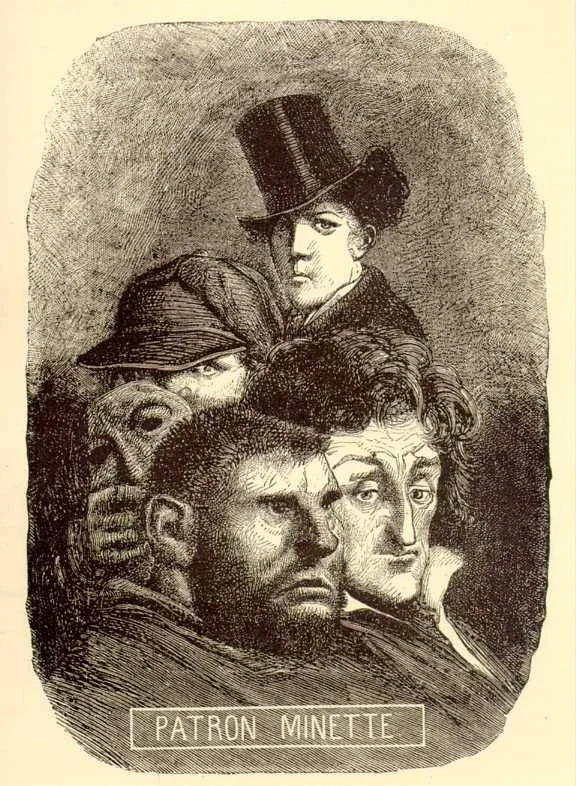
Reading this makes it pretty easy to understand why Hugo was considered one of the best thinkers of his generation. In this quote (and overall chapter), he posits that slang has risen as the voice of the underclass and ought to be seriously considered with linguistic integrity. Just because it’s used by “the wretched” doesn’t mean it’s any less valuable. That’s exactly why he goes through all the trouble of explaining the little differences in the Patron-Minette’s vernacular.
Back in the present day, the weaponization of accents to build and reinforce class barriers hasn’t really gone away. While it is certainly an issue that accents are being weaponized to make fun of and discriminate against others, there is also beauty in how communities form their own ways of speaking. Multicultural London English (MLE), for example, has emerged from a wave of immigration to the UK from countries like Pakistan, China, Ghana, Jamaica, and so many more. In this way, Hugo was (as always) prescient, arguing that slang helps us understand each other as humans and build community. It shouldn't be something we ignore because we don't understand it.
So while my classmates and I will continue to parrot British slang, I’ll be aware of the people behind the language. “Say no more" isn’t just fun banter; it mostly originates from MLE. “Bless your cotton socks” is BBC English. As an American, I get to play with these phrases and say them without anyone having a second thought, since I’m just someone who’s joking around. Now, though, I know that this isn’t the reality for everyone in the UK. I suppose we’ll just have to add accent divides to the list of things that Britain needs to modernize,