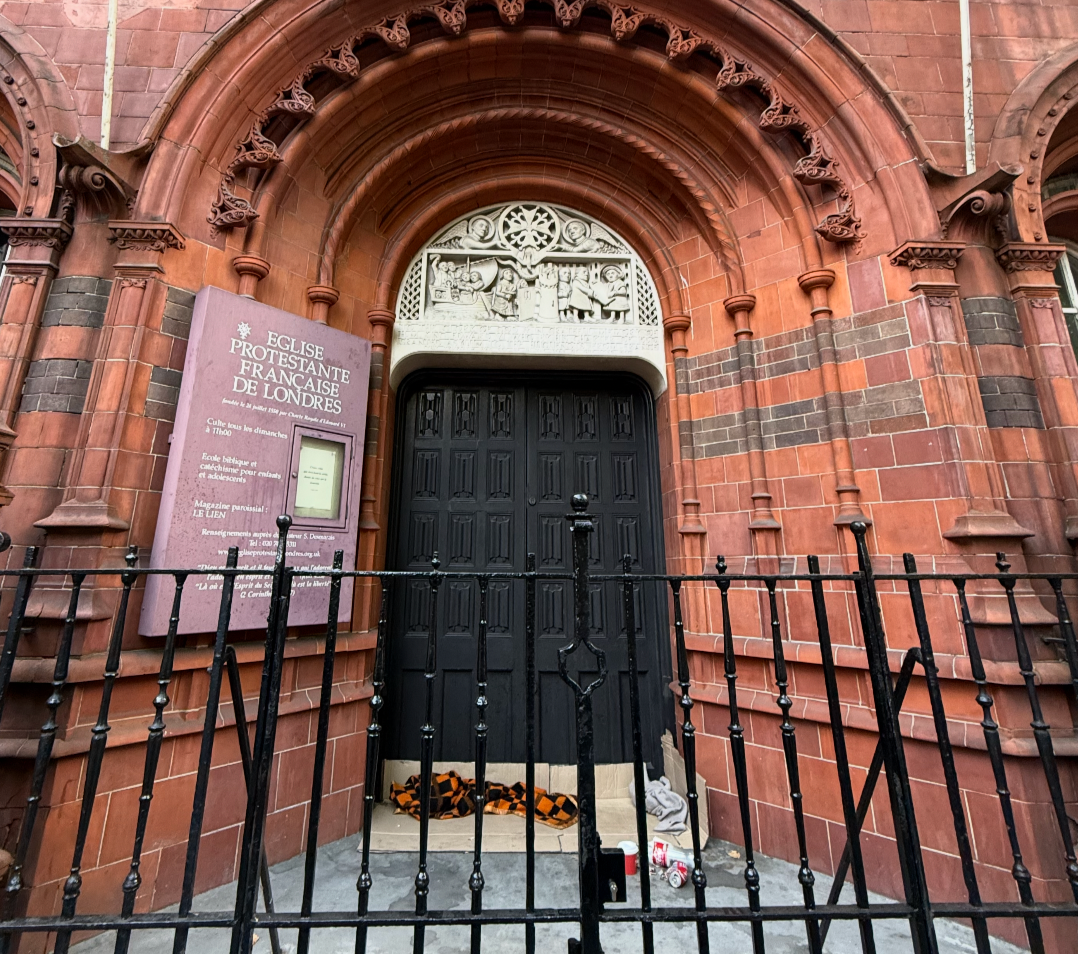
This trip has taken us to a lot of churches. By my count, at least six in the last two-odd weeks. Honestly, this trip will probably be the most pious time in my life, considering it has doubled my lifetime church visits. To say the least, during our excursions, I’ve been having somewhat of a culture shock. I didn’t grow up religious, and because of that, I never had a place of worship to go to on Sundays or a Faith (capital F) to rely on. This is probably why I feel so apprehensive about the churches that we’ve seen.
Donation box in case anyone felt so inclined to contribute
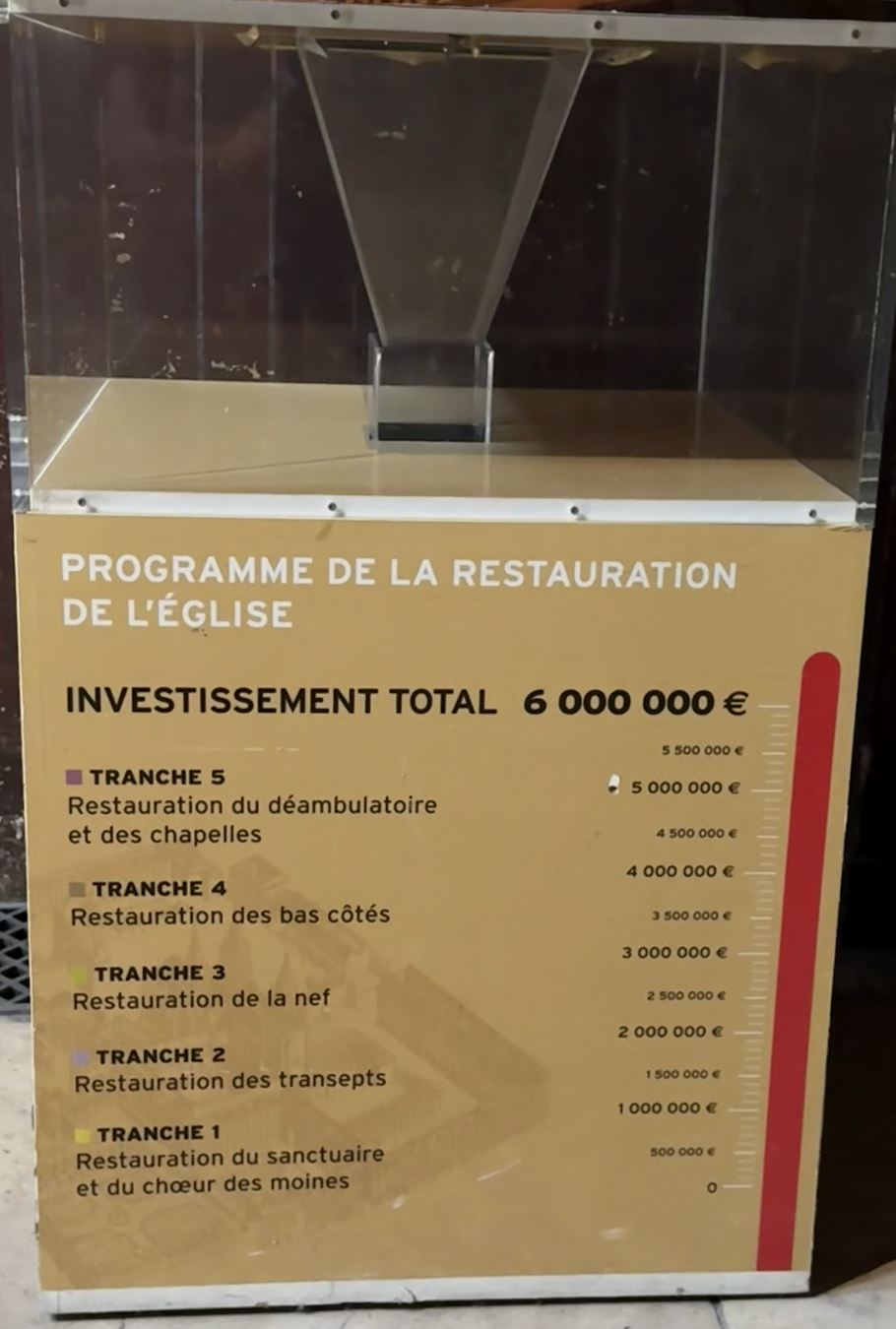
Don’t get me wrong: they are (mostly) beautiful! Some minor taste qualms aside, the architecture, artwork, and grandeur of it all are pretty hard to ignore. This is exactly why so much money is spent on the upkeep of these places. Notre Dame, for example, costs 4 million Euros a year to maintain. The restoration of it alone cost approximately 800 million Euros. But this isn’t true of just the big famous churches that people flock to visit. The Church of Saint-Germain-des-Prés, for example, spent 6 million Euros on its recent renovations. It’s true that this Church is one of the more well-known churches in Paris, but it’s not necessarily a major tourist attraction. I say this all to underscore that, in general, churches spend a lot of money. And this is only on the upkeep!
While walking around, I’ve noticed that, as in any city, there are often unhoused people asking for cash to support themselves or to find a place to live. What's more interesting to me, and seems to be more of a phenomenon here in Paris (and also in London) but not in the US, is people sleeping on church steps. To enter some of these grand buildings, you pass people who are genuinely struggling to live safe and full lives. The irony is staring us straight in the face. To state the obvious, it feels wrong. Why is so much being spent on the upkeep of these buildings when there are people begging for help right outside?
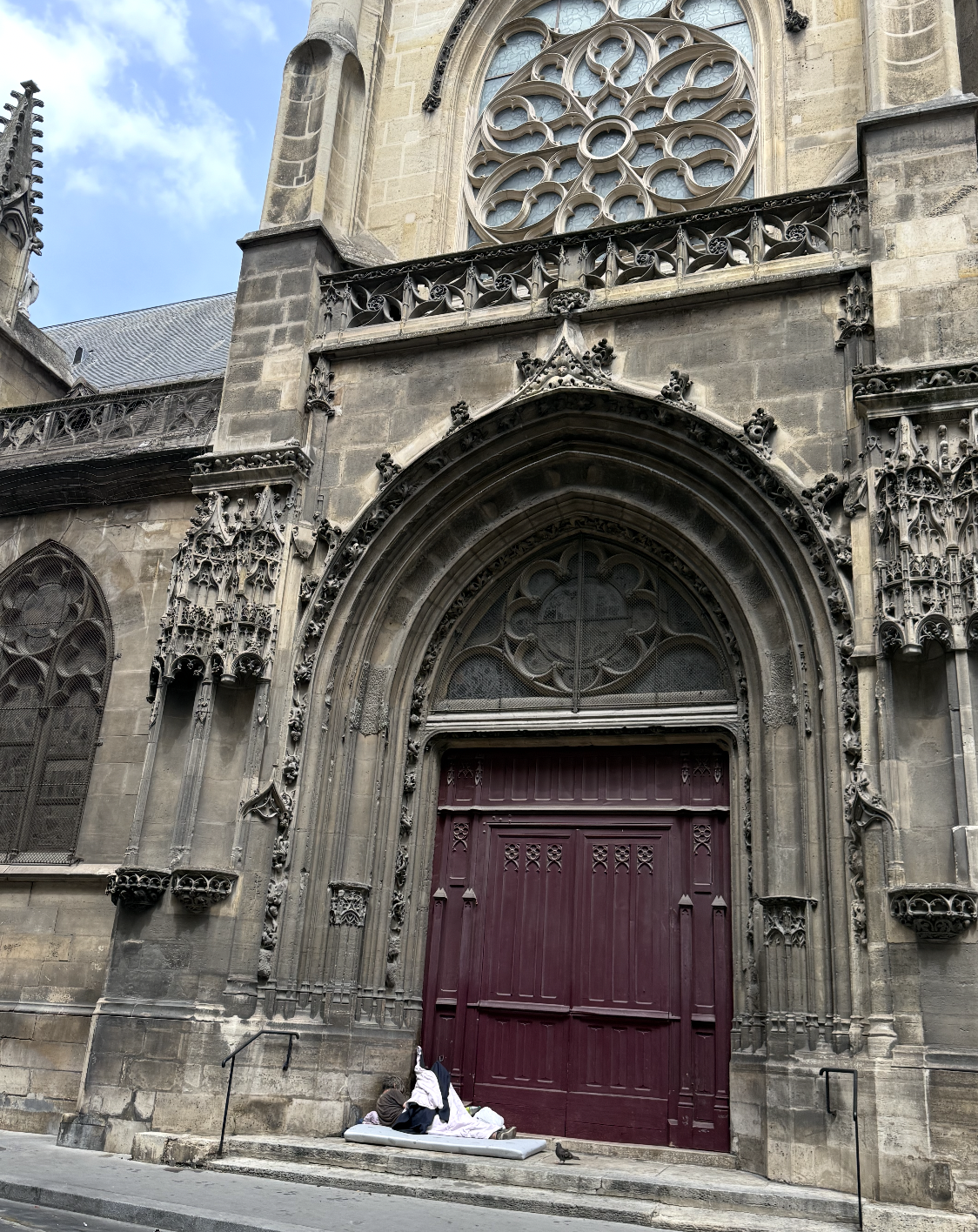
A man sleeping outside the door of the Church of Saint-Germain l'Auxerrois.
In Les Misérables, Hugo riffs for quite a while on churches and their morality. He distinguishes between religion as an institution and religion used as a practice of radical charity. Bishop Myriel, for example, is arguably the moral center of the entire novel. Instead of being swept away by the status he could have had, Myriel lives a simple life and gives away all he can, up until he gives Valjean the candlesticks he needs to build his life back up. As Myriel says, “It’s not he who commits the sin that’s to blame but he who causes the darkness to prevail.” This is the type of altruism and humanity that is encouraged by religion, at least from Hugo’s perspective. Further, he explains:
"...hatred of luxury would not be an intelligent hatred. It is a hatred that would imply hatred of the arts. Nevertheless, other than for official and ceremonial purposes, luxury among churchmen is a transgression. It would seem to reveal habits of little true charitableness. A wealthy priest is a contradiction in terms."
Hugo’s criticism touches on misplaced priorities. In his view, religious wealth is justified only when it serves people rather than possessions. Yet not everyone is Bishop Myriel, as is clear from the juxtaposition of beautiful buildings with suffering just outside.
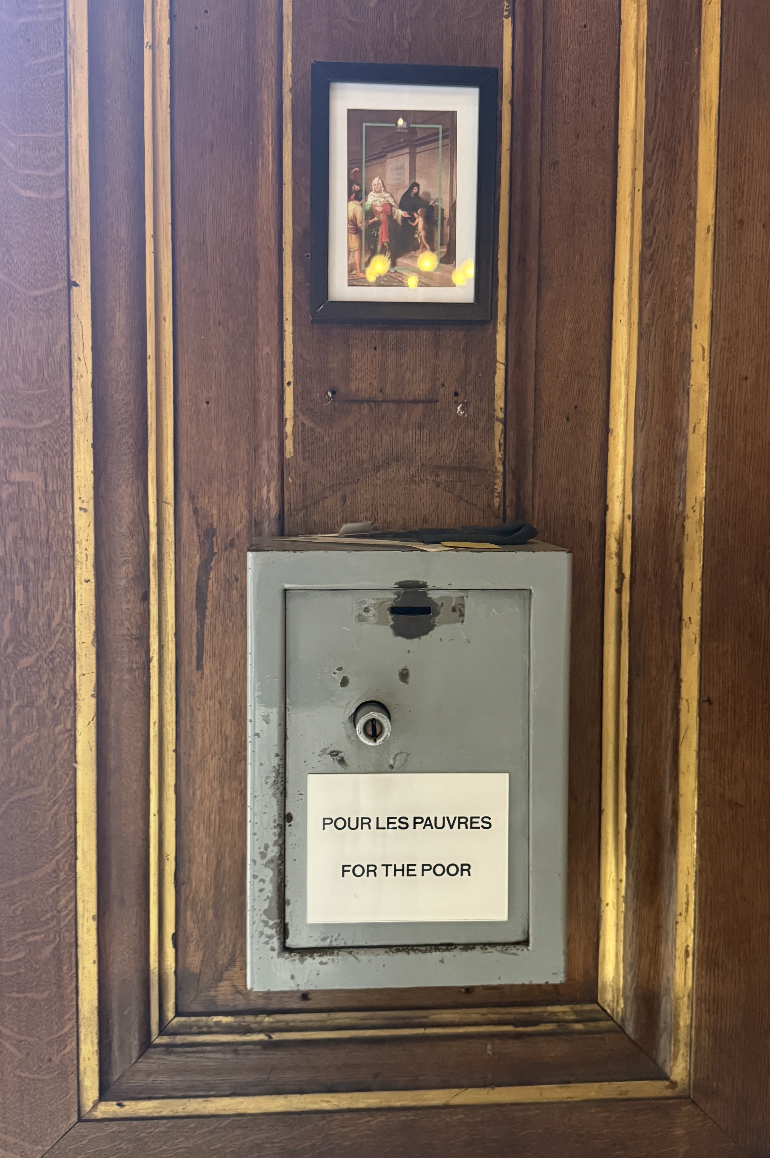
Tiny box hidden in a corner of the Place de La Madeline asking for donations for the poor
This has lingered with me as we continue to visit more and more churches. I have to believe that the story is surely not as simple as churches refusing to help those in need. Now, the US and France have different views on the Church's role as a community figure. But where my knowledge base is focused, in the US, this isn’t fully true. The tax structure of the United States allows religious entities to function as nonprofits, meaning that they don’t have to pay taxes. Many economists conceptualize the tax-free status of nonprofits as a subsidy that the government provides to organizations for the benefits they provide to the public. Charities like Feeding America provide direct services and are substituting for the government, which is why they are tax-exempt. Yet, while it’s a common argument that churches do significant charitable work, which justifies their tax exemption, this isn’t necessarily true. Unfortunately, only a tiny minority of congregations engage in social service, with the median amount churches spend on social services in the US being $1,200, or around 2% of a church’s budget. In this way, it has consistently been shown that charitable choice initiatives (which aim to provide even more public tax dollars to religious entities on the grounds that churches are substituting for government services) are empirically unnecessary and normatively unfair.
However, all of this is about the US and its long and complicated history with religion and charity. But what about France? Well, in France, religious organizations are also exempt from taxes. However, any church built before 1905 is owned by the state, which then allows religious groups to use it free of charge. So that money preserving Notre-Dame isn’t a religious subsidy; it was, at least officially, a cultural endeavor which Hugo would ostensibly approve of. Learning about this was quite interesting to me, because it became clear that France does not expect religious organizations to act as social service providers and substitute for the government. The irony I initially felt was partly due to importing American assumptions about the role of churches into a country that has instead assigned that responsibility to the state. And, in fact, France’s welfare system is one of the most comprehensive in the world. A 2020 OECD report finds that France tops the list of welfare spending, putting over 31% of its GDP into social services. Conversely, the US spends only about 19%, expecting nonprofits to fill the gap.
I do not consider myself to be unaware that different places function differently in terms of welfare, religion, and government. However, I am still quite surprised at just how differently these ideas are treated in France and the US. And while I do strongly believe that it is the government’s responsibility to provide for its people to the point that homelessness becomes a thing of the past, the pang of irony I feel when walking into these grand churches may not go away anytime soon. France may deem that responsibility the State’s rather than the church’s, but the same question remains: what do our institutions, religious or secular, owe to the people most in need? Hugo would probably argue that the distinction ultimately matters less than the outcome. Whether charity comes from bishops or bureaucracies, a society should be judged by how it treats those living at its margins. As Hugo says, men are like nettles.
“With even the minimum of care, the nettle would be useful. Neglected, it becomes a nuisance. My friends, remember this: there are no such things as bad plants or bad men. There are only bad farmers.””