
One of the most interesting class conversations we had was on the biblical allusions in Les Misérables. We were asked whether we think Hugo’s incorporation of Christianity in the book aligns with our beliefs and with the Bible.
The idea that the book’s themes could have possibly not aligned with biblical teachings was so alien to me—simply because I felt they aligned so well. I was interested in finding the exact scripture that either supported or contradicted this.
The first and most obvious Biblical references start with the character of Bishop Myriel. During our class discussion—I think, if I’m remembering correctly—someone referenced how the Bishop gave up his home for the hospital patients and allotted the majority of his budget to social causes, and contrasted his actions with some some modern-day church operations. However, his actions do directly align with what the Bible calls us to do:
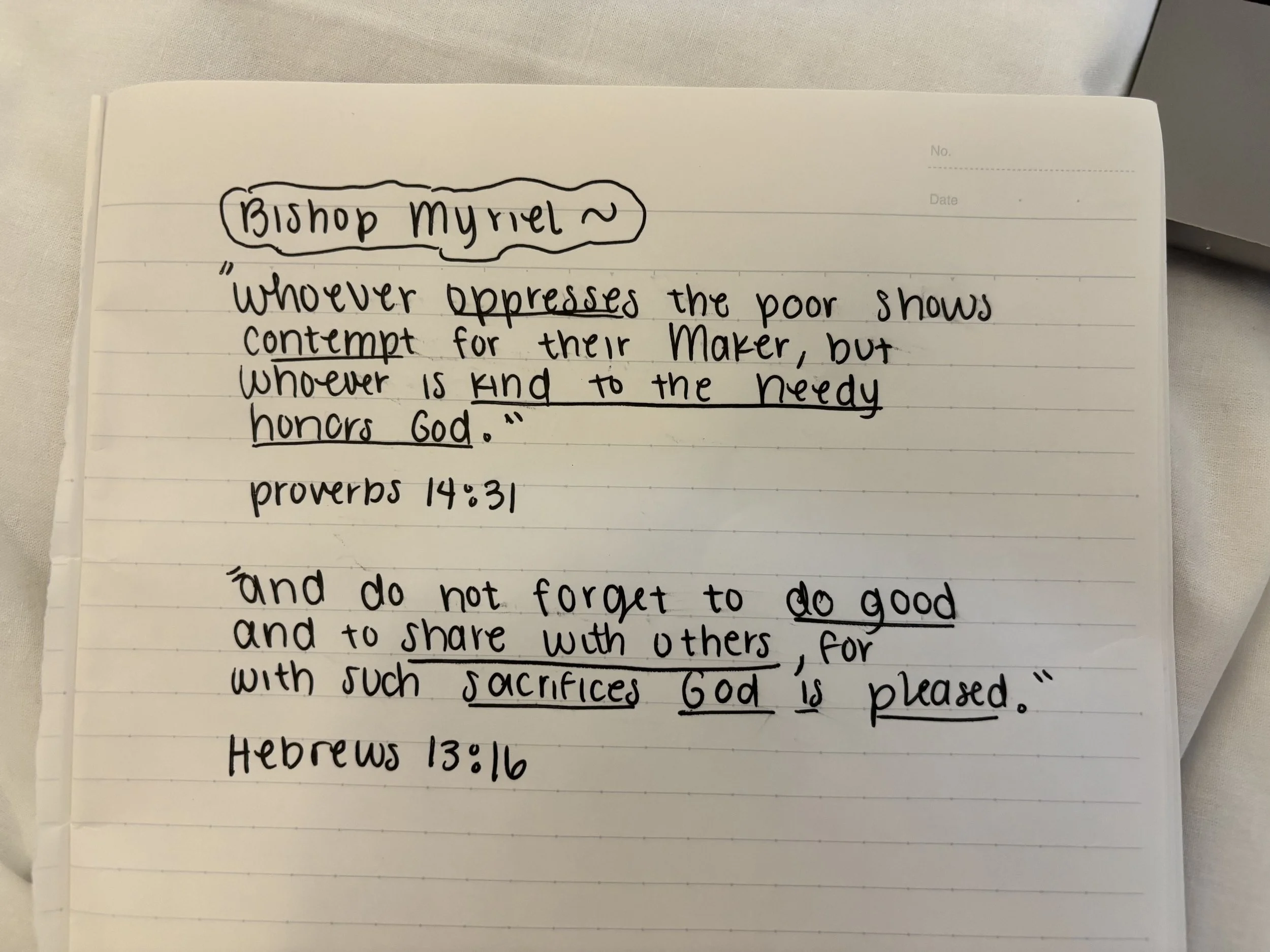
The verses I found correlating to the Bishop’s way of life—namely, Proverbs 14:31 and Hebrews 13:16.
But in my opinion, a more interesting reference Hugo made was the biblical metaphors in Javert and Valjean—each representing a different testament of the Bible.
The Old Testament is centered around history and law, closer to Javert, while the New Testament coming after the death and resurrection of Jesus Christ, is focused on mercy and forgiveness, like Valjean. In Christianity, we believe the Father sent His Son to die for our sins, and in doing so, He fulfilled the law of the Old Testament, establishing a New Covenant. Therefore, Jesus’s sacrifice offers us forgiveness for sins, alleviating the stricter laws and punishments of the Old Testament. An example of the difference between the testaments is in the Old book of Proverbs and New book of Ephesian. Both books offer guidelines for us to follow, but Proverbs is stricter and more detailed while Ephesians is—in my opinion—more generalized, centered on love and trying to be a good person.
Therefore, I believe Javert and Valjean both align with the Bible, but in different ways. Javert is a representation of the Old Testament in his unending search for justice and his strict moral compass. His beliefs are centered on obedience to the law and authority, similar to the Old Testament. Javert centered his life on the ideas of a “respect for authority and hatred of rebellion.”
In fact, Javert’s principles are so challenged by Valjean’s forgiveness that he is inspired to end his own life, as Hugo writes:
“A benevolent malefactor, merciful, gentle, helpful, clement, a convict, returning good for evil, giving back pardon for hatred, preferring pity to vengeance, preferring to ruin himself rather than to ruin his enemy, saving him who had smitten him, kneeling on the heights of virtue, more nearly akin to an angel than to a man. Javert was constrained to admit to himself that this monster existed. Things could not go on in this manner.”
Javert’s principles are so deconstructed by Valjean’s virtuous, forgiving, selfless character that he cannot comprehend it—nor go on.
I wonder if in writing Javert’s suicide, Hugo was trying to make a greater commentary on misunderstanding and call for Christian forgiveness.
I sometimes see Christians struggle with the concept of Jesus’s total forgiveness, as well as moving on from the Old Testament. But this Christian dilemma is a tale as old as time, evidenced in this parable:

Luke 7:36-50.
In the same way Javert cannot comprehend Valjean’s forgiveness, neither can the Pharisee comprehend Jesus’. But Jesus does not prefer the non-sinner over the sinner, and all sin. He offers a consistent love, only asking us to offer the same in return. If Jesus forgives us, and we accept this forgiveness, yet refuse to offer it to others—by judging them and holding grudges—where is the fairness? Bishop Bienvenu—and, by virtue, Jean Valjean—exhibit the grace of God. Hugo continues this exhibition in writing Fantine from a position of empathy and pity for the condition society forced her into, rather than judging her in an era where prostitution was more shameful than it even is today.
Furthermore, I do think—though this is an entirely personal opinion—Hugo chose names for the protagonist and antagonist that directly relate to these concepts.
Authors never choose throwaway names—there must be some meaning, whether it references personal history or is some symbolic creation. This is evidenced in Hugo’s metaphorical naming of the Bishop Bienvenu, meaning “welcome.”
I think, possibly, Javert is a combination of Latin roots and words—juris meaning “justice” and “law,” and either veritas, being “truth,” or severus, being “severe.” All of these possibilities correspond with his harsh characterization.
“Jean” Valjean is a name meaning “God is gracious”—so obviously symbolic of Valjean’s Christlike goodness. I also found some verses, included below, that remind me of his story and life trajectory; that is, life post-imprisonment for stealing to feed his sister’s family, his decision to change for the better after experiencing Bishop Myriel’s goodness, his generosity to the people of M-s-M and his factory, and his dedication to raising Cosette.
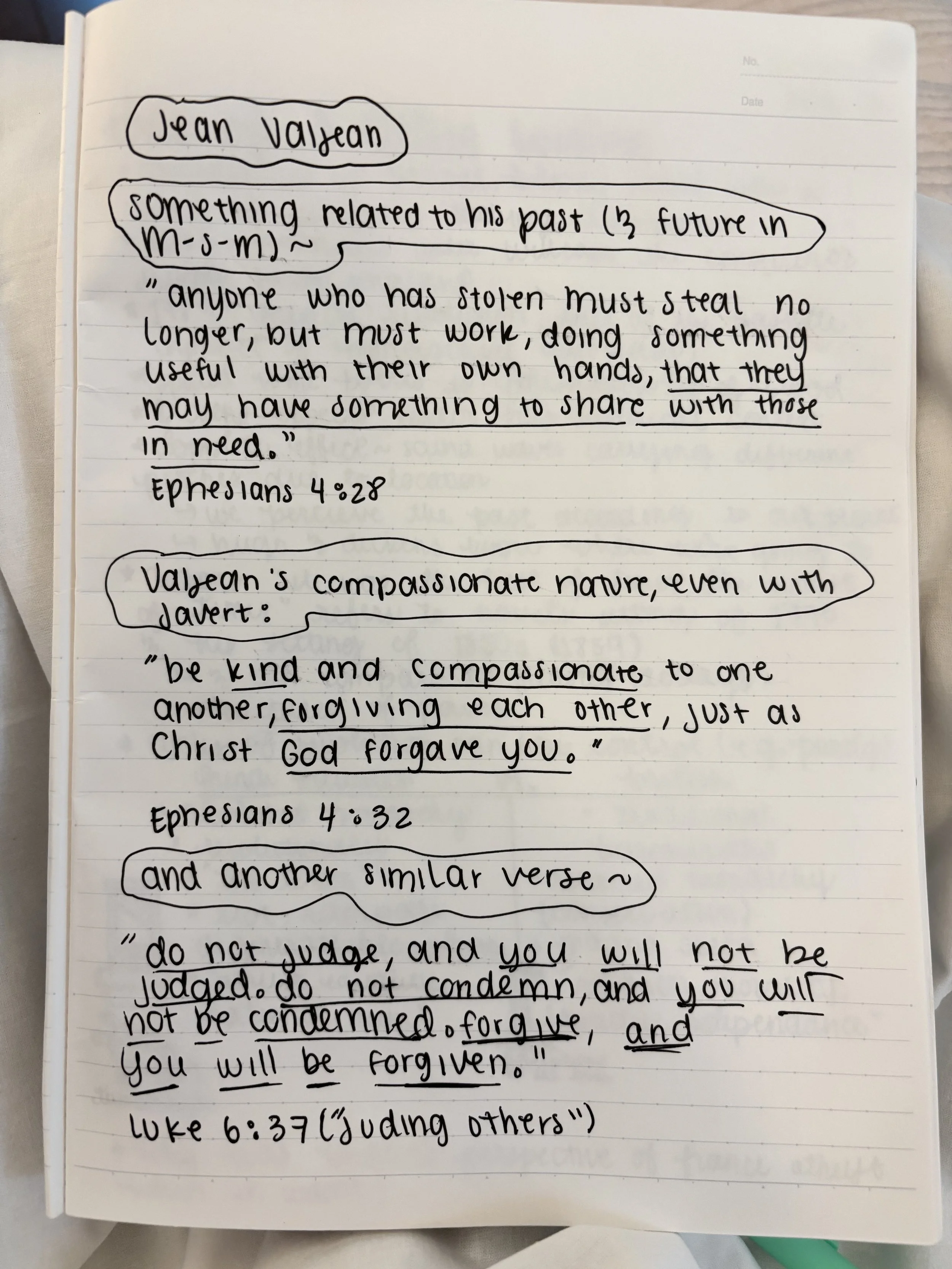
Verses that correlate to Hugo’s writing of Valjean—Ephesians 4:28-32 and Luke 6:37.
I really believe Les Misérables mirrors biblical teachings. In fact, reading it for the first time, it was astonishing to me how accurately Hugo portrayed goodness. So while some Christians’ belief systems may contradict with Hugo’s writing of faith in Les Mis, Christianity does not; it directly aligns. One, or two, or three Christians’ beliefs or misinterpretations—as we discussed in class—do not speak to the goodness of Christianity as a whole, nor the religious accuracy of Les Mis. Instead, such contradictions speak to the fault-prone nature of humans. Just as my religion and faith are centered on forgiveness, so is Les Mis.