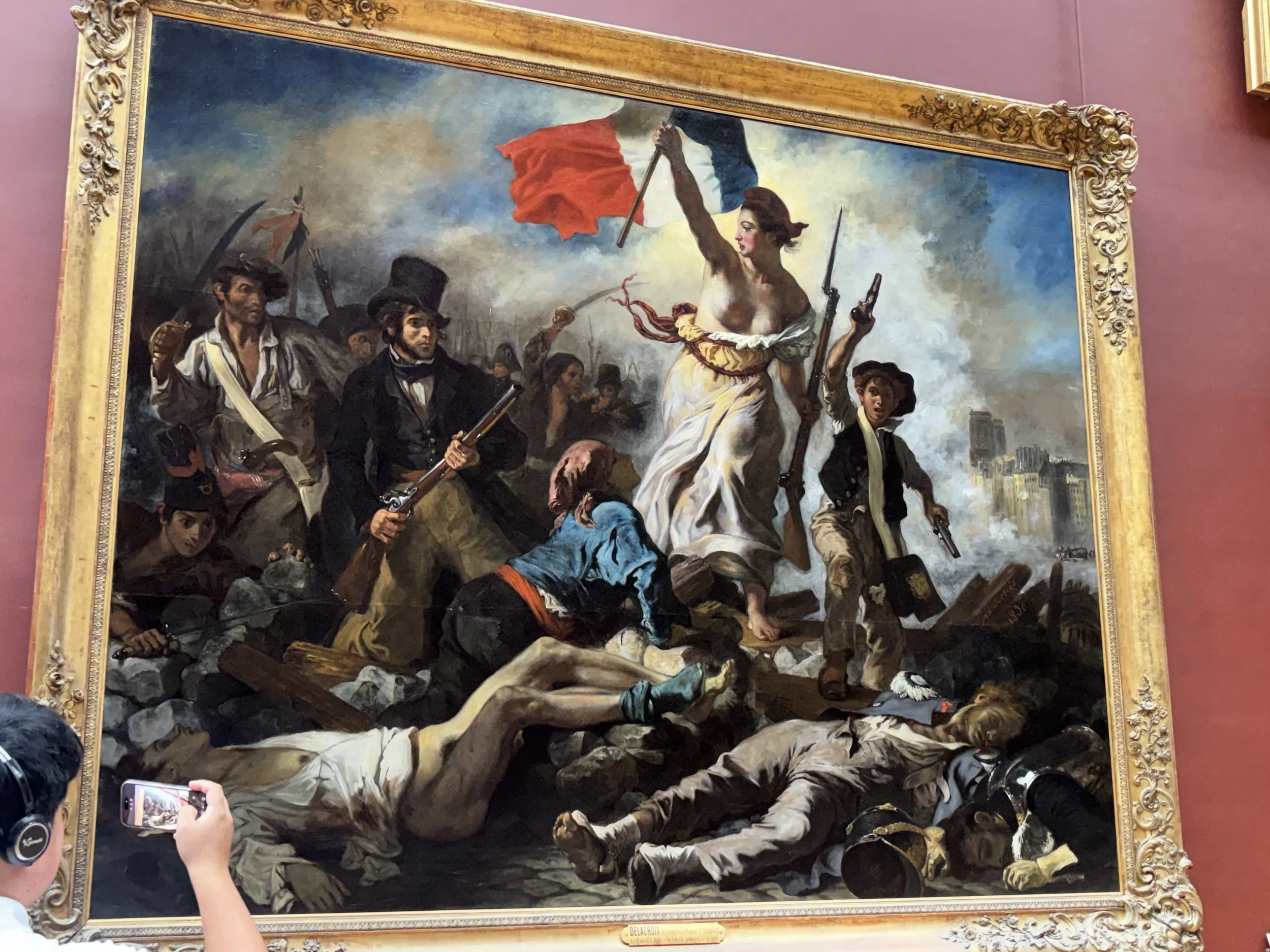
Delacroix's Liberty Leading the People (1830), photographed in the Louvre. Revolutionary art often celebrates those behind the barricade. But who was standing on the other side?
Who are the people?
It is a question that sounds almost too simple to ask. Yet standing in the streets of Paris where the barricades of Les Misérables once stood, I realized it may be one of the most difficult questions any society can answer.
Our class had spent the afternoon tracing the route of the June Insurrection of 1832. We walked through streets that today are filled with cafés, tourists, and cyclists, yet beneath the pavement lies the memory of one of France's most famous acts of resistance. Victor Hugo transformed these streets into the setting of Les Misérables, where a small group of students and workers built barricades knowing they would almost certainly die. Standing where those barricades once rose, I found myself thinking less about the students behind them than about the people standing across from them.
The National Guard.
Growing up, I always associated uniforms with protection. Whether police officers, firefighters, or soldiers, uniforms are designed to communicate safety and stability. They represent institutions that exist to preserve order. I had never stopped to consider that the same uniform could symbolize something entirely different depending on where someone was standing.
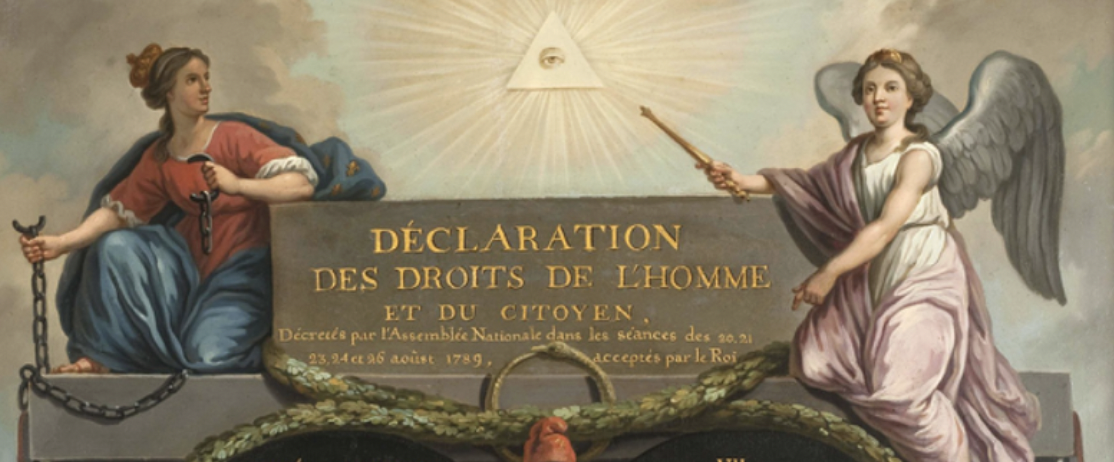
The Declaration of the Rights of Man and of the Citizen (1789). It proclaimed liberty, equality before the law, and freedom from arbitrary imprisonment. The challenge was never simply defending these ideals, but deciding who had the authority to define them.
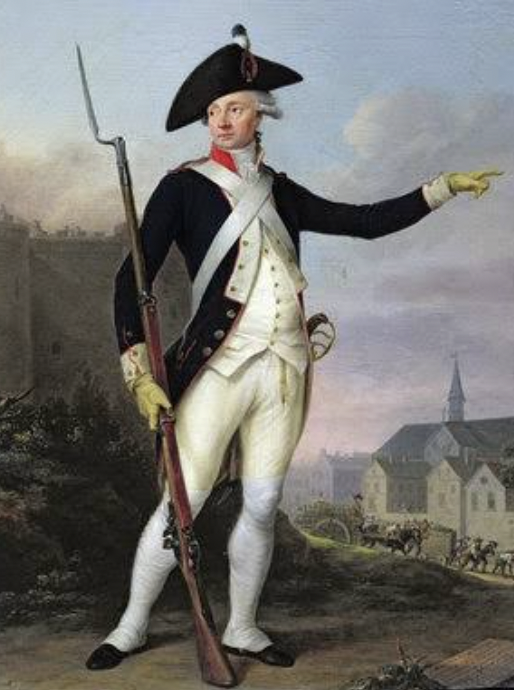
Founded to defend the people in 1789, the National Guard later found itself facing citizens who believed they, too, were defending the people.
The National Guard was established during the French Revolution in 1790, shortly after the fall of the Bastille. It emerged alongside revolutionary ideals that sought to replace arbitrary royal authority with the rule of law. France had just rejected the lettres de cachet, royal orders that allowed people to be imprisoned without trial, and adopted the Declaration of the Rights of Man and of the Citizen, proclaiming liberty, legal equality, and protections for individual rights. The National Guard was created to defend those principles and protect the Revolution itself.
At first glance, it seems like a straightforward story. A force created to defend freedom. A symbol of a nation determined to break away from oppression. But history rarely remains straightforward. Just forty-two years later, Hugo presents an entirely different image. During the June Rebellion of 1832, the National Guard stood opposite the students gathered behind the barricades. These young men believed they were fighting for liberty, justice, and a better France. Many of them saw themselves as heirs to the Revolution of 1789. Yet the National Guard, born from that very Revolution, was now firing upon them.
What changed?
Initially, I assumed the answer was obvious. Perhaps the National Guard had abandoned its purpose. Perhaps the students had become radicals standing in the way of progress. But the more we discussed Les Misérables throughout the week, the more I realized Hugo is asking something much deeper than who was right or wrong.
The National Guard never stopped believing it was protecting France. The students never stopped believing they were fighting for France. The conflict was never simply about power. It was about who had the authority to define the people. Perhaps every revolution reaches the same moment: when both sides become convinced that they alone are defending the people.
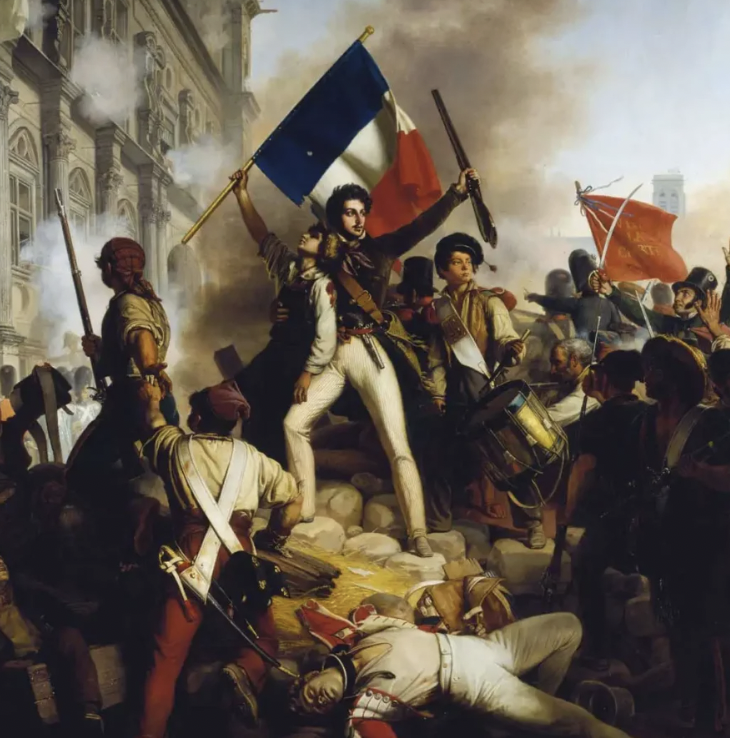
The June Rebellion of 1832. Victor Hugo transformed this failed uprising into the climactic scene of Les Misérables, challenging readers to look beyond who won and ask what each side believed it was fighting for.
History often encourages us to divide the world into heroes and villains because it is easier that way. We celebrate revolutions that succeeded. We criticize governments that failed. Looking backward, the answers can appear obvious. But for the people actually living through these moments, certainty rarely exists. Governments rarely see themselves as oppressive. More often, they believe they are preserving stability. Protesters almost always believe they are demanding justice. Both frequently claim to be acting on behalf of the people. Both hope history will eventually prove them right.
Walking through Paris forced me to acknowledge how uncomfortable that tension really is. Hugo refuses to portray history as a simple struggle between good and evil. Instead, he presents competing visions of justice, each convinced of its own legitimacy. The National Guard is not depicted as inherently evil, nor are the students portrayed as unquestionably righteous. They simply represent two different visions of what France should become. That complexity is precisely what has allowed Les Misérables to remain relevant for nearly two centuries.
Leaving the barricade, I found it impossible not to think about our own time. Conversations surrounding policing continue to raise many of the same questions Hugo explored in 1832. Public trust in law enforcement often depends on lived experience, historical memory, and political belief. Some see police as protectors of democratic order; others point to moments when state authority has undermined those same ideals. The circumstances are different, and history should never be forced into easy comparisons. Yet the questions themselves remain remarkably familiar.
What has endured is something more fundamental: every generation must decide where the line between authority and justice should be drawn.
That realization made me think differently about institutions themselves. We often imagine that organizations possess fixed identities. We describe them as good or bad, trustworthy or corrupt, heroic or oppressive. Yet institutions are ultimately shaped by people, by governments, by public expectations, and by changing political ideals. The same institution can be remembered as a symbol of liberation in one generation and as an obstacle to progress in another.
Perhaps that is why Hugo's barricades continue to resonate. They are not simply monuments to revolution. They are reminders that democracy is never static. The values a society claims to defend must constantly be examined, questioned, and redefined.
Earlier in the course, Professor Chater challenged us to think carefully about the difference between a riot and an insurrection. At first, I assumed the distinction depended on violence. After standing where the barricades once stood, I am no longer convinced it is that simple. Perhaps those labels often depend less on what happened than on who is telling the story, who prevails, and who ultimately writes the history books.
Standing in a quiet Parisian street, it was difficult to imagine gunfire echoing between the buildings or barricades stretching across the road. The city has moved on. Cafés occupy spaces where students once prepared to die. Tourists wander through the neighborhood without realizing the history beneath their feet.
Yet the questions remain. Who speaks for the people? When does protecting order become resisting progress? And perhaps the most unsettling question of all: Who gets to decide who the people are?
If I had stood on that street in June of 1832, would I have believed the students were defending France? Or the National Guard?
I left the barricade without an answer.
Somehow, I think that is exactly what Victor Hugo intended.