
As a part of our class we had to write an essay, (sadly, we don’t spend all our time walking around pretending to be Jean Valjean). I wrote my paper in response to the question of how well Victor Hugo speaks to contemporary audiences. One of the main issues I grappled with, was the role of women within Les Misérables. However, as we’ve worked our way through Charles Dickens’ A Tale of Two Cities, other art, and history I’ve been looking at this question more broadly.
Discussing women in 19th-century literature can be a tricky subject. Personally, I find it difficult to find the line between understanding that social norms and conventions were wildly different from modern feminism versus condemning authors for their treatment and views on women. I enjoyed both Les Misérables and A Tale of Two Cities, and I found it easy to get lost within their worlds. Then, they hit you with a “One of the generosity of women is to yield,” and I’m yanked right back out. I’d say this is an eye-rollable offense. Annoying reminders of the patriarchal thought process like this are present in both books. And yet, I liked the books. Does this make me a bad feminist? I certainly hope not. When deciding my own distinction between period-typical attitudes and book-ruining offenses, I found that intention played an important role. I don’t believe Victor Hugo or Charles Dickens meant to intentionally degrade and suppress women’s rights and autonomy; to me, their offenses are born of ignorance but not malicious intent. Their ignorance would be a bigger obstacle if their female characters did not push against the authors’ own limitations. I believe that if either book were written today, the perpetuation of women as wholly submissive creatures would not be present. Alas, these books were written in the 19th century.
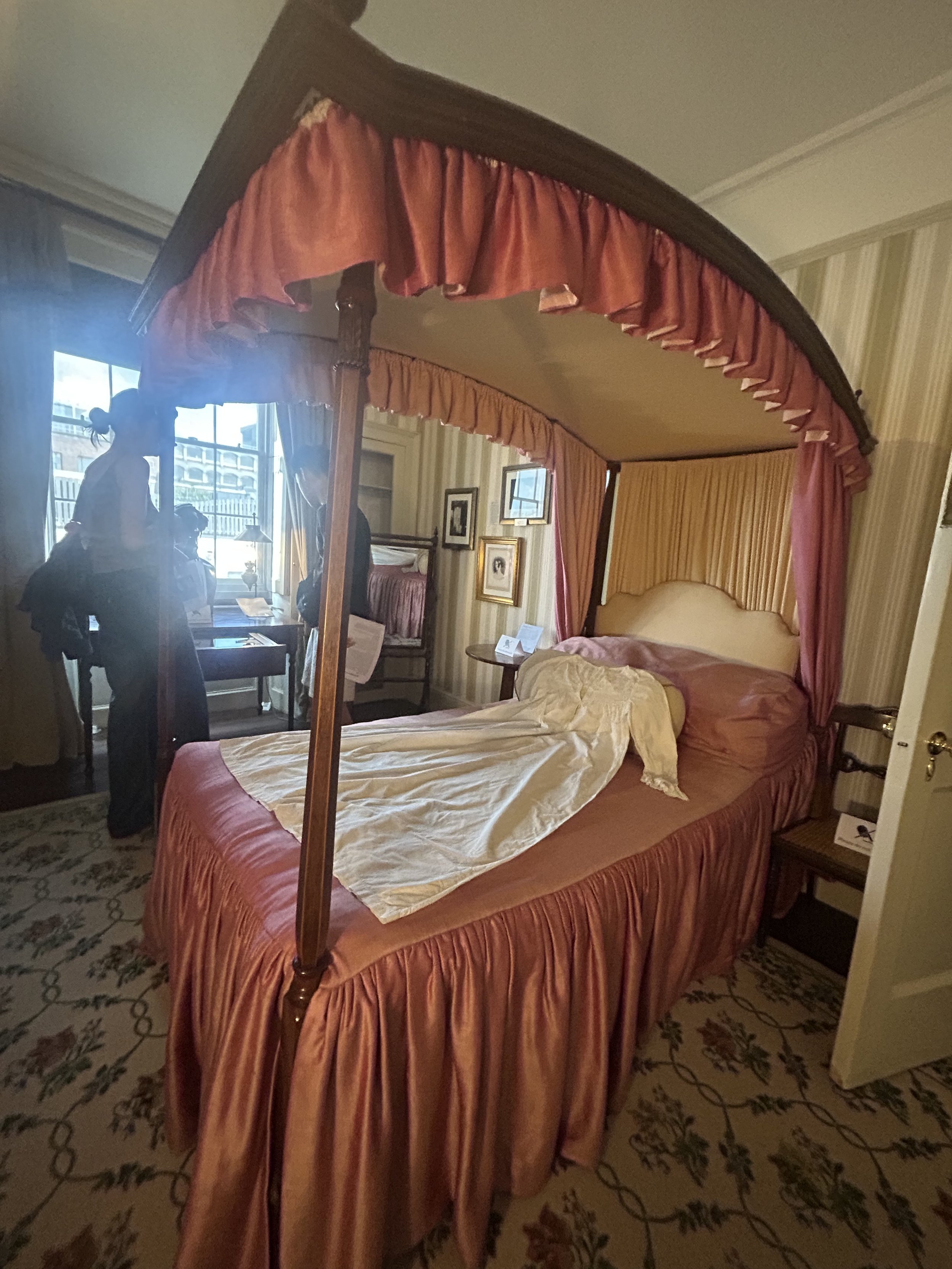
The bedroom of Charles Dickens’ sister-in-law, Mary Hogarth. Mary died in Charles arms at just 17 and is said to be the inspiration for many of Dickens’ pure and perfect female characters, like Lucie Manette in A Tale of Two Cities.
I find Dickens’ treatment of women quite baffling. His novel contains a perfect, beautiful, dutiful woman whose entire purpose revolves around the men in her life. Lucie Manette has no ambition beyond her role as a daughter, wife, and mother. She’s entirely good, angelic, and unflawed. All to say, she’s boring and absolutely fictional. And yet, the novel also contains a fascinating portrait of a vindictive, unforgiving, and intelligent woman whose autonomy leads her to storm the Bastille. When you meet Madame Defarge, she’s silently knitting while her husband runs the wine shop. How absolutely predictable of Dickens. I quickly learned that my own immediate dismissal of Madame Defarge was ill-placed. She isn’t just knitting; she's “knitting, knitting, counting dropping heads” (wow). She isn’t knitting socks or mittens but writing and marking enemies of the revolution to die. She directs all the women in the neighborhood to do the same and even remains in charge within her marriage. I feel I should include one of my amazingly academic annotations about Madame Defarge to fully illustrate her character. Here, the husband, “Defarge, with his pipe in his mouth walked up and down complacently admiring, but never interfering; in which condition, indeed, as to the business and his domestic affairs, he walked up and down through life,” to which I wrote she is running this man. Or when Defarge questions how long it may take the revolution to succeed, she responds with, “‘Vengeance and retribution require a long time; it is the rule’… ‘How long’ demanded madame, composedly, ‘does it take to make and store lightning? Tell me?’” I, of course, wrote GOTTEM BADDIE. For all of Lucie’s angelicness, Madame Defarge makes up for it with maliciousness. I would have loved to see a female character that fell somewhere in the middle, but I still can applaud such a marvelously flawed woman.
Hugo also walks the line between saintly and realistic female characters. Fantine becomes pregnant before being married and is abandoned before the father ever knows. This, at the time, would have been scandalous and damning. Fantine sells her hair, teeth, and body to provide for her daughter– saintly actions by unsaintly means. By the time she falls ill, she transcends into an angelic figure, even to the nuns taking care of her. When we first began talking about Cosette, Fantine’s daughter, it seemed like she was a Lucie Manette figure, beautiful, devoted to her father and husband, and lacking any personality. But as I looked back, there was so much of her character that we were simply erasing. She certainly is not the most nuanced or well-developed character, even by 19th-century standards (Jane Eyre anyone???), but still, as readers we’ve ignored aspects of her character so that we could take the easy route and throw her into the innocent, naive, subservient female character bucket. I don’t think Cosette is so easily classified. One day she learns that she is pretty (and Hugo has some… interesting takes on what that does to a woman) and wields it “like a knife”. Her train of thought isn’t saintly; after meeting Marius, she decides the officer she used to watch is “dull, inane, stupid, feckless, conceited, disagreeable, impertinent, and very ugly” (I even included this quote in my essay; it was too funny to ignore). We allow Marius, Cosette’s husband, to retain other pieces of his character after he falls in love but reduce Cosette to an infatuated girl in love. Which, to be fair, she is. Still, Marius is the one writing her love poems, and Cosette is 15! And I don’t know about you, but a 15-year-old girl with a crush is a fearsome thing to behold.
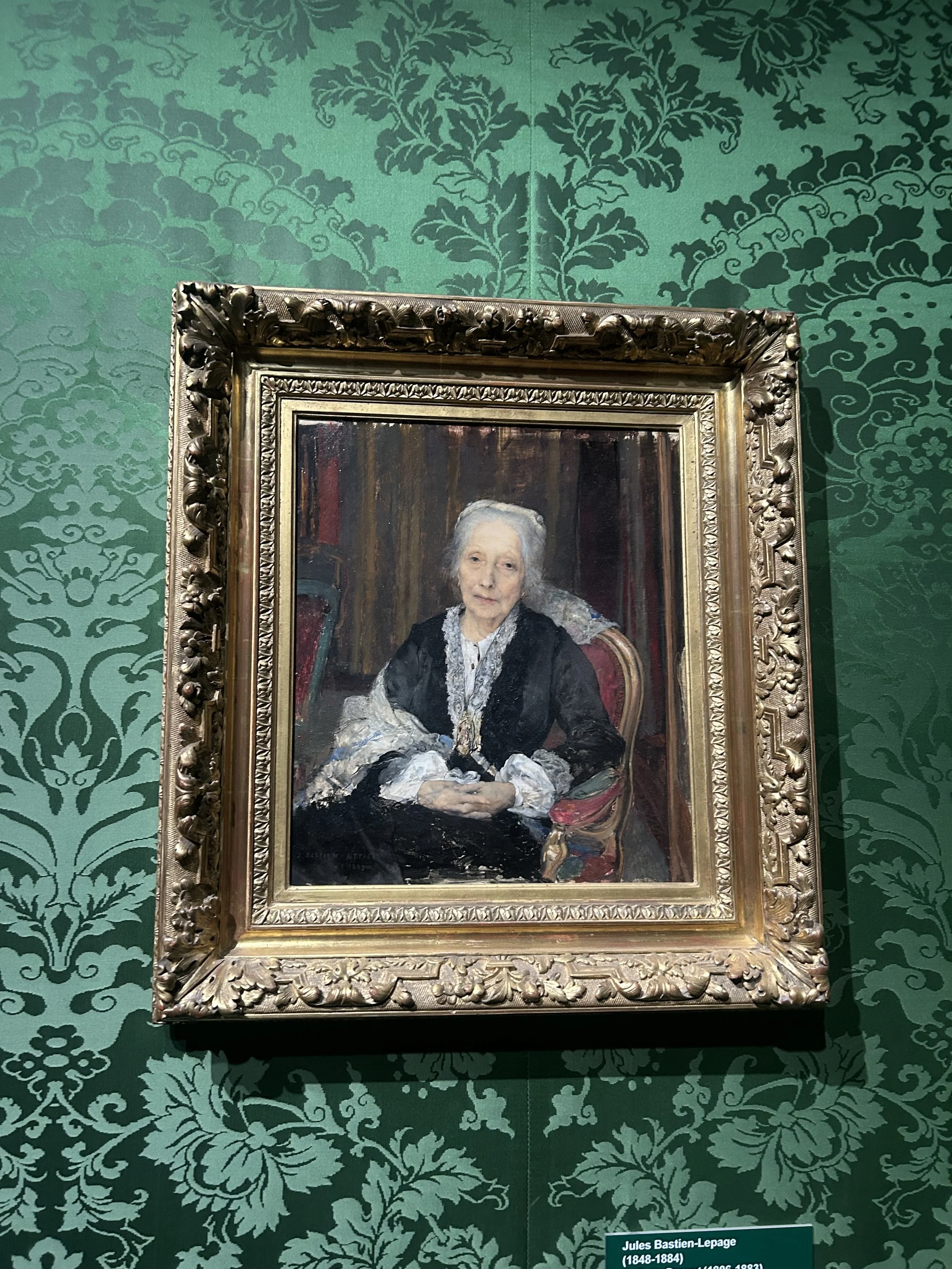
A painting of Juliette Drouet, Victor Hugo’s mistress and companion for 50 years, in his Paris home.
Something I found really interesting was the difference between the relative “innocence” of female characters in the books and the art we’ve seen in museums and even churches in London and Paris. Dickens and Hugo both draw very strict lines on what they deem as invasive to portray in their books. A lot of the other artists of this period, or even earlier, don’t seem to have such qualms. Semi- or full nudity seems incredibly common in the artwork of the 19th century, which seems a little strange considering the strict societal conventions about public decency. Once again, another distinction must be made: what is art and what is sexual provocation dressed up as allegory. Calling a nude statue a goddess does not negate its true purpose. Once again, intention matters. Nudity or even sexuality is certainly not inherently nefarious; it can be honest, empowering, and beautiful. However, consent from those involved and awareness from the artist of the power they hold are essential when crafting such vulnerable pieces. There must be a larger purpose than simply gratifying voyeuristic tendencies of the men who could afford this art at the time.

Le Déjeuner sur l'herbe (The Luncheon on the Grass) by Édouard Manet in 1862 and 1863. The painting calls out how women are treated in art without hiding behind the guise of allegory.
Men portraying women in art is a conversation that is very much relevant today. In fact, I learned about Laura Mulvey’s concept of the male gaze when reading her essay Visual Pleasure and Narrative Cinema for a Cinema and Media Studies class at USC. I find it quite sad how similar the male gaze functions between traditional visual art forms, like paintings or sculptures, and modern forms of visual media, like film, animation, and video games. At their worst, they remove the woman and leave only a shell meant to be sexualized behind. It’s hard to watch as people stand around and take pictures of paintings that seem to intentionally remove humanity in favor of sexuality. It appears that the woman in the painting is offering herself to the viewer, or at worst, there for the taking. This plays into the voyeuristic aspect of art, and I would argue contributes to the “ego libido” of the viewer. For the paintings driven by and for the male gaze, the women are explicitly crafted as objects. In film, the narcissistic gratification of ego libido is achieved by viewers identifying with the powerful male protagonists who have these women at their disposal. The viewer simply inserts themselves into these roles. For these paintings, the owners essentially play the part of the male protagonist. These women are at their disposal. They may view them when they please and control who else may get that privilege. I don’t believe those who commissioned such paintings actually cared about the goddess or figure the woman was supposed to be portraying; I feel their pleasure from these paintings came from knowing it was a real woman being depicted, over whom they had control. Please note, I have intentionally only alluded to male gaze-driven paintings vaguely as I don’t feel it necessary to subject those pieces to more attention.
This isn’t to say women and femininity can’t be appreciated and depicted in art; I vehemently want more of that. I want more women with character, more with flaws, more who wield their body as they see fit. It’s heartbreaking to see the same issues of a 19th-century painting present in an advertisement on the metro. Just as we adjust our expectations for feminism in past centuries, those in the future will have to adjust to ours. I, for one, hope they condemn our complacency. And if life imitates art, I fear I must get working.