I was tired. The sunlight was beating down on our bodies. It was 80 degrees out. There were too many tourists. I enjoyed my experience but I had enough; it was time to go home.
On a sweltering summer Saturday, my classmates and I were walking through the gardens of Versailles. We had just finished looking through the Petit Trianon, but we still had a long walk ahead of us. The massive size of Versailles was unexpected for me, so what took about 40 minutes felt like hours. But I had a thought that came to my mind that I told my classmates: “If the women during the French Revolution could march from Paris to Versailles, walking to the Palace’s entrance is nothing.”
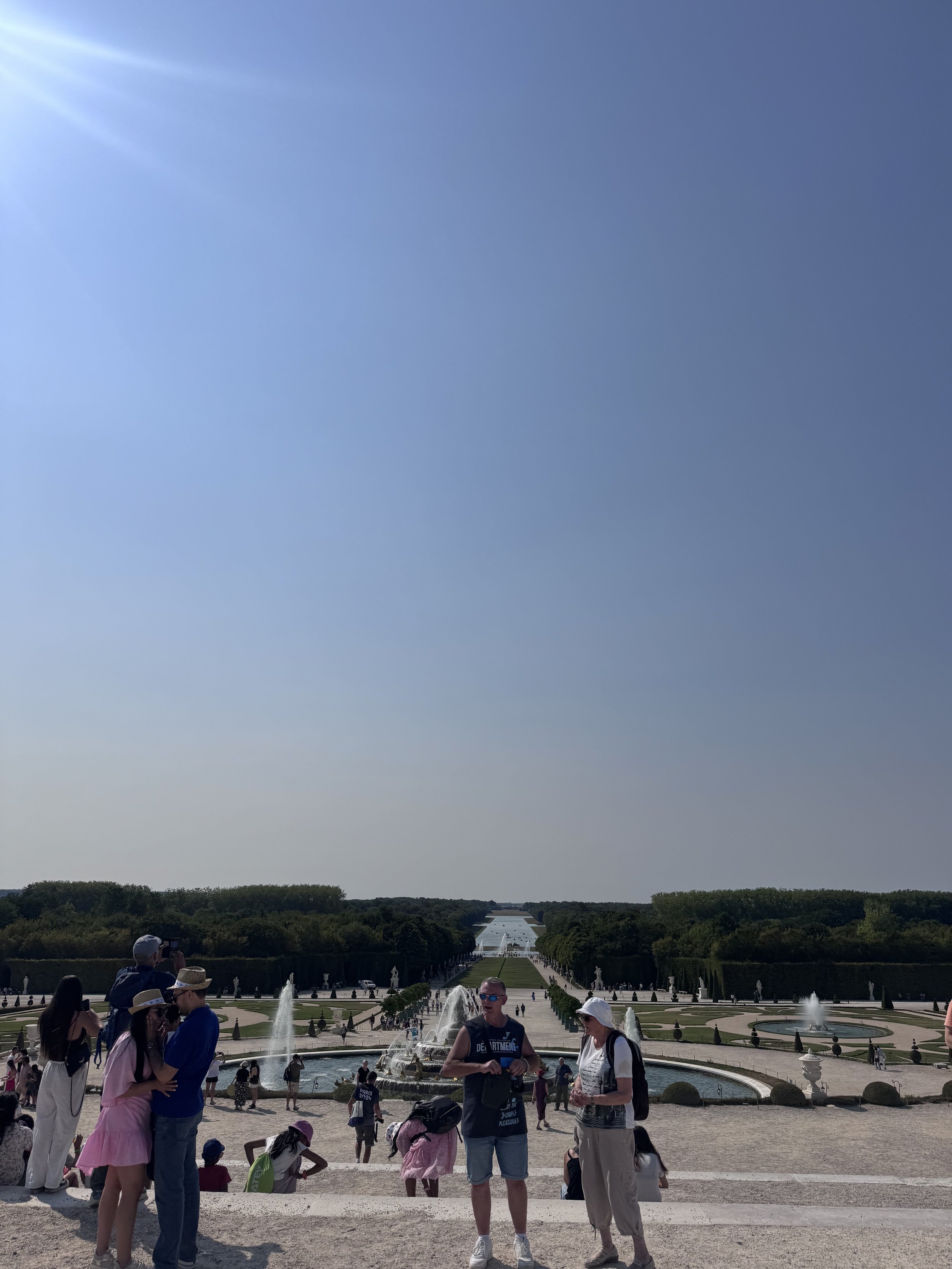
The long path we walked from…
These were some joking words of motivation, as I don’t really believe in comparing one’s suffering to another. However, I am fascinated by the extremities that many revolutionaries go through due to their utmost passion and willingness to sacrifice for the cause. The Women’s March on Versailles is a good example of this. The rightful rage that the French had because of not only the extreme societal inequality and the French ruling class’ oppression, but also because of the meaning of Louis XVI being in Versailles, fueled a complete overhaul of France’s social and political structures. It meant that the king was able to be isolated from Paris, the capital of the nation, because he felt that he was above them. It meant that the leader of the nation was able to escape the wishes of the people. The people had had enough of this centuries-old hierarchical structure. A five-hour march to Paris was nothing compared to the suffering they had been enduring. The payoff from spending five hours of their time was so great, as anything was better than living under an autocracy.
I also thought about how marches are significant parts of many revolutionary movements throughout world history. In 1965, Martin Luther King and other civil rights leaders led a march from Selma to Montgomery, Alabama in protest of oppressive Jim Crow laws that enforced racial segregation. Protestors were tear gassed and brutally beaten by police officers during this march. But they kept going. Being tired was not an excuse, as they were also tired of centuries of white supremacy and the consistent oppression and stripping of humanity from Black Americans. Their goal of voting rights and racial equality needed to be accomplished. In 1934, Mao Zedong led the Long March during the Chinese Civil War, which was an escape from the corrupt Chinese Nationalist forces. From the Chinese perspective, the Long March represented the communist revolutionary struggle for liberation from hierarchies that had oppressed the working class for millenia. Despite a multitude of attacks and casualties, they kept going; to them, this suffering was needed to achieve their goal of a communist China.
Why are marches so important though? When does a walk become a march? Marches represent the great lengths a movement is willing to go through, or “march” in order to achieve a goal. In this case, it’s essentially a glorified walk. But marches also refer to military demonstrations that display the pride and strength of a nation. Soldiers “march” in an organized and glorified manner to show greatness.
From a revolutionary perspective, these events that I mentioned above are more than just walks, journeys, runs, or any form of travel by foot. There is a sense of determination and “glory”, similar to how soldiers march to represent their nation. Revolutionaries march for the sake of a societal cause, which is their “destination”. Marches are walks that encapsulate the spirit of what one is truly fighting for and the suffering one is willing to endure in order to achieve a goal.
Pondering about this march on Versailles led me to also think about the revolutionaries that started the 1832 Revolution in Paris, which was depicted in Les Miserables. While the revolution was not even close to the scale and impact of the 1789 French Revolution, the revolutionaries were also extremely committed and were willing to sacrifice their lives for the sake of the revolution. The catalyst for the revolution, which was the funeral of General Lamarque, could be compared to a “march”.
“So on the fifth of June, a day of sunshine and rain, General Lamarque’s funeral procession passed through Paris… Then came a strange, excited, countless multitude, local sections of the Friends of the People, the Law School, the School of Medicine, refugees of all nationalities, Spanish, Italian, German and Polish flags, horizontal tricolours, every conceivable banner, children waving green banches… unorganized and yet united in spirit, now a tumultuous mob, now a column. Insurgent groups chose leaders for themselves.”
This excerpt encapsulates unity. The people of Paris are gathering and “marching” through the streets as a way to express their discontent with the July Monarchy. They are coming out and taking action for a purpose: To revolt against Louis Philippe and liberate their nation for the sake of equality and self-determination. We can see that multiple social groups are uniting for a revolution and putting themselves at risk just so that they can fight for a France where they can be free from autocracy.
We later find out in the book that the revolution was unsuccessful. Sometimes sacrifice and revolutions do not work out in the end. Yet, it is still beautiful that there was a united attempt from French society to call out the establishment and take collective action against hierarchy and oppression.
Sometimes protests and revolutions have imperfect or unexpected outcomes as well. For example, the civil rights movement and their marches were successful in terms of the passage of the Voting Rights Act and desegregation, but many Southern states are still led by right-wing governments who implement policies that are considered to be oppressive to Black Americans, women, and other marginalized groups. China had some initial success with dismantling oppressive institutions and social structures through land reform and gender equality initiatives, but they ended up becoming an authoritarian government that engages in the oppression of minority groups and imperialism against other surrounding nations.
Perhaps France is an example of what countries or regions could have been in terms of states with a long history of revolutions and change. Maybe China could have achieved a liberal democracy if it had gone a different path. Maybe states in the American South could have voted in more liberal governments that would have implemented more progressive policies to alleviate poverty and inequality. But opposing forces are always present and can often impede on efforts to achieve true liberation.
To me, the fact that the revolutionary spirit of France was so profound, as that is how I believe a society progresses. Progress is not an easy path, and it only comes when people express dissatisfaction, whether it be a small protest or a major revolution that changes the soul of the nation. I am inspired by Enjolras, Marius, and the student group’s determination and drive that allowed them to organize a revolution, as well as their free discussion of ideals that are crucial to achieving democratic values in a society.
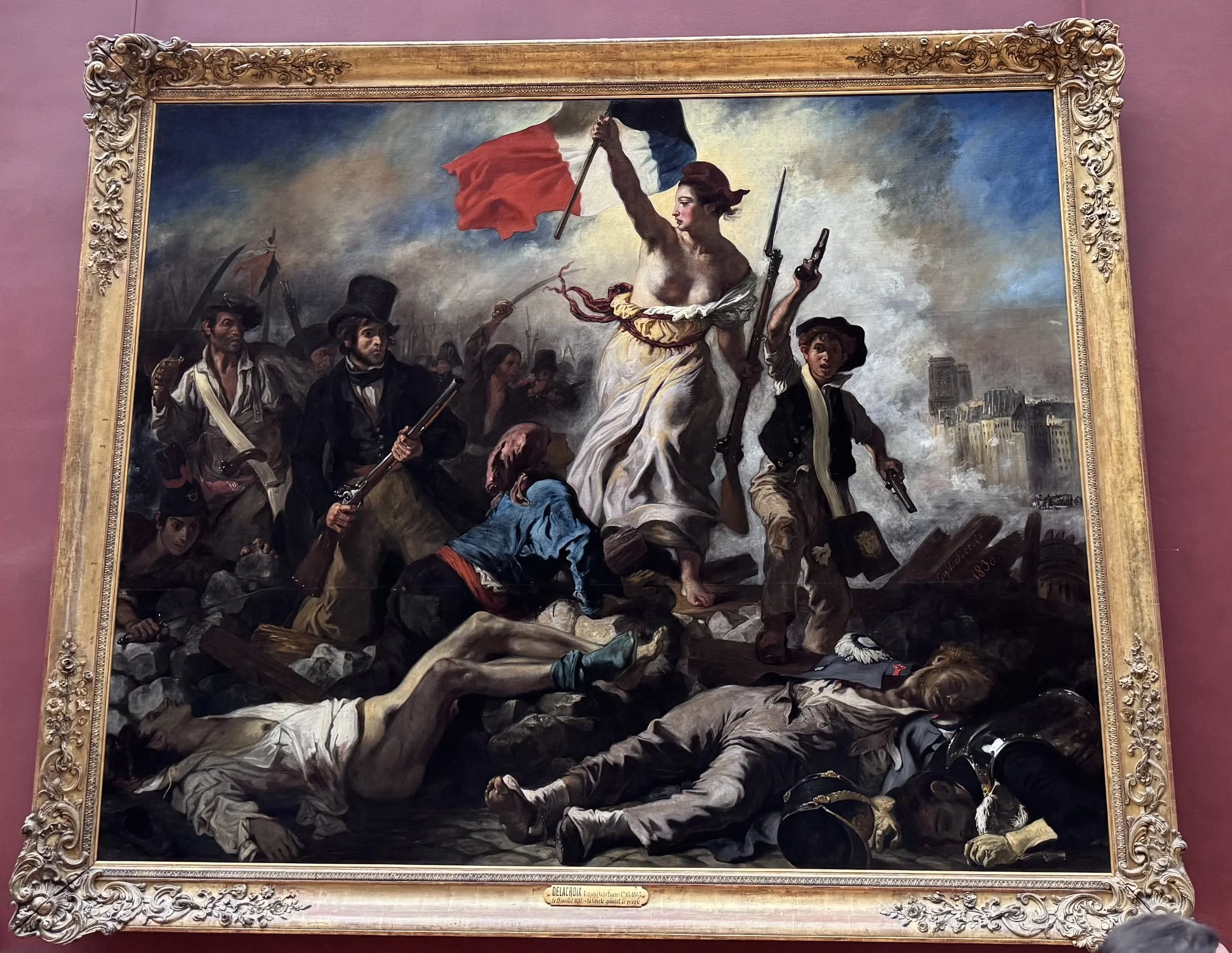
France had still partaken in centuries of imperialism throughout the globe during these times of domestic revolutions, and radical political forces and ideals from the left and right that could threaten democracy and liberalism are still present in the nation today. But I can appreciate that great change was still able to occur and a vibrant Western democracy was able to emerge from this process. After all, it is the existence of democracy that allows these radical values to gain traction. Perhaps it was because of France’s established position as a dominating and developed European power compared to other nations that had undergone colonization or poverty that hindered their growth, as it allows them to avoid the dangers of populist and authoritarian forces that often emerge through developing nations.
So was our walk from Versailles a march? Probably not. But maybe you could argue that our walk to the train station had a greater purpose of us writing these blogs and thinking about ideas that could potentially inspire us to contribute to a greater good. Maybe we are all engaging in a mini-intellectual revolution right now and marching through the streets of Paris to expand our worldviews and forming ideals that will be revolutionary in the future.