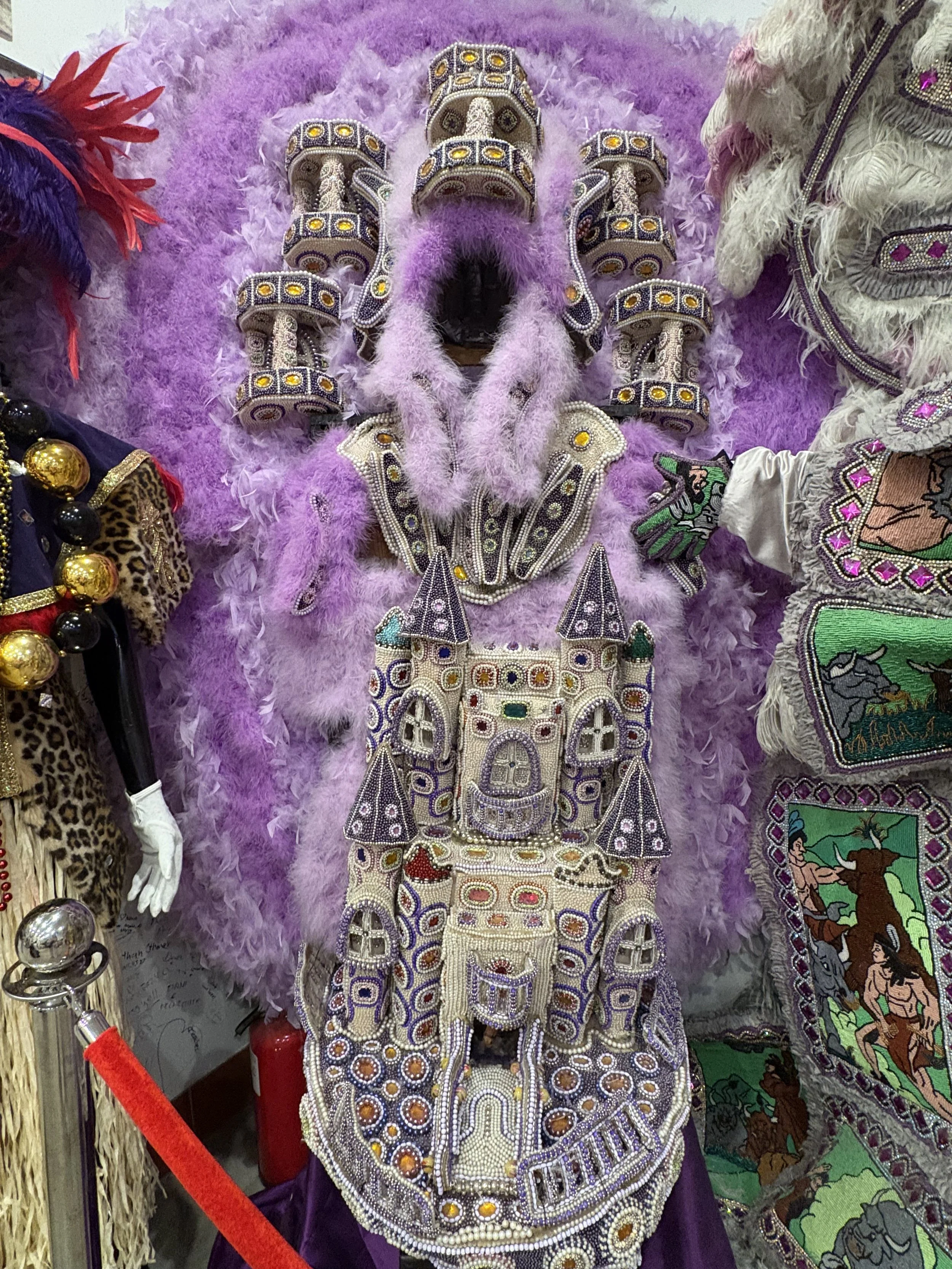
I’m damp from the rain, sweat sticking my hair to the back of my neck. It’s been a long day. I’m looking forward to going back to the hotel, showering, and rotting in my bed with a cup of tea — but we still have one stop left. Little did I know that this would end up being one of my favorite stops of the trip. We’re at the Backstreet Cultural Museum, an unassuming building that stands on the corner of two residential blocks. You wouldn’t suspect such a plain building of housing the most colorful, spectacular clothes you’ve ever seen. In fact, as I looked up at the parade outfits of the Mardi Gras Indians (as they’re primarily known, though our museum guide said they actually call themselves Black Masking Indians), I felt less like I was looking at clothing and more that I was witnessing some brilliant work of art. I do believe that clothing can be inherently artistic, but this was something entirely beyond. These outfits clearly weren’t created for function. The joy was in the process, in spending hours and hours meticulously crafting something new every single year. I’m getting ahead of myself, but I just found the entire thing so cool. Every year, the Mardi Gras Indians make a brand new suit for themselves, always homemade, always more intricate than the last. They wear these outfits in parades throughout the year – which I had the pleasure of actually seeing in person too. The entire thing just felt like such a celebration of culture and so fun and just cool, for lack of a better word.
I guess after learning about all of the trauma and horrors inflicted on Black Americans, it is so cool to see a museum dedicated not just to suffering, but to joy and resilience. Its founder, the late Sylvester “Hawk” Francis, dedicated so much in order to create this museum and maintain it, and after visiting I could see why. I guess New Orleans has just got me thinking about resilience a lot. It’s been happening since we first got here, driving into Grand Isle and seeing all those colorful houses on stilts like a cluster of oddly shaped tropical birds. The homes were, of course, built this way to withstand hurricanes and flooding. Some houses clearly had done a better job than others — there were several that had fallen into disrepair — but I liked to think about all the houses that must have been built and rebuilt. Instead of just giving up and going somewhere else, the locals on Grand Isle, and the general Southern Louisiana region, recognized they had something worth fighting for. They rebuilt. The houses now are stronger than the ones before.
All across New Orleans, I have seen this same resilience. The ten of us piled into a van earlier this week to go on a tour of the Lower Ninth Ward and New Orleans East to map out The Yellow House. On the way, Andrew pointed out the Caesar Superdome, where thousands of New Orleans residents had sheltered for days in abysmal conditions. We drove past swaths of greenery interspersed with shotgun-style homes, some new, some that definitely had been victims of hurricanes past. All that nature hadn’t always been there, our professor explained. It was as a result of hurricane damage that many homes had been demolished, owners unable to pay for repairs or rebuilding, leaving these lots empty for months, years, even decades. The lush greenery was the earth finally winning the battle that had been waged against it for years, but it’s not only nature that rebuilt itself. The people of these communities managed to survive through the devastation. Physical destruction is different than the destruction of memory. The communities that were destroyed were part of why Katrina was such a tragedy, but it also created a memory worth rebuilding. Those memories didn't leave, as The Yellow House makes clear, just because people had to cross state lines or leave their homes. Broom remarks that only her grandmother, an Alzheimers patient, is able to truly let go.
Is this the only condition, this unknowing, under which one should cross over state lines, leaving your familiarity behind? Is this the only way to properly leave home? - The Yellow House, pg 293
What I'm about to say might sound like a frivolous comparison. In fact, it definitely is. However, it’s been on my mind, so I’m going to compare it anyway. While this is nothing like losing my home, community, potentially even loved ones, I’ve been going through a breakup while on this trip. A pretty rough one – the kind that shakes your entire sense of self, your entire future, leaves you grieving. Memories become the only thing left. While it’s silly to compare the death of my relationship to the genuine devastation and horror caused by Hurricane Katrina, I will say that seeing the amount of resilience here has made me reflect. People who have been through horrible experiences and traumas have been able to rebuild. Not always easily, especially at first. Broom's entire family essentially moves in with her brother right after Katrina. After surviving the destruction, the family must be in discomfort while they figure out what to do next. However, there are small moments of joy that intersperse this tragedy in this time, such as when their neighbor Herman raced a track star for everyone's amusement.
We were all tickled by how seriously he had been, to believe he might actually win! His performance brought levity to a grave, sinking reality. For the time it took Justin to beat Herman, no one thought about the Water. - The Yellow House, pg 296
In both The Yellow House and what I saw with my own eyes, I was struck by people's adaptability. They have found a way to create community and joy, to celebrate and not only survive but thrive. In the grand scheme of things, no matter how impossible my own life seems at the moment, people have been through so much worse and gotten through it. The human spirit is so capable of resilience, of joy, as I witnessed in the Backstreet Cultural Museum, the Second Line parades, books like The Yellow House and the real communities they are part of. There is something so inherently beautiful about that, something comforting and almost a bit hopeful.
This probably (definitely) isn’t my best blog post. It’s a bit all over the place honestly. My thoughts are still fractured when it comes to this topic, and I have difficulty distilling all of the reflections and feelings I’ve had into actual words. I guess, long story short, New Orleans has shown me so much — it has shown me some of the worst of the worst of human cruelty, of oppression and destruction and heartbreak. But it has also shown me resilience. It has shown me how revolutionary joy is and how strong the human spirit can truly be. I wish I had some grander conclusion to arrive at here, but I don’t. For now, I'm just thinking.
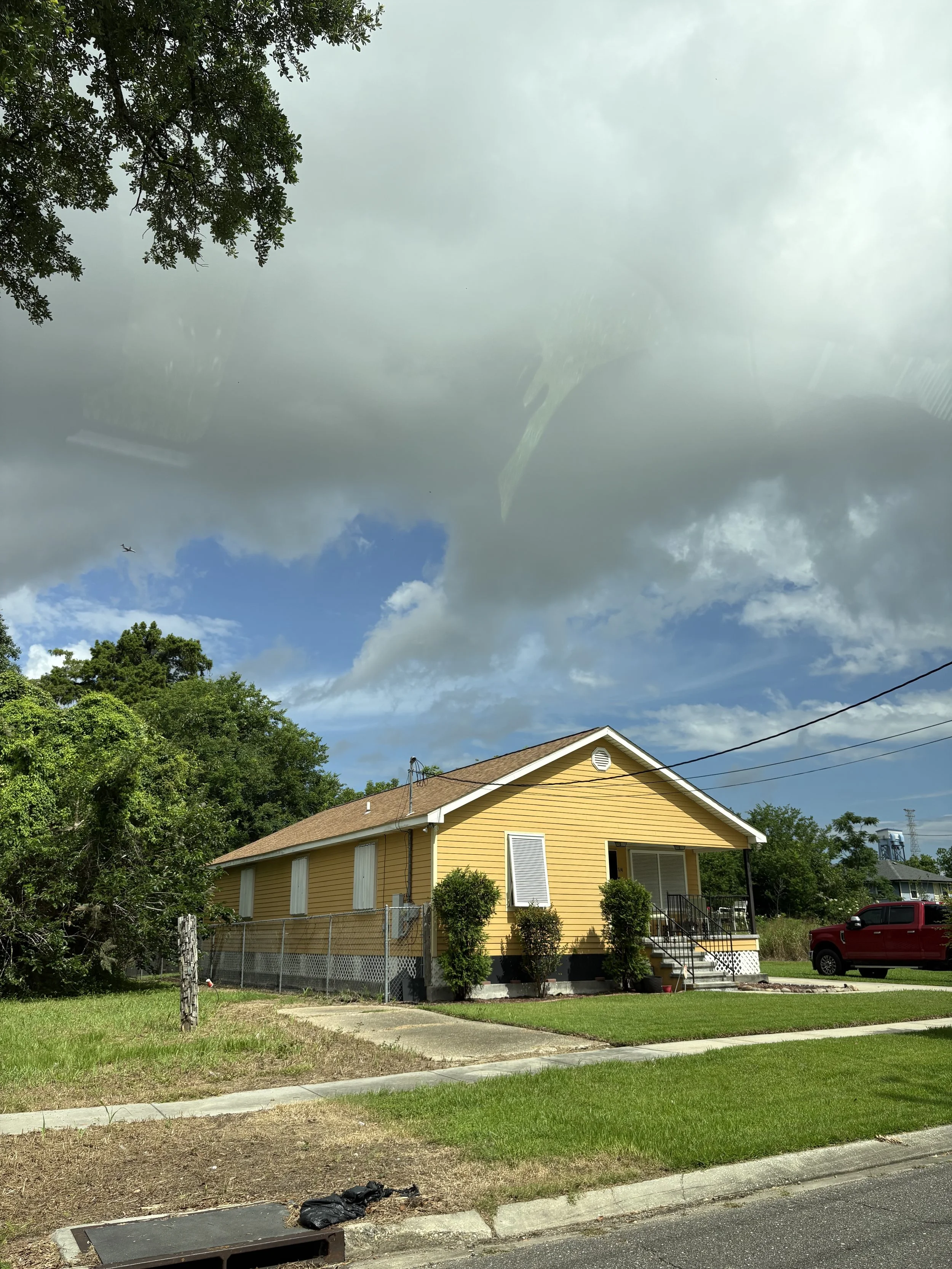
One of the houses in the Lower Ninth Ward surrounded by this lush greenery.
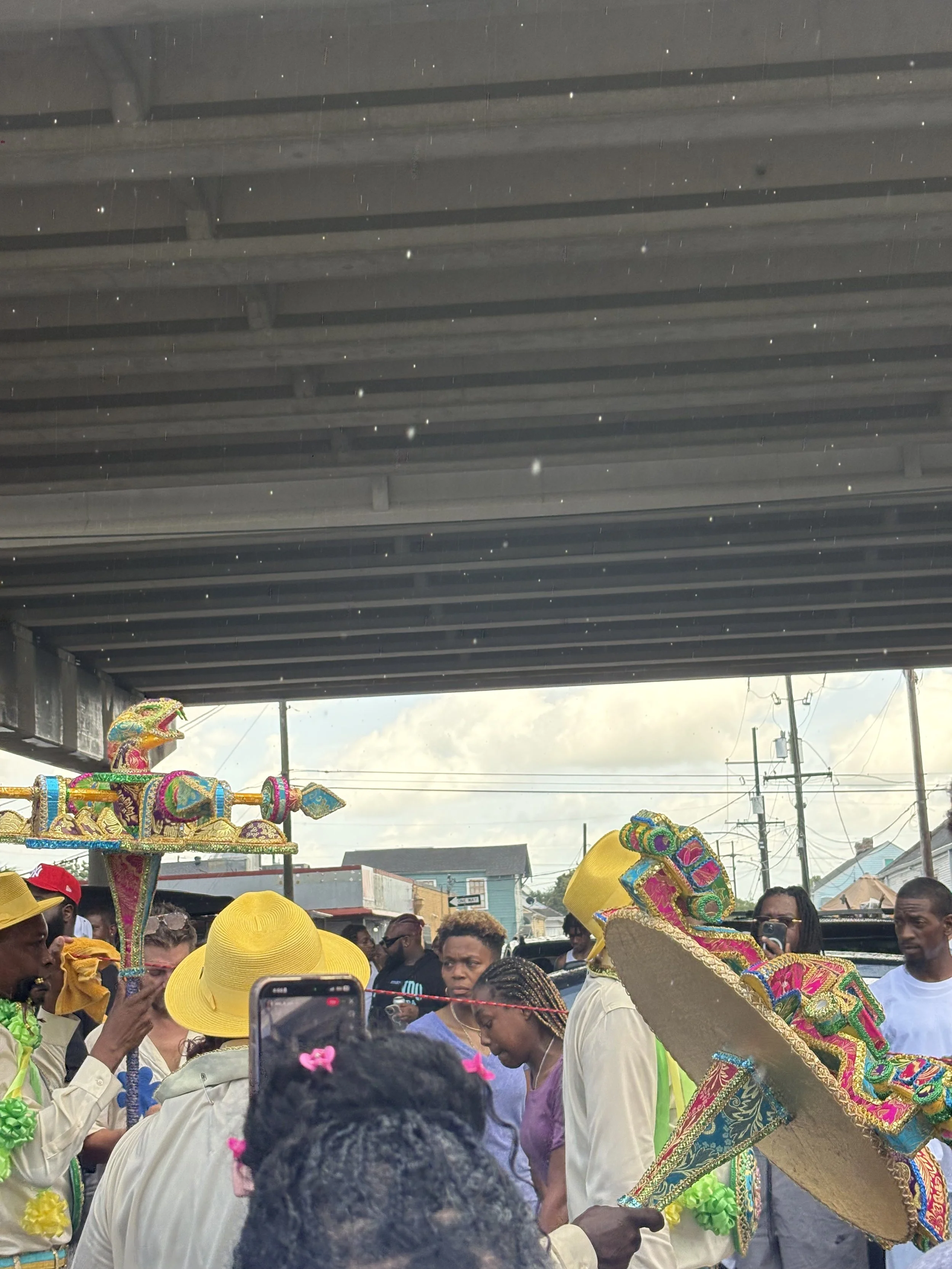
A moment from the Second Line Parade we went to.