Bittersweet

When thinking of my trip to New Orleans, what I feared most was not the unknown, not seafood, rather something I know pretty well — myself. 

It had been three years since I had taken a trip alone for a long duration in another state and in the meanwhile I had been quite comfortable in the familiarity of Los Angeles. 

Although I applied to this program with excitement to experience something new, I couldn't help but fear I'd retract from the unknown as a hermit hides in its shell. 

What I had failed to realize however was that it had been three years since I had last traveled alone, three years of all things brand new. A new school. A new environment. New friends, new family members, and a me who had become much more willing to confront something that was new

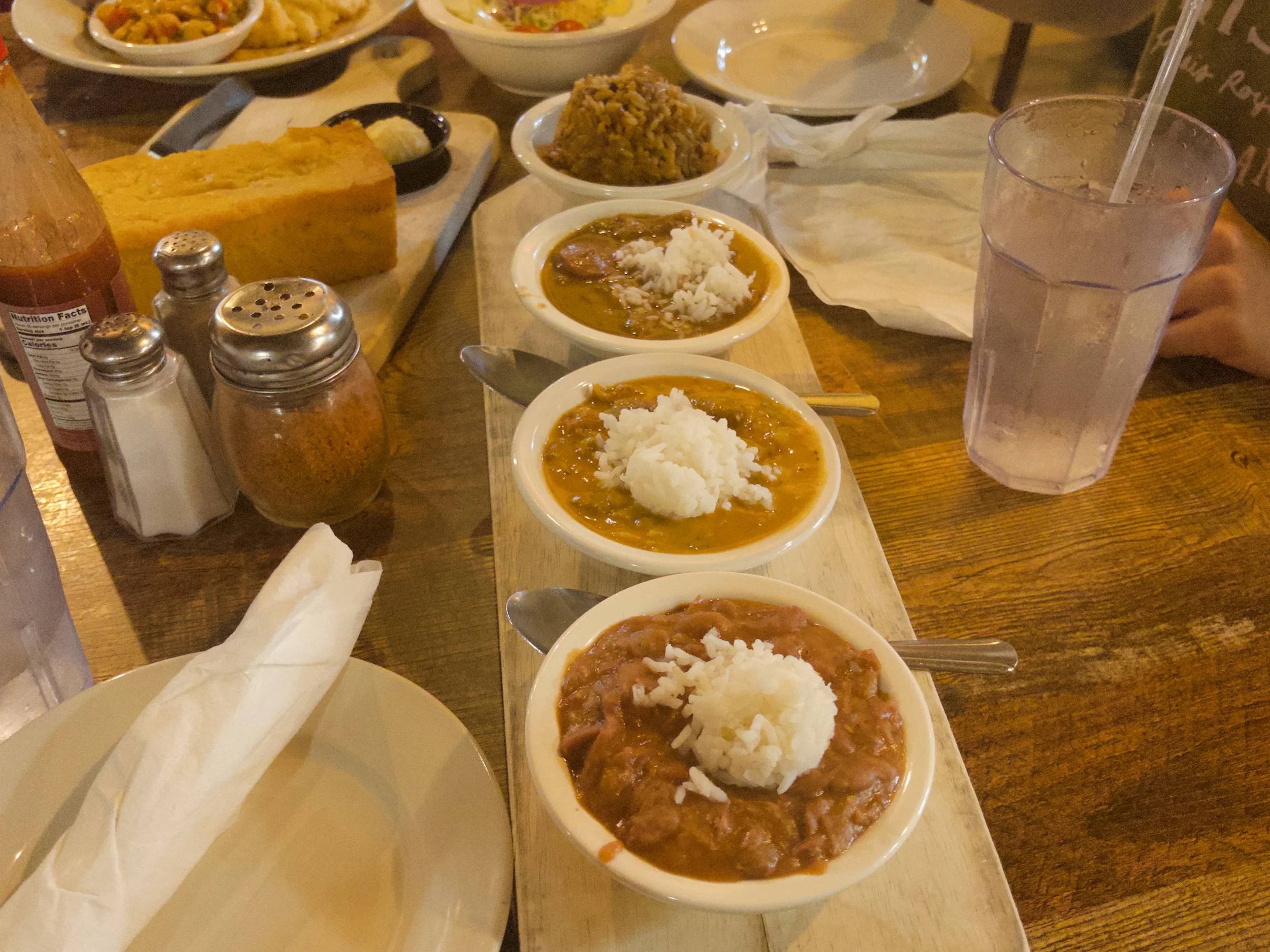
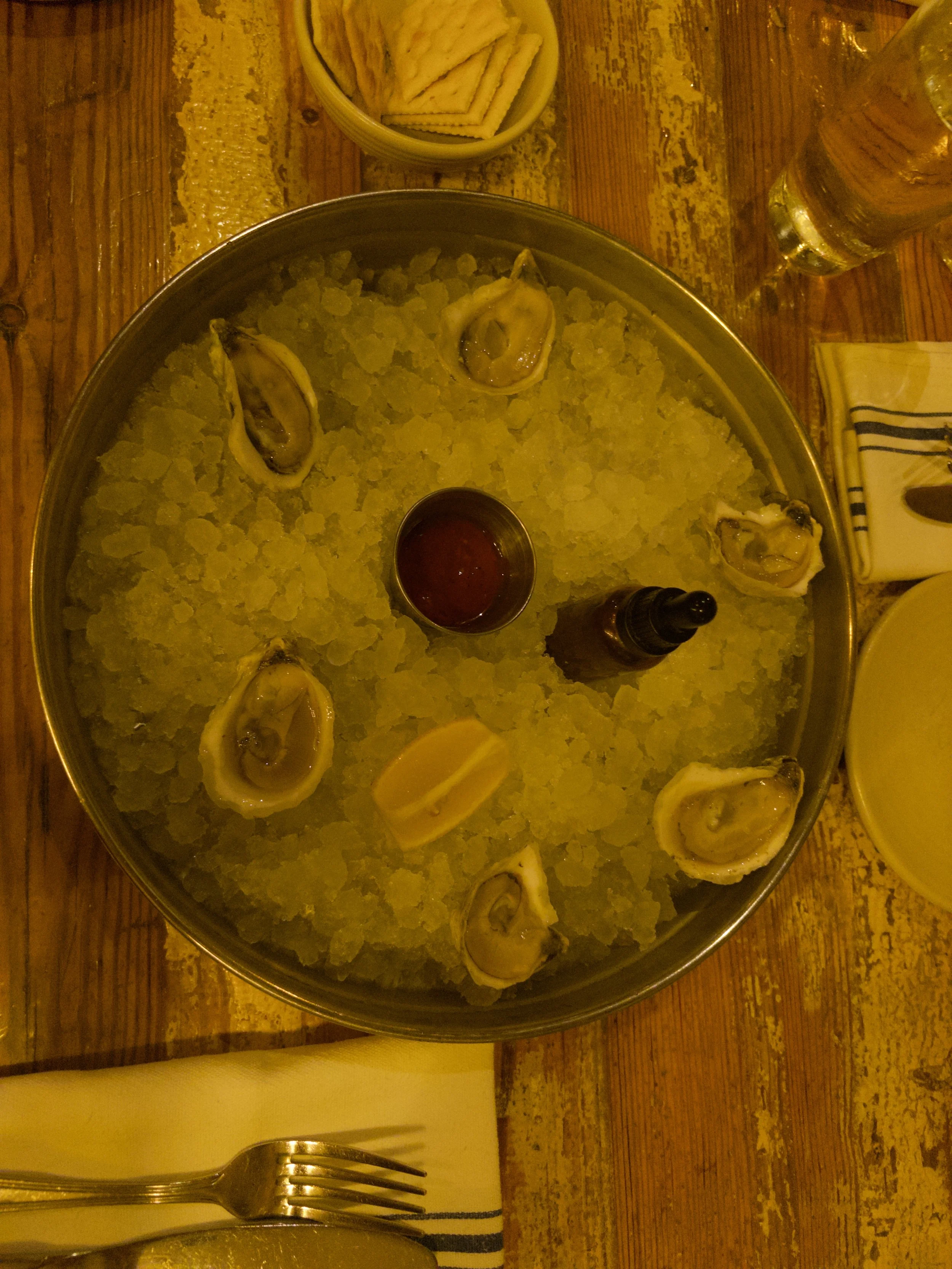
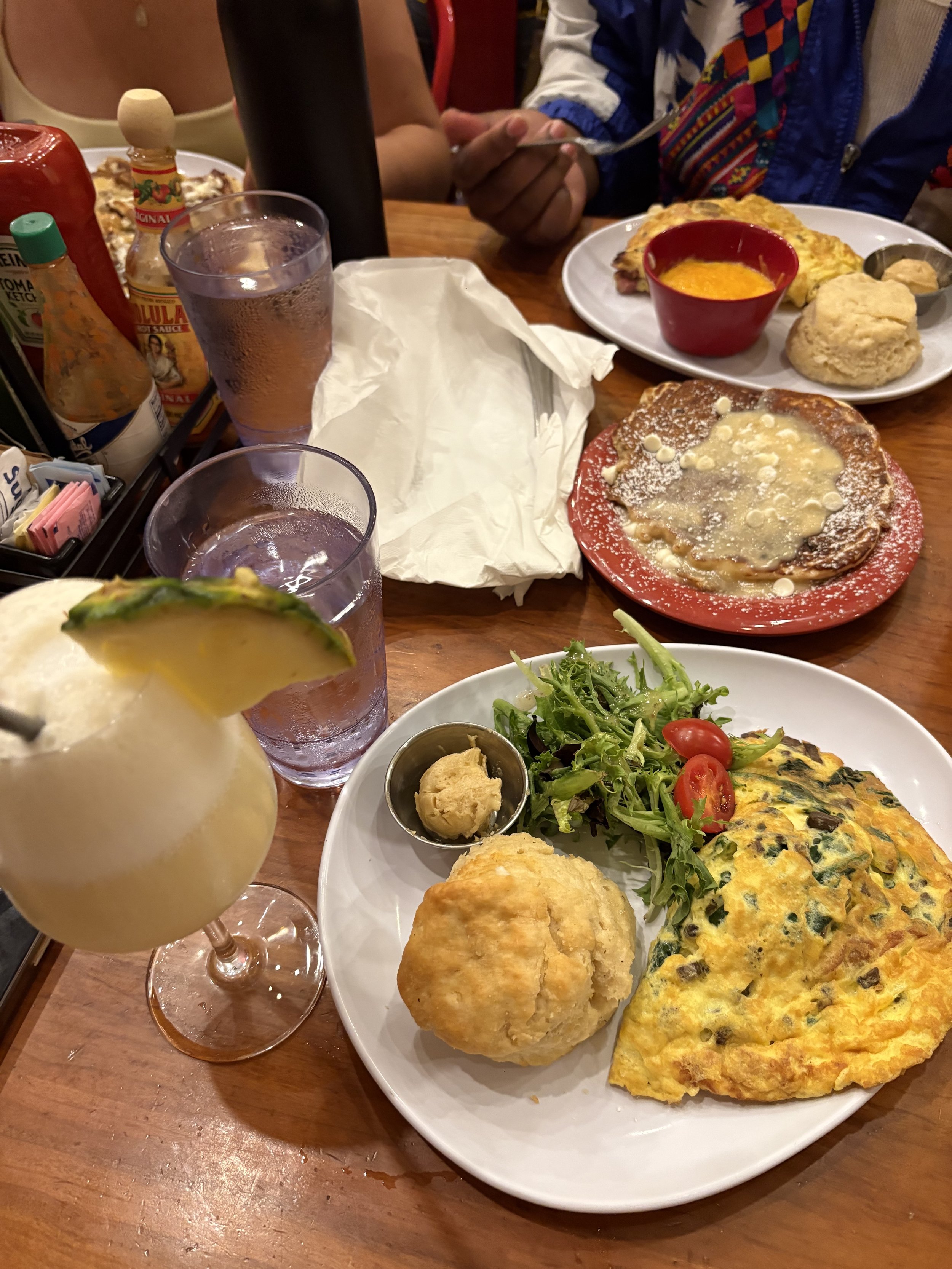
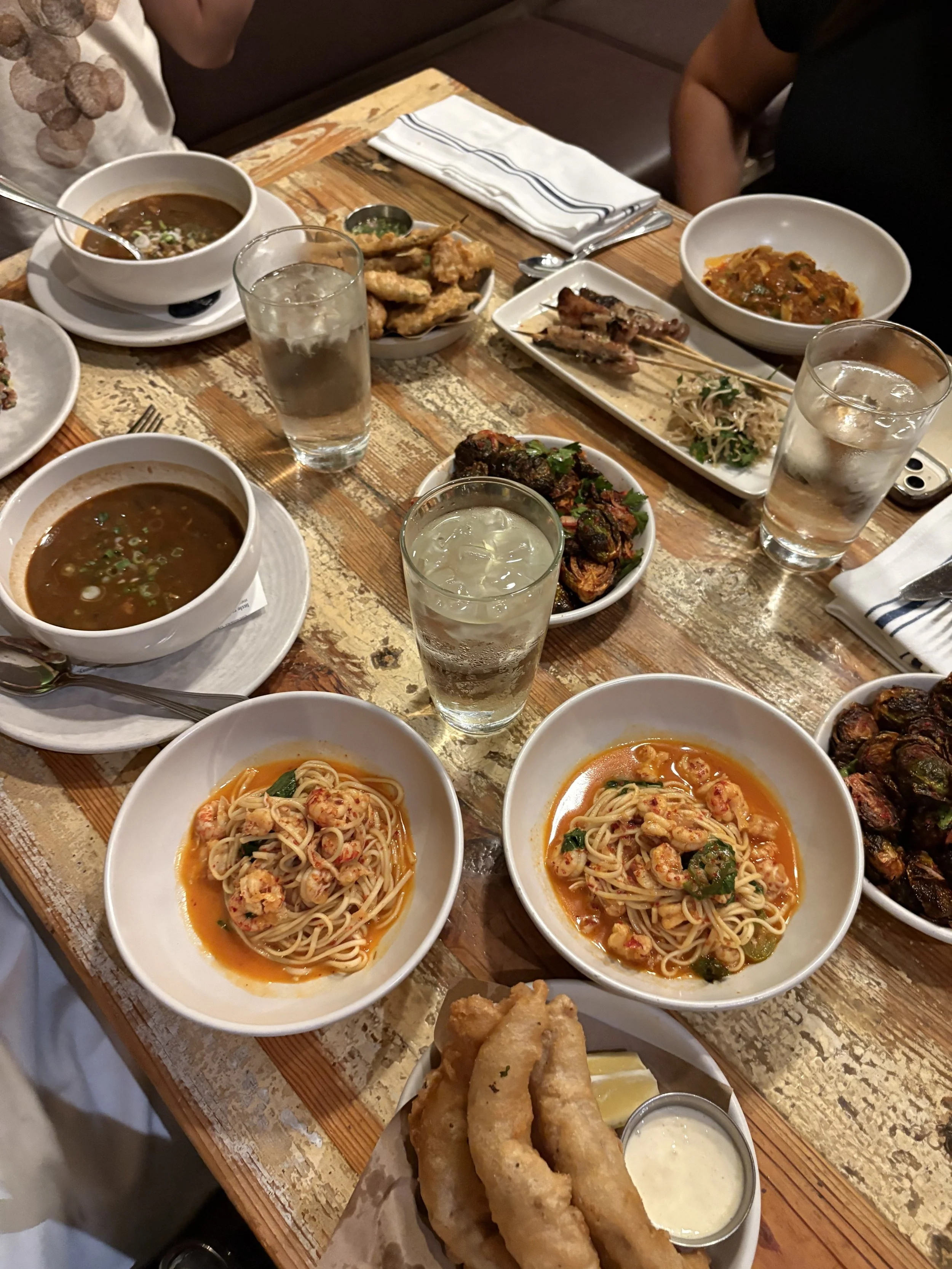
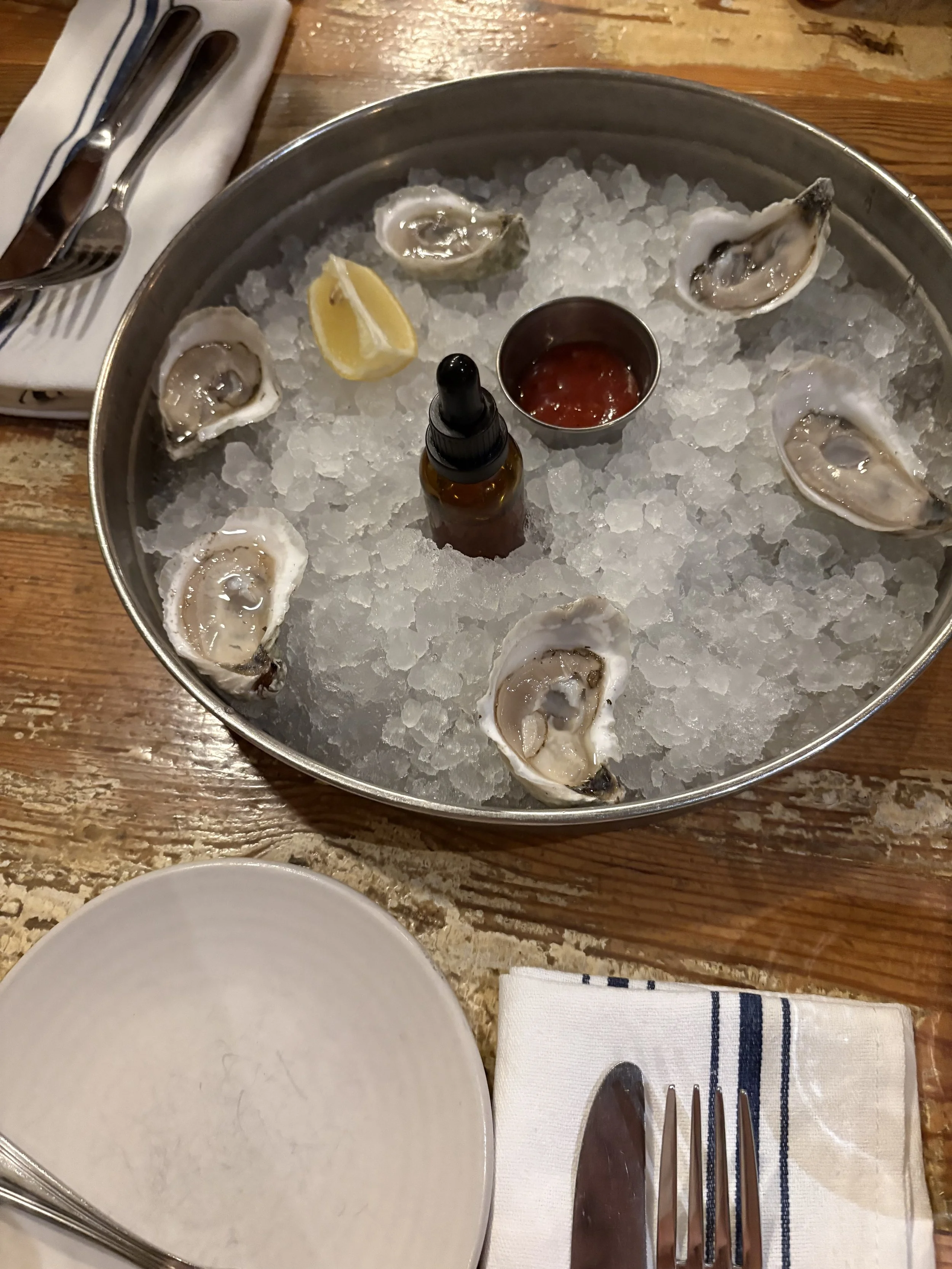
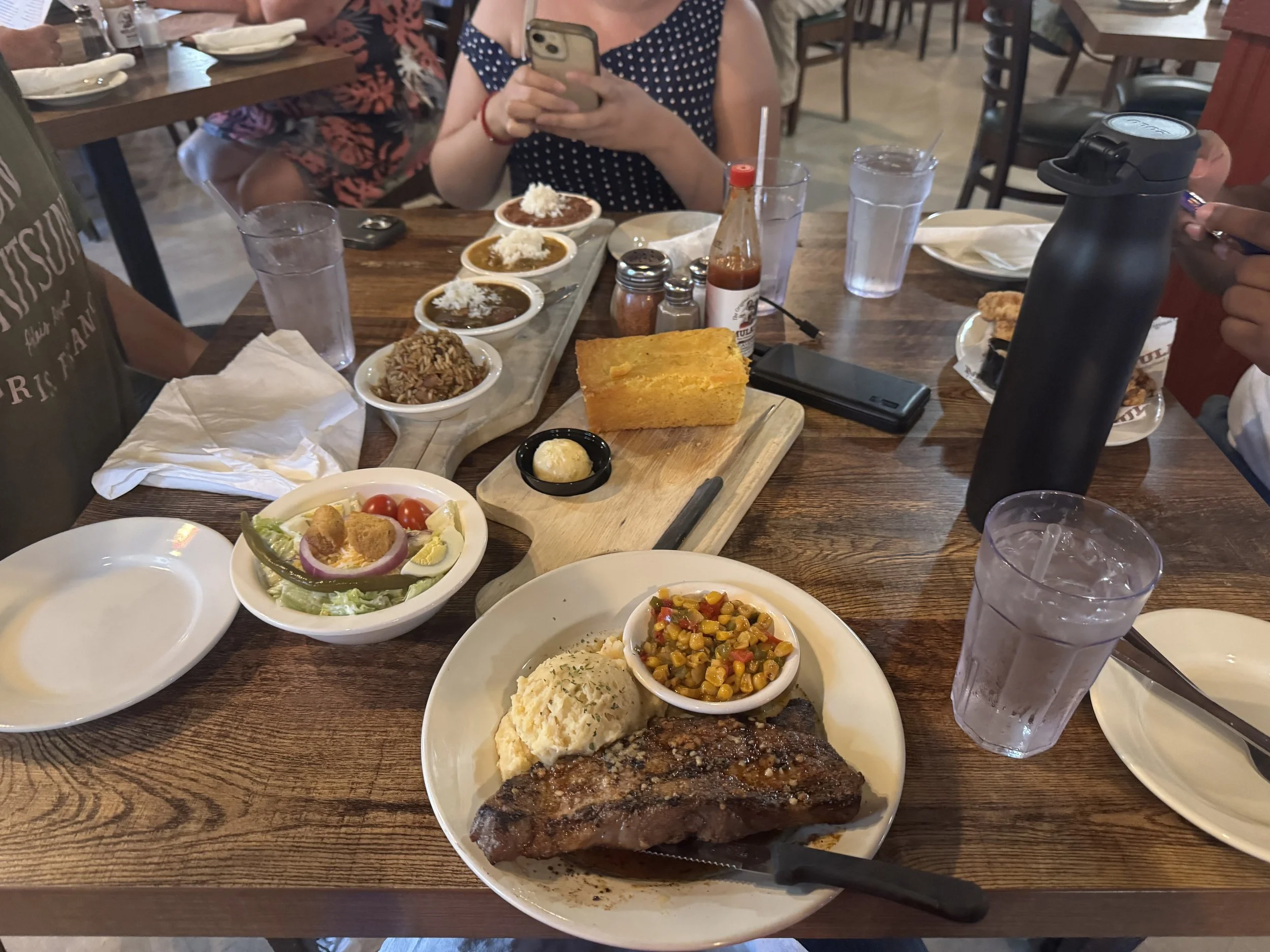
So I tried seafood.

I ate oysters, shrimp, catfish, and trout. 

And did I like it? 

YES

But what I enjoyed even more than the seafood, were the conversations amongst it. The people among those experiences.

Within these past three years, I've grown out of my shell. As cheesy as it sounds, it’s true. My insecurities no longer supersede my confidence, I'm less likely to cower from who I am from the fear of rejection. I'm more likely to embrace it. And as a result, I've been able to build such beautiful connections on this trip. 

But a connection is formative upon a relationship between the two, a presence of the self and of the other. 

On our trip, Andonis introduced me to the topic of dividualism. The idea that there is not one individual identity, but varying identities within ourselves that manifest through our connection with others and I find this to be true.

Each conversation with each of my peers on this trip brought out different sides of me. Each provoking different thoughts. Different emotions. Different memories. 

And that’s the beauty of humanity. The ability to learn alongside and from each other. The ability to challenge each other. To grow amongst each other. To understand each other. And most of all, the ability to gain a sense of self from one another. 

I LOVED my experience in New Orleans. I'm so grateful for this whole experience. But yesterday I left and today I'm 20.

Heading back into the familiarity of Los Angeles and into the unknown of my twenties, I know one thing for sure. I don't want to limit myself. To second guess, to fall to fear. I want to explore. Try new foods. Learn new things. Travel to different places. But most of all, I want to explore my life through the wonderful connections I make, both old and new.

Saxophone

I have 26,074 photos saved on my phone. 26,074 photos to my name. Far too many. I can make the excuse that I’m simply too lazy to clear my camera roll, but I wouldn’t be addressing the root of the problem. How did these photos end up there in the first place?

I took them. 

I took many

I spam my phone with images in hopes of capturing fleeting moments, but in the very act I lose them. It’s a problem, but how could I resist it? With phones, you capture an image almost instantly. In seconds, I can preserve what I deem as valuable. But does a moment left uncaptured make it less valuable than one that is? Although I have 26,074 moments captured on my phone, I have a million more captured through what I’ve seen, smelled, touched, tasted, and heard. 


Memory is invaluable. 

Inquire about my grandfather and you’ll get a different response from each Raygoza. He loved pistachios. He smoked. He drank. He was quiet. He was calm. He was loving. He was abusive. He was caring. He was distant. He was a musician. He played the saxophone. 

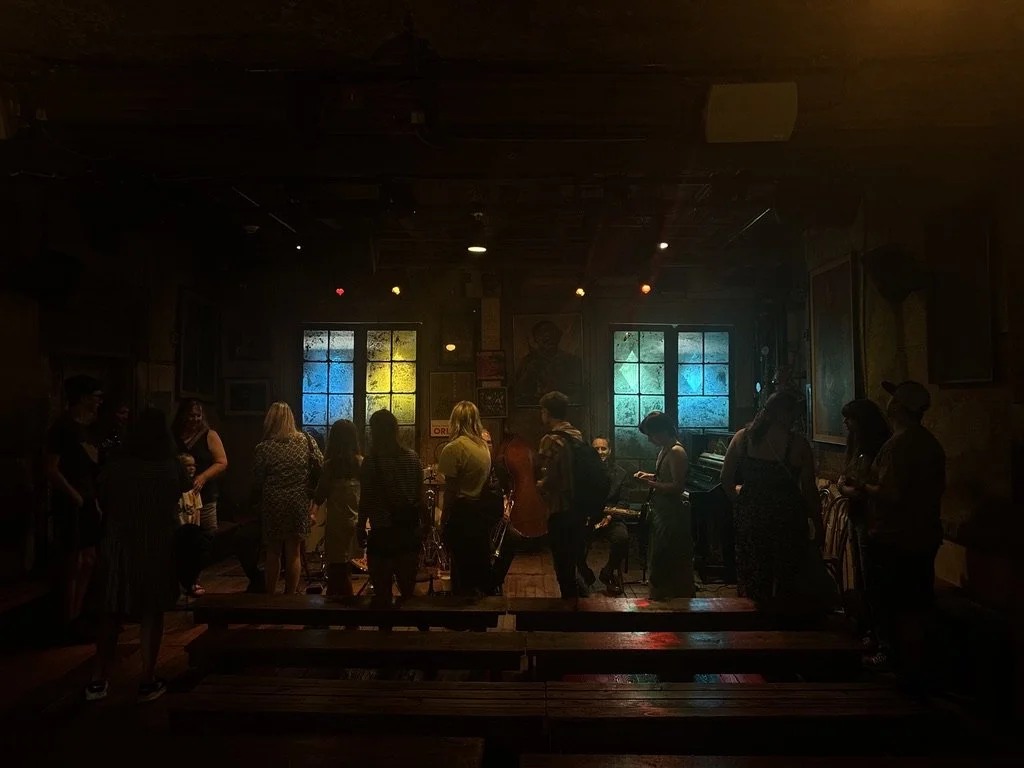
Before we head to Preservation Hall, Andrew speaks of what the experience will look like. He says that sometimes they play the clarinet, but today it’s the saxophone. Phones are not to be used during the performance. There are no images, no videos. When the sax solo begins, my still feet break into a rhythm, each step recalling a memory of my grandfather that isn’t mine. I had never met him. He passed away before I was born. My memory of him is composed of perspectives that are not all one in the same. Still, they create a connection I otherwise wouldn’t have. A connection between me and him, between the music and me.  


Memory is imperfect

It’s built from perspective. Perspective shapes memory and memory shapes connection. In Michael Ondaatje’s Coming Through Slaughter, Ondaatje intertwines his creative mind with the historical perspective of Buddy Bolden, often referred to as the Father of Jazz. In doing so, my remembrance of Bolden is forged by the perspective of Ondaatje. It’s inherently flawed and it prompts the questions: Whose memory gets to be preserved? How is it preserved? And who gets to preserve it? 

I think back to the statue of John McDonogh, a wealthy slave owner who willed 2 million dollars to New Orleans public schools, now replaced by a potted plant in Lafayette Square. Down Lafayette Square on Saint Charles Ave and above eye level lies the small plaque acknowledging the New Orleans Slave Depot. Although the McDonogh statue is no longer there, having been toppled by protesters in 2020, I dwell on the question of how a slave owner gets a larger memorial than the suffering of enslaved people in these slave markets? It’s upsetting, but not surprising. America has long been selective in the memory it chooses to tell. The white perspective, the white story, has long dominated avenues of remembrance from memorials to film to the history books we read in class. 

Memory is power

And the protestors who tore down McDonogh’s statue resist a memory, a power that is abusive (to say the least). Instead, individuals like Sylvester Francis, preserve a memory rooted in resilience, love, joy, community and culture. A memory rooted in Black Power. 

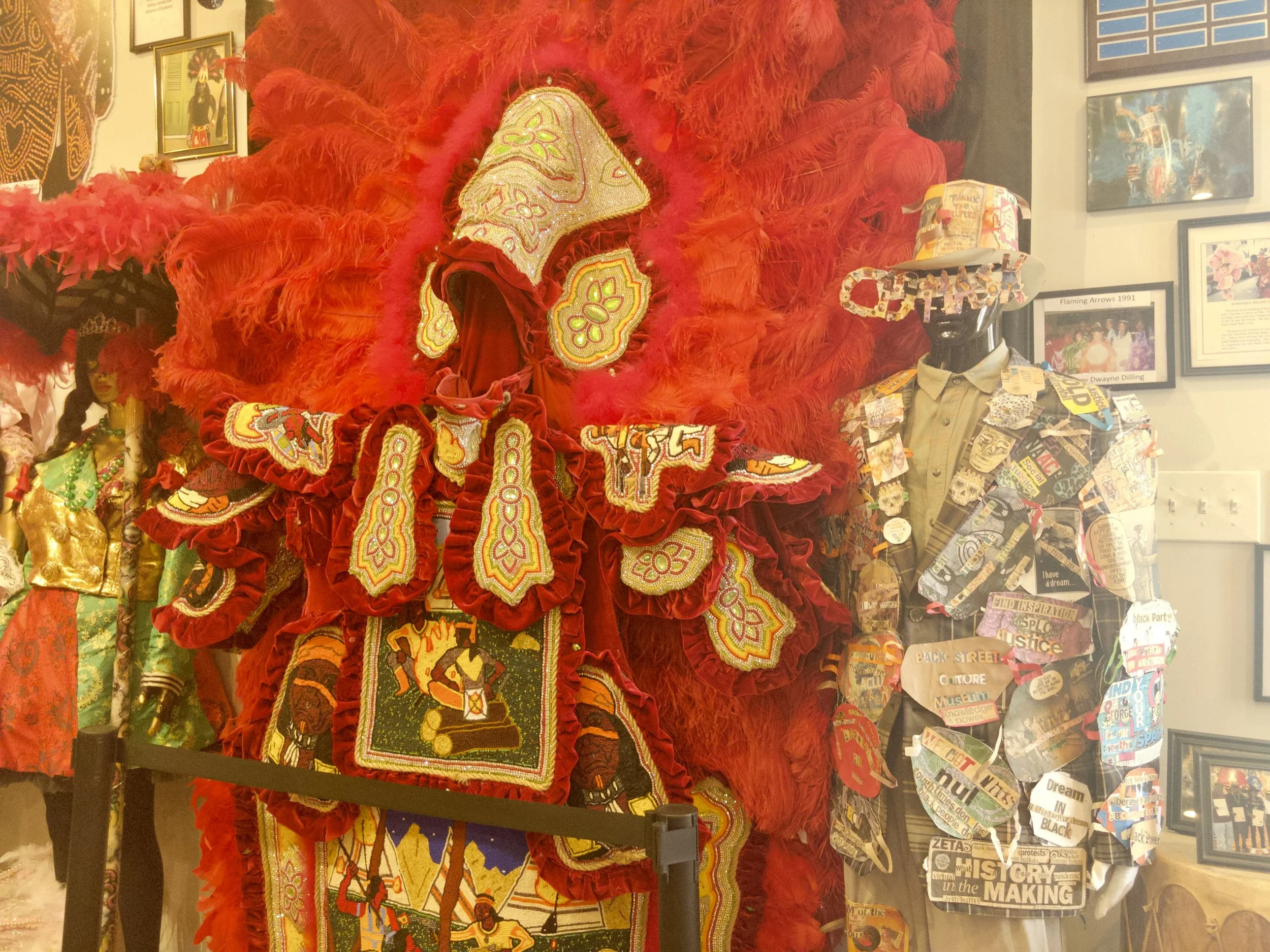
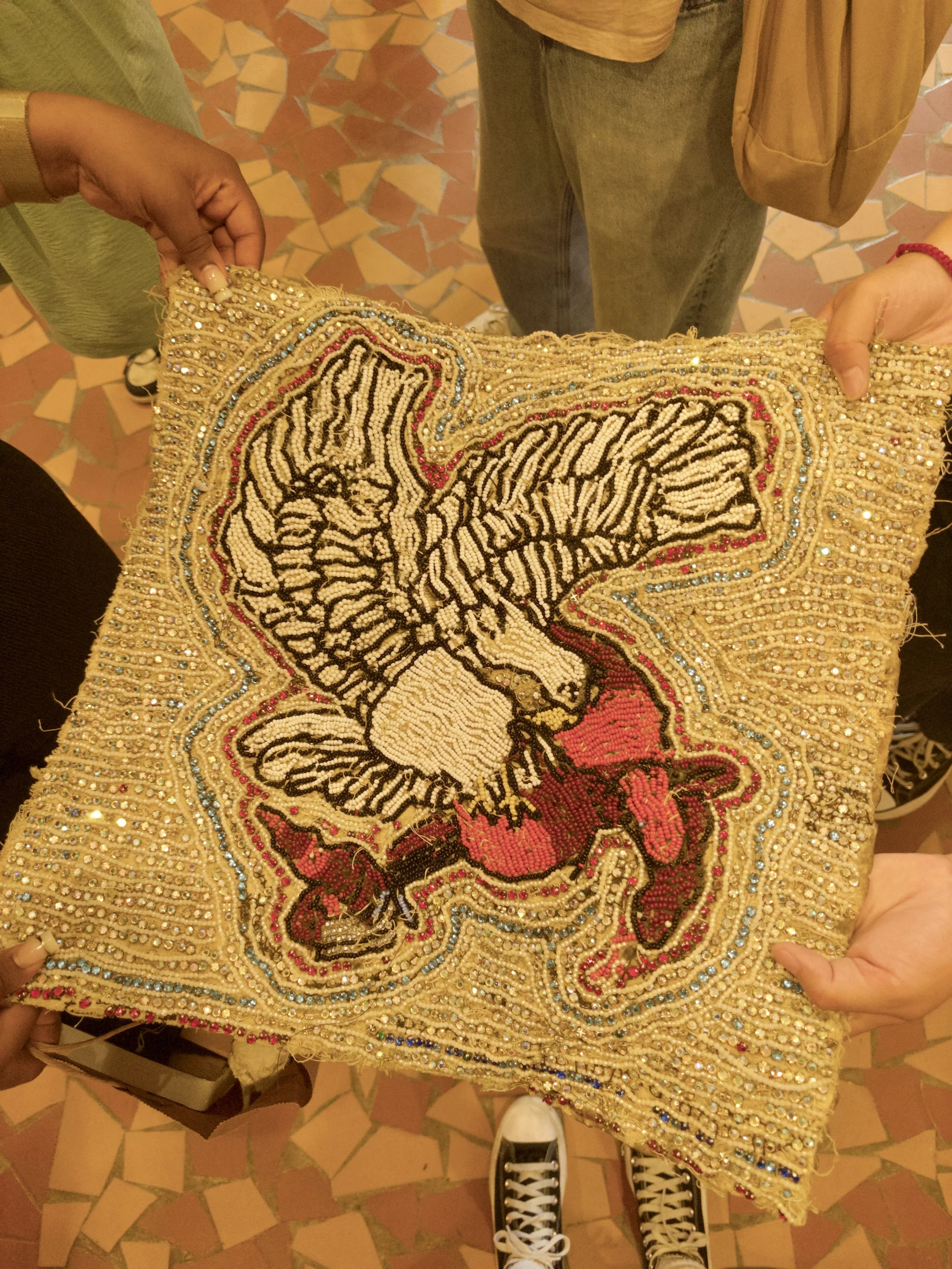
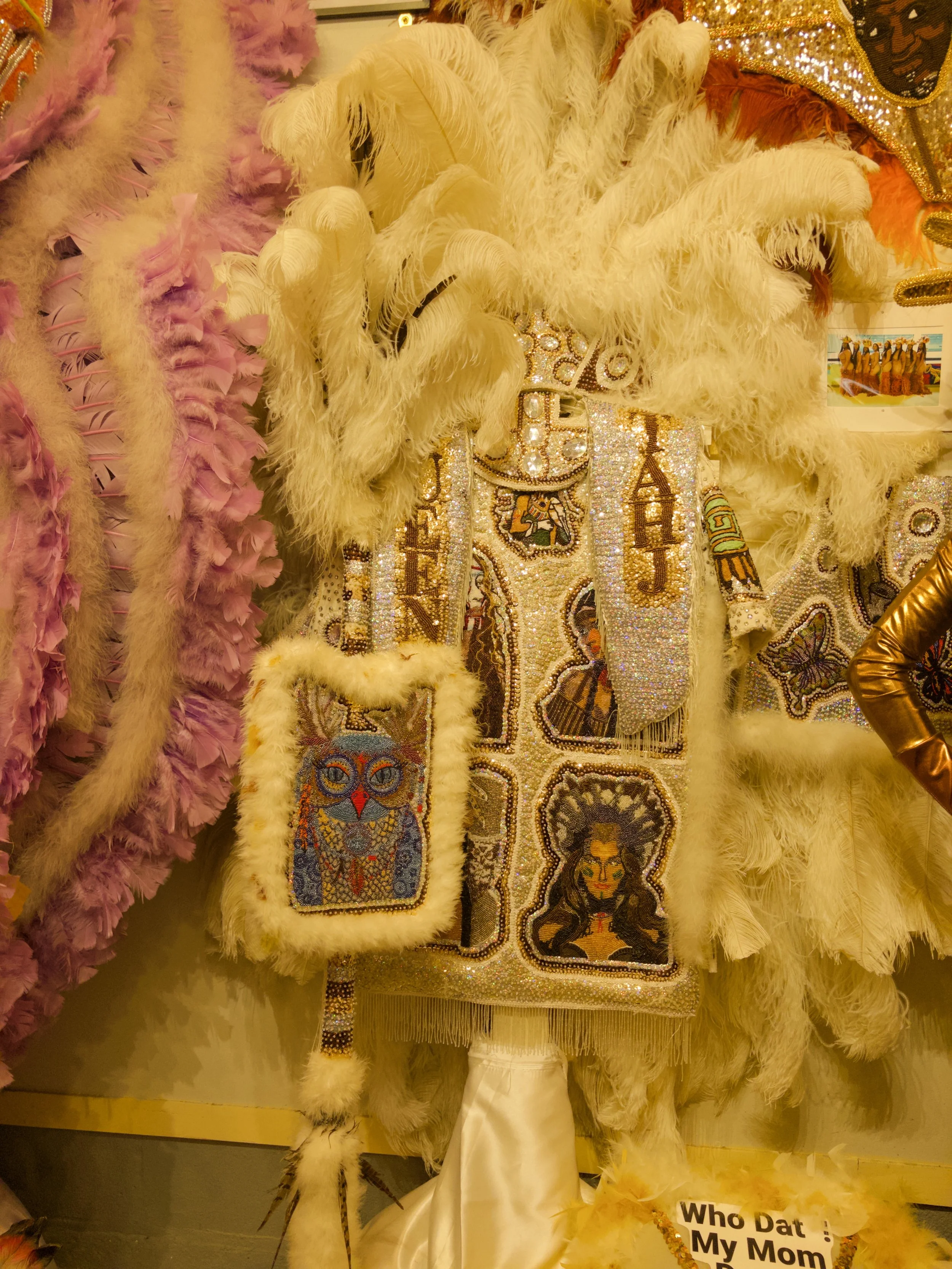
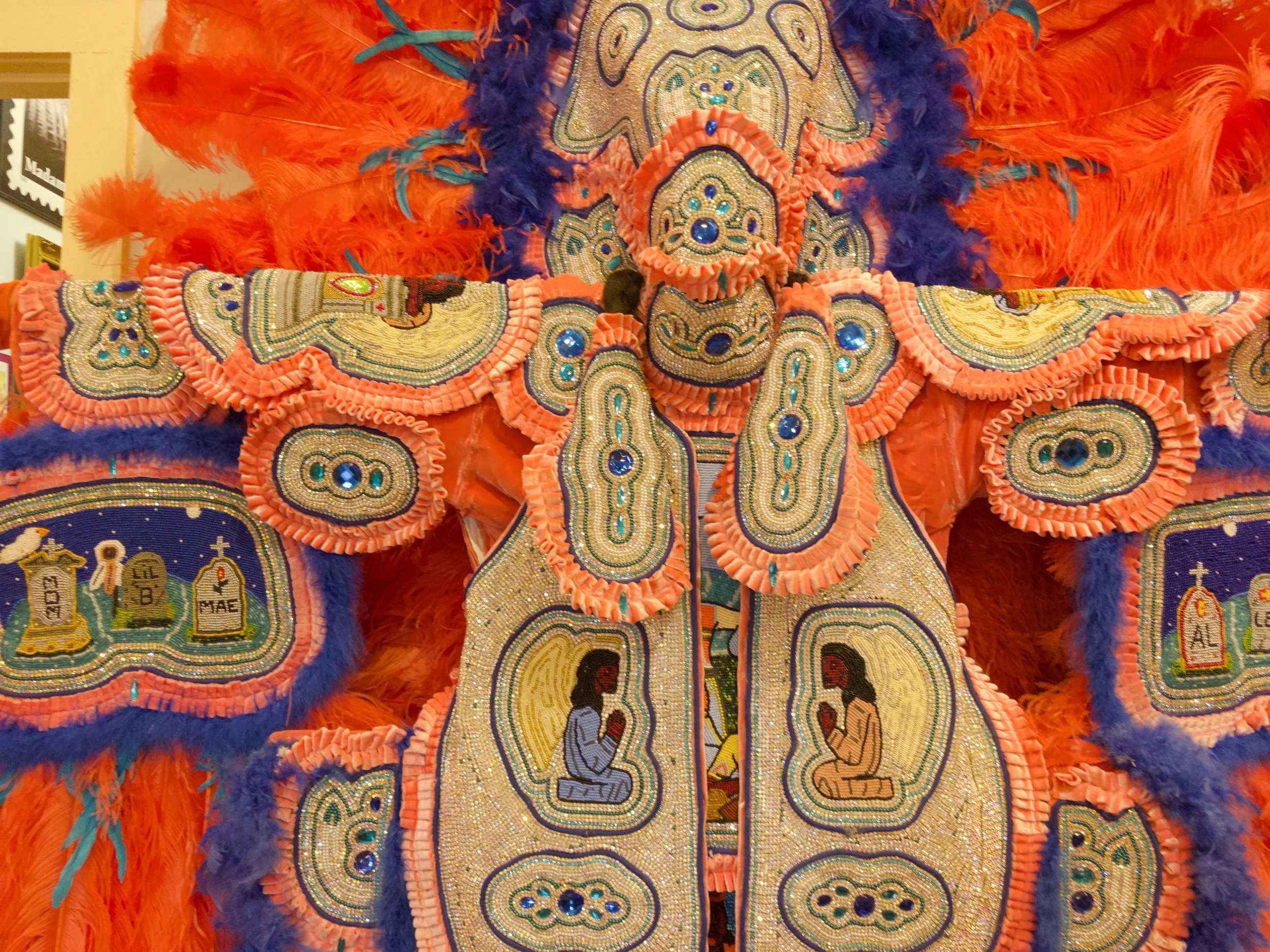
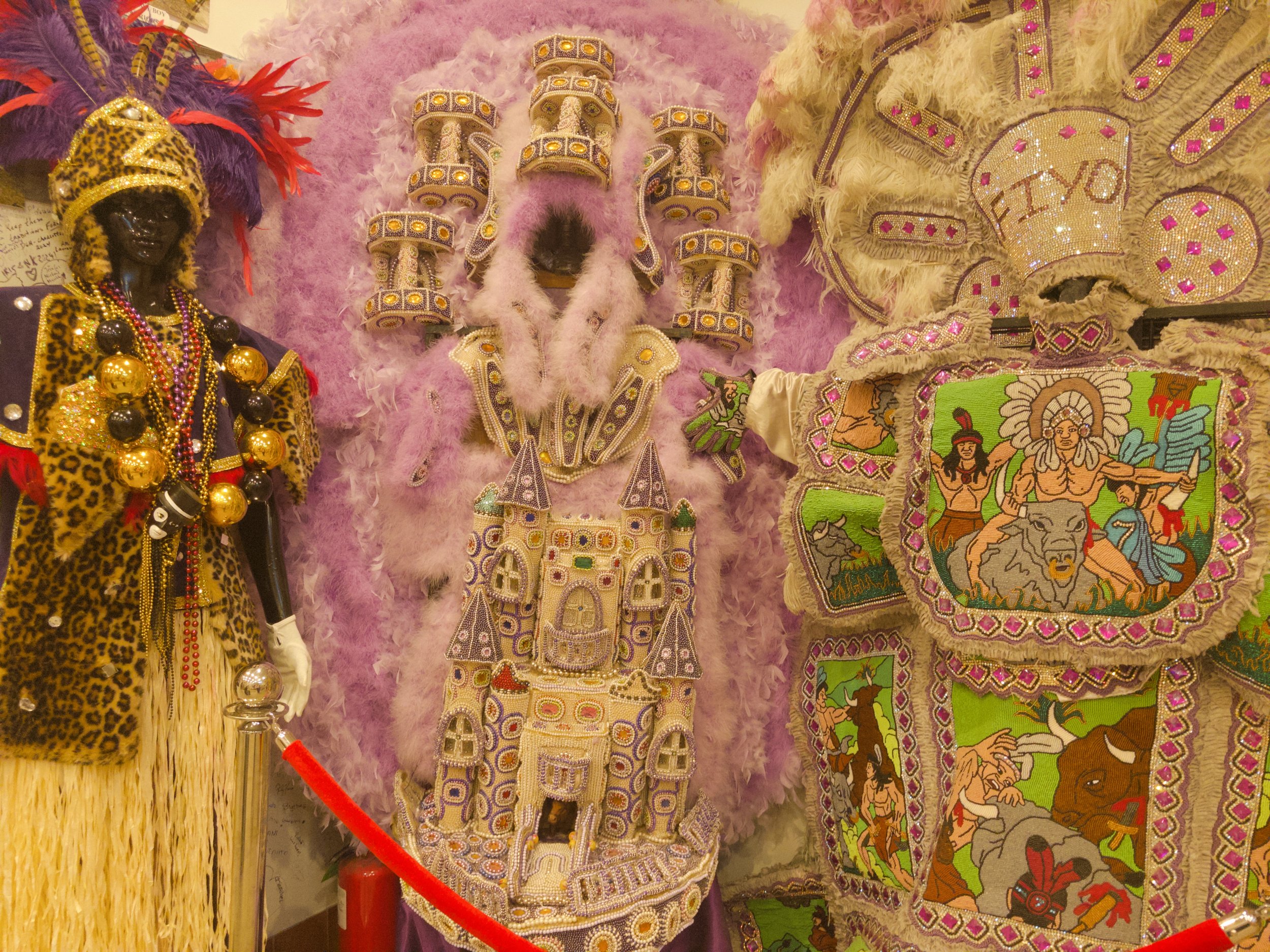
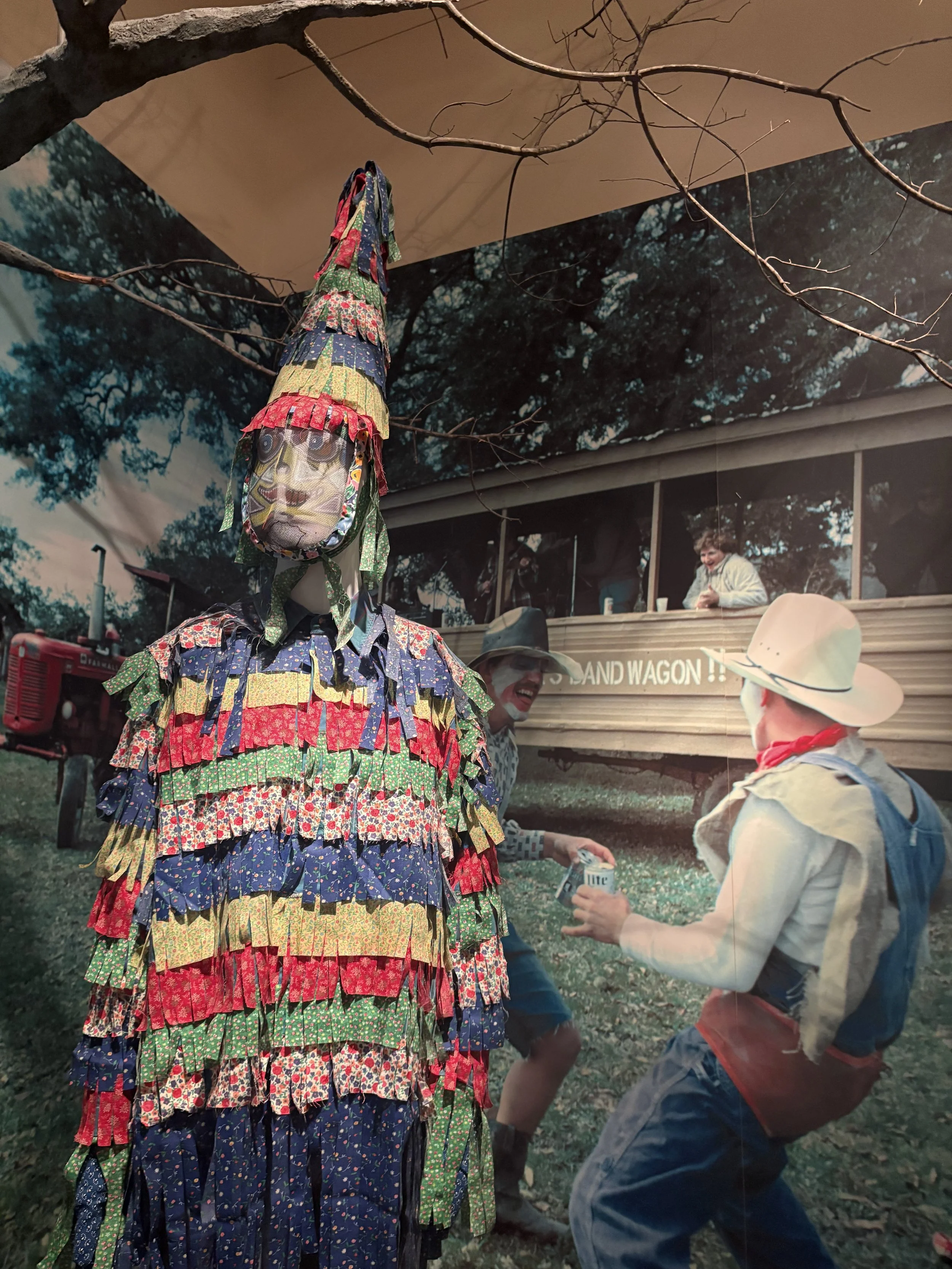
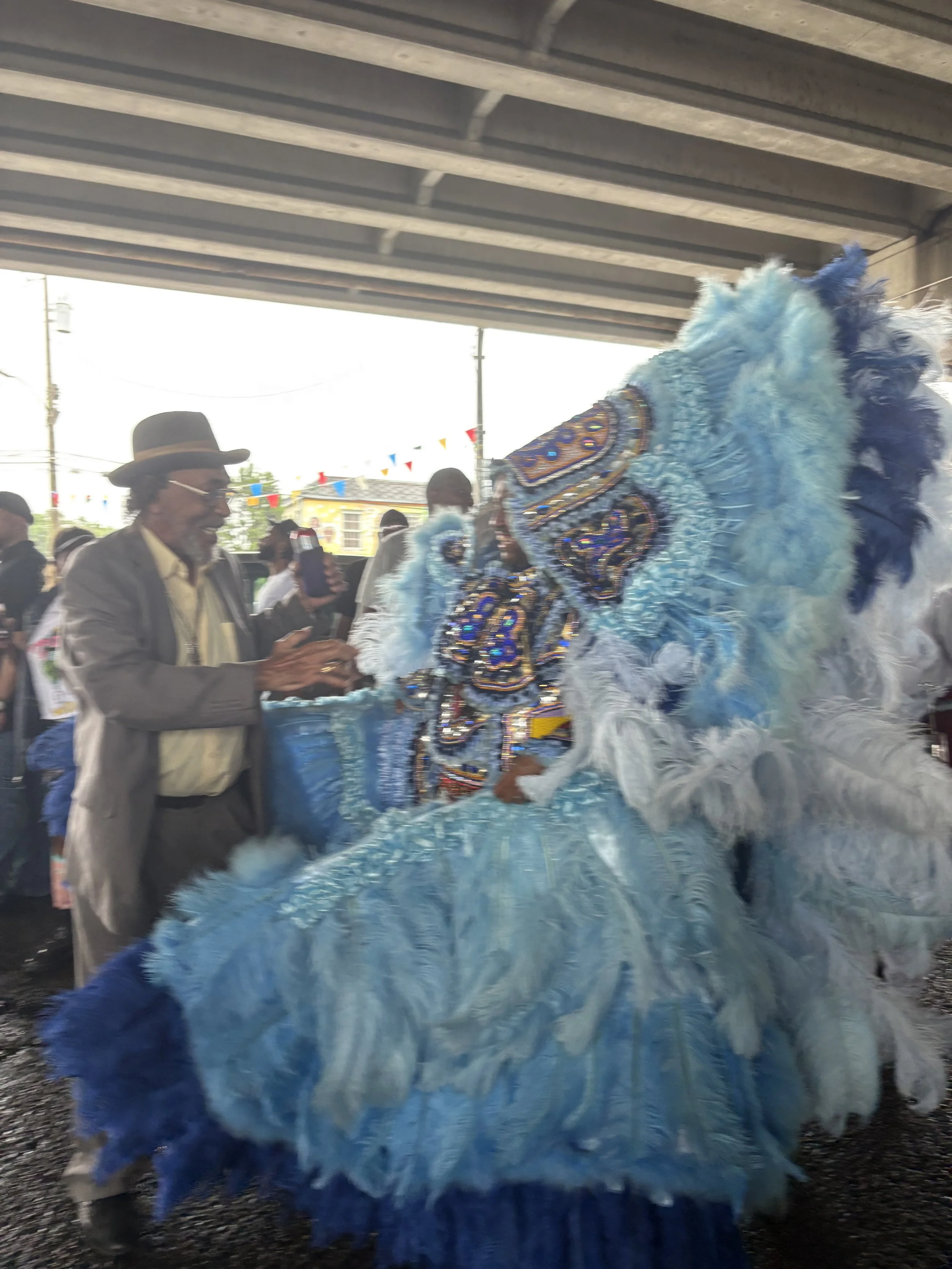
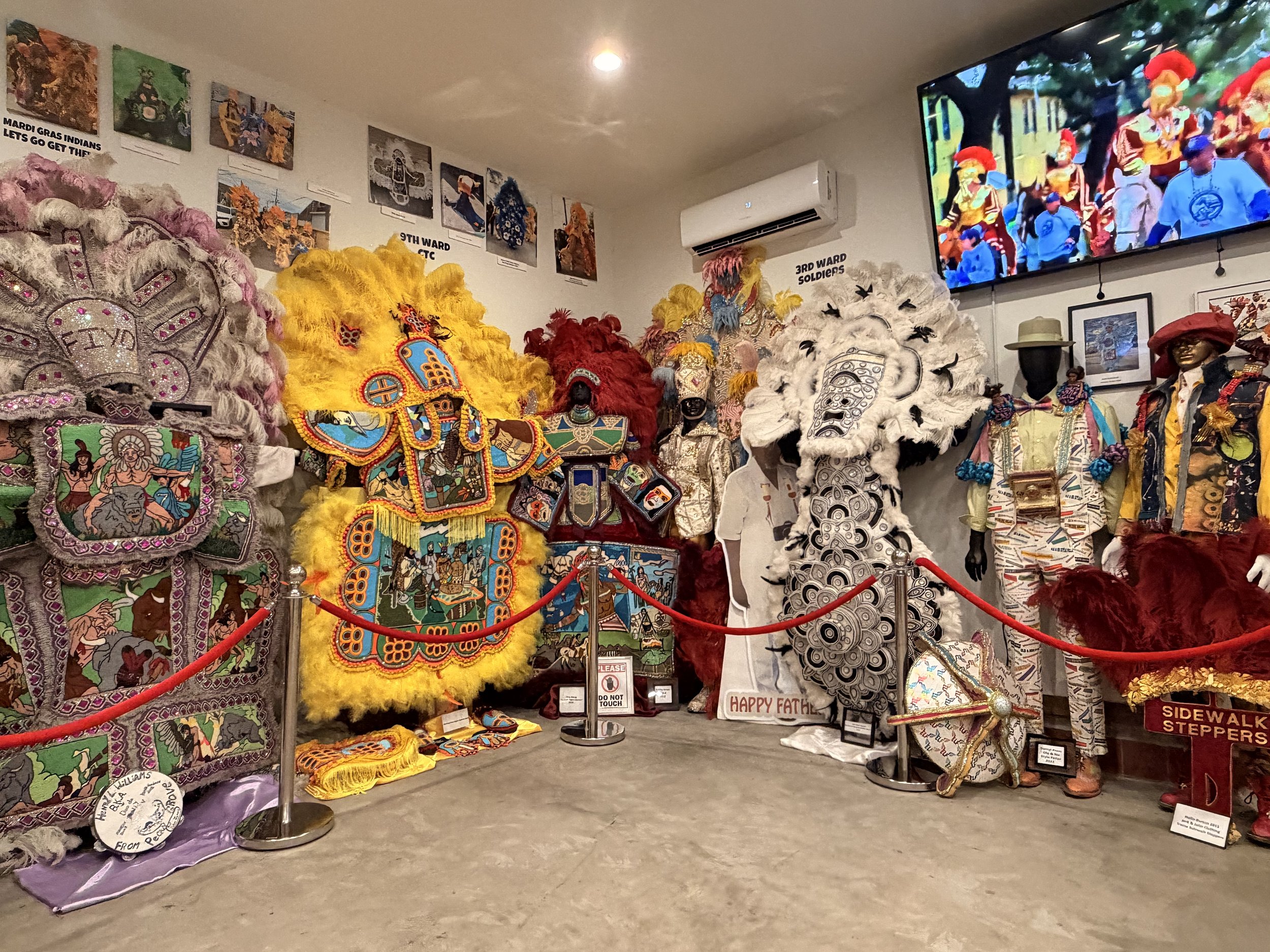
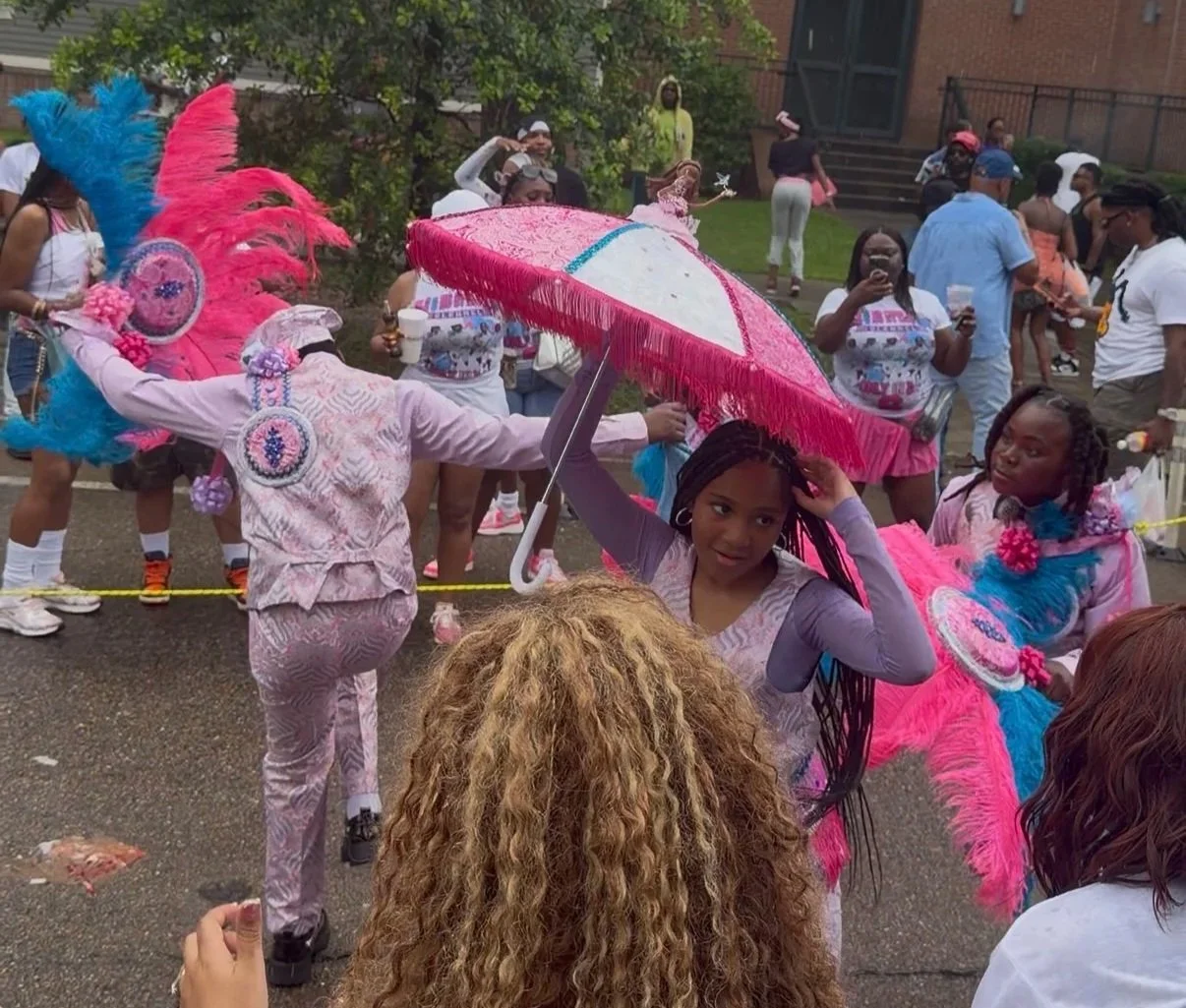
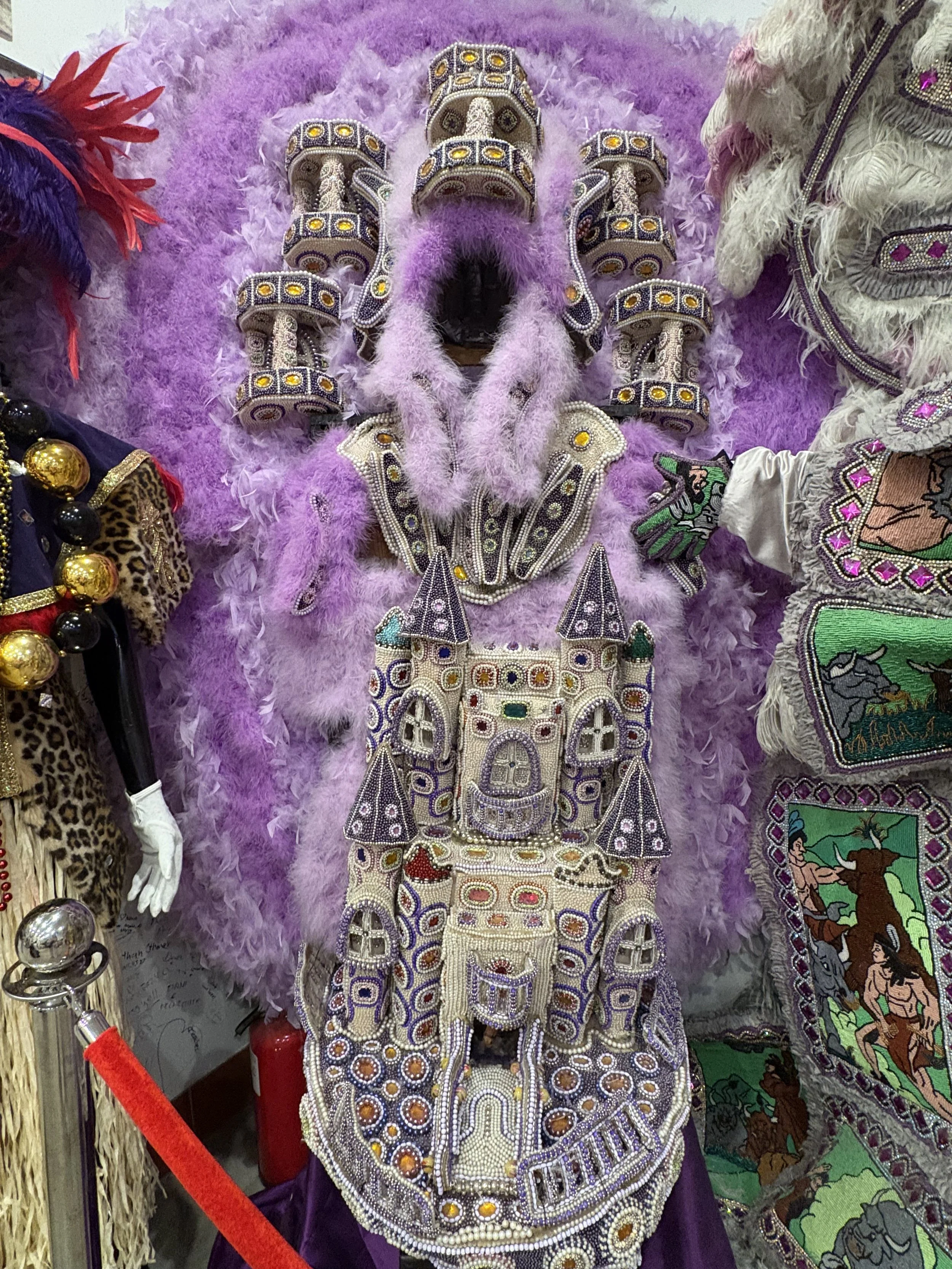
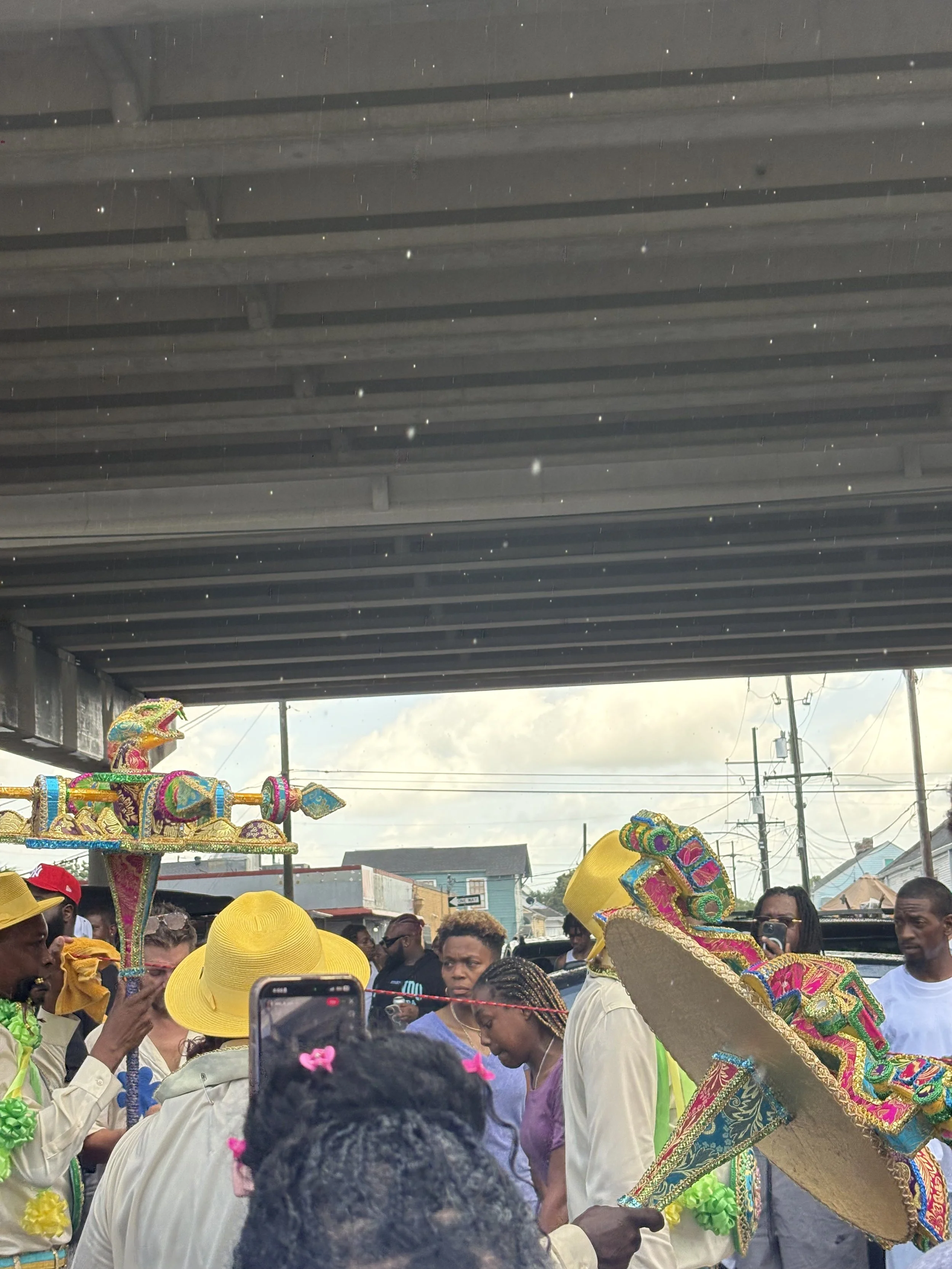
At the Backstreet Cultural Museum, my eyes wouldn’t dare to look away from the brilliance of beads. Each bead strings a story together. It radiates a legacy of Black resistance and pays respect to the Native Americans who assisted Africans escaping enslavement. Each bead, each feather, each plume is brought together through a year’s long labor at the hand of those who choose to wear them and no suit is the same nor reworn. Each suit remains dedicated to the year in which it is made, preserving its history while continuing its legacy. These are the suits of the Mardi Gras Indians. 

“On my tombstone, you’ll be able to see a man had his dream and the dream was to open up a museum.”

– Sylvester Francis

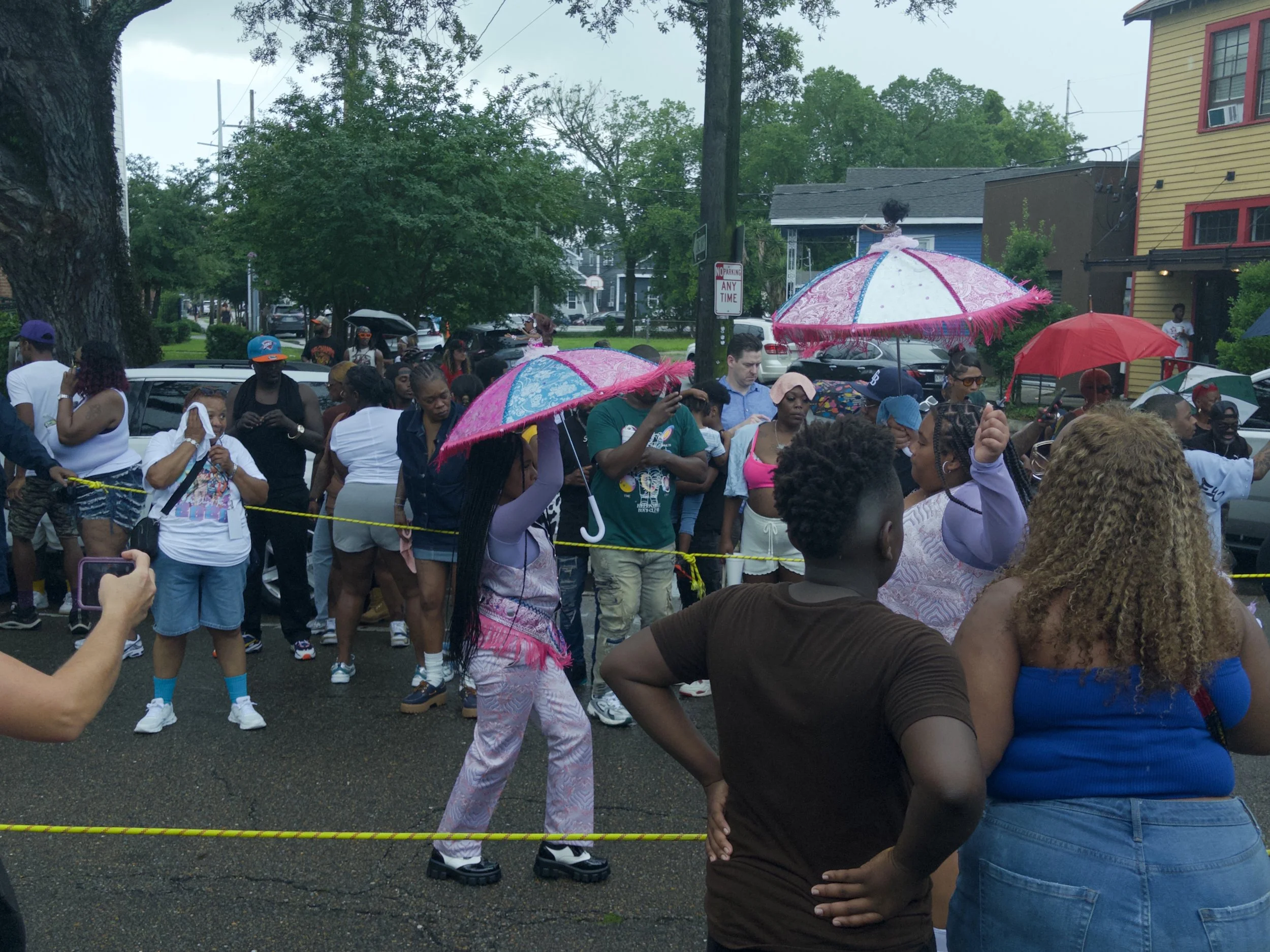
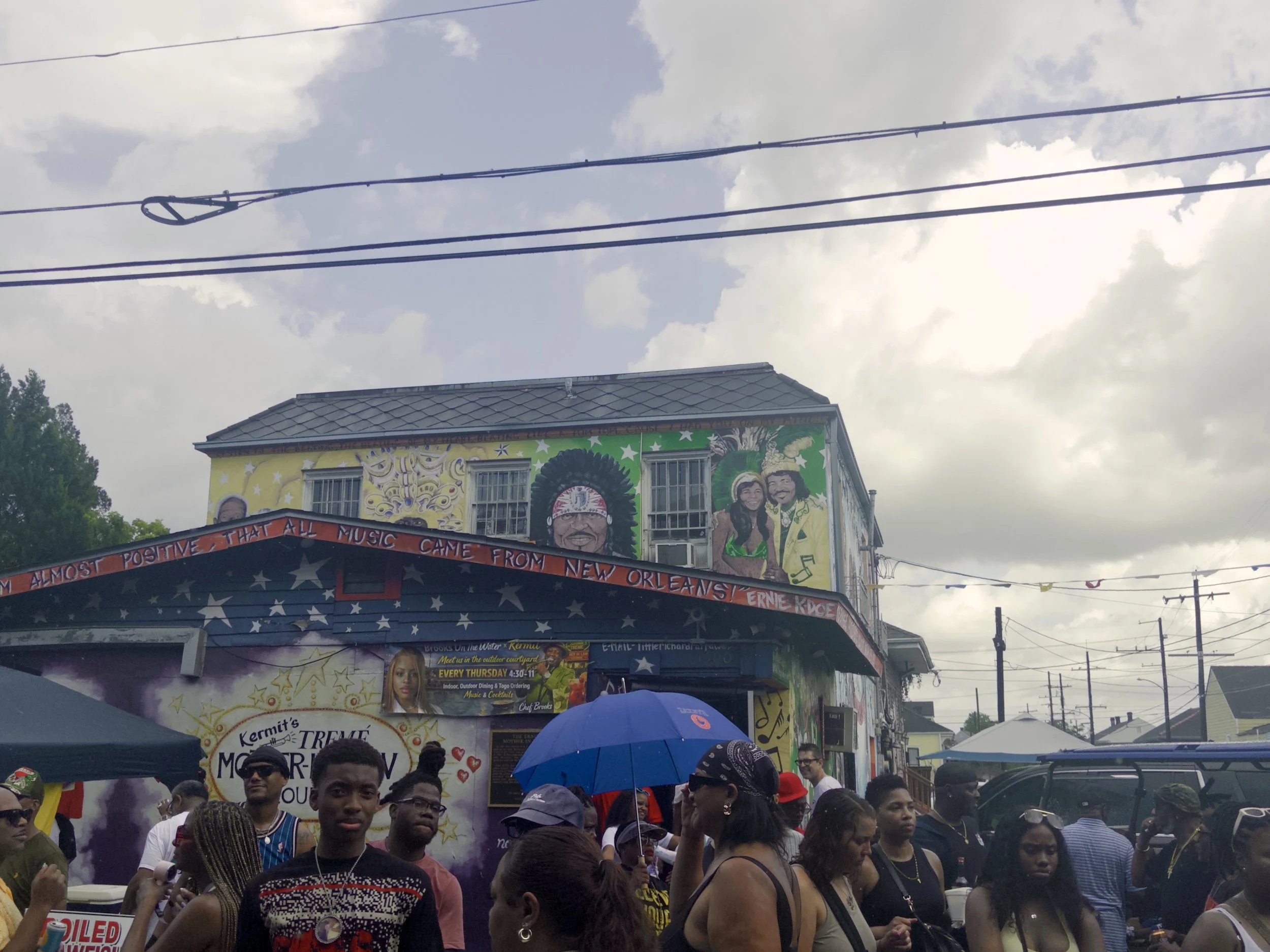
Sylvester Francis is the founder of the Backstreet Cultural Museum, who dedicated immense time and money to recognize the traditions, the celebrations, and the memories engrained in his own community, the memories that make New Orleans what it is. That is power. And this power transcends beyond its walls and onto the streets, vibrating through the vibrant sounds and sensations of the Second Line Parade.

To be honest, I don’t think my picture taking problem will stop. Or maybe my storage will stop it. But this trip has reminded me of what memory is and it is much more than an image.

The Original Sin City

When people talk about going to Sin City, they picture Las Vegas, but there was a time when Sin City in North America was New Orleans. During the early French Colonial period, New Orleans was a penal colony, which immediately made the city a breeding ground for vice. Despite efforts to eliminate this behavior, the free and loose culture of sin still lingers to this day.

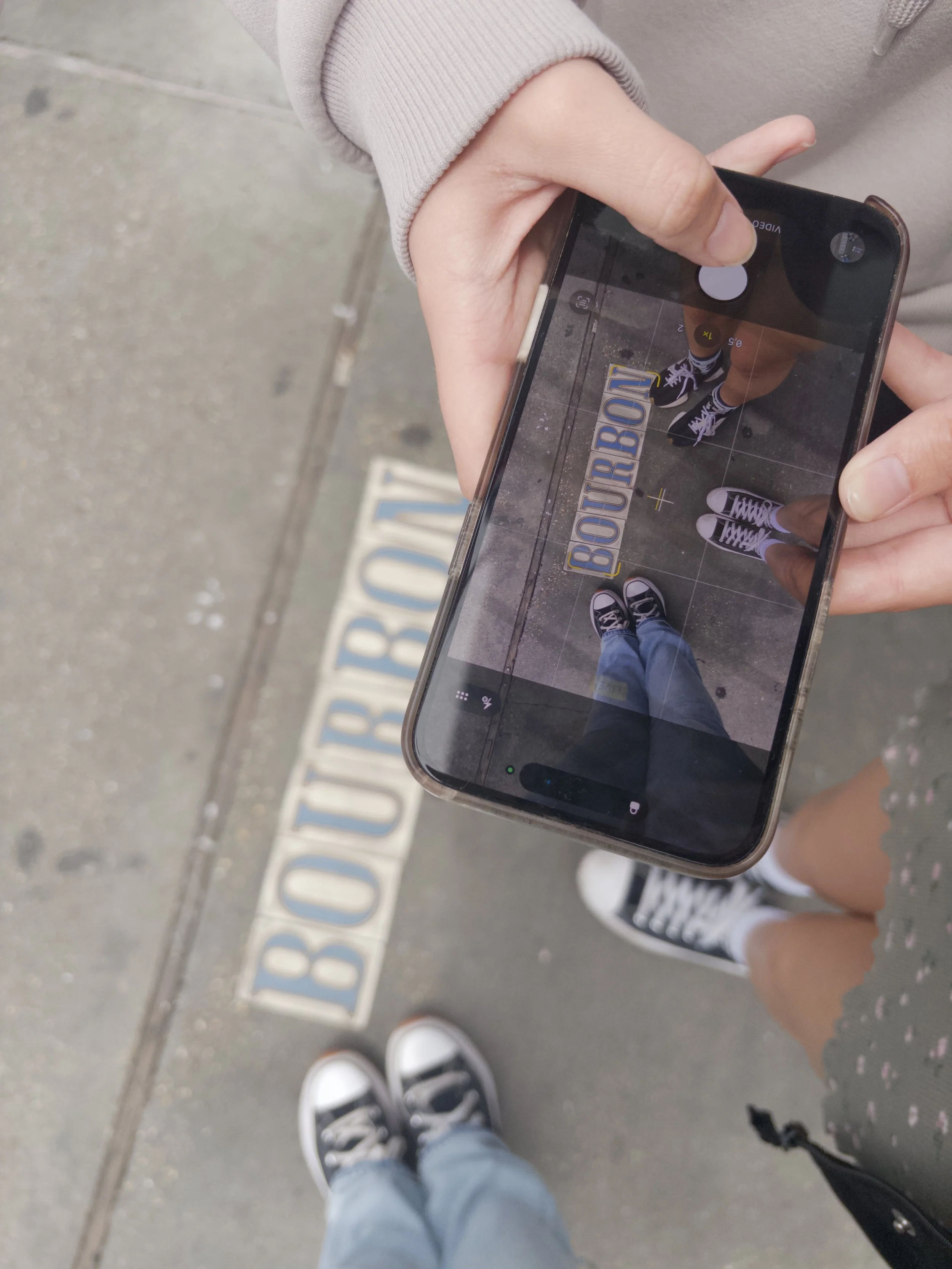
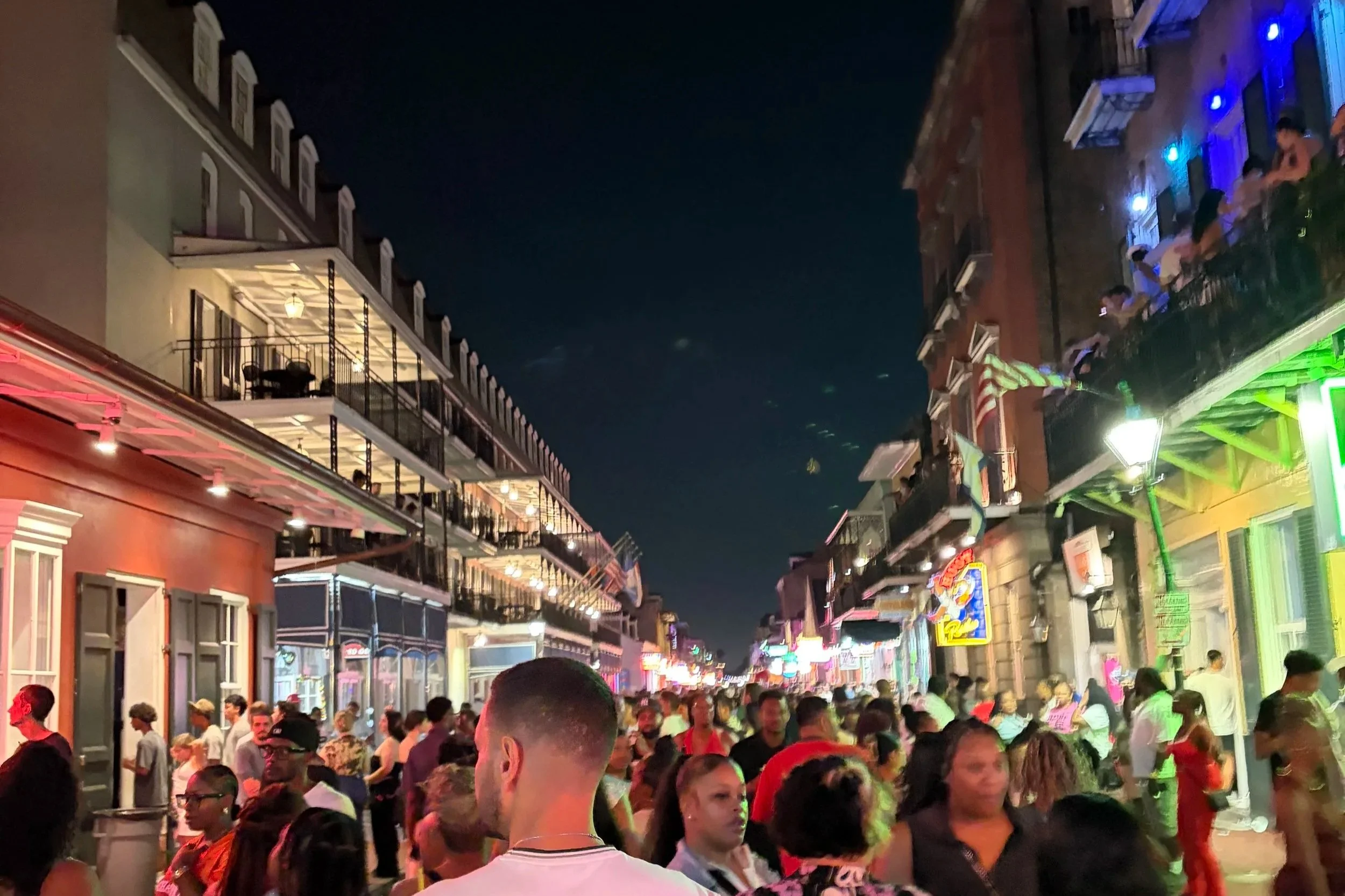
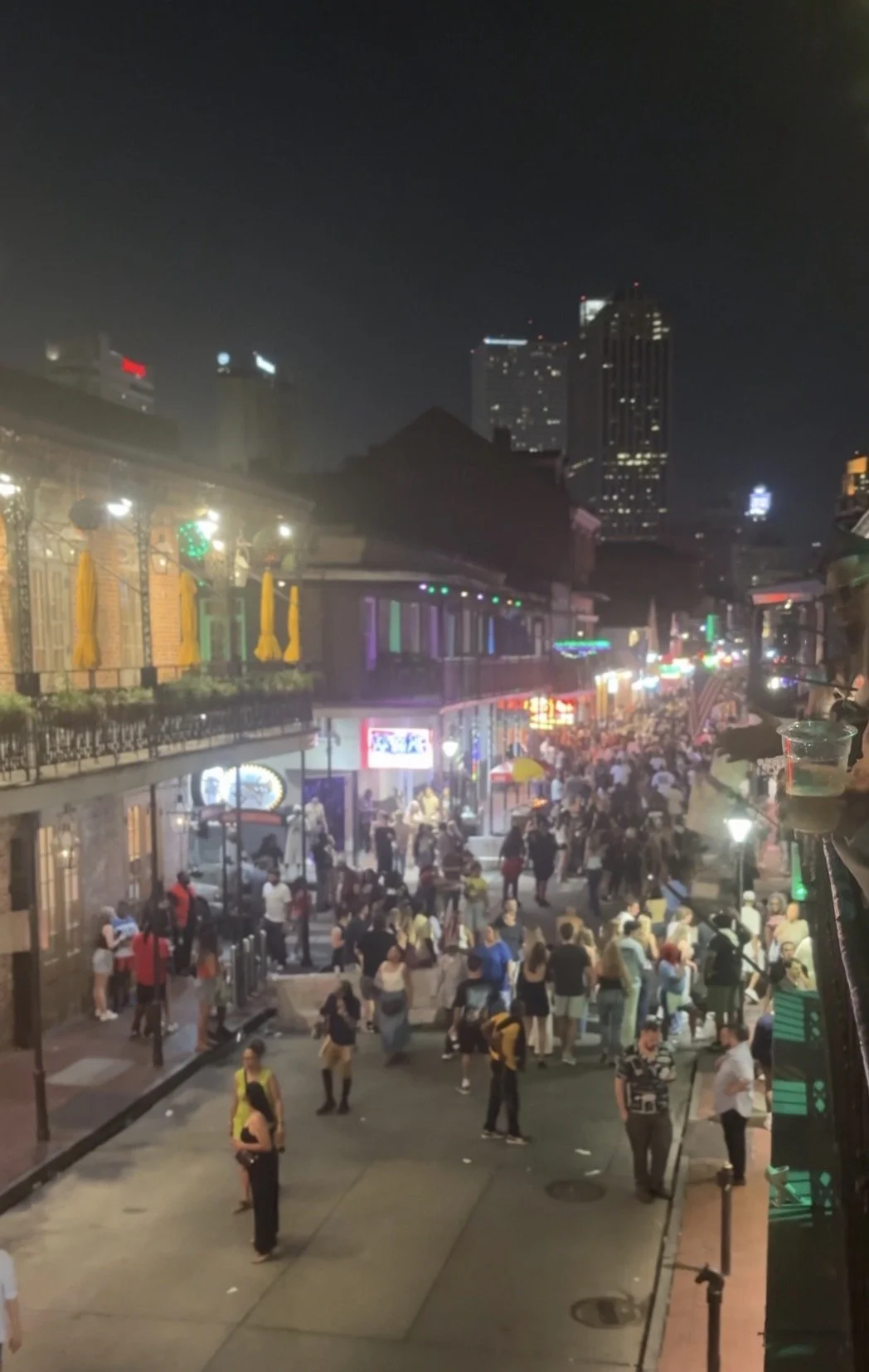
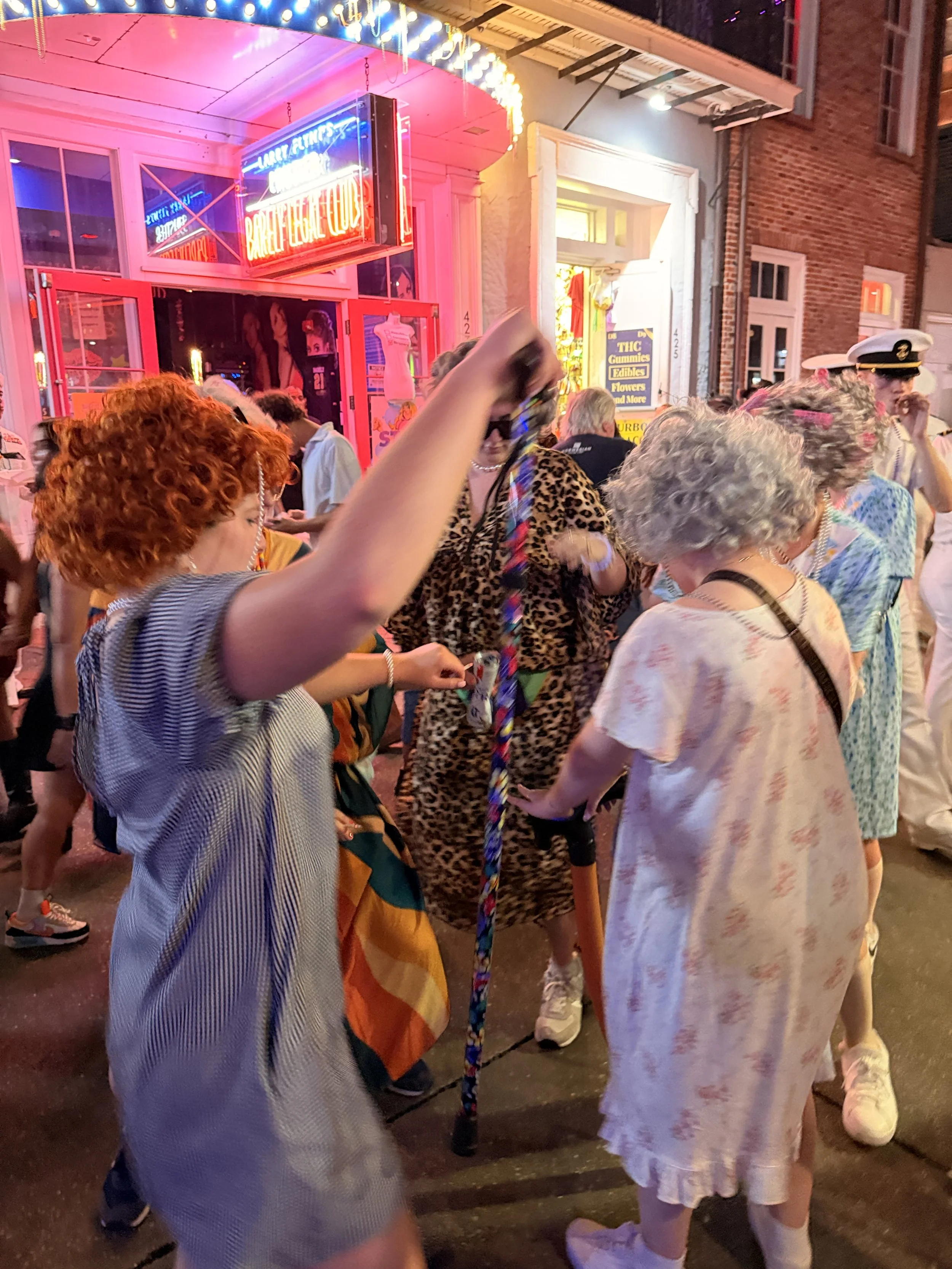
This culture is synonymous with Bourbon Street, a place where you can drink, dance, go to strip clubs, see live music, buy beads, and eat from hot dog carts all within a historic setting. This is exactly why Ignatius Reilly from A Confederacy of Dunces by John Kennedy Toole feels the need to take up arms against the vice of New Orleans. In fact, New Orleans is the only place where a story and a character like Ingatius works. On Bourbon Street, there are people everywhere, some drunk, some even more drunk, and some who should have gone home a couple of hours ago.

Section Bourbon Street


Bourbon Street is in the heart of the French Quarter

In all seriousness, there is something beautiful about the activities that go on on Bourbon on a backdrop of historical, colonial buildings in the French Quarter. The relics of a time of the Calviers, art, philosophy, manners, and the gentility of white Southern culture. Ignatius is a part of these relics; he believes in chivalry, kings, religion, morals, and crusades. It might seem like he was born at the wrong time, but he was born exactly where he belongs. He is like the buildings on Bourbon, with their elegant facades forced to be used as bars and clubs, similar to how he has these morals that get directly in the way of his work as an office worker or hot dog vendor.

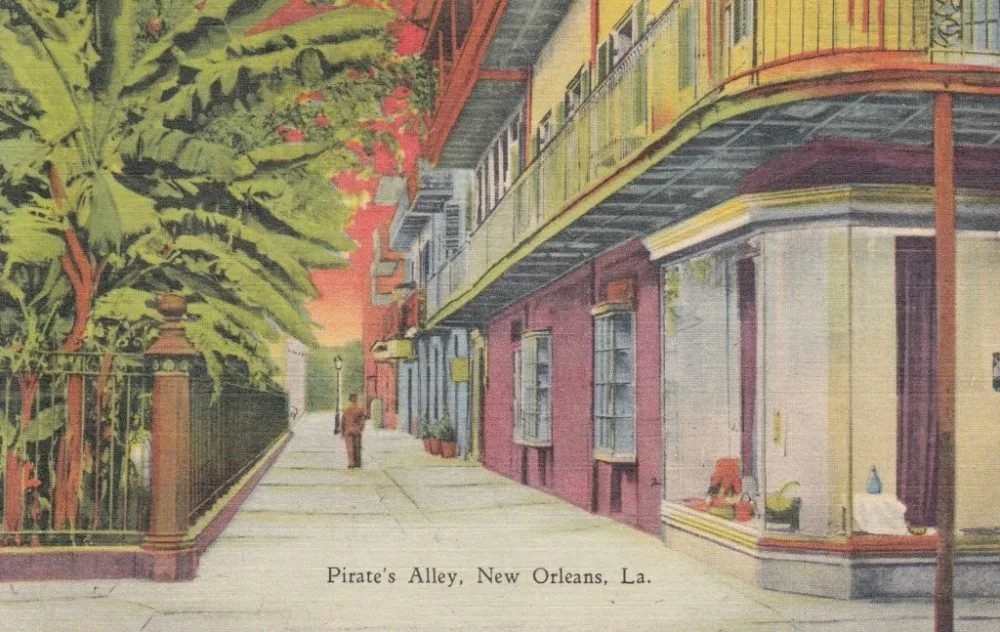
The irony of the stories of Ignatius is where the book gets its humor, as Ignatius constantly tries and fails horrifically to fight against immorality in New Orleans. I personally could understand why a person would find this book funny, but I had a hard time enjoying it myself. However, once I was in the place and walking around the places mentioned in A Confederacy of Dunces, and I learned more about New Orleans history and culture, the humor and stories made more sense. Once I was able to experience firsthand the touristy Pirate’s Alley, the clubs in the French Quarter, and the different areas where I saw actual hot dog vendors with questionable ingredients and hygiene, the more I felt “in” on the jokes and humor of the book.

I also relate in a way to Ingastius as someone who doesn’t drink and doesn’t like to go on dates. Like him, I can be a little prudish, but unlike him, I have social awareness and don’t push my beliefs on others. This is why I thought I would have a similar reaction to Bourbon Street as Ignatius does with all the people, places, or things he deems as vulgar or obscene. I originally didn’t want to go down there at all, but I felt like I should at least try it once while I’m here. However, I was pleasantly surprised; there is something about Bourbon Street that feels authentic. Although I wasn’t a fan of the smoke, the people, and how loud the music was, it didn’t feel like it was a tourist attraction, oddly enough. I knew it was, but to an extent is a tradition from when New Orleans was a penal colony for only a couple of years. For literal centuries, it has been a place for people to party and a place of acceptance. I mean it when I say I do not see such a high concentration of pride flags on one street on a regular basis. It helped me realize just how futile Ignatius’ attempts to “save” the people of New Orleans were, because if someone like me (who doesn’t really go out) enjoyed the crazy environment of Bourbon Street, Ignatius stands no chance.

I have sought to escape in the Prytania on more than one occasion, pulled by the attractions of some techincolored horrors, filmed abortions that were offenses against any criteria of taste and decency, reels and reels of perversion and blasphemy that stunned my disbelieving eyes, that shocked my virginal mind, and sealed my valve.
— Ignatius Reilly, A Confederacy of Dunces by John Kennedy Toole

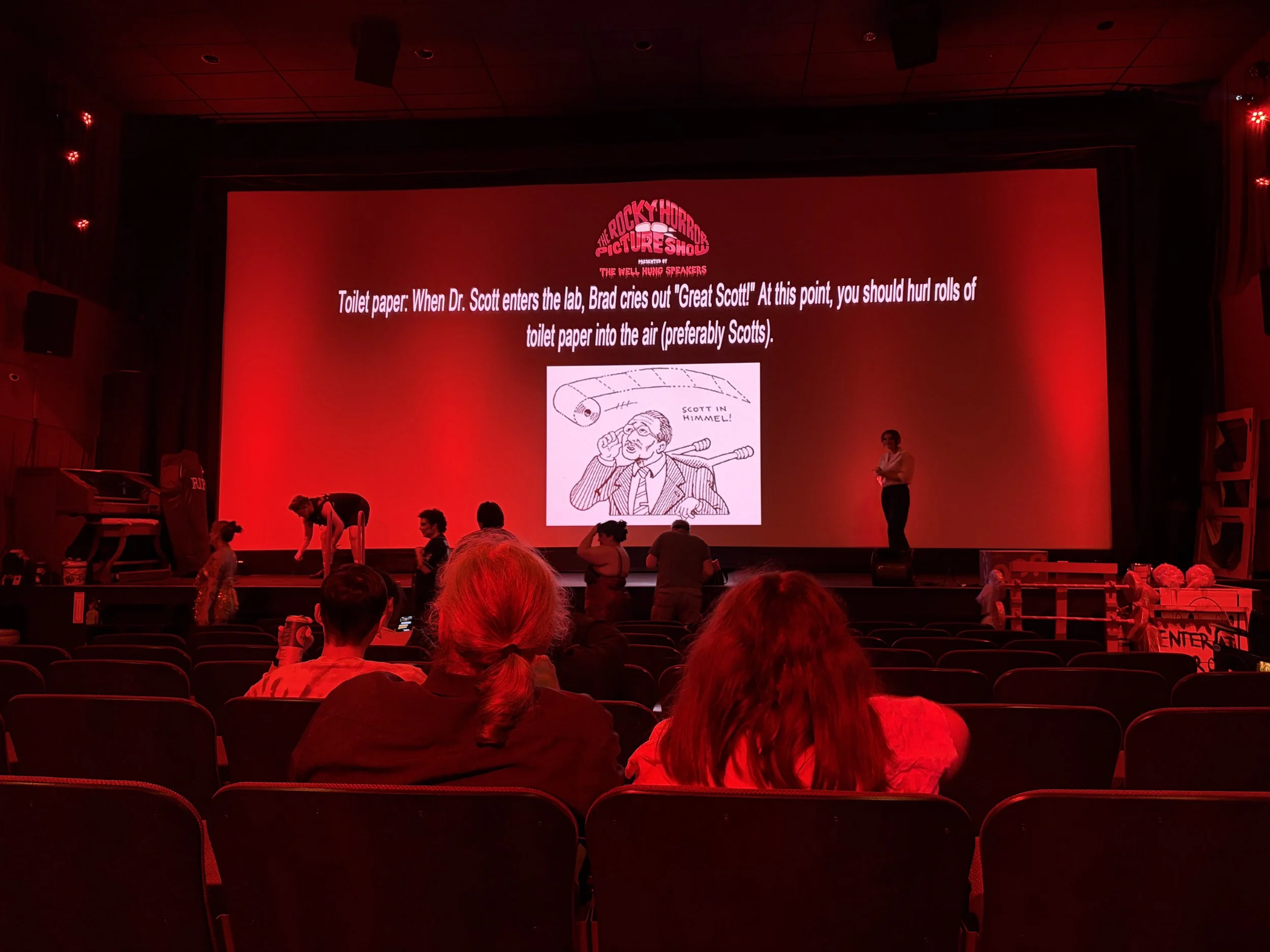
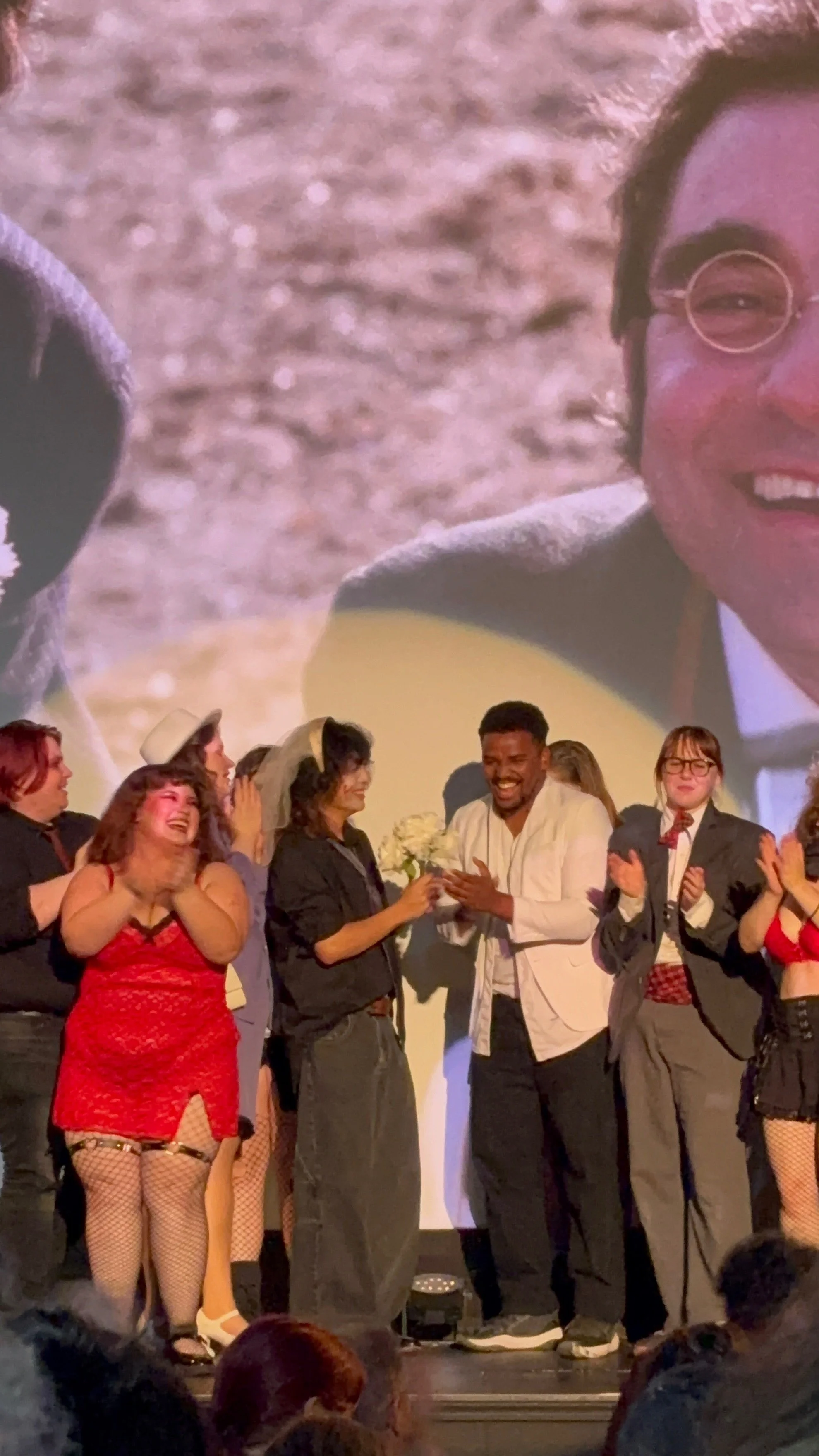
However, there was one moment during my stay in New Orleans that made me feel like I was Ignatius. I went to the Prytania theater, the same theater that Binx from The Moviegoer and Ignatius go to, to see a midnight screening and live shadow cast of Rocky Horror Picture Show. I had not seen the movie in over 2 years and didn’t realise that there was going to be a shadow cast, which is when actors reenact the movie live in front of the screen, so I went in underprepared and didn’t set expectations well for Isabel and Trey, who went with me. To say what we experienced was obscene would be an understatement; every inappropriate thing you could think of happened in some capacity. I was Ignatius in that theater, was shocked and appalled at what I was seeing, but once it was over, I wished I could see it again. The only difference between the two of us was that I stayed silent most of the movie and threw rice, while he made his presence known and threw popcorn.

Whatever happens in New Orleans can only happen in New Orleans. It is the only place that has made my jaw drop while feeling real and authentic. It is the only place where such a large character like Ignatius Reilly could make sense. From its long history of vice in a beautiful backdrop. The contradictions of New Orleans just work, and I’m going to miss them.

Bonus Content!

In case you were wondering, here’s what the finished product of my Minecraft shotgun houses looks like.

The Citygoer

Modern New Orleans is a city unlike any other, with communities that are seemingly perfect capsules of time and up-and-coming downtown areas like the business district. All are rich in history and highlight the unique neighborhoods and people that call this city home. In my three weeks exploring New Orleans, I can confidently say that the literary journey we bookpackers have taken has been unlike any other adventure I have had.

The experience of feeling like you are in Disneyland, with the fantastical architecture of the French Quarter and its spooky tales, to feeling like you are in a movie with the romantic buildings of the Garden District, is unlike anything else. The theaters that have been preserved over time, with conservative exteriors and wild midnight showings of the Rocky Horror Picture Show, are just one example of the city's eccentric nature. The layers of history, in the eyes of enslaved people and women, create a picture of strength and resilience. Stories from Maria and Nancy, our teachers at our Cajun cooking class, and their journeys during and after Hurricane Katrina, show just how stubborn and unbending the people of New Orleans are. Places like the Backstreet Museum are reminders that culture and love do not disappear, but are fueled by disaster. The beautiful, gracious city we only had the privilege of visiting has and continues to be the home of celebration, multicultural identity, hearty food, and art.

The characters, real people, and fictional worlds we got to visit, Ignatius Reilly, Edna Pontelier, Louis de Pointe du Lac, Sarah Broom, Buddy Boldin, and Binx Bolling, are the greatest reflection of the city. Representing real people and ideas, perceptions of slavery, womenhood, and the constant class and power struggle of the South. The opportunity to explore them in their natural habitat, walking where they walked, seeing what they saw, and even experiencing their world was such a special experience. I can firmly say that nothing will ever compare to the emotional and physical connection I feel to those characters, those pieces of writing, and this city.

Books like The Moviegoer have left permanent imprints on my being and how I see the world. The post-war world in New Orleans is a unique period of history for the city, where we see veterans returning to an industrialized place that has seemingly moved on. The combination of the Old World South and the up-and-coming business of the 50s is what makes New Orleans the perfect place to research characters like Binx Bolling, and how his ideas and perspective reflect the values of the culture of New Orleans.

In New Orleans I have noticed that people are happiest when they are going to funerals, making money, taking care of the dead, or putting on masks at Mardi Gras so nobody knows who they are
— Binx Bolling, The Moviegoer (Chapter 1)

The Moviergoer encapsulates the post-war period of New Orleans, romanticizing it and passing over the racist and problematic depictions of African Americans and women, which is a pivotal aspect of Binx’s character. His treatment of women, and perspective towards African Americans, and generally people of color, is astonishing. Particularly, his descriptions of Mercer, the butler of Binx’s Aunt Emily, are filled with suspicion. Binx feels uneasy and unsure of Mercer and can’t decide if he would describe him as kind and devoted or as knowing and calculating. Binx’s depiction of Mercer is a reflection of how white society in the South perceives black individuals as unreliable and untrustworthy. This narrative stems from systemic issues that we have as a nation; it lies within our politics, our cultures, and our class structure. The United States is built on ‘untrustworthy’ men and ‘unstable’ women like Kate, Binx’s step-cousin and love interest. We as a society rely upon those who are mistreated, oppressed, and ultimately villainized. This story is personal to so many, and many who have been put into a box like Mercer, deemed unworthy and strange by people like Binx. This is the result of our longstanding systems, and it is seen in almost every aspect of American life today.

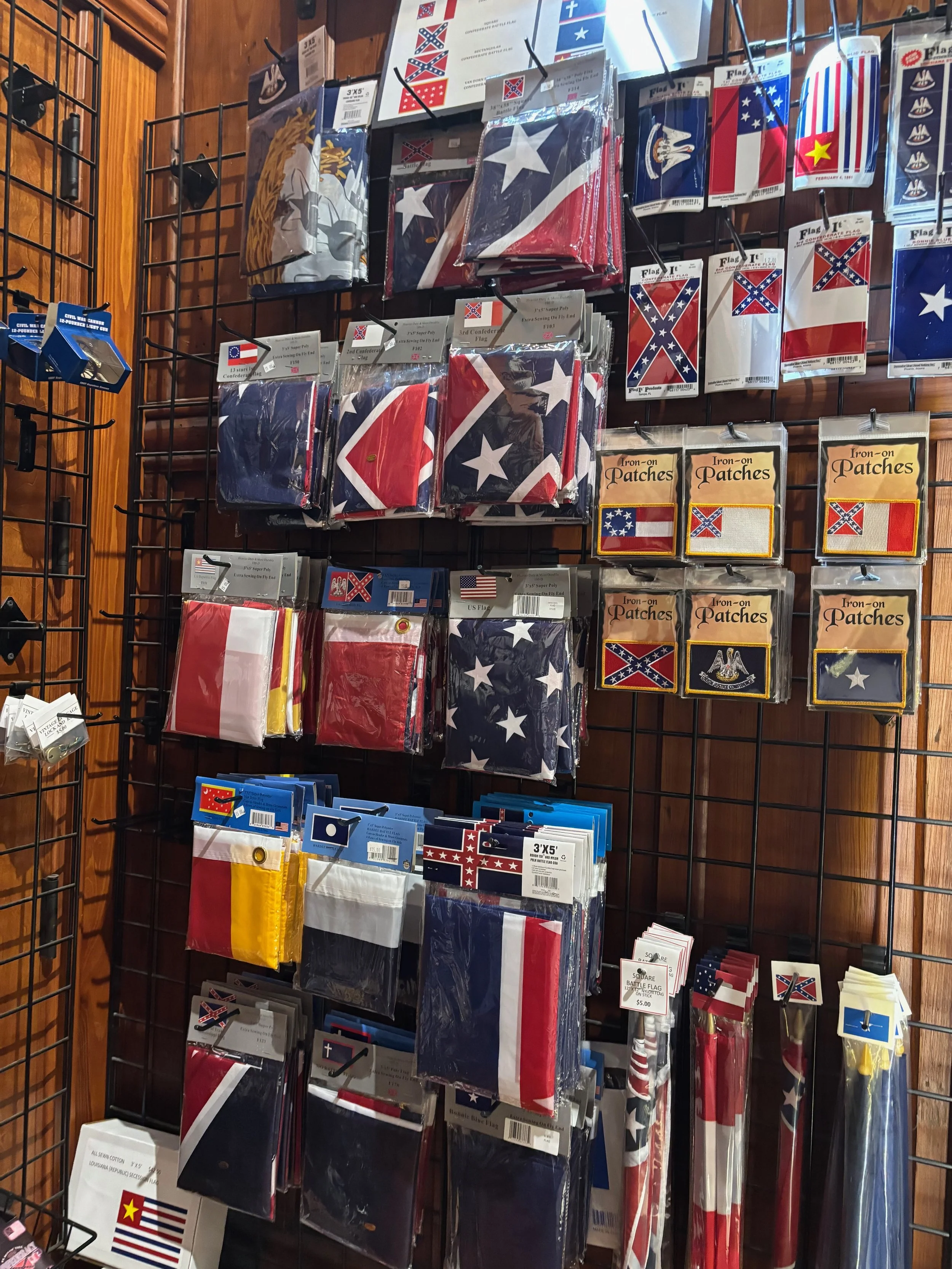
New Orleans, a progressive city in the southern part of the United States, reflects this tension and ongoing struggle. As it welcomes so many, it also lies within a culture of the ‘undying’ South. Experiences like visiting the ‘Civil War Museum,’ which really is the museum of the Confederacy, make these stories a reality. The slave pens and auction buildings just across the street from a church, and the multi-million-dollar mansions just miles from the neighborhoods devastated by Katrina, are the truth of the city.

In its beauty, there is devastation, physical and cultural. Through personal stories from Sarah Broom and fictional characters like Ignatius Reilly, we see the great diversity of the city and how the devastation permanently alters individual lives. This special experience of bookpacking is the epitome of how to understand this devastation and beauty. To see how characters like Binx Bolling live in privilege, yet suffer on the ultimate human journey.

Binx’s flaws are the cicities'laws, his misogynistic view of women, his bigoted view of people of color. This lives not in the underbelly of the city but at the forefront of its deliberate actions. Which neighborhoods to save in Katrina, which parts of the city are well-funded, all of these facts are based on the current struggles that Binx represents. New Orleans searches for an identity that is not built on the backs of enslaved people, nor on the backs of women who suffer silently in their roles. It searches for the harmony of people, of all backgrounds, connecting them with music and food. This hope that the unyielding people of New Orleans have is what makes it the most special book-packing location.

An experience like this, shared with others, is so special. To spend it with students of all areas of study, entirely different backgrounds, and strong opinions, made this journey what it was. With the help of our passionate and informative professor, we together explored these challenges and made sense of what New Orleans was to us, an onion, blue, jazzy city, filled with Creole women and vampires.

Sun Sets on New Orleans

This is the last piece of writing I will submit in college. Possibly ever, if I decide against pursuing more degrees. Sixteen years, millions of words written, and my journey ends just how it began: me staring at a blank page. I’m not sure what to write for this final blog. How exactly do I begin to synthesize the experience I’ve had the last month in New Orleans? How do I come to terms with the fact that this incredible experience is ending? That college is ending? That the days of following a clear path are over?

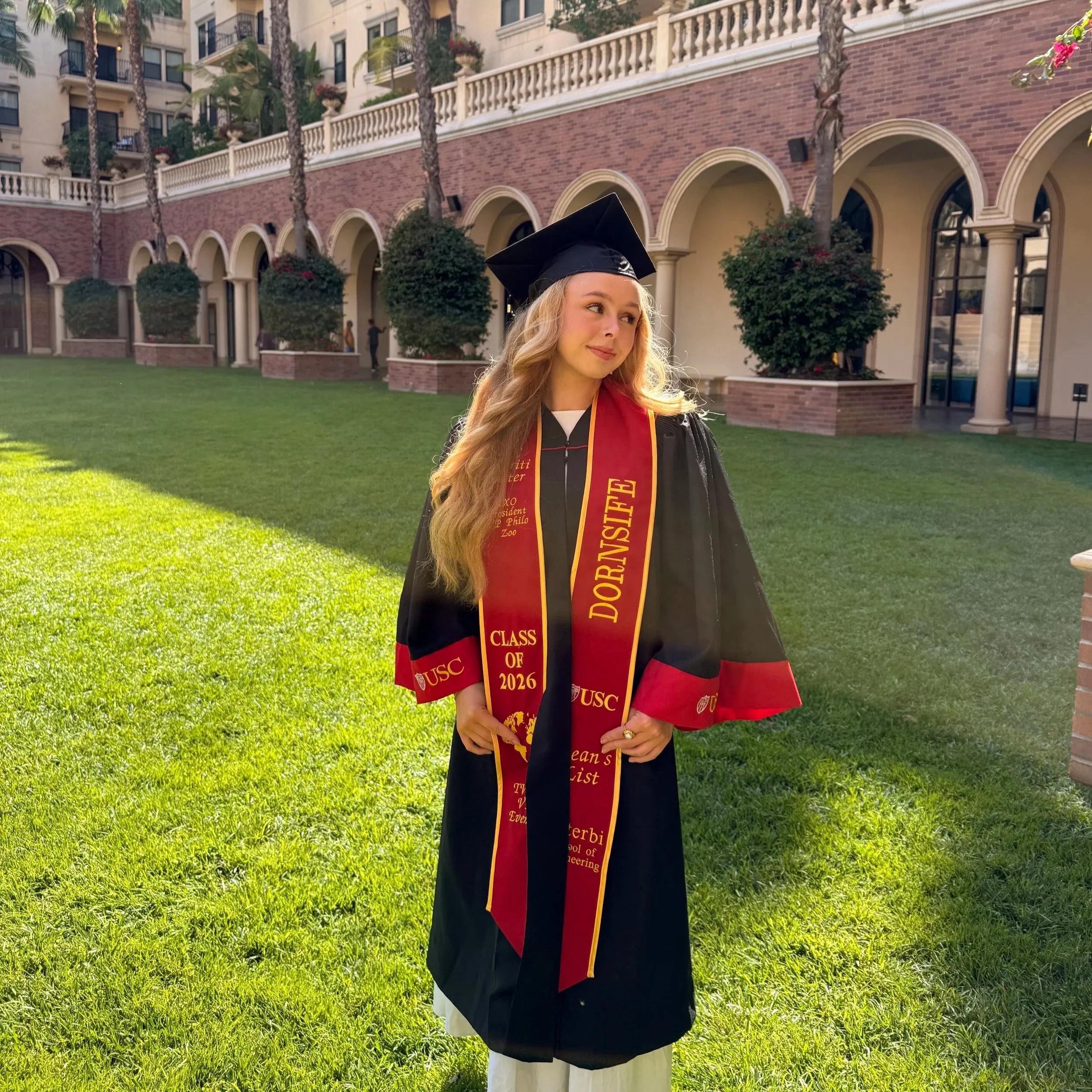
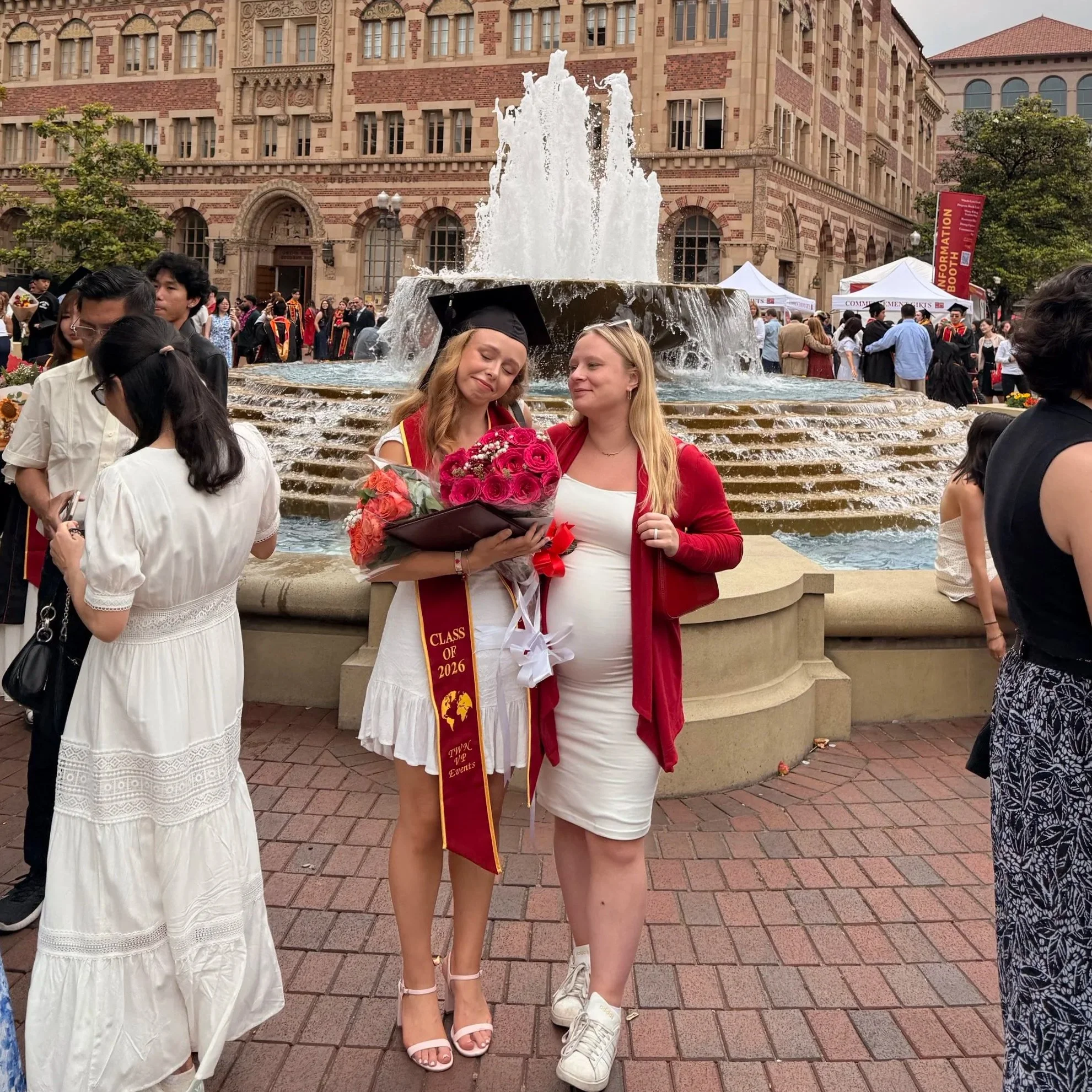
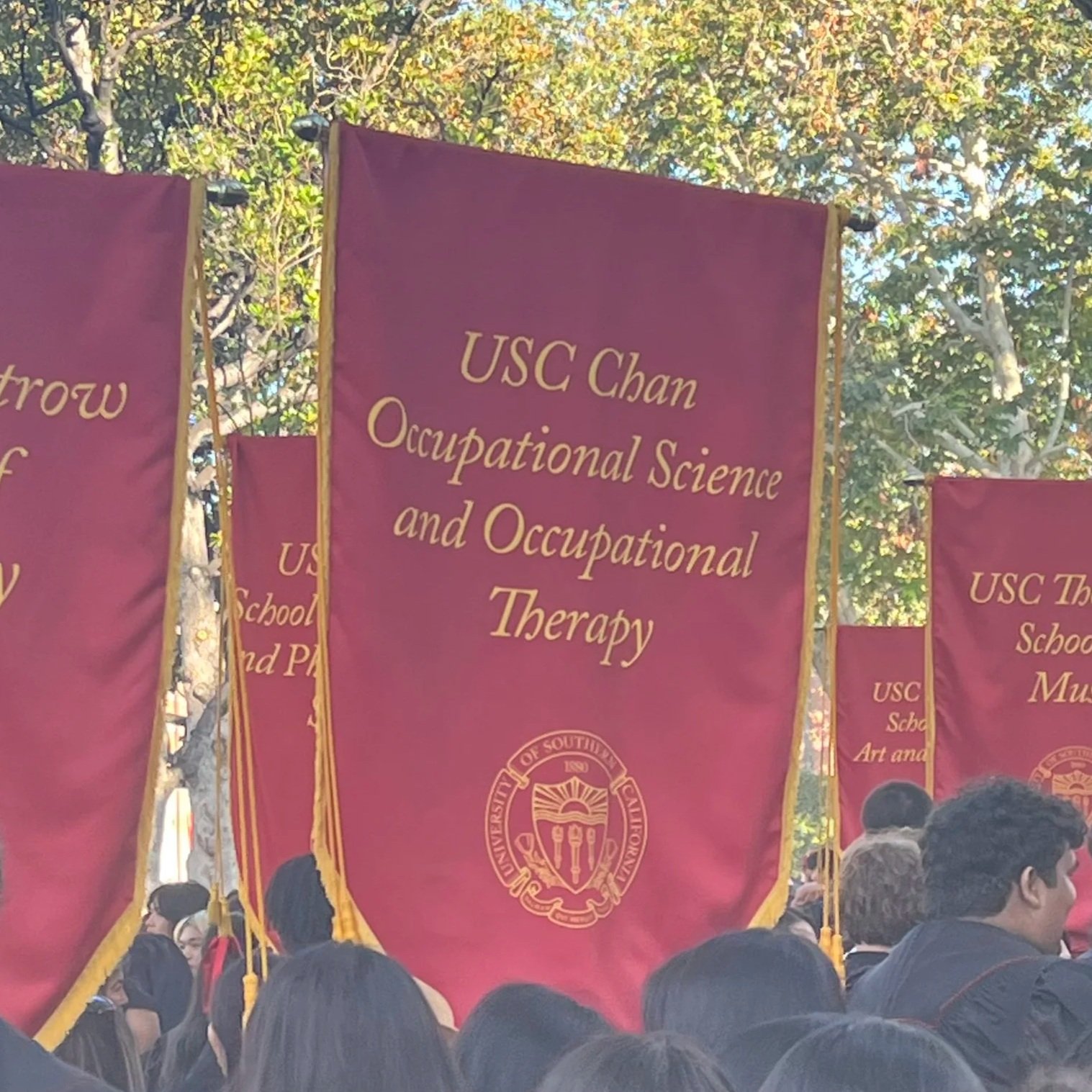
Photos from my graduation!


I don’t know where to start.

In case you somehow couldn’t tell, I haven’t outlined a single one of these blogs. I’ve gone into each with a vague idea of what I want to talk about, but from there I’ve just let my thoughts lead me. I thought this one would be the same. In fact, I thought it would be the easiest to write because it’s just going to be me summing up my experiences over the past month. It seems as though I was wrong, but I’m going to try to do my best.

While The Moviegoer mentions it specifically, almost all the books we read for this class contained some element of ‘searching.’ Every character, from Edna all the way to Ignatius, was looking for something, either internally or externally. We’ve discussed in class many times what it is about New Orleans that brings up all these philosophical and existential questions, how the collision of cultures mixed with the Deep South ‘lost cause’ myth converge to create a city that is still searching for its own identity.

I came to New Orleans searching for something too, though I didn’t know it at the time. I’ve loved to read since I was three years old. In fact, the book People We Meet on Vacation is what originally sparked my desire to go to New Orleans. It felt very romantic to me, very inspiring. Because beyond reading, I have always harbored a calling to be a writer one day. As early as I started reading, I also began filling notebook upon notebook with writing. My brain felt like it was exploding with ideas. Writing to me seemed as natural as breathing, and imagining stories in my head became my primary source of entertainment in a no-TV home.

That calling to write has never gone away, but, as many childhood dreams, it’s been stamped down by the crushing realities of adult life. Writing is difficult. It’s scary. The words in my mind never come out the same way on paper, and even if they do, can I really handle baring my soul to someone else like that? Both my inner critic and my fear of people reading my work have tainted the process of writing for me. I put so much pressure on myself that all that creativity I once had gets extinguished.

Writing is also just, objectively, not the most financially sound career decision. I have never desired this whole ‘starving artist’ thing. There is nothing enjoyable, I have learned from experience, in not knowing how you’re going to pay your rent this month or eat anything other than instant ramen and sunflower seeds for the foreseeable future. I crave financial stability. So as much as I would have loved to major in literature or history or classics, I chose to study economics. That isn’t to say that I don’t enjoy what I do. I have quite an analytical streak that takes well to studying patterns and predicting trends. It’s only that for every bit of practicality I have, it is matched equally in creativity. I don’t have the chance to nurture both parts of myself, and so my imagination has withered from lack of care.

Essentially, that was just my long-winded way of saying that I’ve been feeling a little… uninspired recently. Between that, a breakup of my long-term relationship, graduation, there has been a yawning crater of absence in my life. I felt drawn to New Orleans because of the sense of romance and individuality in this city. There seemed to be so many stories, so much rich history. To quote Andrew, this city is quite fecund. It teems with abundance in every direction, from the different cultural influences to the extravagance of Mardi Gras to the French quarter houses resplendent with wrought-iron leaf, bright colors, and lush bougainvillea. There is something a little bit magical about this city. To go back to my first blog post, New Orleans feels like nowhere else I have ever been. Being here sparks my curiosity, not comparison. I haven’t ranked it against the other cities I’ve been to in my lifetime. It doesn’t feel necessary — all my energy is spent learning the history and imagining the stories that could have taken place here over the centuries. It feels like New Orleans is a mystery, and if I pop into the right bar at just the right time or stumble upon the right novel in a bookstore then I will unlock the key to understanding more about this place.

A collection of photos that I hope encapsulates the vibe of this city better than I could explain it in words:

So. Did this trip singlehandedly reignite my passion for writing? Did I find what I was searching for? I don’t know. I don’t think it’s quite a fair ask of one city, to totally change your life in a month. I think I’ve spent the last month so inundated with experiences, history, perspectives, people, food, and novels that it will take some time to fully sort through and reflect upon everything in full. What I will say is that in this city so teeming with life, I felt as though I was able to collect some of that energy for myself. Everyone and everything here is alive. That’s the best way of describing New Orleans. Alive. Through this experience, through seeing and doing and learning and thinking and laughing and crying and talking and eating and drinking and sweating in the heat and running in the rain,

I’ve been able to feel.

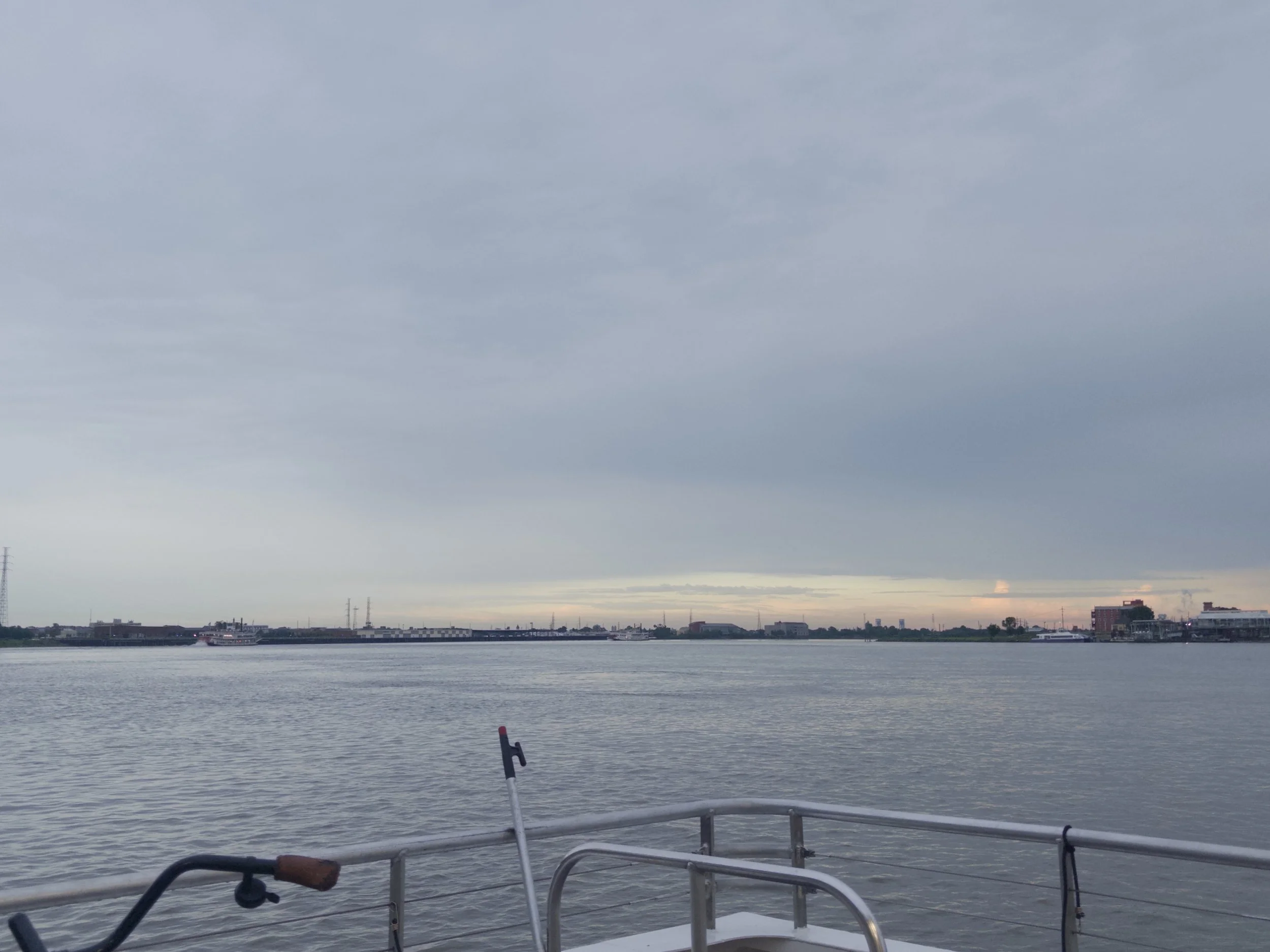
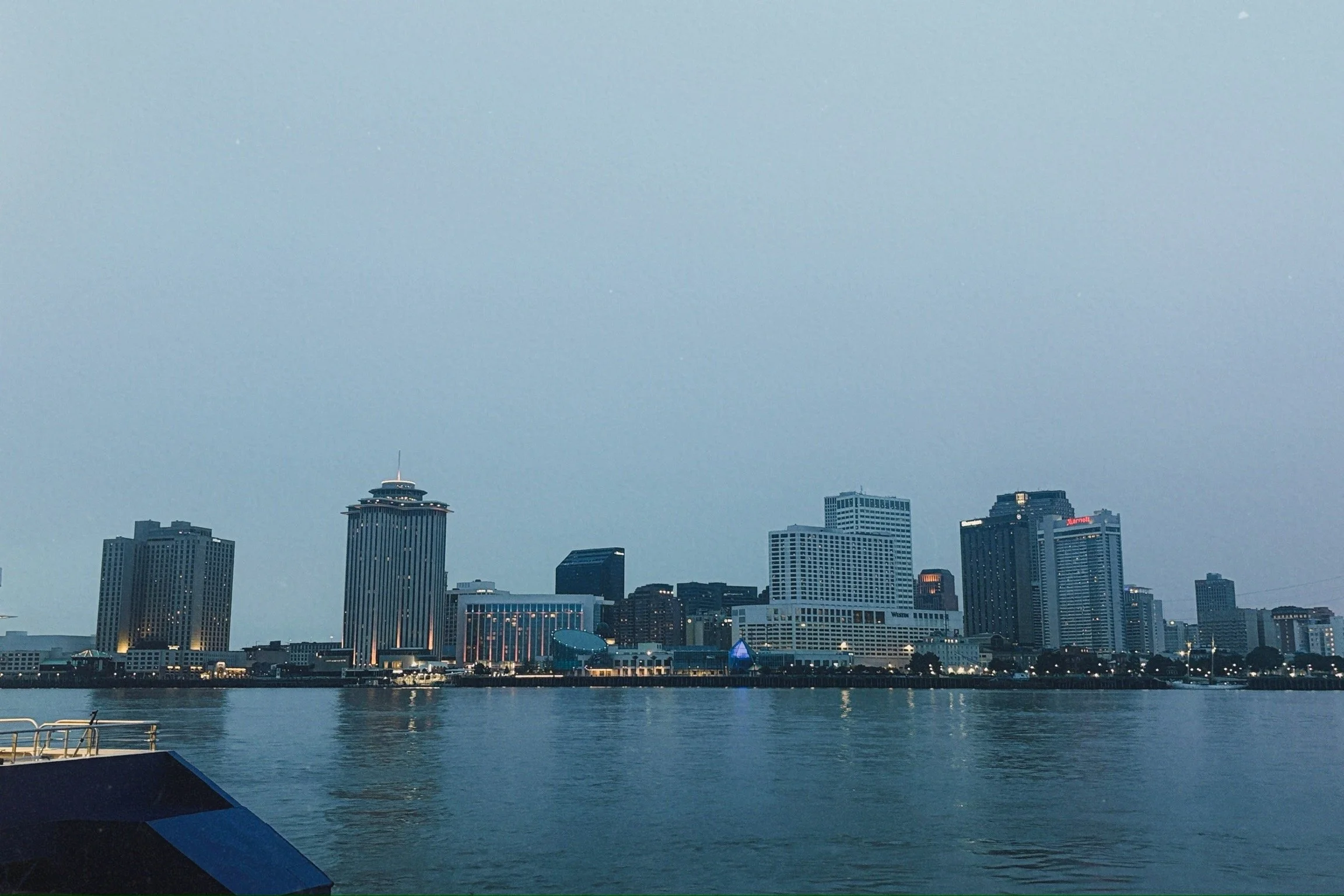
I’ve been able to connect with the piece of myself from which my creativity and my humanity stem. I’ve been able to remind myself that the world moves on even when it feels like it’s ending. I’ve been able to watch the sun set over the Mississippi River, marveling in the beauty of my surroundings, at how so many paths for so many people could have led them right here.

Anyways, there is much more I could say on this topic, but I fear it devolving into a sappy and nonsensical ramble which is not the point here. TLDR: New Orleans was really cool and I’m thankful for this experience. Let’s just leave it at that.

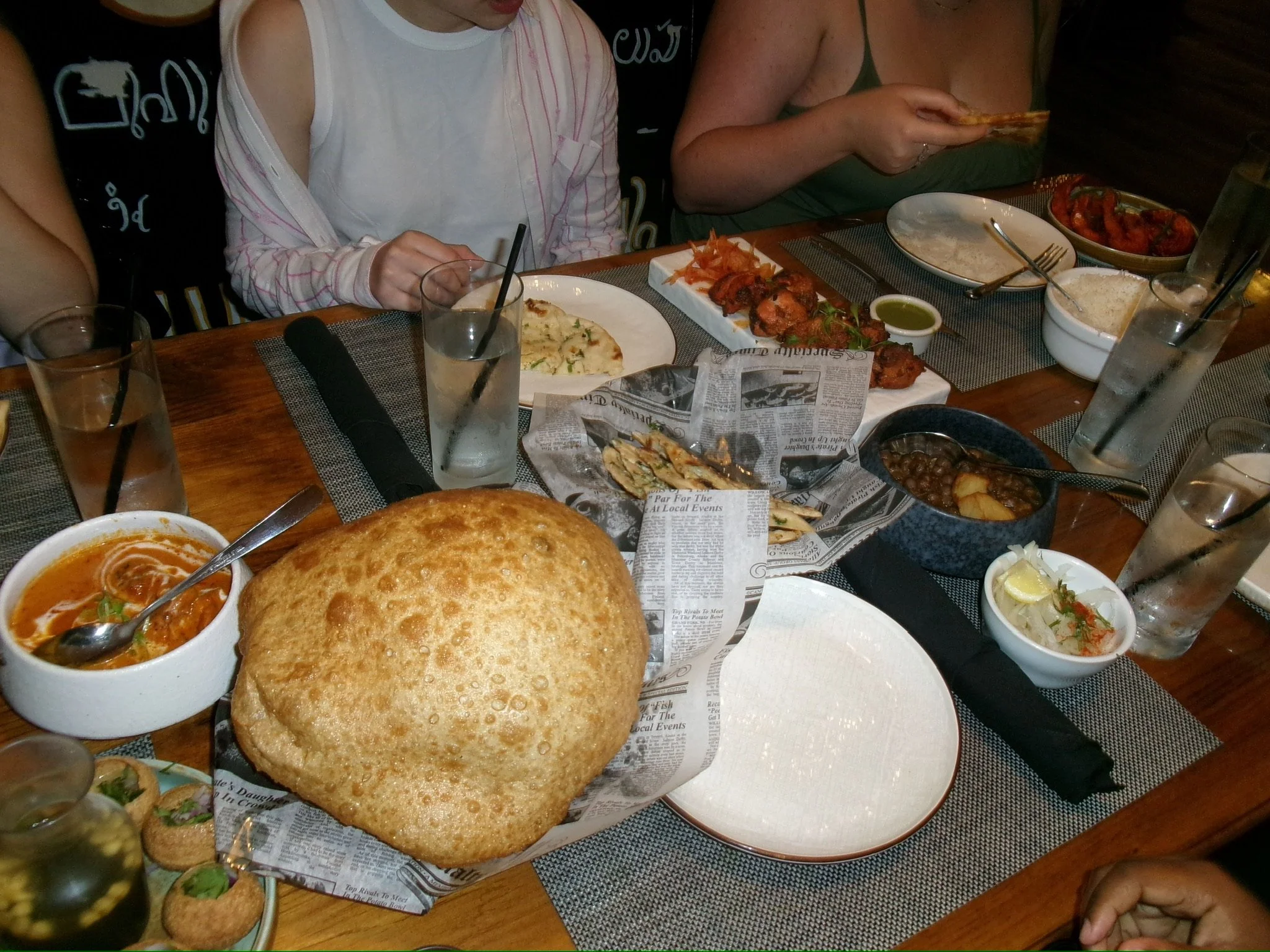
FOOD

!

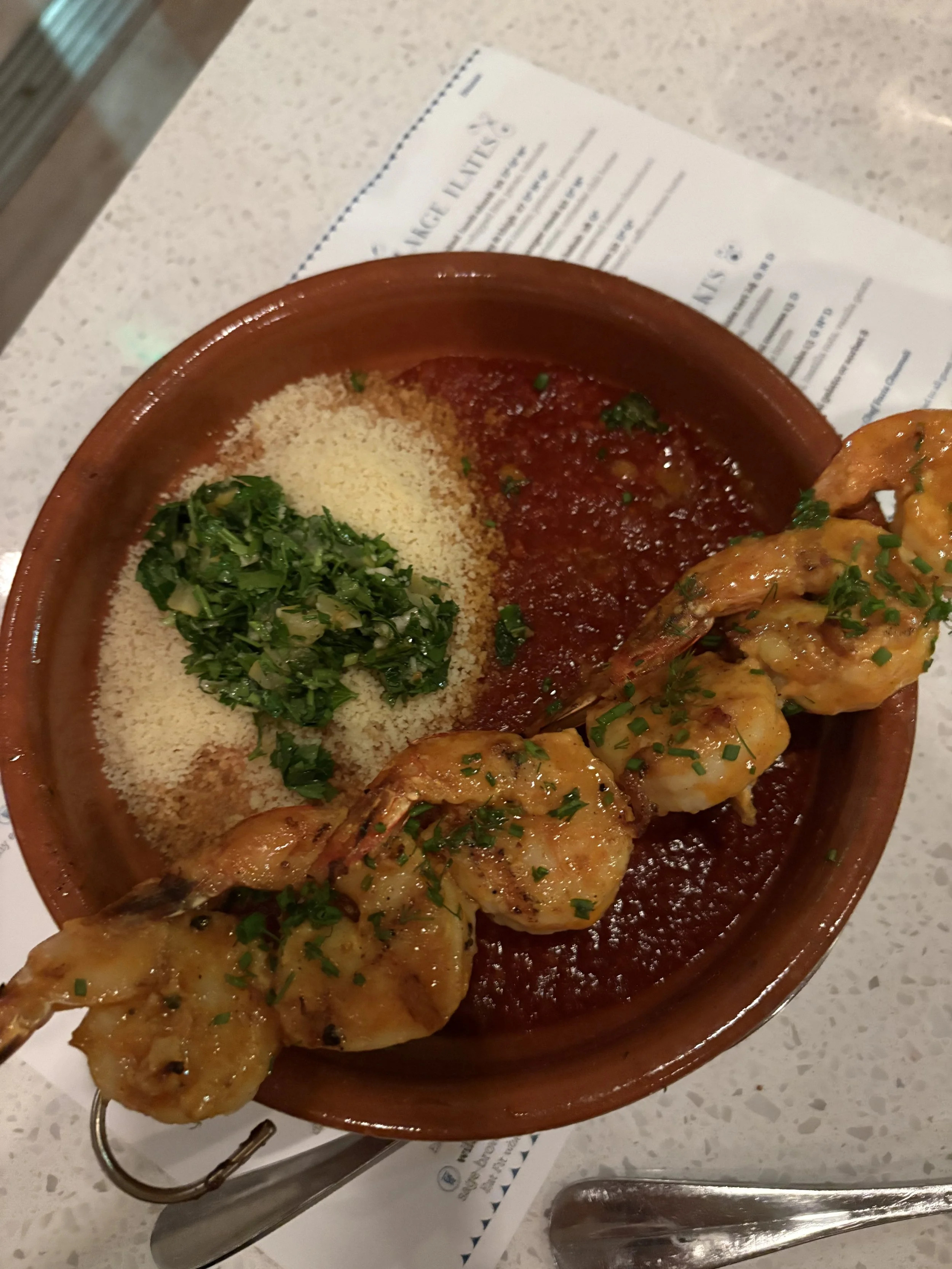
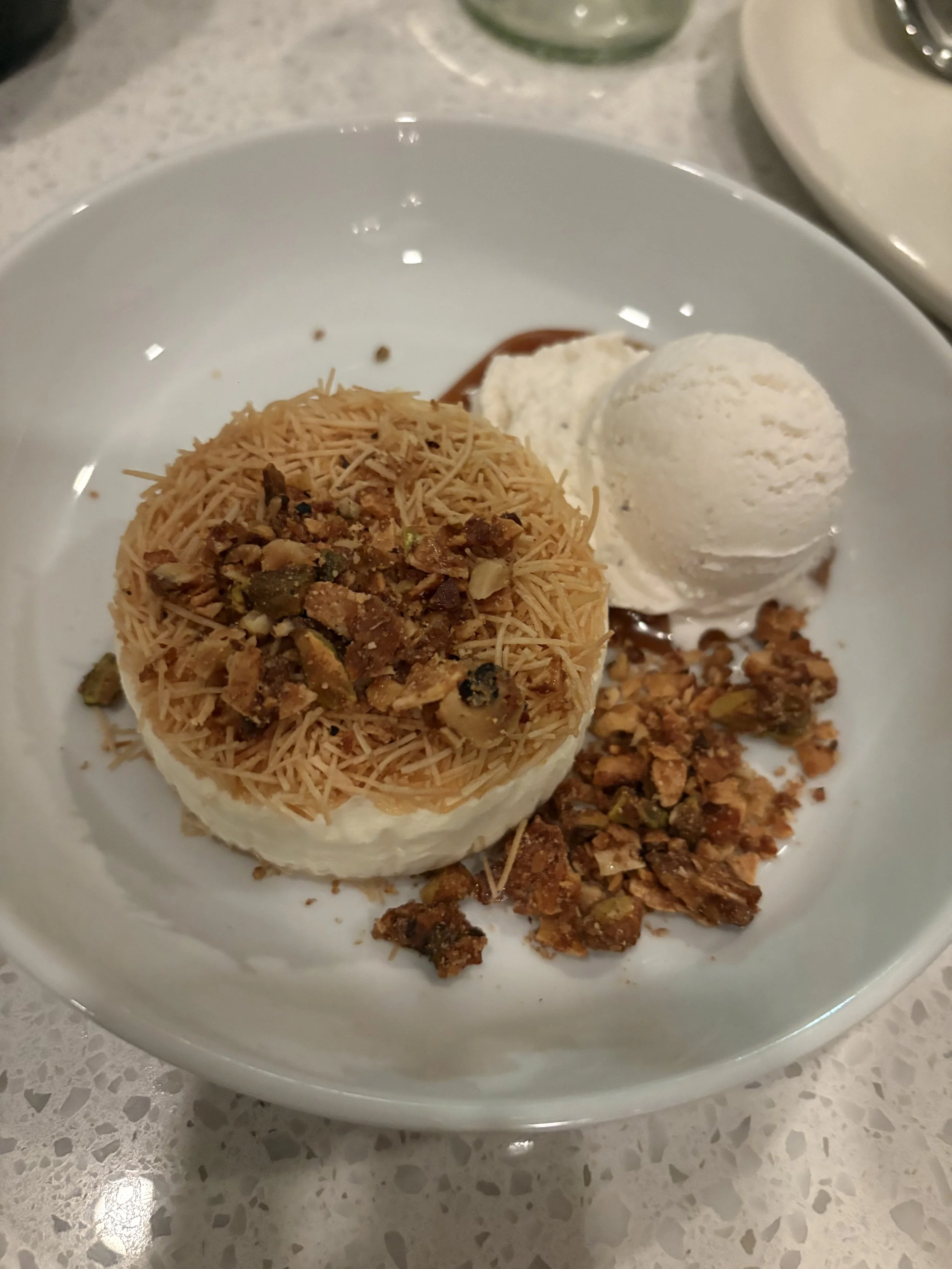
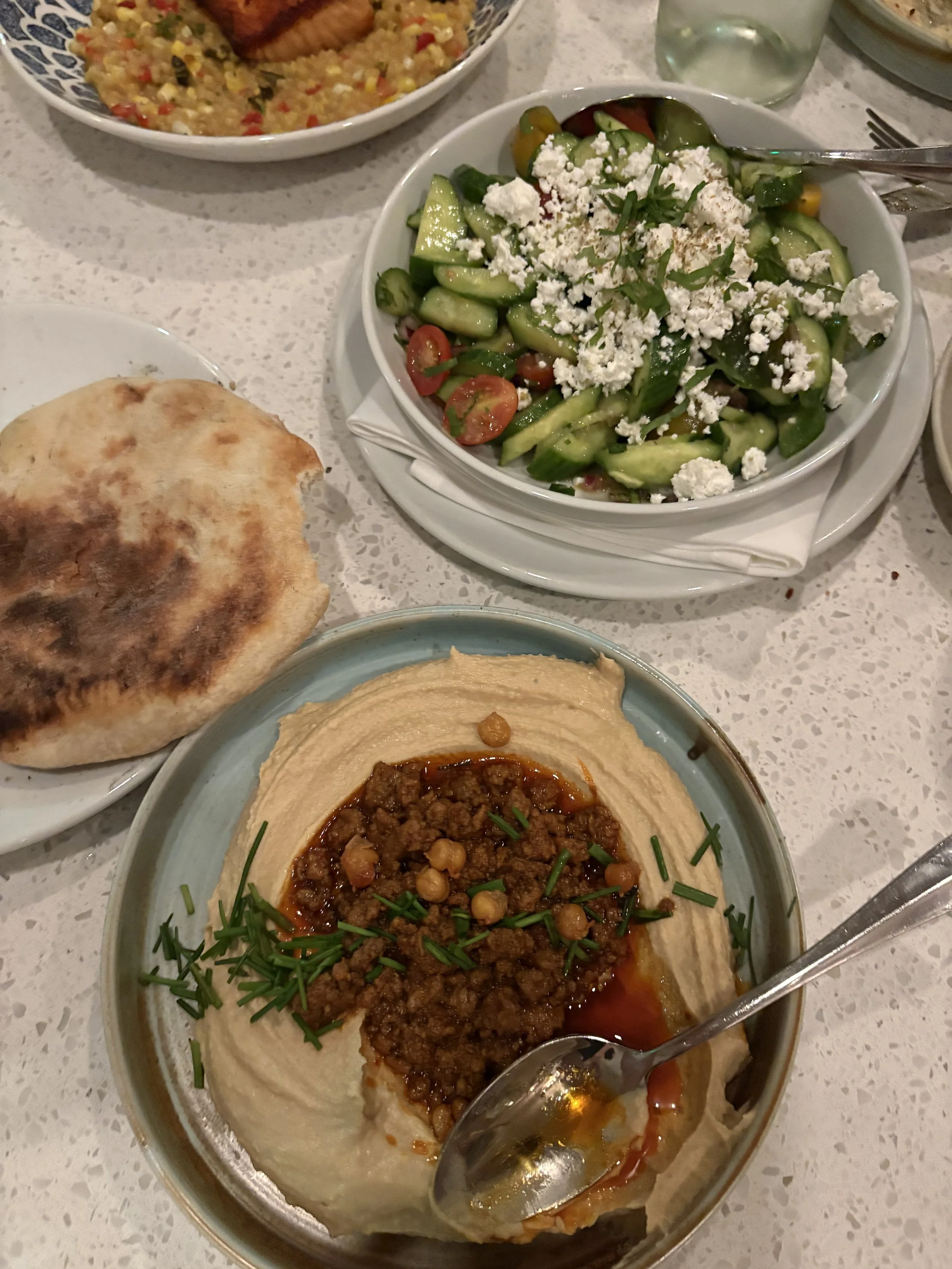
FOOD !

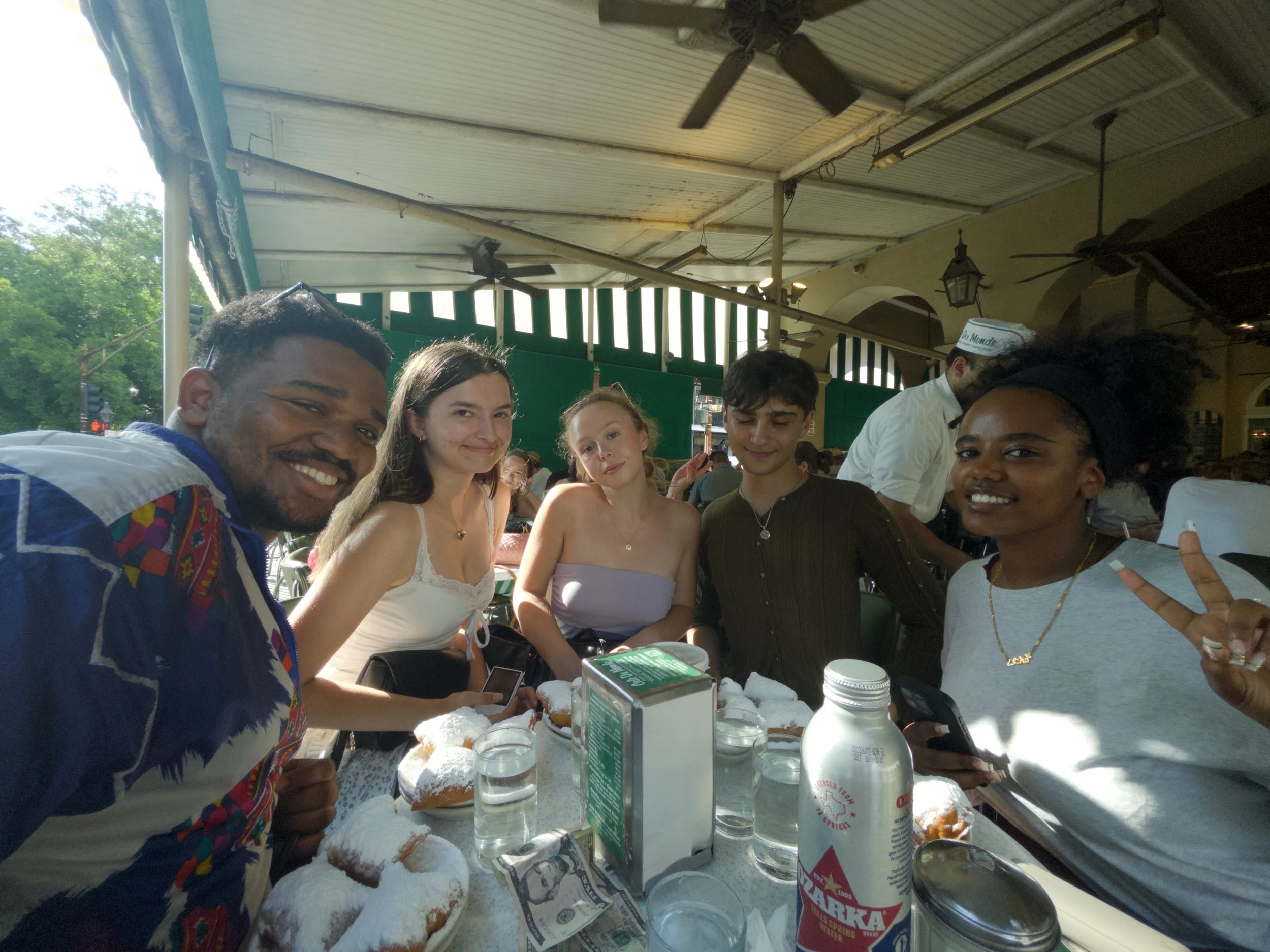
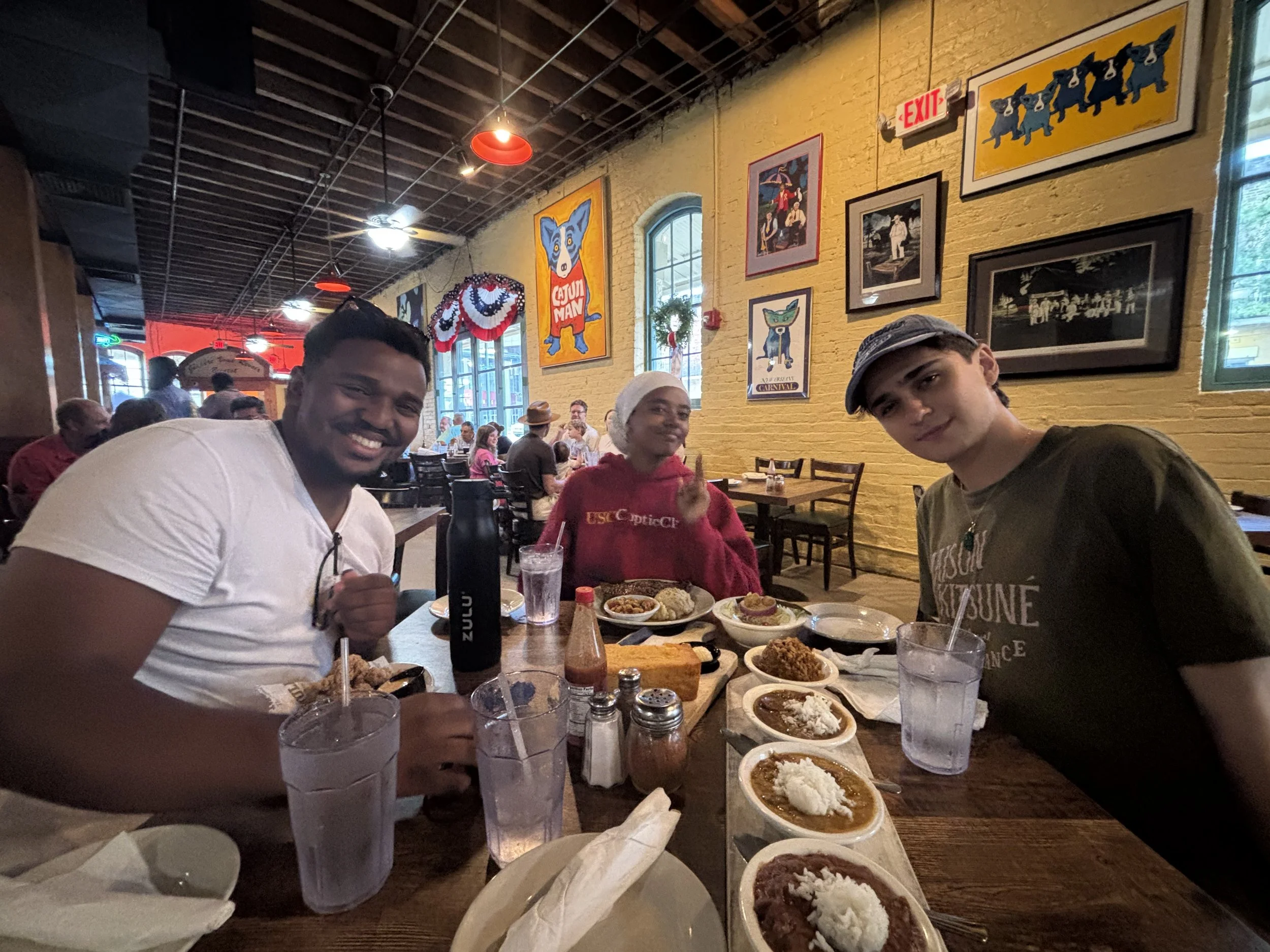
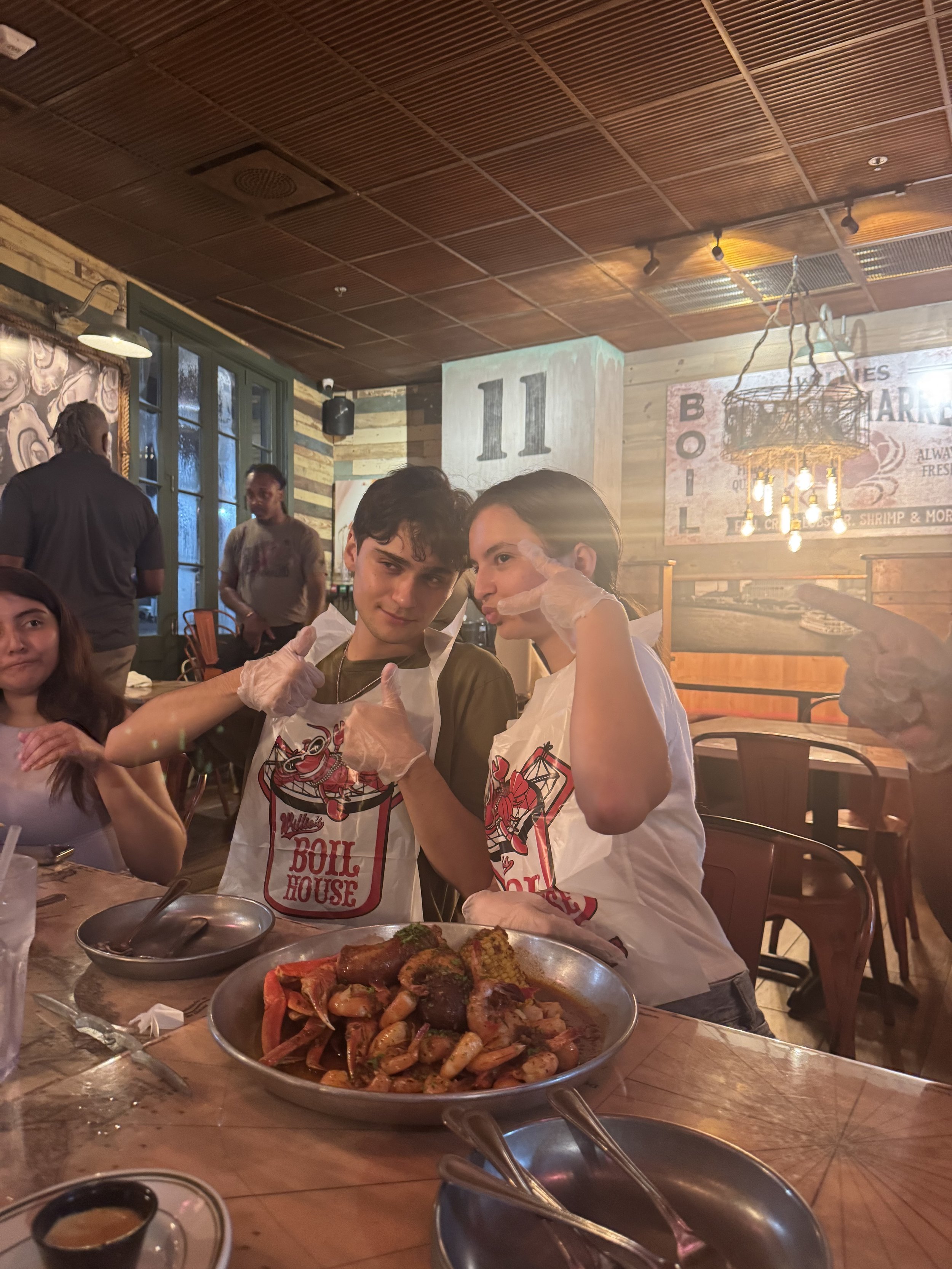
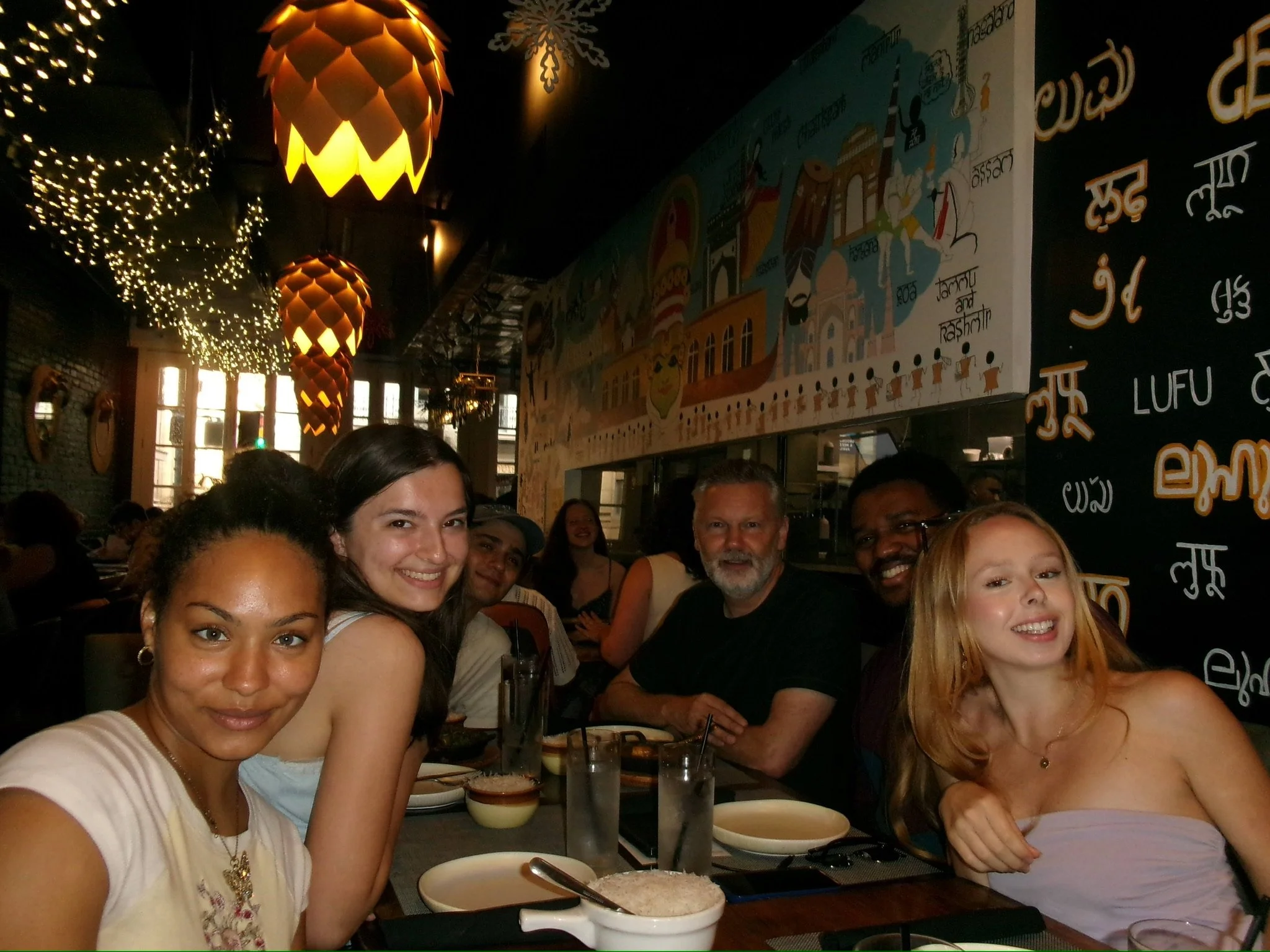
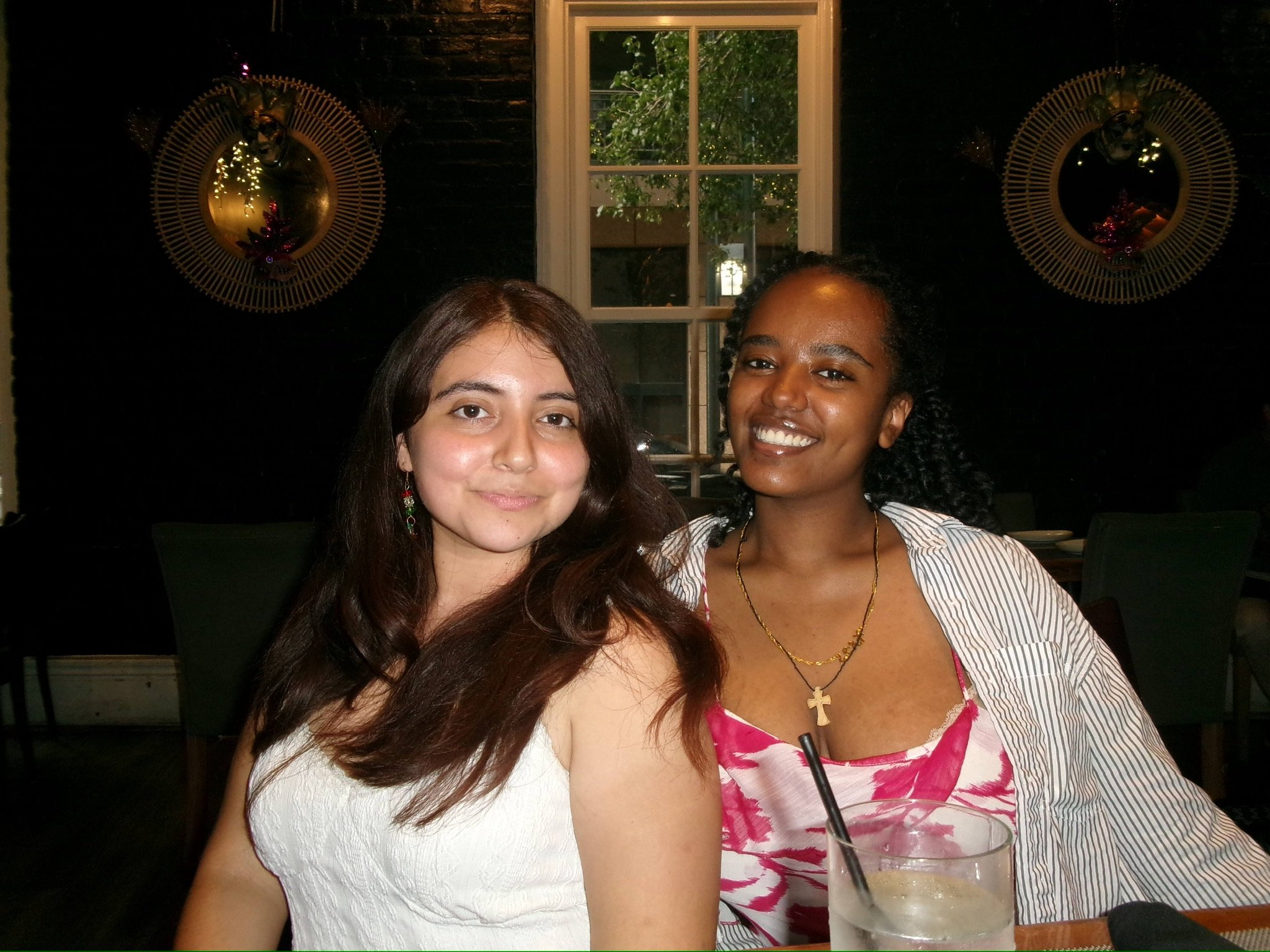
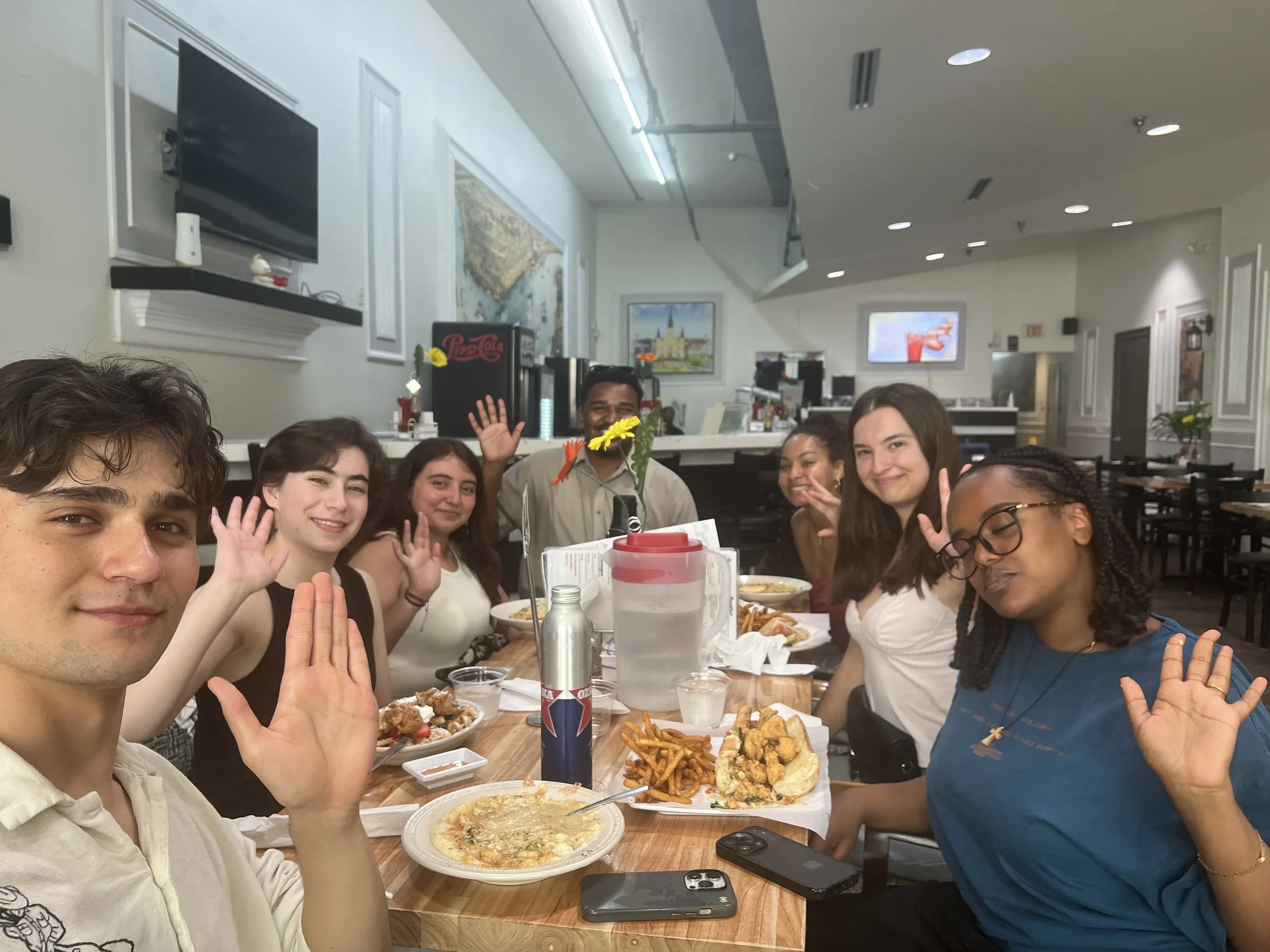
This experience wouldn’t have been what it was without all the people that made it so fun. Missing you guys already, enjoy these photos (though you might like some more than others tehe)

Love letter to New Orleans bookpacking

Now that we have come to the end of bookpacking, it's safe to say I have finally found the words to explain it. 

It's a program where I got to learn about different cultures and explore different types of cuisines and learned about the history of the American education system that failed to teach me in high school.  And the people I came to this experience with soon became my friends. 

I was initially so scared to come on this trip, scared of the uncharted territory, but now that I have exprienced it was amzaing to say the least. The time I have spent in Grand Isle and New Orleans have been a time of reflection and personal growth. 

The books I have read on this trip and the places we have visited were like mirrors, all these characters staring back at me. I found myself relating to book characters like Louis de Pointe du Luc, characters I never thought I would relate to. I had to face my blackness in America; no matter where I'm from, people will always perceive me as just another Black person, and even though I never truly cared for how other people perceive me, I should be more intentional about the way I move through life. Being talked about or discriminated against because of my faith or how I see the world through my faith has been one of the surprises of the trip. I have never experienced anything like that before, but also I have never been this bold and forthcoming about my faith before as well. New Orleans is normally associated with the supernatural, all the voodoo, and the vampire stuff; because of that, I felt the need to stand firm in my faith so that I would still be unwavering in the face of anything that came my way.

In a city full of music, food, and culture, as we went through and visited places on our list and in between all that, I found myself just sitting with my thoughts. This was so difficult for me to do as someone who comes from an architecture background. Leisure is not normal for me. That’s what I said in the beginning of this trip but not anymore. I found myself slowing down my pace while I was walking and taking in everything as I walked through the city, talking and joking around with friends and staying at the cafe or restaurant an extra 30 minutes or an hour or so. In a world full of go-go-go where we are always looking for the next thing, we sometimes forget to appreciate the small things along the way, and all the work we do is actually so we can live. I feel fully immersed in the French influence in New Orleans, where leisure is a good thing and I don't have to be so stressed at all times.

Every day was something new in this city. One day we are seeing celebrations like the second line parade and Backstreet Museum, and the next we are visiting the Hurricane Katrina museum, and then the next we are seeing one of the most beautiful and mesmerizing performances EVER at Preservation Hall. Even through the pain and the natural disaster this city has been through, it always found a way to hold on to joy in everything. 

I want to be as resilient and vibrant as New Orleans. 

“What is it about this city that makes people want to write?” — Andrew Chater

People usually go to Los Angeles or New York to find themselves or to reinvent themselves. I say, come to New Orleans. A city TRULY like no other. Professor Andrew and I were talking about how weird it feels to not have one place to call home. For me, I always felt in the middle, too Ethiopian for my American friends and too American for Ethiopian friends; even going back and forth between LA and ATL never really felt like one place was my home, like my ride-or-die home. It was always about the people at the different places, never about the place. I never truly felt like I belonged, always in between, and felt a bit strange, too. But not in New Orleans. In New Orleans I didn't need to belong because the city is a collection of many different people and cultures and languages; I suddenly felt less strange. Even Louis from Interview with the Vampire says that there are so many interesting characters in the city that a vampire won’t stand out, I agree. 

This program brought so many different people all together. All the people that came on this program with me, our paths couldn’t be any different from one another's. We probably wouldn’t have crossed paths if it wasn’t for this program. Which I'm very grateful for. As much as I learned from this program, I also learned a lot from them. 

I aspire to be:

As curious and full of energy as Sadie 

As welcoming and caring as Isabel 

As kind and patient as Trey 

As happy and considerate as Vanessa 

As sharp witted and man of taste like Andonis  

As smart and courageous like Laura

As funny and whimsical like Celeste 

As creative and compassionate like Jaenalyn

And finally, as knowledgeable and thoughtful as Professor Andrew

New Orleans will forever have my heart!

Goodbye for now.

Details are not dead

People say details are dead in architecture; I say they just haven’t been to New Orleans.

New Orleans doesn’t behave like most American cities, where the architecture presents itself as clean progress or uniform planning. Instead, it’s a constant negotiation between time periods and materials and different cultures that never fully agreed to merge but simply coexist. The architecture in this city is curious; it's not just one thing. It doesn’t feel accidental; it feels layered. 

The old and the new are always pushing and pulling one another.

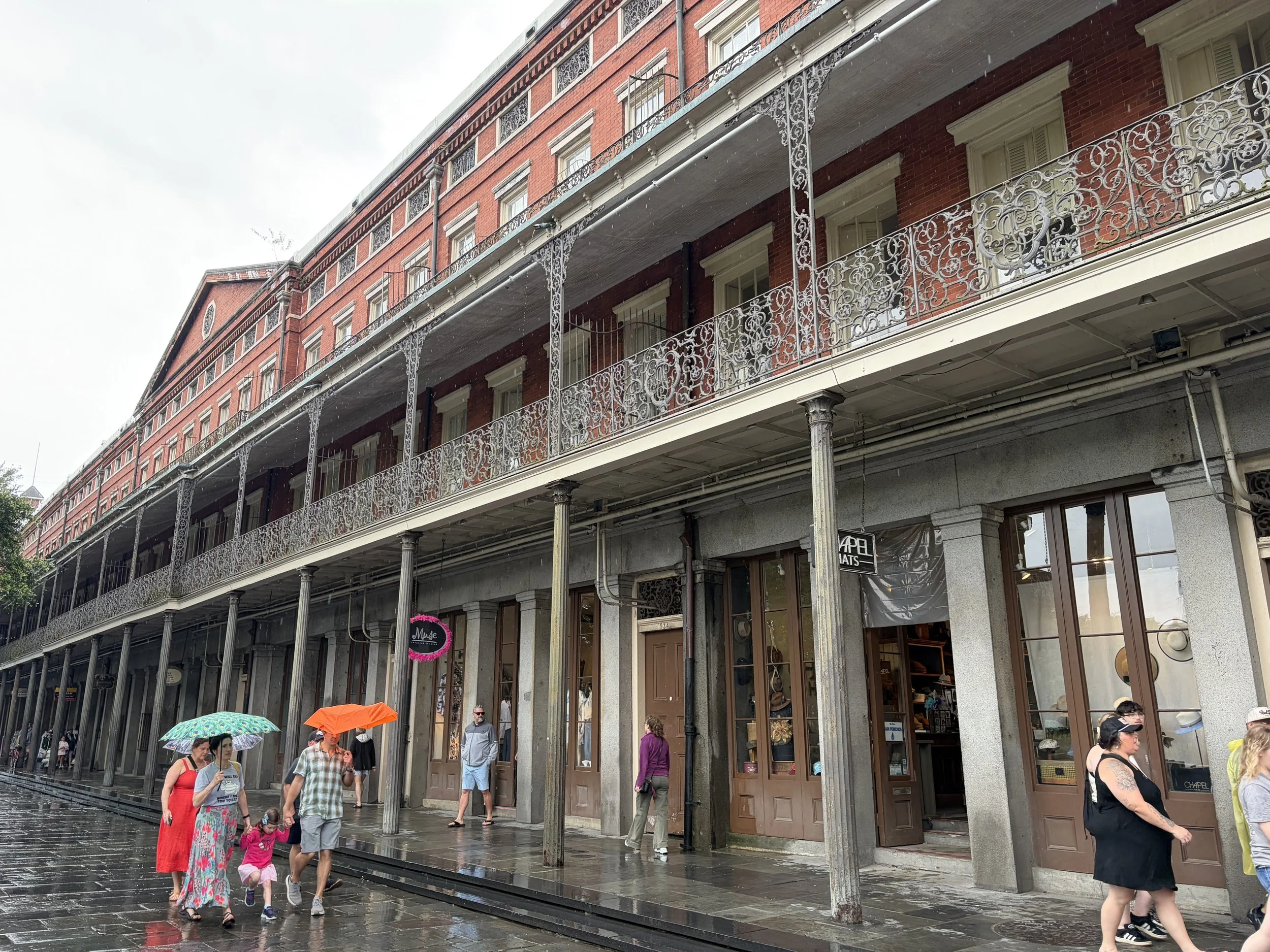
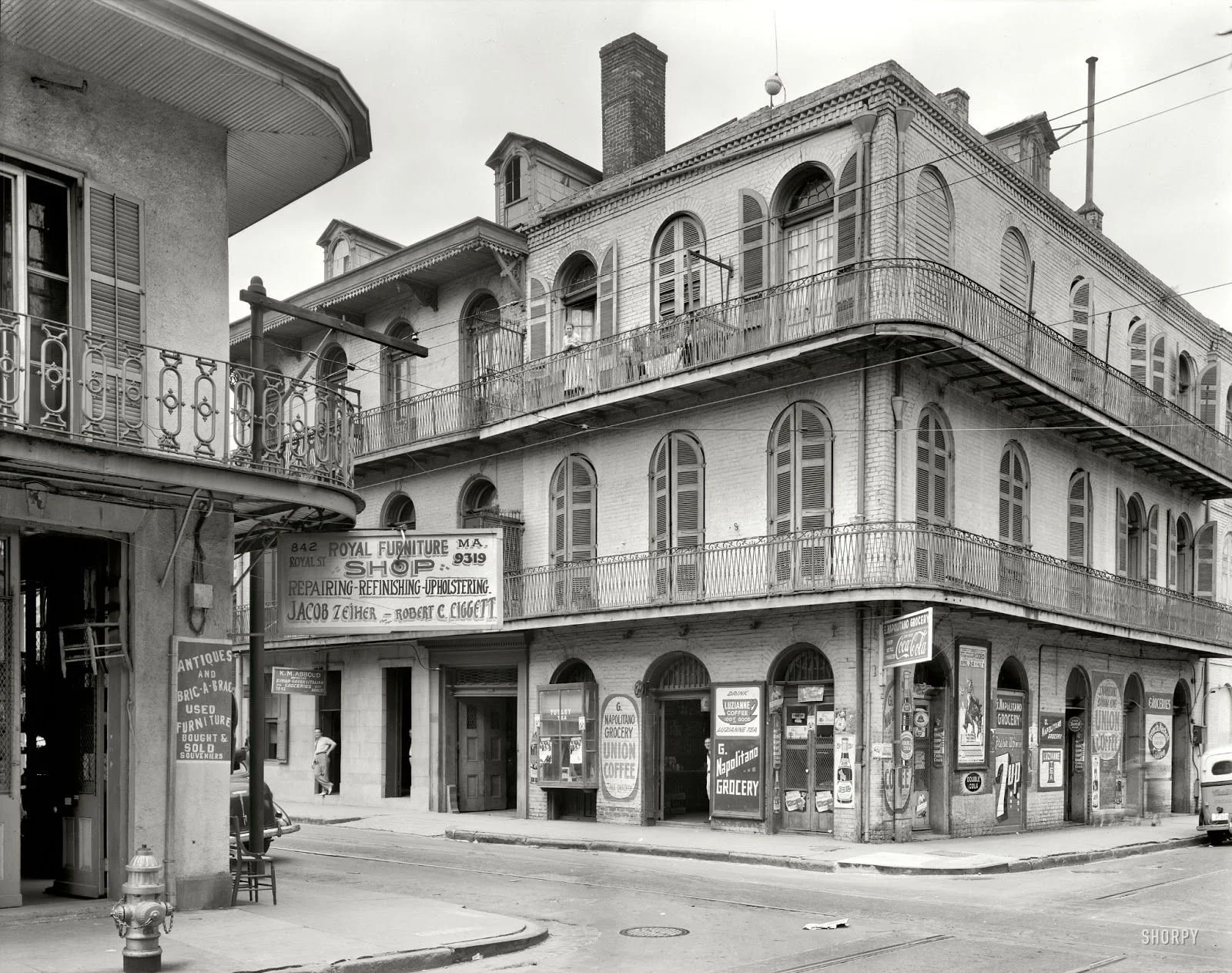
As an architecture student, I can’t help but move through a street without inspecting every building I come across. I notice the tacked-on balconies/galleries and the fully flat sides that make my head turn in confusion. I notice the abundance of stairs and the lack of inclusive entrances and walkways—not afterthought ramps that are bolted on later but a meticulous, accessible design that accommodates everyone without having to use different walkways or entrances. I notice the wrought iron balconies that must have taken hours and hours to perfect and the various types of columns. I notice the shortage of adequate water drainage. All this, and the city carries it all unapologetically.

In most big cities I have been to, they are always trying to show their uniform continuation of buildings that all look modern and show seams but not New Orleans. New Orleans is proud to show its seams: the patches where the time has caught up with the building, the places where materials were swapped out, and moments where buildings from different eras come together without ever fully resolving one another. 

Bookpacking helped me see the city from different perspectives. I got to see the city through the lenses of the books I have read so far.

In Interview with the Vampire, New Orleans is almost too beautiful to be real, so glamorous and gothic, draped in wrought iron and dim lights. In Confederacy of Dunces, the architecture is neither romantic nor mystical but simply real/human. It cracks, it leaks, and eventually collapses. In The Moviegoer, the elegance has started to loosen up. The city feels fixed and more uncertain, drifting, which reflects how the main character in the book, Binx Bolling, was feeling during the entirety of the book. In Coming Through Slaughter, the architecture becomes something more unstable. Buddy Bolden’s New Orleans is less about structure and more about vibration, the wooden houses and narrow rooms that seem to bend under the weight of music and memory. In The Awakening the buildings become a form of confinement. Edna Pontellier, or Kate Chopin’s house parts, the room, and the galleries that are carefully maintained domestic spaces are very elegant and suffocating in equal manner. The contradiction between the openness of nature and the enclosure of social expectation mimics Edna’s struggle between desire and limitation, wanting to expand but yet be so restricted. In The Yellow House, architecture is described as a breathing entity that reflects complex matters like systemic inequality and familial bonds. And, in the yellow house, we see architecture isn't about beautiful structures but a weapon that has been used to keep people of color at a disadvantage. All these books I have read show that the buildings are never really just the background but more so an active participant in the lives that are unfolding inside or around these buildings.

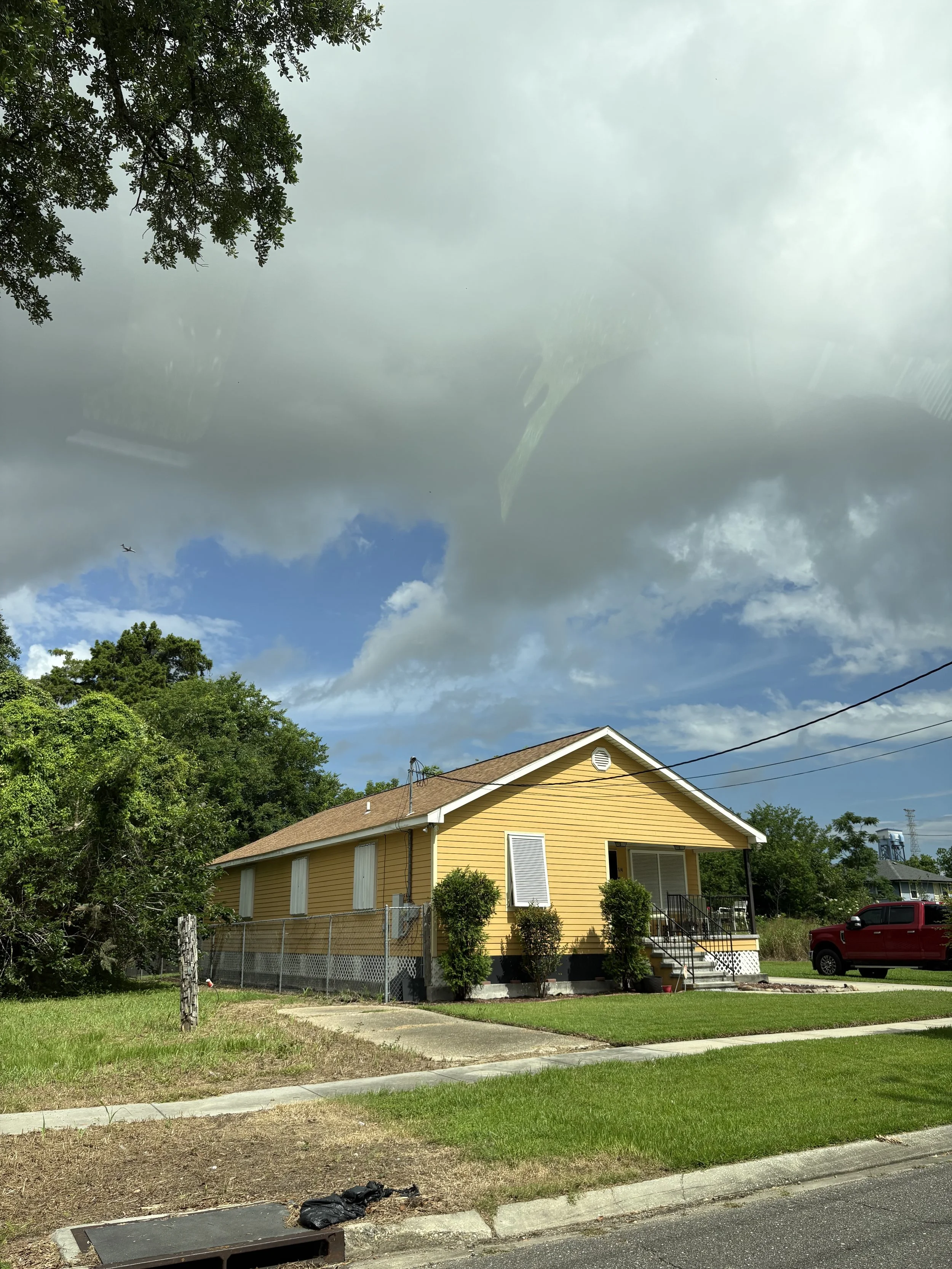
My personal favorite is the shotgun house. They originated from West Africa and were further developed in Haiti. They are my favorite because they are one of the smartest designs I have ever come across so far. One of the design features is that the interior and exterior doorways line up perfectly from front to back, which, combined with the high ceiling, allows cross ventilation to happen, which is so important in places that are humid like New Orleans.

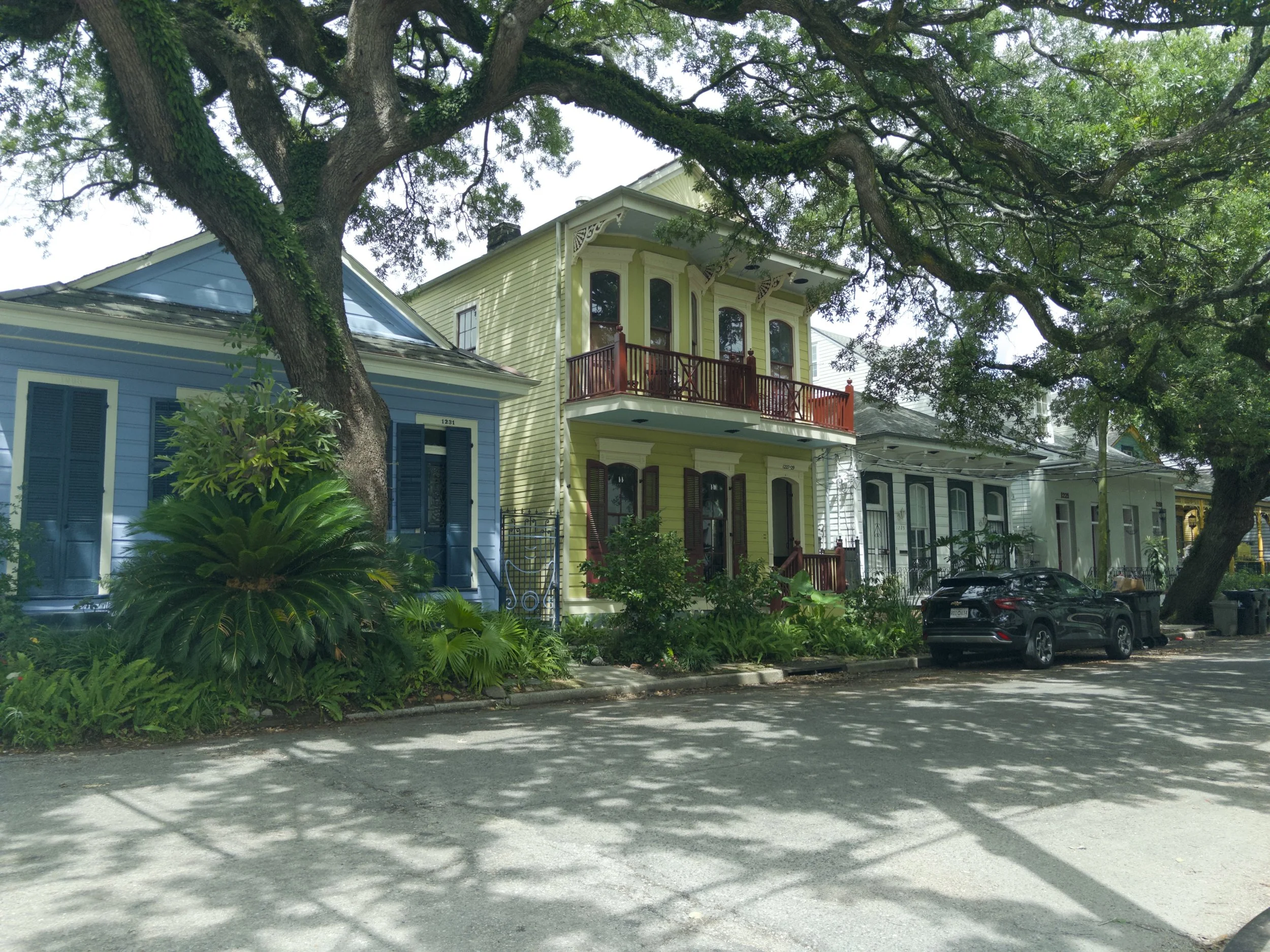
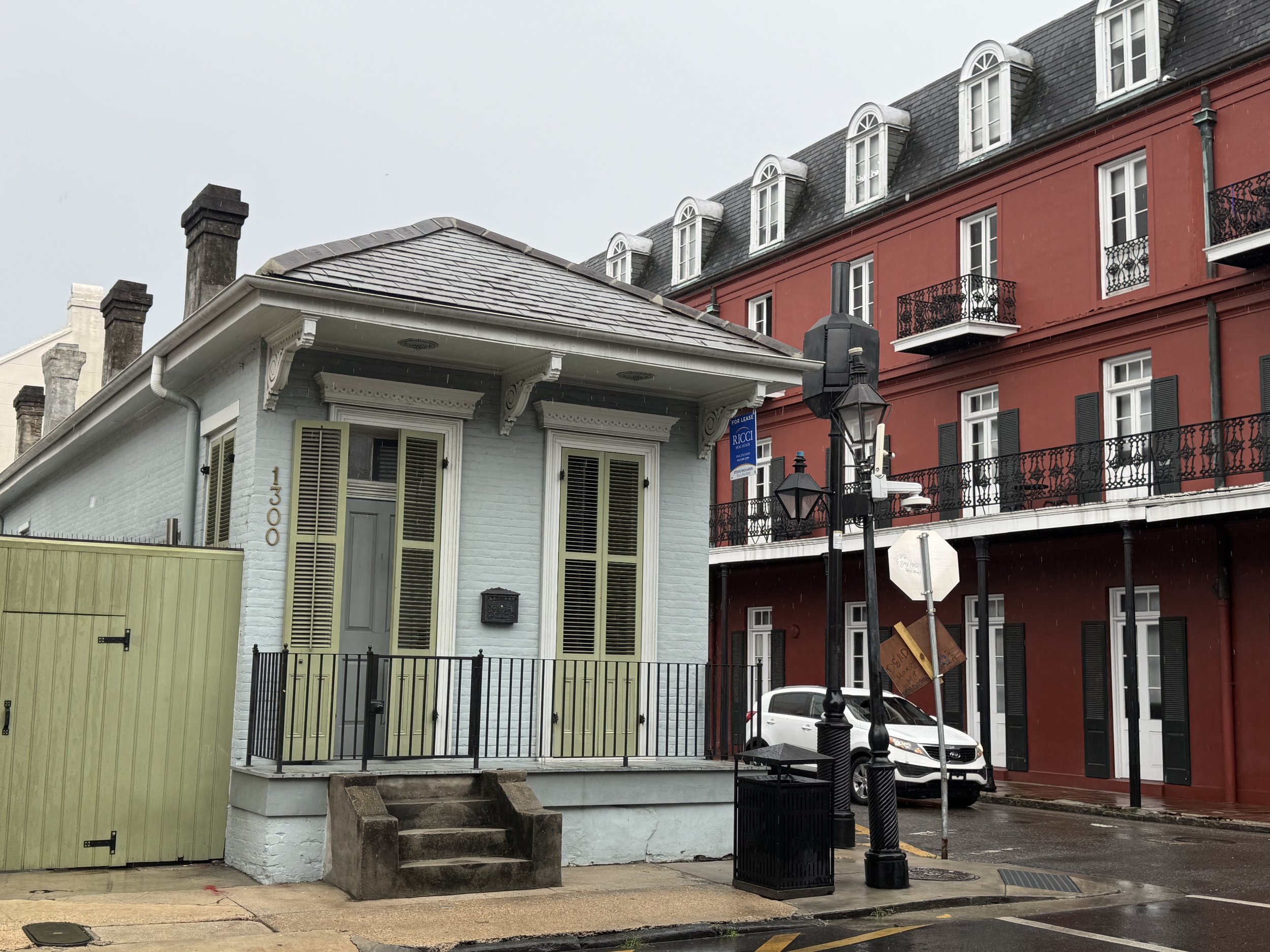
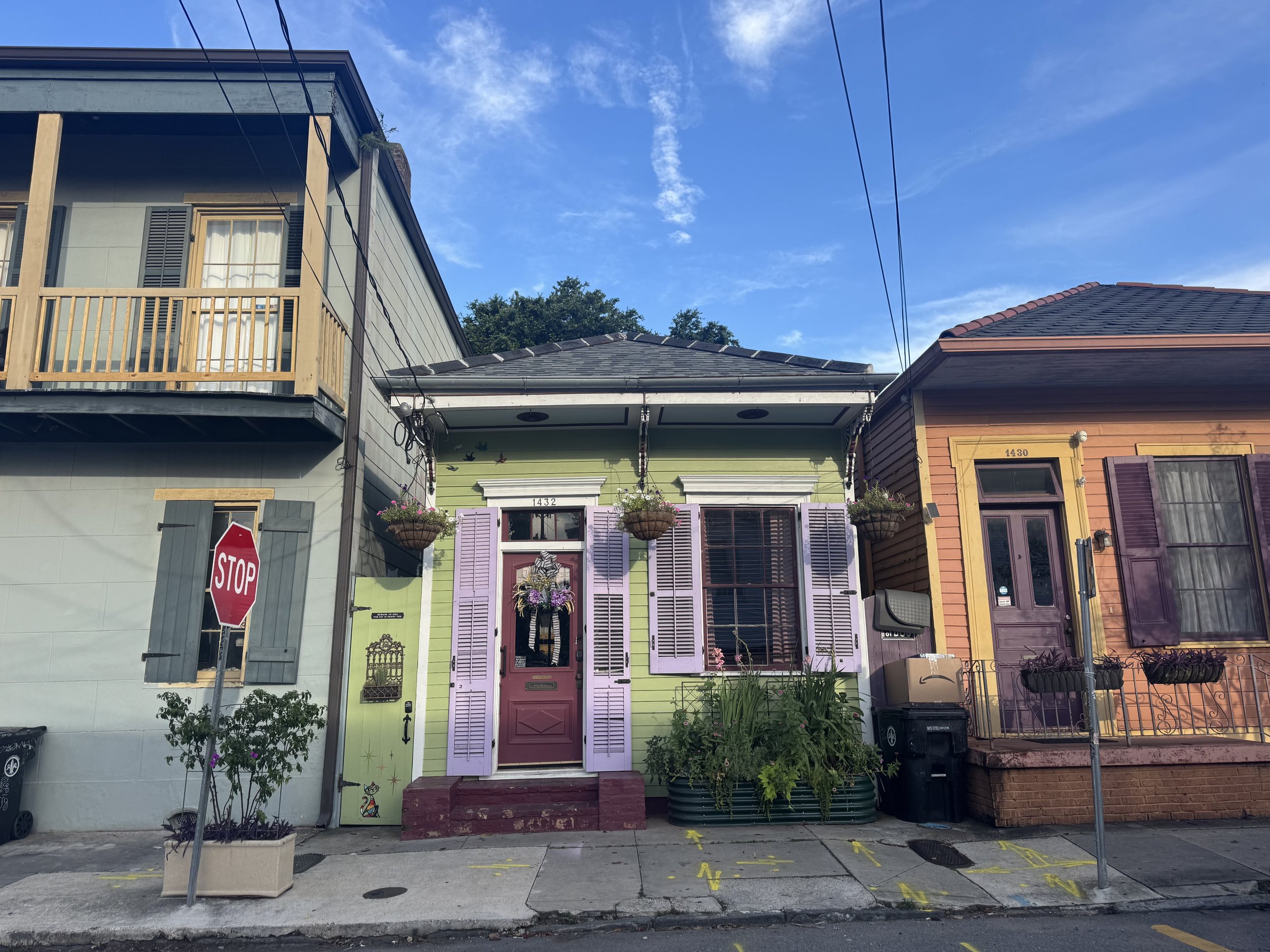
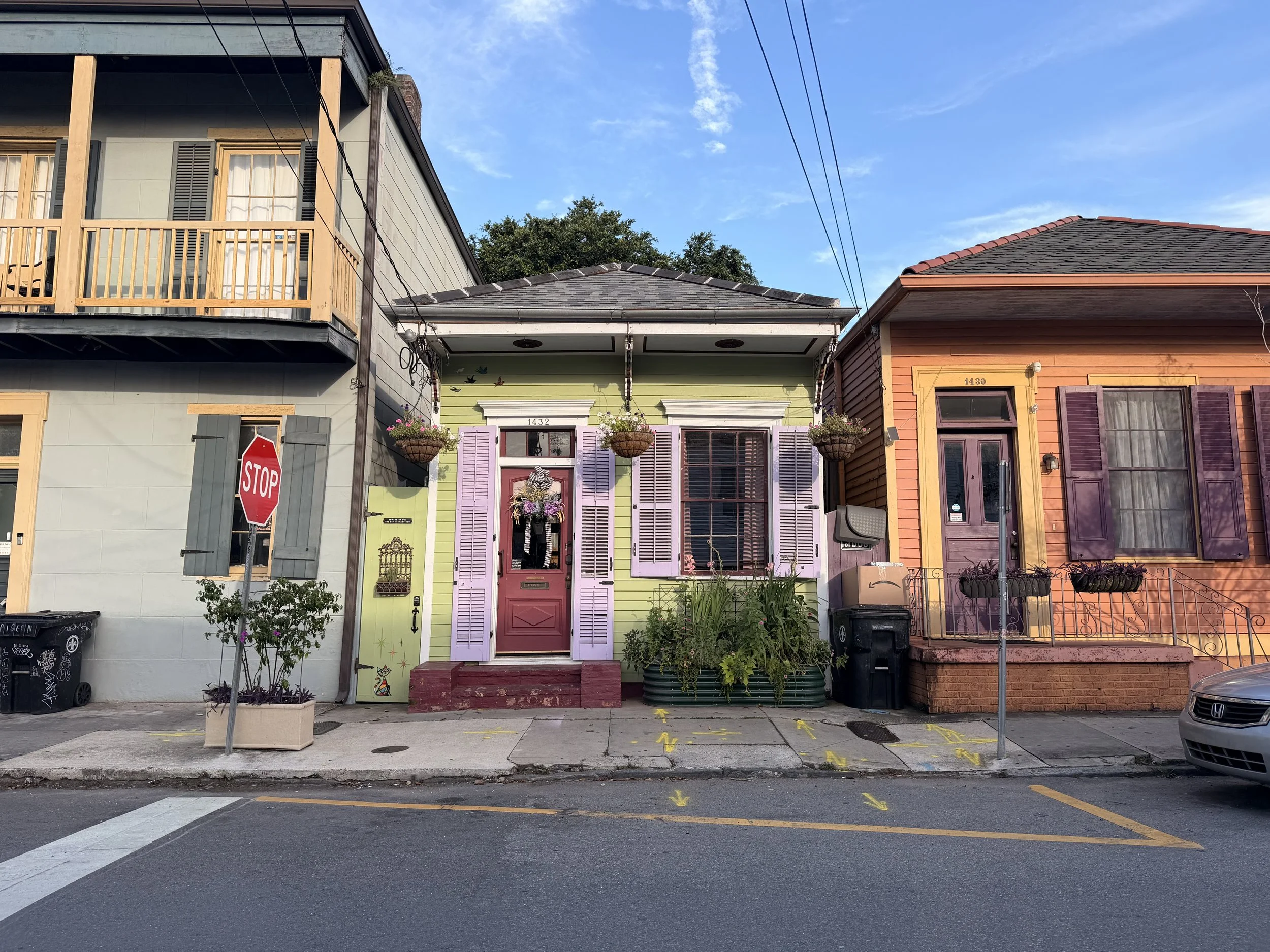
New Orleans is filled with shotgun houses that are just explosions of color, not afraid to show out like the people who live in them. In most American cities, a bright pink or cobalt blue house is a statement of defiance against a sea of beige. Here, it simply belongs. The explosion of color isn't just ornamentation for its own sake, but it's an extension of the same spirit that produced the wrought iron, the courtyards, and the layered history visible in every block. It is a city that refuses to be muted.

New Orleans architecture is not a result of a single grand vision executed cleanly. It is a result of centuries of improvisation under pressure shaped by hurricanes and floods, by the collision of the French, the Spanish, and the African influences, and by poverty and wealth existing side by side. It is architecture that was never finished because the conditions that produced it never stopped changing. And yet it endures, not despite that instability but because of it. The buildings are resilient like the people who occupy them. 

Details are not dead. They just require a city patient enough and stubborn enough to hold onto them.


Hello Mr. Capote

Edna and Adèle never did anything more than cuddle, Buddy and Bellocque never buddied up, and Binx, the guy who pays more attention to movies than his female dates, was adamantly heterosexual. Don’t get me started on Louis and Lestat. All these 19th and 20th century writers allow raunchy sex, but apparently everyone drew the line at being friends with Dorothy. Despicable. On my last day here, I decide to take matters into my own hands. 


Hello Mr. Capote.


Per various sources, when Truman Capote lived in New Orleans he rented an apartment on 811 Royal Street. I approach the building, and I see Ghost City Tours of New Orleans. I get tense, and frankly annoyed. I got it wrong, that was 809. I walk into 811 and a wave of relief comes over me. 


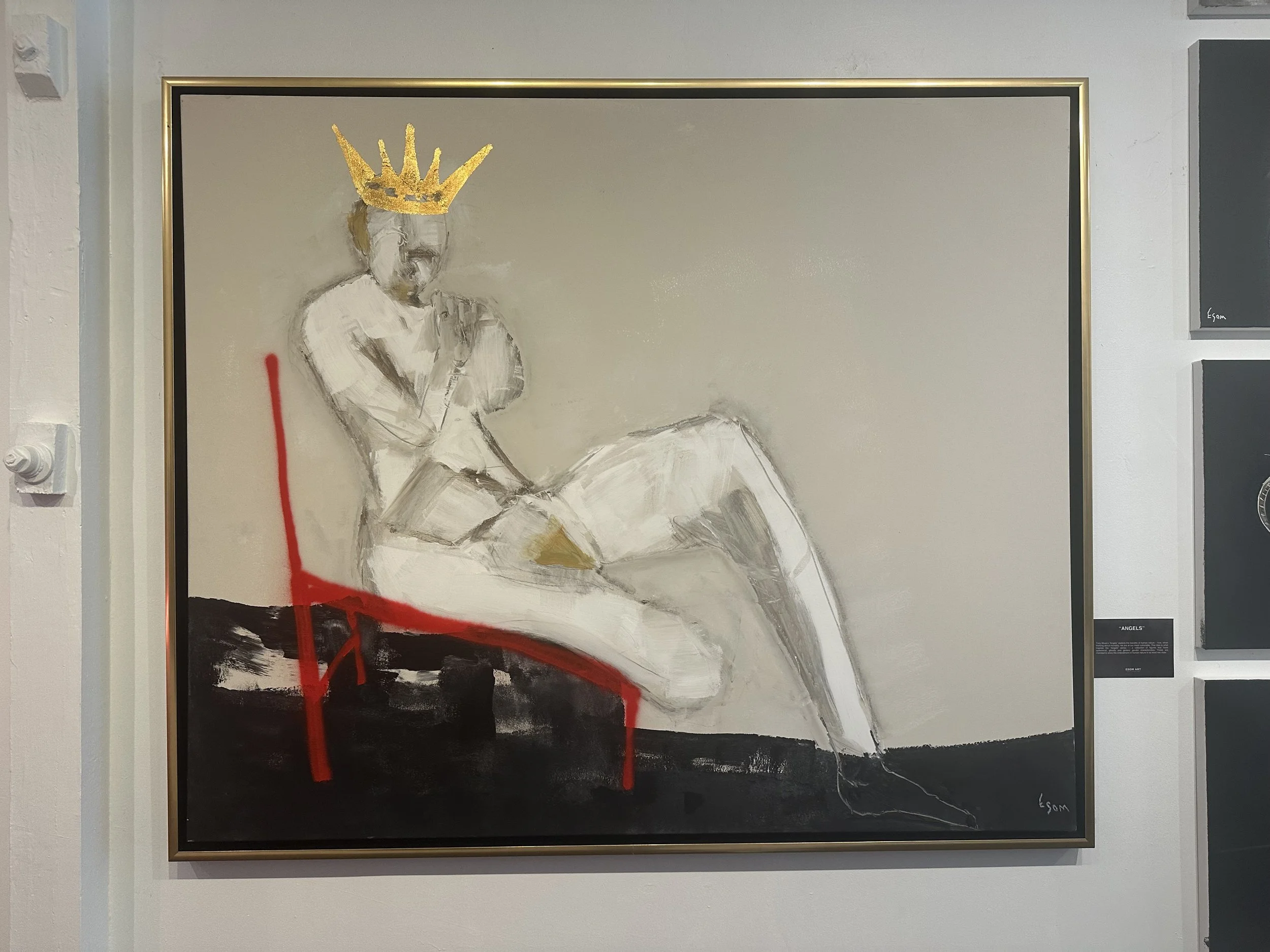
Truman’s past apartment is now Esom Art. I start chatting with the guy in front and tell him I’m in New Orleans reading books. I ask him if he knew Truman Capote used to live here. He says no, but that doesn’t matter to me. Swans, erotic and bizarre poses, the naked body as a foreground; the art is still queer. Truman’s presence is still here. We crack a few jokes and then I continue to examine the art. One piece really speaks to me, and it turns out to be his favorite too. Gay guy taste is universal. 


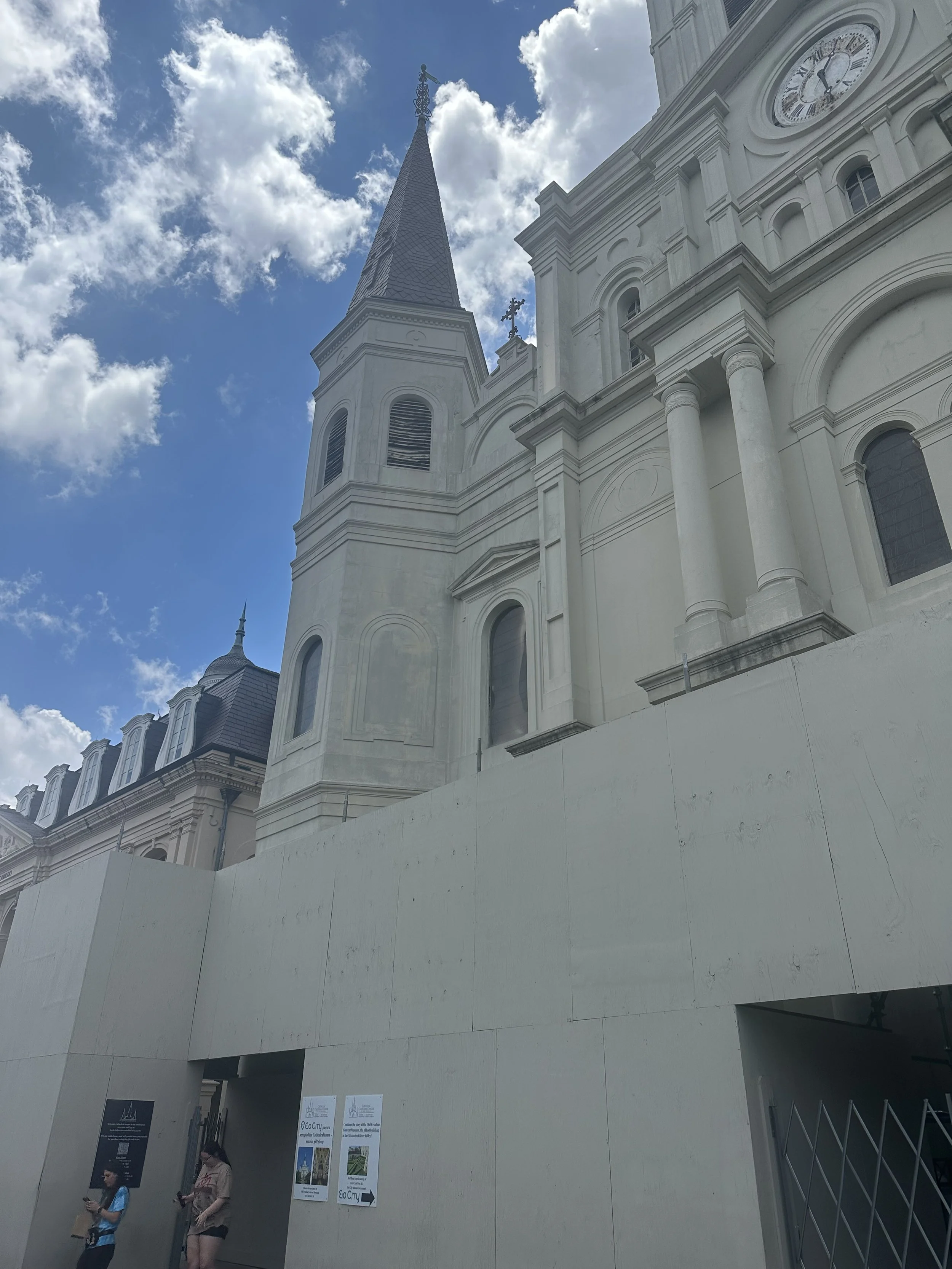
Truman apparently also liked loitering around the Saint Louis Cathedral. I ponder my bittersweet relationship with religion. I never ever believed in any God. I still don’t. I am really pondering religious people. I couldn’t stand them, and then when I tried to take queerness out of the emotional equation I ended up feeling disdain. I can’t say I’ve had a full change of heart throughout my life, but I am more open now. In New Orleans I have seen more and more religion as a community and culture rather than homophobic bible thumpers. After visiting the Katrina exhibit and the Whitney Plantation, I realized the church went from a place forced onto Black America to one of its strongest assets during hard times. Again my relationship is bittersweet; its origins in the U.S. are disgusting but it has turned into something so powerful. Should this be celebrated? I don’t know. 


Truman might have just liked the aesthetics of the church. I’ll admit it, I do too. I love the iconography, I also love when the seven deadly sins or ten commandments are personified in fiction. I love how my grandma prays to remove the evil eye from me over FaceTime when she hears I have a headache: xematiasma. Even the most atheist queer people have their own special relationship with religion. 


I later walk through the Marigny and see more queerness. An alternative queerness that I’m not sure resonates with my image of Capote. It is less elitist and overt, and rather presents itself in community. It is less loud. I stop at a cafe, and see more community. The baristas recognize couples, the bakers in the back keep extra pastries for regulars. I sense I prefer this more than Breakfast at Tiffany's.

Moving Forward

This may sound naïve, but I genuinely thought I had everything figured out for my life. I am attending a prestigious university, majoring in a field that will lead to a guaranteed doctorate, strong job prospects, and financial stability. I have a loving family, a close group of friends, and a support system. I have opportunities, connections, and a clear plan for the future. From the outside, and even to me, it seemed as though all the pieces were already in place. I had a solid plan, so I assumed I understood where my life was heading.

But one of the most valuable lessons I took away from the New Orleans trip was realizing that those two things are not the same.

Throughout the trip, I was exposed to new perspectives from both my classmates and my professor. Whether we were discussing a book or historical period in a seminar, talking over meals about our experiences, or reflecting after a long day of exploring the city, I found myself encouraged to think beyond my initial ideas. What surprised me most was how often a conversation would challenge an idea I had been confident in just moments before. I entered many discussions expecting to defend my perspective, but I often left reconsidering it. Rather than weakening my views, those moments forced me to think about them more carefully.

The discussion that stayed with me most centered on Walker Percy’s The Moviegoer, specifically its ending and whether we thought it was ideal or not. When I first finished the novel, I was honestly disappointed. After following Binx Bolling through his existential search, his fascination with movies, and his constant questioning of everyday life, I expected some kind of dramatic revelation. Instead, Binx marries Kate, returns to his faith, and begins medical school. The ending felt anticlimactic, almost as though he had abandoned the very search that made the novel somewhat interesting.

During our group discussion, however, my perspective began to shift. As we talked through the ending together, I realized that my disappointment came from my own expectations rather than the novel itself. I assumed that because Binx spent so much of the story searching, the ending would provide a grand answer. I expected clarity or some profound discovery. Instead, Percy offers something quieter.

“The search is what anyone would undertake if he were not sunk in the everydayness of his own life.”

- Walker Percy, The Moviegoer

When I first read this line, I interpreted it as a justification for searching. It seemed to suggest that ordinary life was insufficient and that meaning existed somewhere beyond routine. After our discussion, I began to see the quote differently. By the end of the novel, Binx does not necessarily reject the search; rather, he learns that searching alone cannot sustain a meaningful life. Meaning is not simply discovered, but it is also created through commitment, relationships, and participation in the world around us. One of the most insightful moments came when Professor Andrew spoke about how Binx ultimately finds what gives his life value. Rather than continuing to drift from experience to experience, Binx chooses a direction. He commits himself to responsibilities and a future. What struck me was not the specifics of those choices, but the idea that a meaningful life does not always look dramatic from the outside. Sometimes fulfillment emerges through ordinary actions rather than extraordinary revelations.

At the same time, I do not completely agree with Binx’s resolution. While I now appreciate the ending much more than I initially did, I am not convinced that the search ever truly ends. People continue to grow and change throughout their lives. New experiences reshape priorities, relationships evolve, and unexpected opportunities arise. The questions that matter at one stage of life may be entirely different at another. In that sense, I think searching is part of being human.

Before this trip, I often felt as though I had already mapped out my future. I knew what degree I wanted, what profession interested me, and what goals I hoped to accomplish. There was comfort in that certainty. Yet our discussions forced me to confront something surprisingly simple. I am only nineteen years old. For the first time, I began to recognize the difference between having a plan and having everything figured out. A plan is valuable because it provides direction, but it cannot predict every possibility. Life has a way of introducing unexpected challenges, opportunities, and changes that no amount of preparation can fully anticipate. The future I imagine today may not be the same future I eventually live, and that is not necessarily a failure. It is simply part of being alive.

New Orleans provided the perfect setting for these reflections. The city itself feels layered with history, culture, and countless personal stories. Walking through its streets, visiting historic sites, and discussing literature in a place so rich with character helped me to think beyond immediate goals and consider broader questions about identity, purpose, and fulfillment. The trip gave me space to pause and reflect in a way that everyday life often does not.

What I ultimately gained from the experience was not a definitive answer about my future. If anything, I left with more questions than I arrived with. Surprisingly, I now view that as a positive outcome. The purpose of education is not always to provide certainty. Sometimes it is to challenge assumptions, complicate easy answers, and encourage deeper reflection. As I prepare for the next stage of my life, I still have goals, ambitions, and plans. I still hope to pursue occupational therapy and build a future that reflects the values I care about. What has changed is my understanding of certainty. I arrived in New Orleans believing that having a direction meant I understood where my life was going. I left realizing that a direction is only a beginning. The future remains unwritten, and rather than fearing that uncertainty, I have started to appreciate it. After all, if life were completely mapped out at nineteen, there would be very little left to discover.

Music, Memory, and Mortality

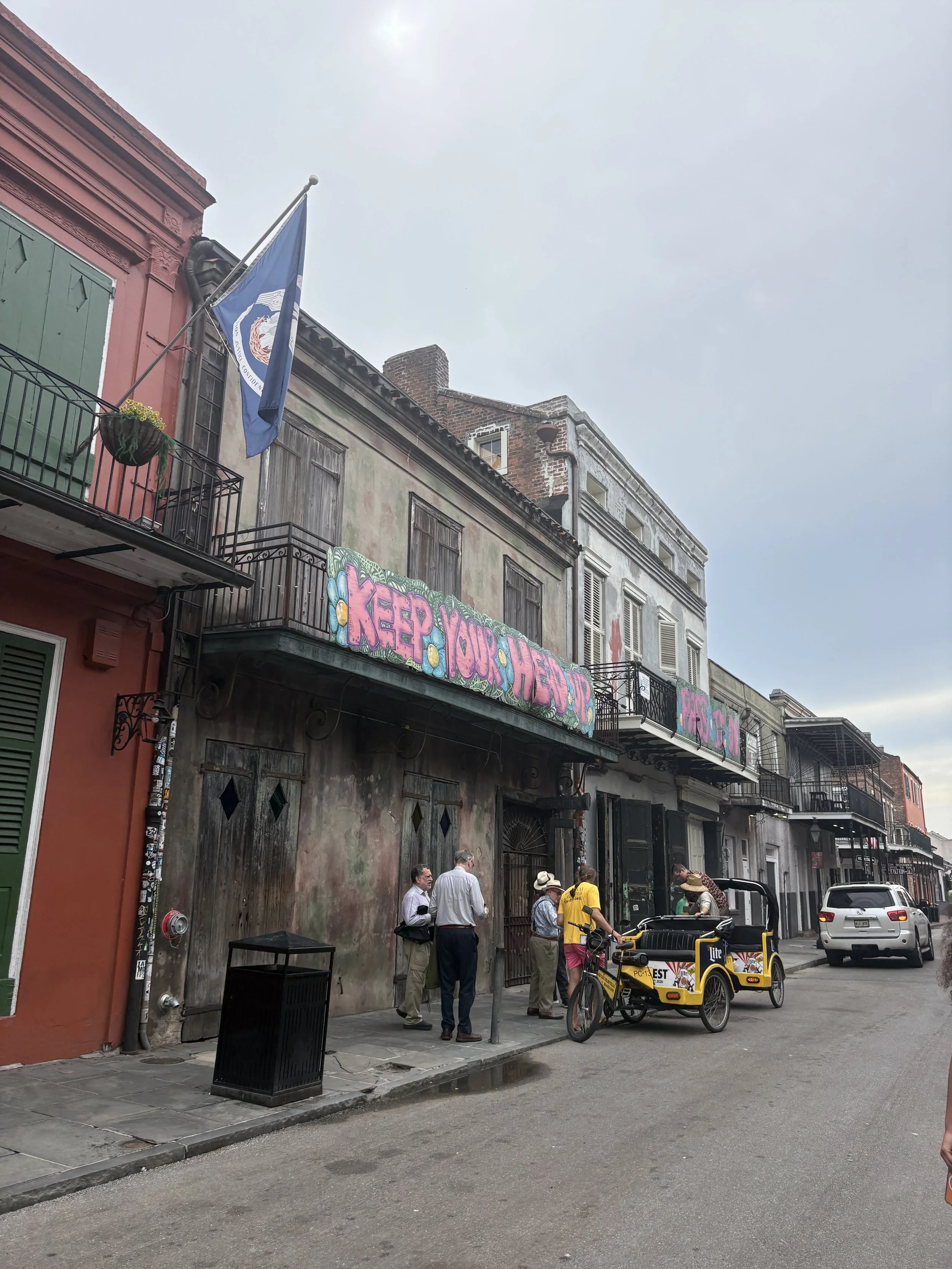
I’m not sure what I expected from Preservation Hall. I suppose I thought that one of jazz music’s most iconic venues would be a bit… grander. But there it was, tucked into the French quarter across from a bar with hand-drawn signs advertising $4 tequila shots. The building was an unassuming dove grey, only revealing its history through age spots and faded graffiti.

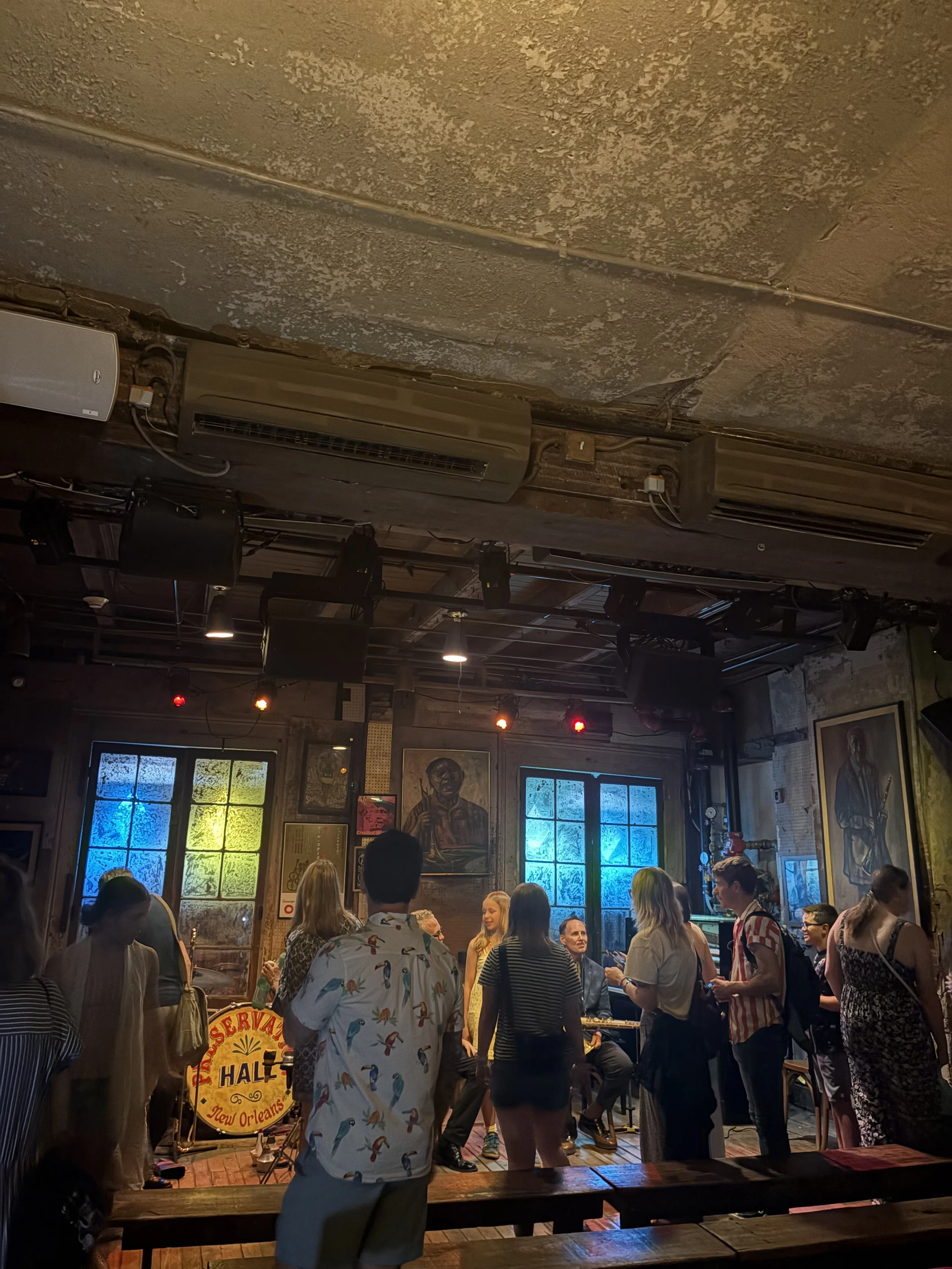
Inside was just as understated. The venue was one room with rows of wooden benches and a small area in the back where we stood. The stage was reminiscent of the ‘Whammy Bar,’ a place in rural Vermont that would sometimes have live music (and also really great truffle fries). I felt immediately transported back to my childhood. When we were told to put our phones away for the performance, there was a part of me that internally panicked. Even though I’m an adult now, I will always on some level be the ADHD ten-year-old trying to sit through a two-hour classical music performance. The idea of being stuck in a room with just my thoughts, (mostly) instrumental music, and strangers made me feel almost trapped.

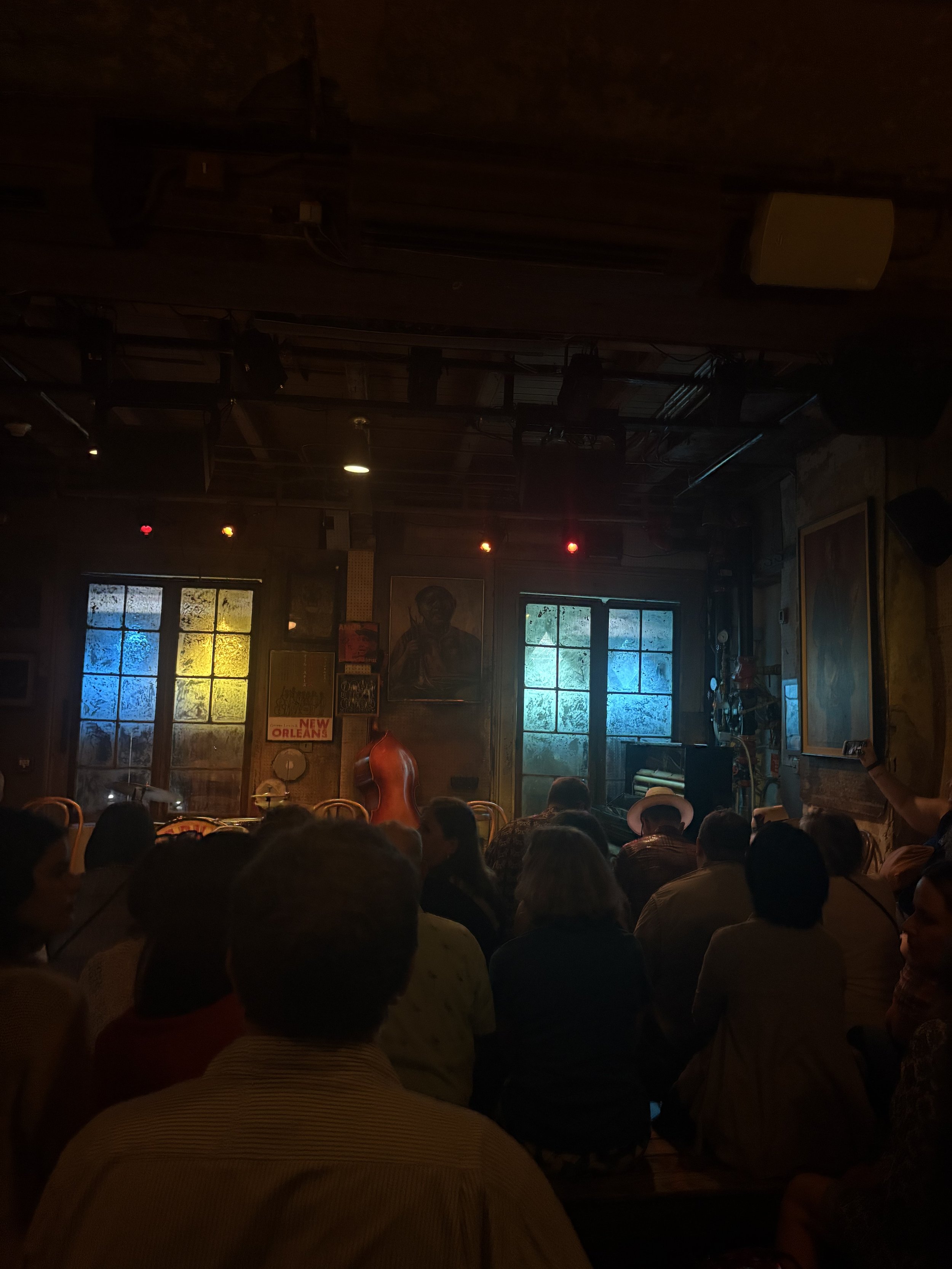
I needn’t have worried, however. From the moment the trumpet blew the first note, I was entranced. Almost spellbound. I watched the band play song after song, from a hilarious rendition of Sweet Emma Barrett’s ‘None of My Jelly Roll’ to rolling bluegrass tunes to slower, deeper melodies. I felt truly immersed in the music. People always talk about jazz being about emotions, like being able to hear the sadness in a trombone or the anxiety of a syncopated beat. I don’t think I entirely understood that idea until this performance, being able to fully focus on the sounds with no phones, no distractions, a lot of the time not even lyrics. I could hear a sweeping melancholy in some of the songs, or the blatant joy in other melodies. Throughout it all ran a sense of abruptness, spontaneity, as though these musicians didn’t take themselves too seriously. Learning afterwards that the performance wasn’t rehearsed but was instead mostly improvised was wild because of the quality, but almost made a strange sort of sense.

In fact, reading Michael Ondaatje’s Coming Through Slaughter about jazz pioneer Buddy Bolden felt almost like being at Preservation Hall all over again. Bolden’s music, though it’s been lauded as fundamental in the creation of modern jazz, was never recorded. His music only exists now through memory, through re-creation. Though we’ll never know how accurate Ondaatje’s portrayal of Bolden is, I do believe he was able to breathe life into the character the same way a skilled musician is able to breathe life into a piece of sheet music by sight. The story of the book is messy, told in bits and pieces. It’s nearly impossible to tell at some points when things switch from one timeline to the next, from Buddy’s narration to another character searching for him. This style is reminiscent of Bolden’s jazz music itself, which was often spontaneous, jumping around. “He was the best and the loudest and most loved jazzman of his time, but never professional in the brain,” Ondaatje writes (pg 14).

“Unconcerned with the crack of the lip he threw out and held immense notes, could reach a force on the first note that attacked the ear.”
— Michael Ondaatje

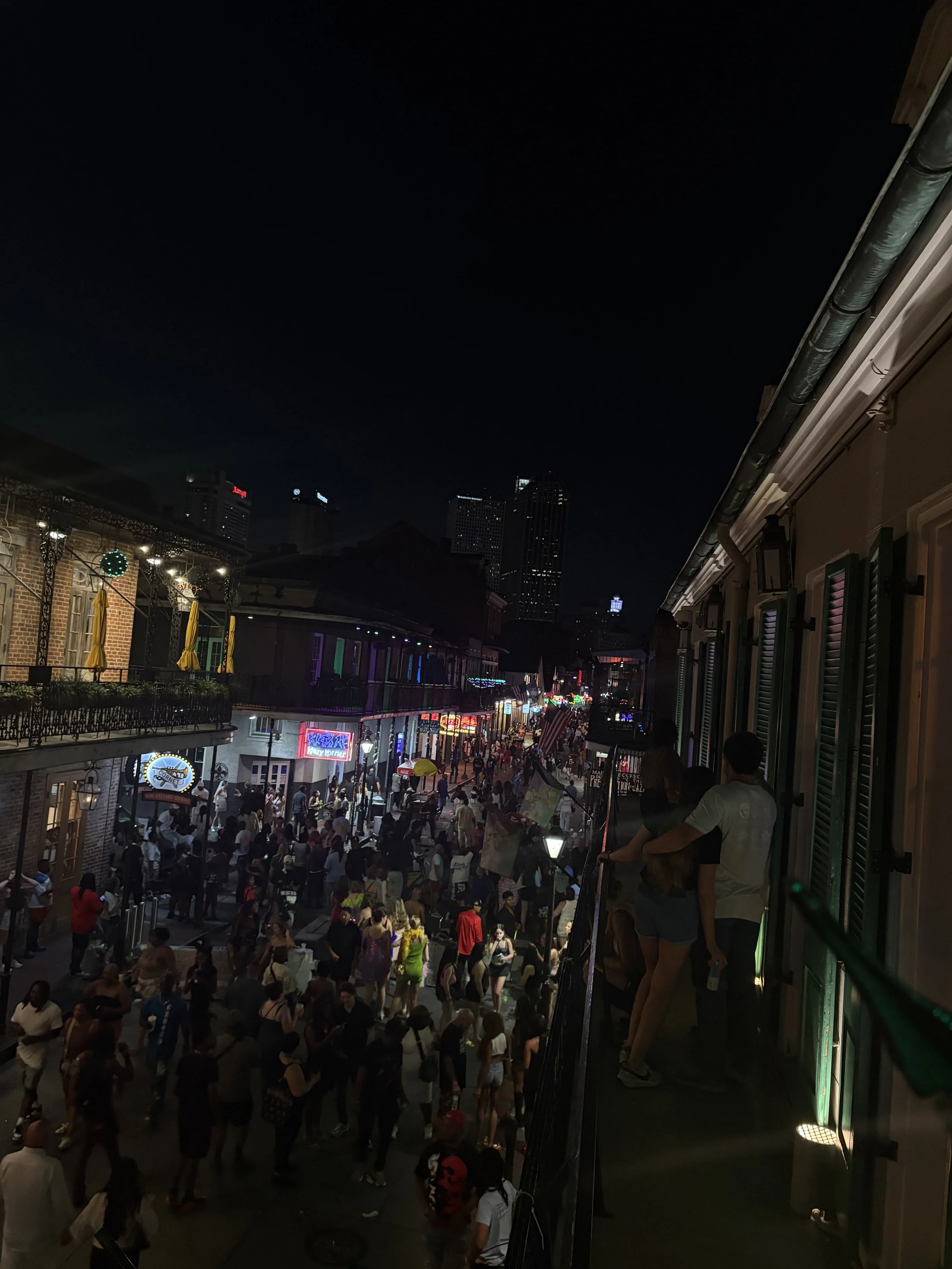
Bourbon St. at night — I can fully imagine dipping into one of these bars and finding Buddy Bolden playing for a rapt crowd.

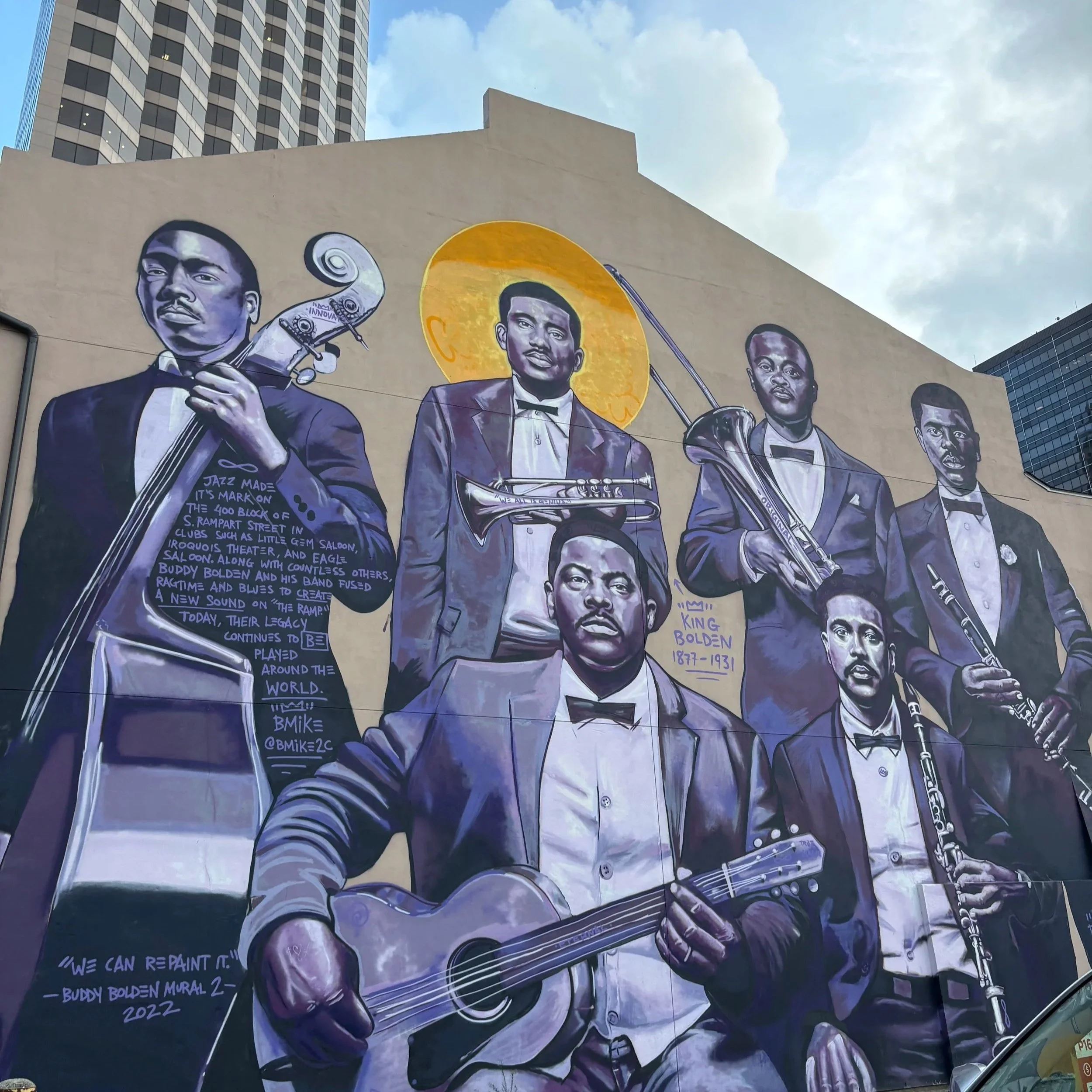
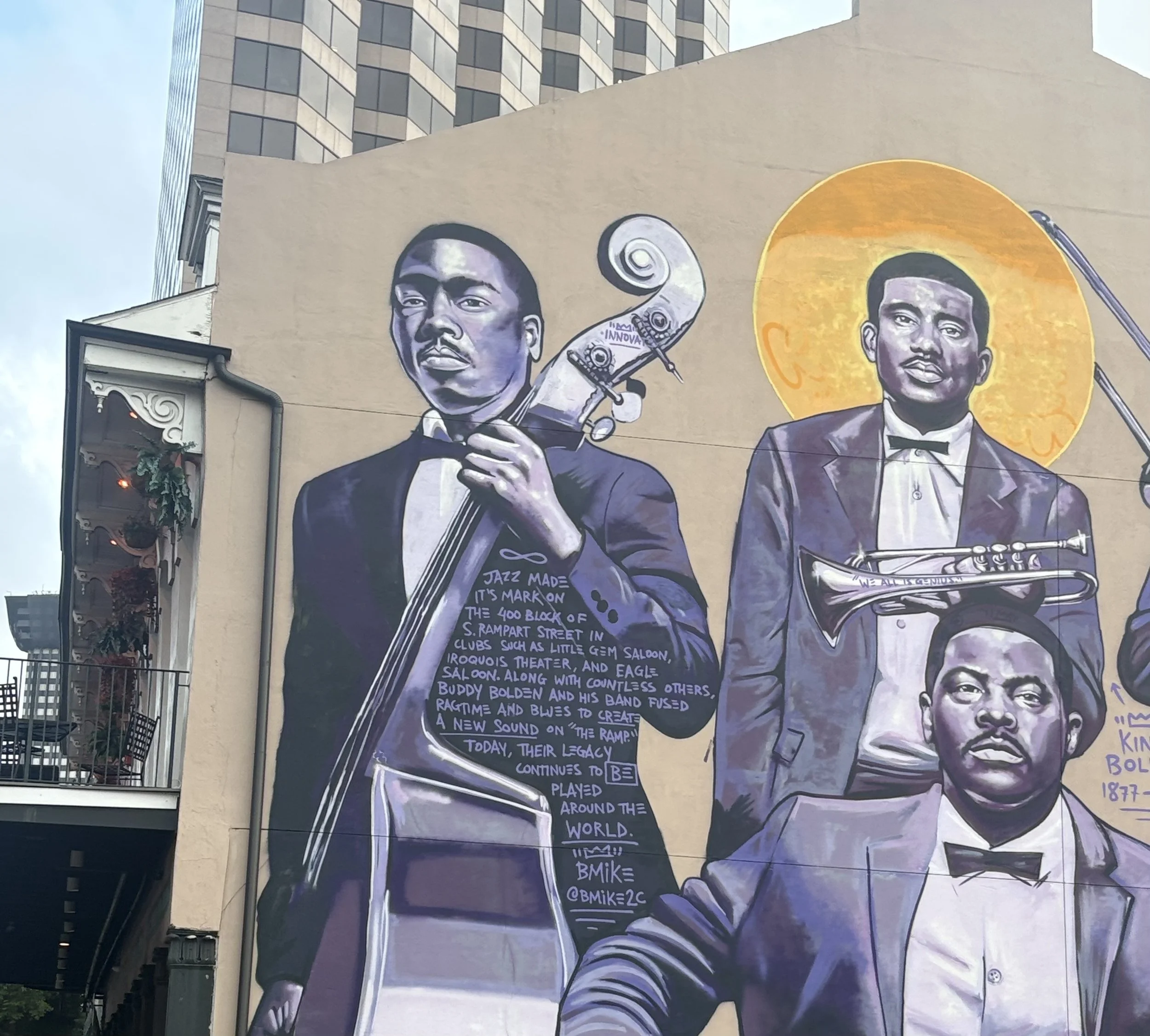
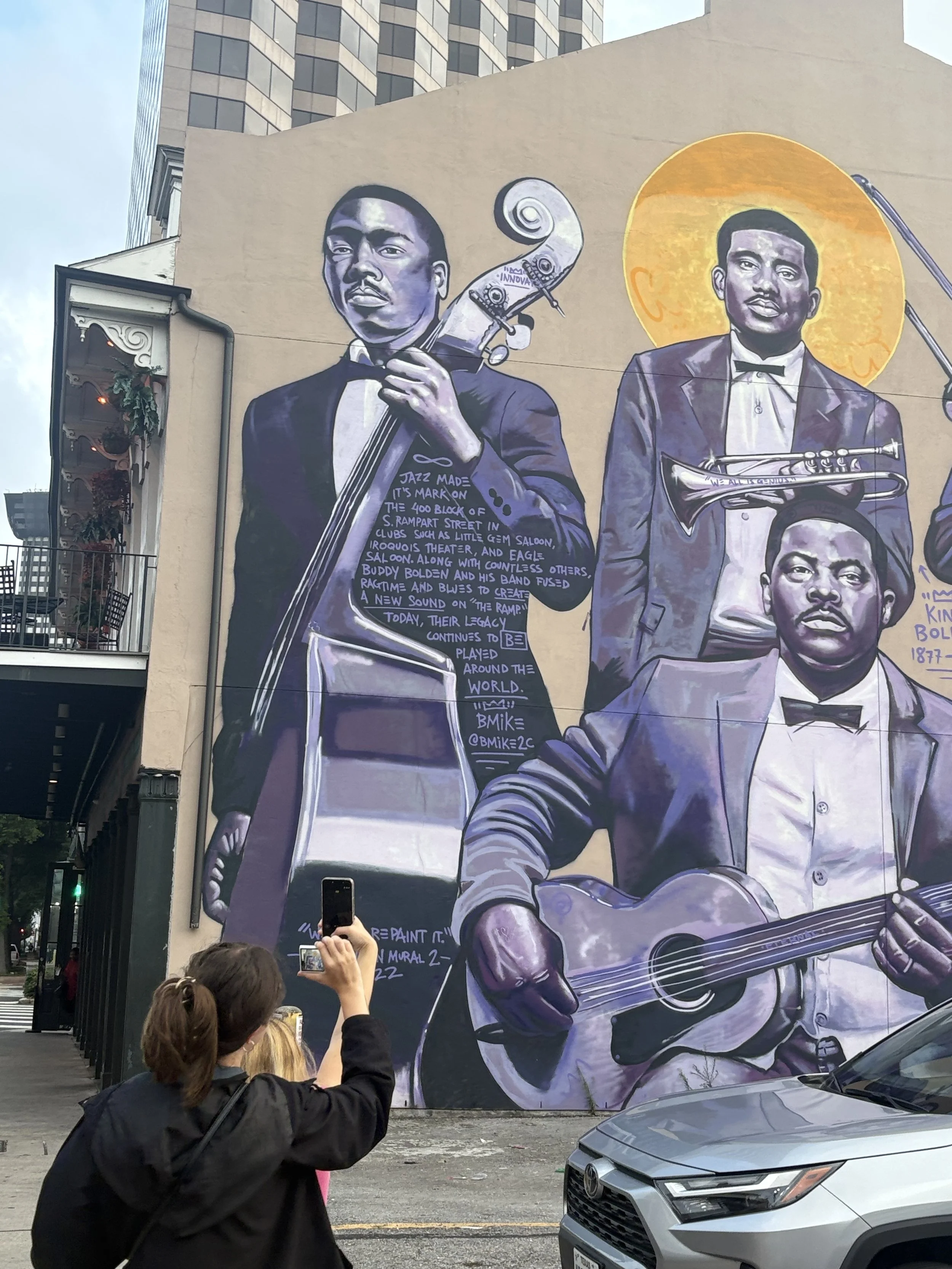
Mural of Buddy Bolden’s band that Laura, Trey, and I came across while getting pizza.

Bolden was a genius, but in a way he was almost more impressive for his lack of genius, of planning and strategy. Reading the book gave me the distinct impression that within Bolden was jazz; as though the music came straight from his soul and one could not exist without the other. No wonder Bolden didn’t have to rehearse in order to play incredibly. He already was talented. He just had to be.

As I stood in that bare bones room of Preservation Hall, heels of my feet almost numb from standing so long, it was as though I could sense Buddy Bolden’s ghost within the walls. Preservation Hall was built after Bolden’s time, and yet I could almost picture him standing on stage playing his cornet, whether a century ago or today.

With all the spontaneity and improvisation I’ve discussed also comes a dark side. It’s risky to play in such a way. For every time you get something right, you also run the risk of getting it wrong. Such is the thesis of Buddy’s life — as much as he’s a musical genius, he’s also an abusive alcoholic going through a mental health crisis that consumes him until he is ultimately taken to a psychiatric hospital where he spends the rest of his life. You can say that the book’s structure (or lack thereof) is meant to represent jazz music, but you can just as easily make a case for it being the disorganization of Bolden’s mind. The book reads like a fever dream with memories flying at you, not separated by time or distance or even narrator. The story is beautiful, but ultimately haunting. It’s one that has stayed with me in my own memory, just as Buddy’s music has lived on through memory, much like Preservation Hall has been kept alive through recollection and word of mouth as there is no recording allowed. I feel as though I hadn’t fully been able to dive into jazz and its influence on New Orleans, and this book really put me in the thick of it. Every time I see a brass band or a street performer singing Ella Fitzgerald, I find myself thinking back to Buddy. I have no way of knowing what his life really felt like, what his music really sounded like, just as Michael Ondaatje didn’t when he wrote the book. But through memory, through imagination, his ghost is kept alive.

Family of Music

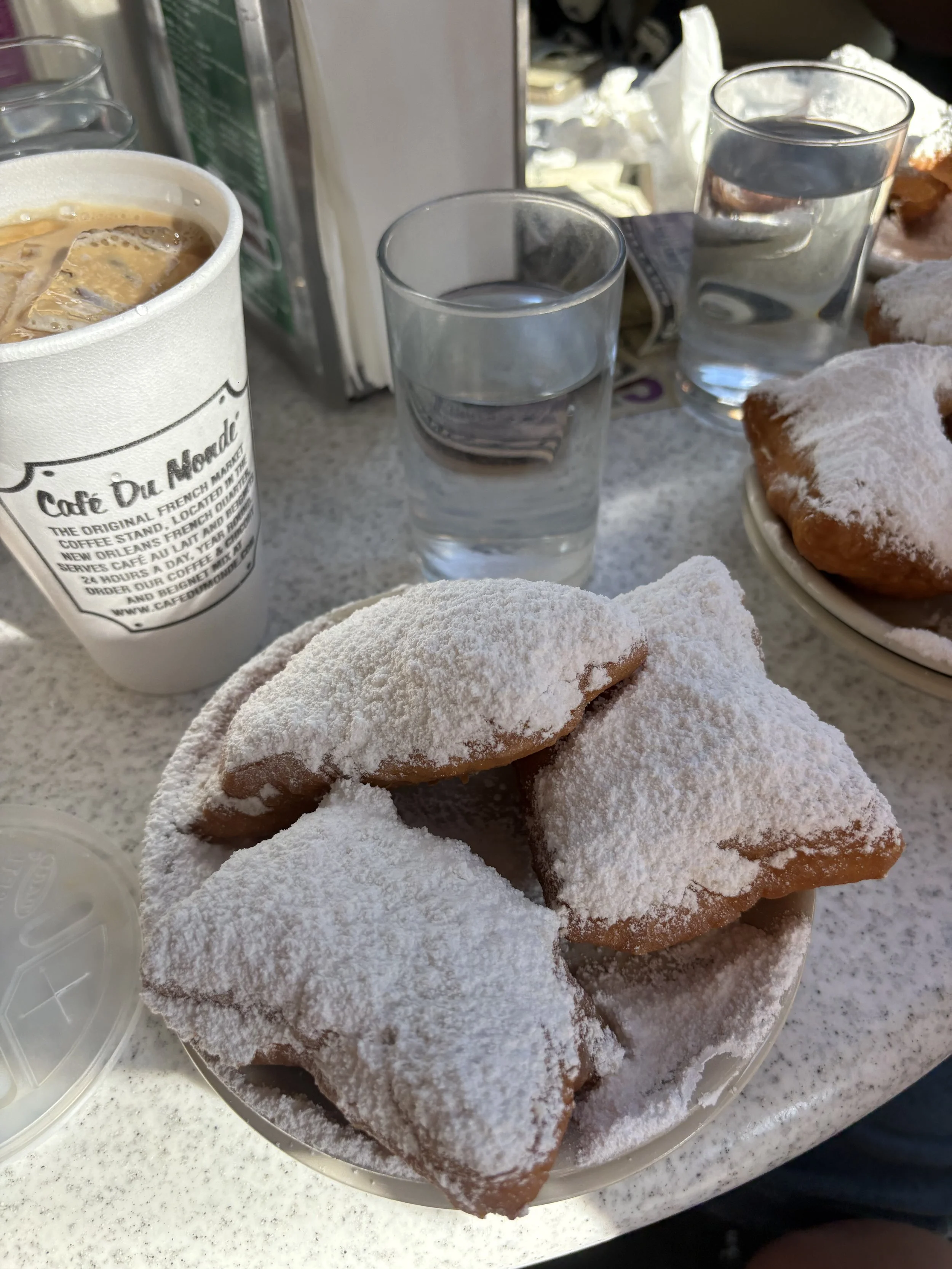
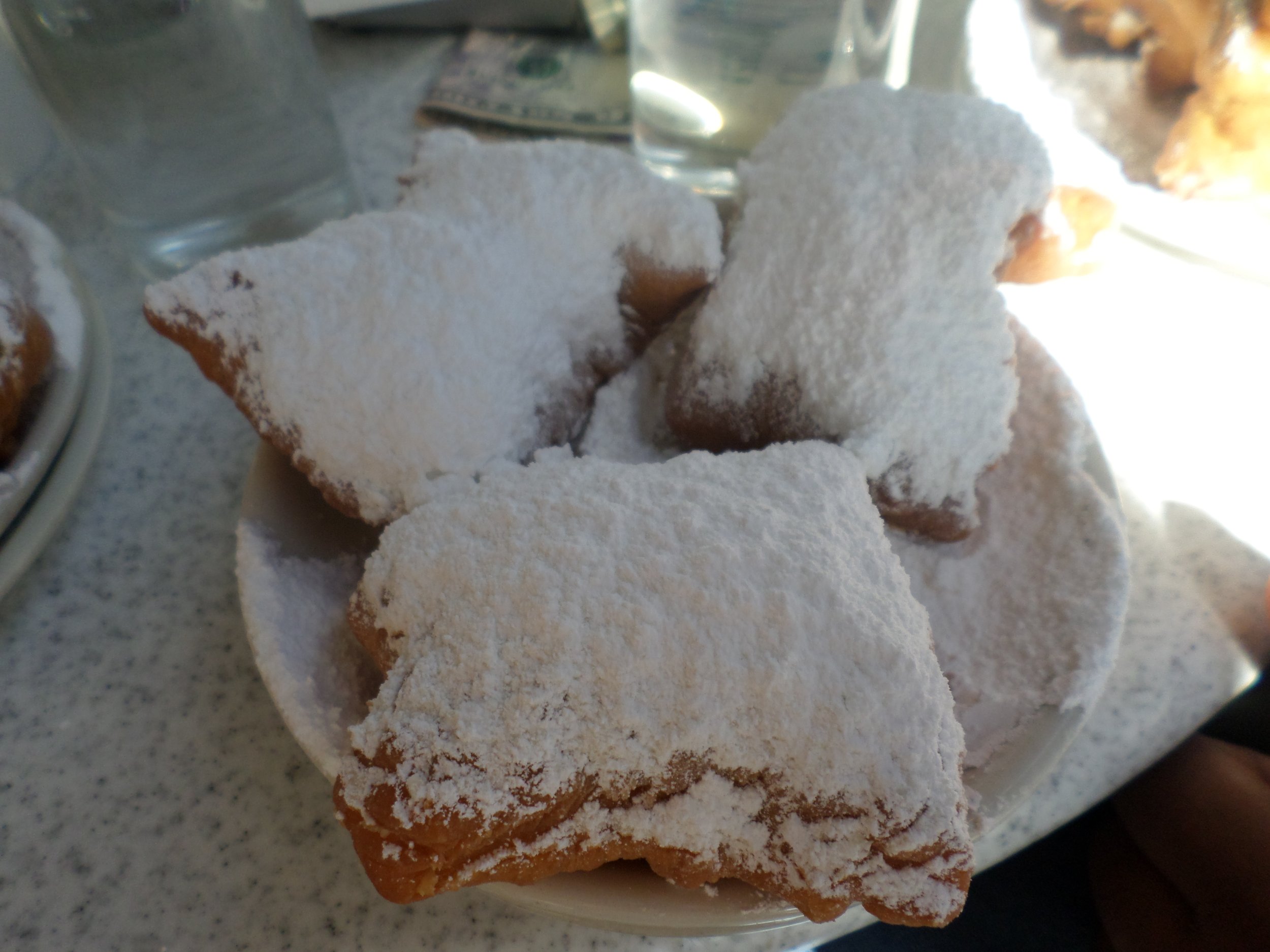
When I think of New Orleans, the top three things I think of are beignets, Bourbon Street, and most importantly, the magnificent, dance-worthy jazz music. But while growing up, I never thought of jazz as having cultural or historical significance. Honestly, it wasn't really anything to me. It just existed, but not as something I could define or even name at the time. It was more like a background noise that had always been there.

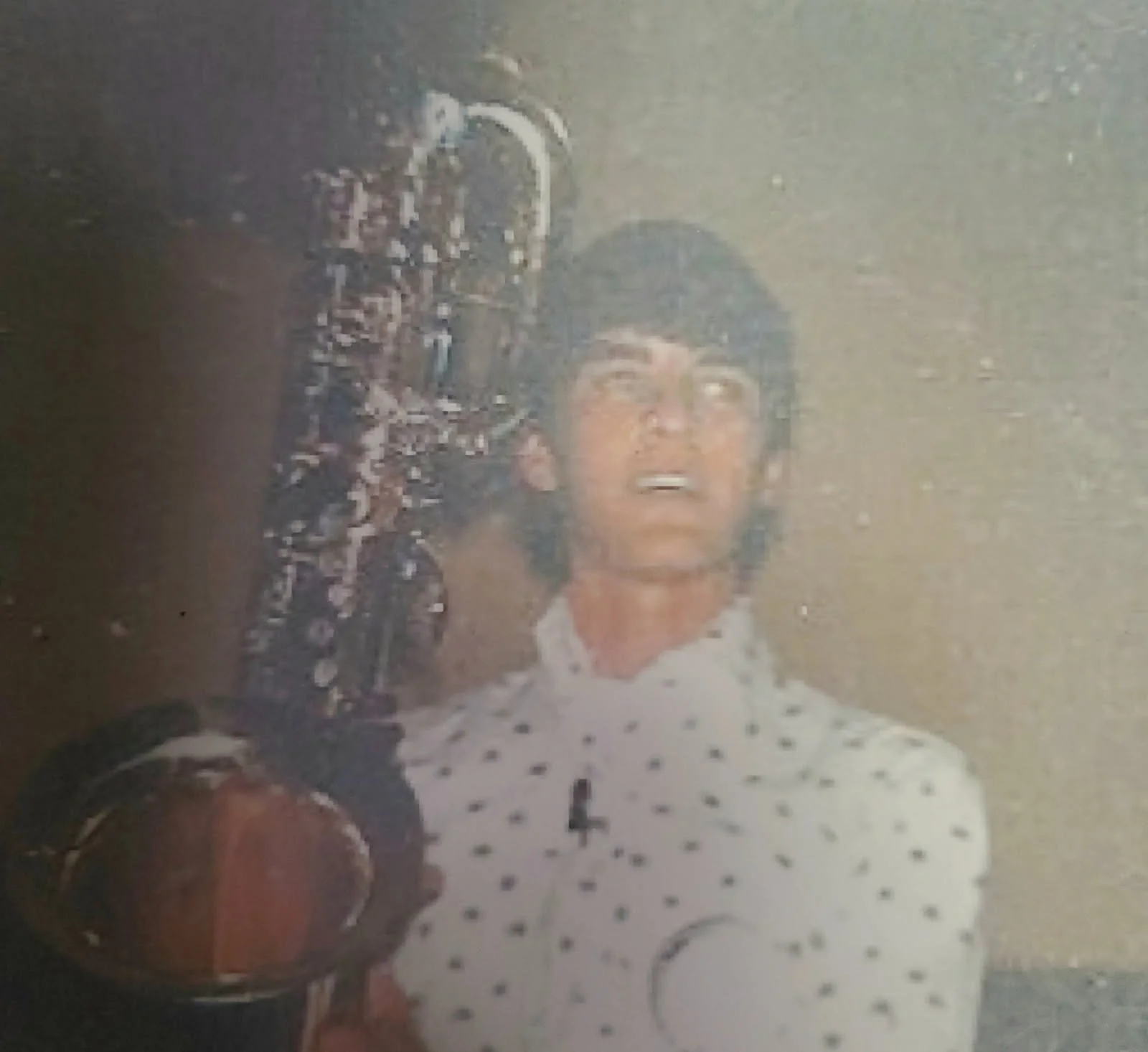
My dad in high school with his saxophone!

This was mainly because of my dad. He played saxophone in high school and majored in music in college before deciding to focus on a different career. Even after graduating, marrying my mom, working since he was a freshman in high school, and raising two daughters, jazz never left him. It shows up in everyday moments, like playing music around the house, casually mentioning songs he likes, and even in the way he reacts to jazz, as if he experiences it physically before ever trying to make sense of it. When I asked him to describe that feeling, he said it is almost instinctive, like it shifts his energy and pulls him into a different rhythm without him even realizing it.

Me peforming in a Christmas musical!

That's probably why I began participating in musical performances growing up. Music had always been present in my life, so getting involved myself and eventually trying to learn an instrument (didn't end well) felt like a natural progression rather than a deliberate decision. Although I never became particularly skilled at playing, those experiences changed the way I listened to music. I became more aware of how performers communicate emotion, how audiences respond to certain sounds, and how the same piece can feel completely different depending on who is performing it. Rather than focusing on technical skill, my experience with music made me appreciate its ability to create a shared emotional experience between performers and listeners.

Looking back, this also made me realize that culture is often absorbed long before it is consciously understood. Some things become familiar not because they are formally taught, but because they are constantly present. Jazz was one of those things for me. I never sat down to study its history or learn how its musical structures developed. Instead, it became associated with specific memories, places, and moments from everyday life. By the time I was old enough to think critically about jazz as a cultural tradition, it already felt familiar. My connection to it was shaped less by education and more by the environment in which I grew up.

My idea of proximity became more evident while walking around New Orleans. Jazz is not separated from the environment and people. It exists throughout the streets, crowds, and public spaces; anywhere I went, I heard some sort of instrument being played. I love how it is not confined to performance halls or concerts. It just appears throughout the city, whether it's brass instruments playing in the French Quarter, musicians gathering on sidewalks to play unrehearsed, or rhythms shifting as people move to the sound. For New Orleans, jazz is not something people go to watch but something they move through.

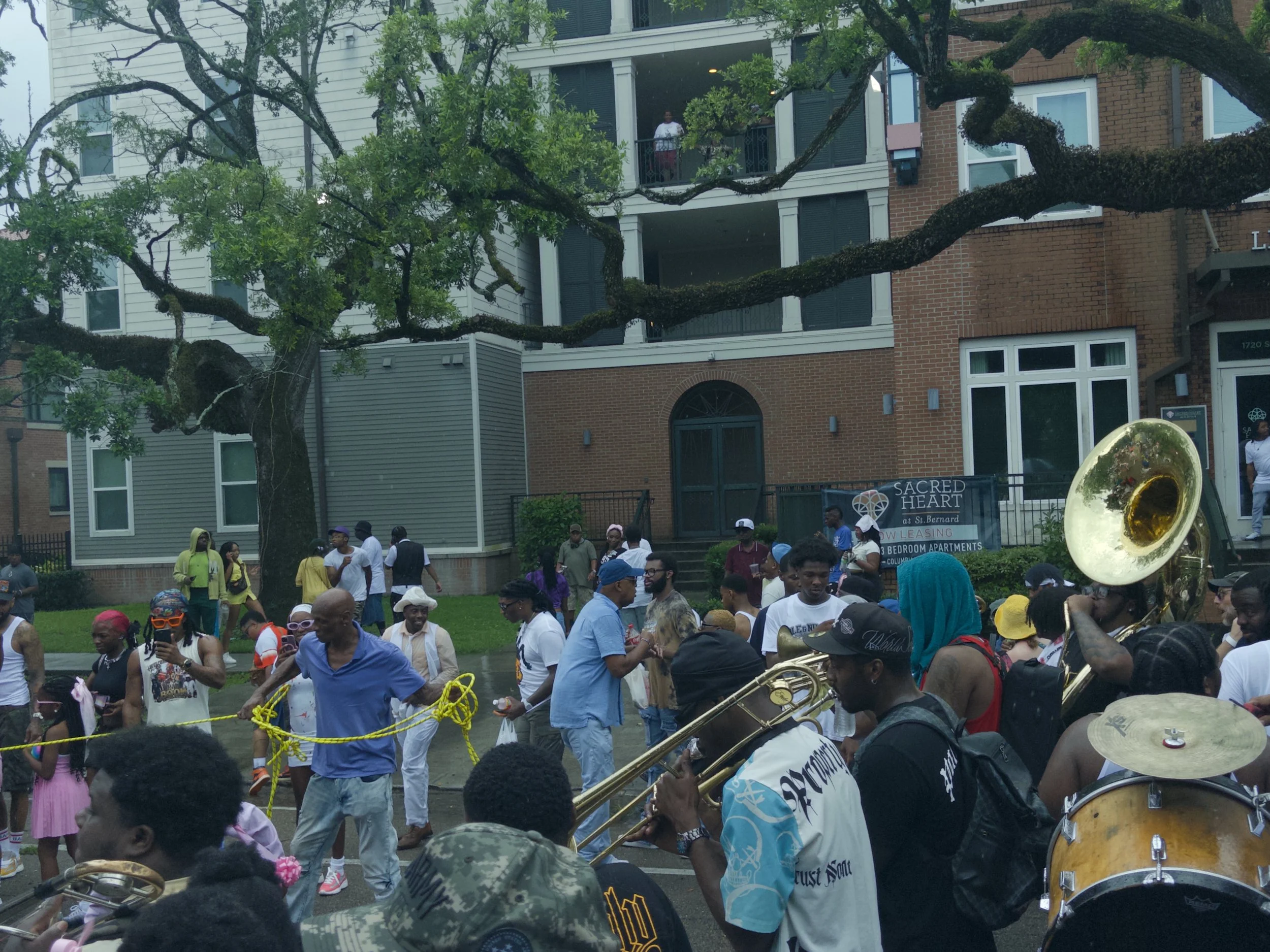
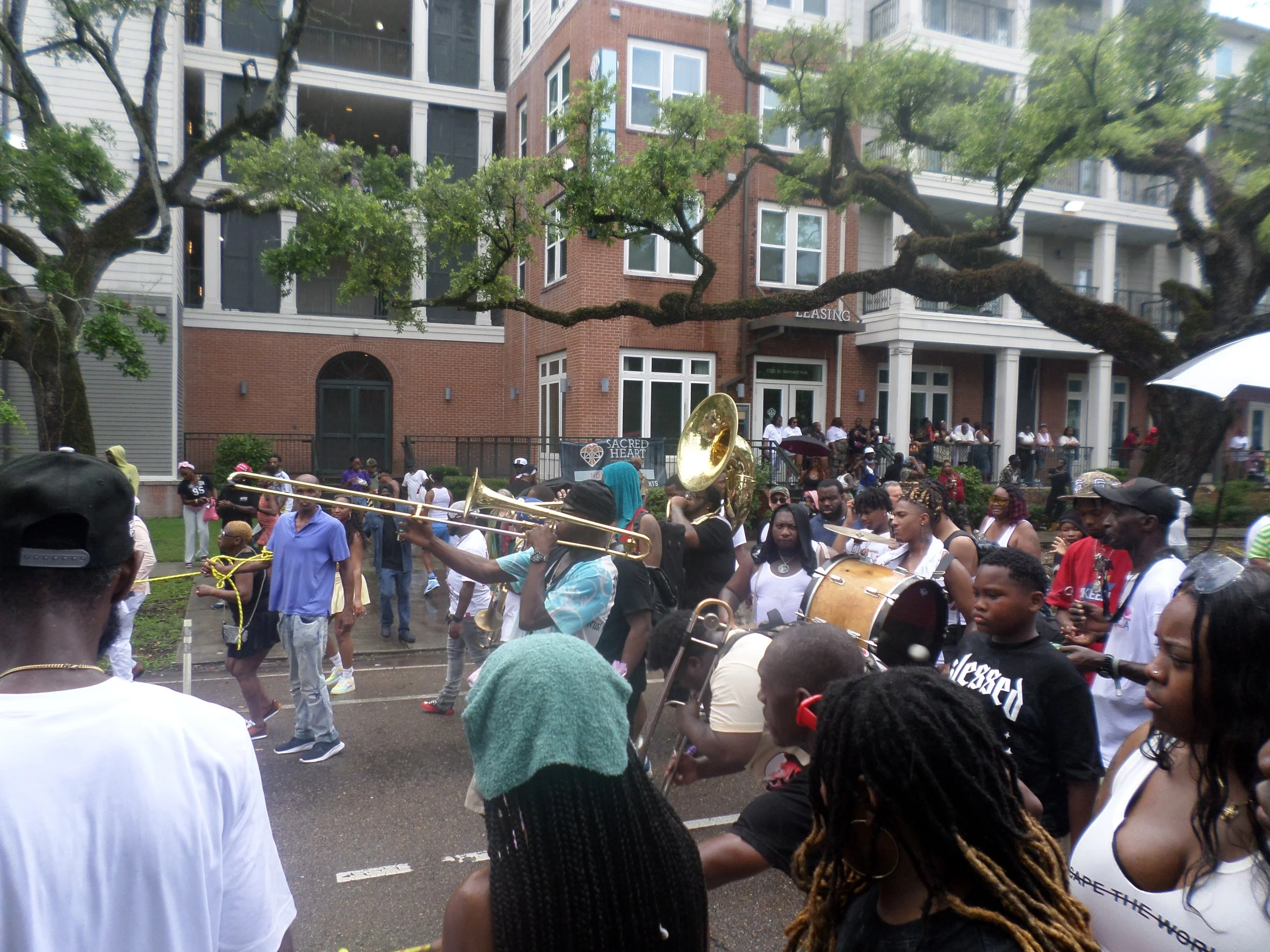
One of the best expressions of this that I had the opportunity to witness is the Second Line Parade. Tourists, like myself, may see it as a musical procession led by a brass band, but I have realized its structure is more participatory than it is performative. After my failed first attempt to see the parade due to heavy rain, I decided to research what the performance meant. I found that the “first line” refers to the main group of musicians and organized participants, while the “second line” is made up of anyone who joins in behind them, including locals, visitors, and community members who follow the music through the streets. What makes this extraordinary is that there is no strict boundary between performer and audience.

The Second Line treats music as something that happens through movement: clapping hands, swaying side to side, and nodding in rhythm as the procession moves forward. The sound itself shifts depending on the crowd, the walking pace, the energy of the moment, and even the weather that shapes how the street feels and responds. Although the tradition has very recognizable musical patterns and historical roots, no two parades are exactly alike. What does stay consistent, though, is the opportunity for people to become involved in it. This may be one of the reasons why the tradition continues to feel relevant across generations.

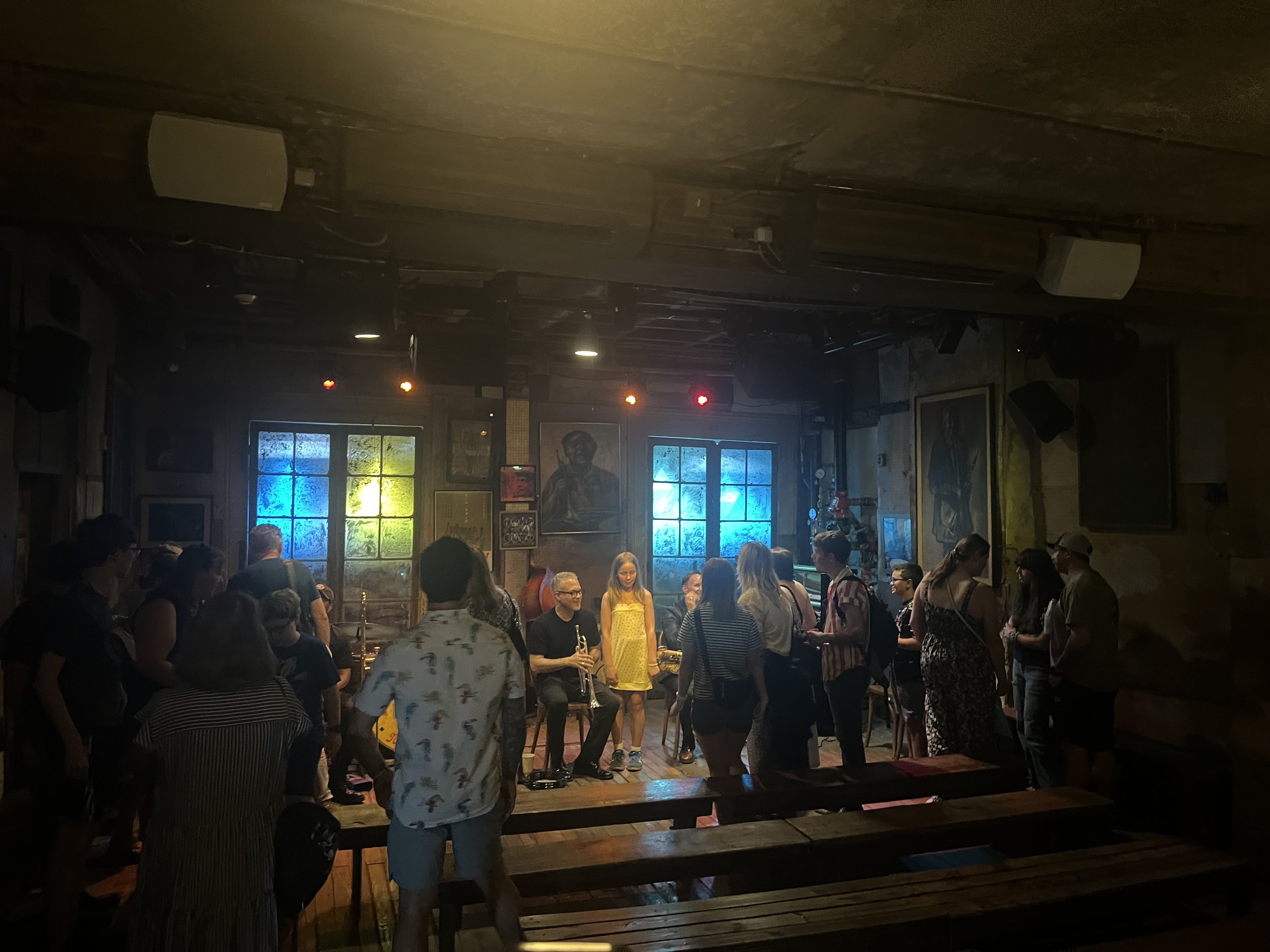
That idea of music existing through movement and participation became even more tangible during my visit to Preservation Hall. Nothing could have prepared me for that performance. It was in a small room, with no elaborate stage effects or technological enhancements that separated the audience from the performers. It was extremely interactive, and the musicians were close enough that the sounds felt immediate, not projected. What I loved the most was seeing how attentive and engaged everyone else was. They did not allow phones or cameras during the performance, so the focus remained entirely on the musicians.

After the performance was over, I began researching the history of Preservation Hall to learn more about why they started the foundation. When I read how it emerged in the mid-20th century, I realized that it was during a time when traditional New Orleans jazz was no longer the center of mainstream music culture. Once newer styles gained popularity, a lot of older musicians were pushed out of major venues and commercial recognition. Preservation Hall then became a place where those musicians could continue performing and share their musical tradition that could have faded from public view. The venue chose to create a space for artists whose contributions continued to be valuable even if they were not commercially dominant.

After researching the history behind the parade and venue, I began to understand Michael Ondaatje’s Coming Through Slaughter in an entirely different way. The novel follows an early New Orleans music performer, Buddy Bolden, but the way Ondaatje tells his story suggests something besides biography. What began to stand out to me was the book's structure and how it was written differently compared to the other books I have read on the trip. I remember discussing in a seminar how the novel does not follow traditional linear narratives, and instead is fragmented, shifting between perspectives and impressions. It reflects the uncertainty surrounding Bolden himself. The novel does not try to tell a complete or definitive story of his life. Instead, it implies that Bolden's life and experiences cannot be fully described by a single explanation. Even the fact that there are no recordings of Bolden's music becomes significant. Rather than treating that absence as a problem to solve, Ondaatje builds the novel around it, forcing readers to think about how historical figures are remembered when parts of their stories have been lost.

“This last night we tear into each other, as if to wound, as if to find the key to everything before morning.”

- Michael Ondaatje, Coming Through Slaughter

What stands out in this line is not just the emotion but the urgency. The characters seem aware that whatever understanding they are searching for may be temporary. That tension appears throughout the novel, where moments of clarity emerge briefly before slipping away again.

Looking back, I am surprised by how often similar questions appeared throughout this trip. Whether I was listening to my dad talk about music, following a Second Line through the streets, sitting inside Preservation Hall, or reading Coming Through Slaughter, I kept returning to the relationship between memory and experience. Each encounter approached that idea differently, yet all of them made me think about how culture continues to shape people long after its origins. Jazz survives because people continue finding new ways to engage with it, reinterpret it, and make it meaningful within their own lives. In that sense, what I inherited from my dad was not a specific collection of songs or facts about jazz history. It was a familiarity with a tradition that I only began to fully appreciate after experiencing New Orleans for myself. Jazz, as I came to understand it, is not something that is kept alive by protecting it from change. It is something that stays alive precisely because it cannot remain the same.

The City of New Orleans

The City of New Orleans

As I spend my time reflecting on my time here in New Orleans, I have come to some revelations. It's hard, really, to write more — I think I've covered a lot surrounding my sentiments of the city covering different topics and backgrounds. So I think I'll just take some time to appreciate the city for what it is. I guess I could talk a bit about the difference between Louis and Lestat, or I could talk about Binx. But ultimately, I think what I want to say is something those books already know, and that I've also caught up to.


There is a reason writers come here. Not just to set their stories here, but to actually be here, to sit in the humidity and let the humidity work through them. Tennessee Williams wrote A Streetcar Named Desire in the French Quarter. Truman Capote grew up in these streets. Anne Rice built an entire mythology out of the specific moral architecture of this place, the way licentiousness and grief share a face here – as shown through Lestat and Louis, which is something you feel the moment you walk outside at night and find the city fully, unapologetically alive in a way that makes you feel like the rest of America has been doing something wrong.


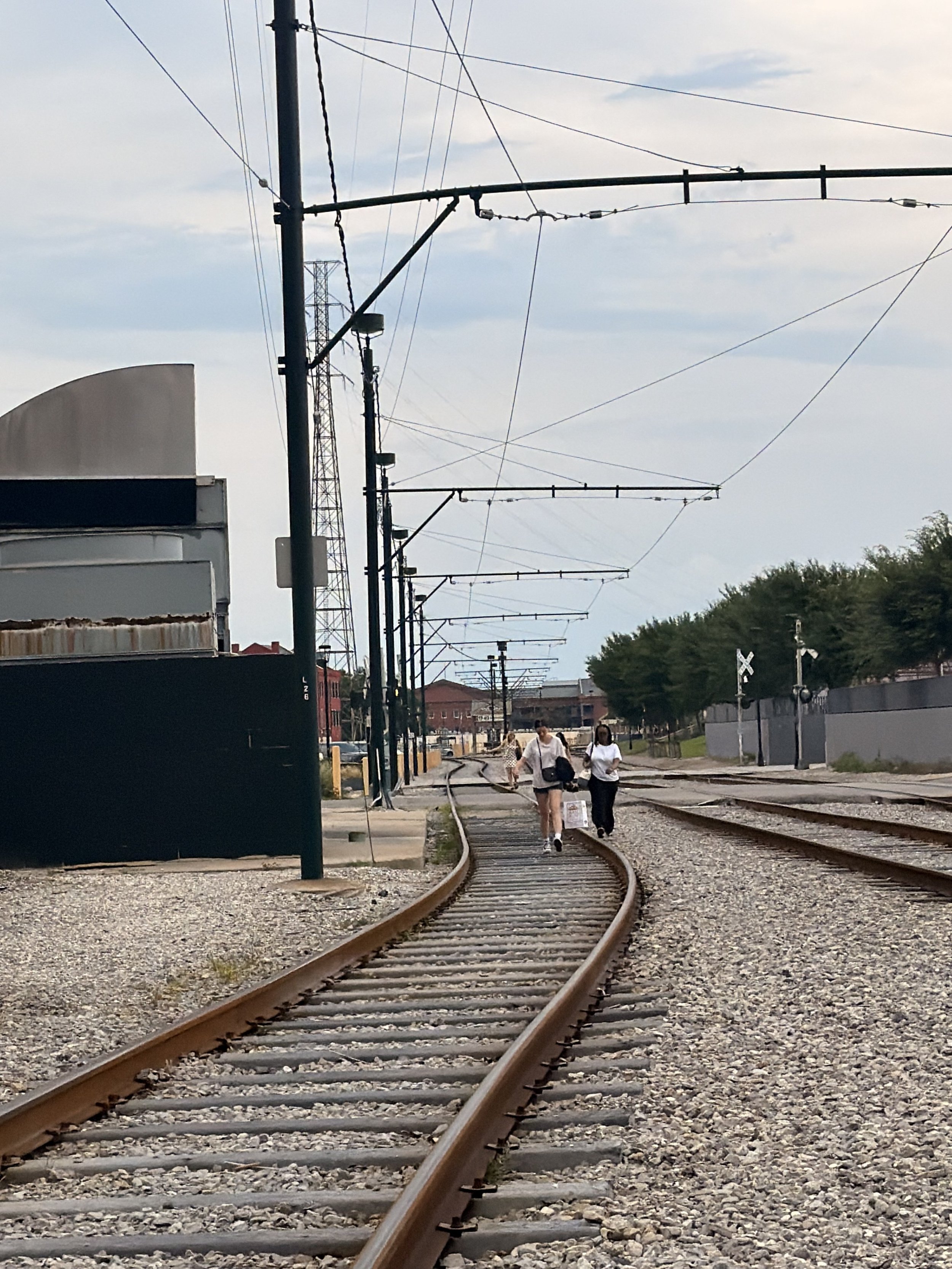
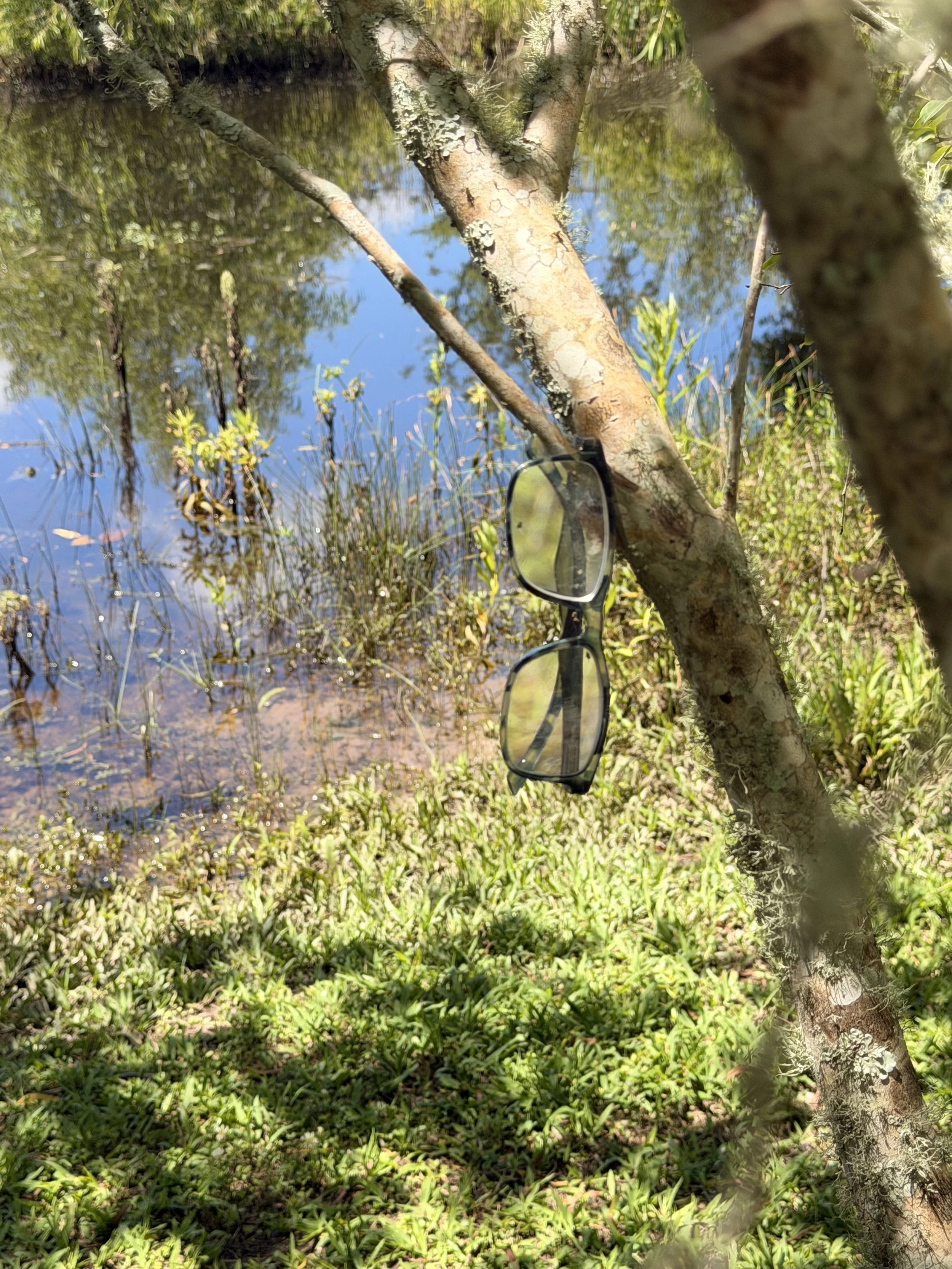
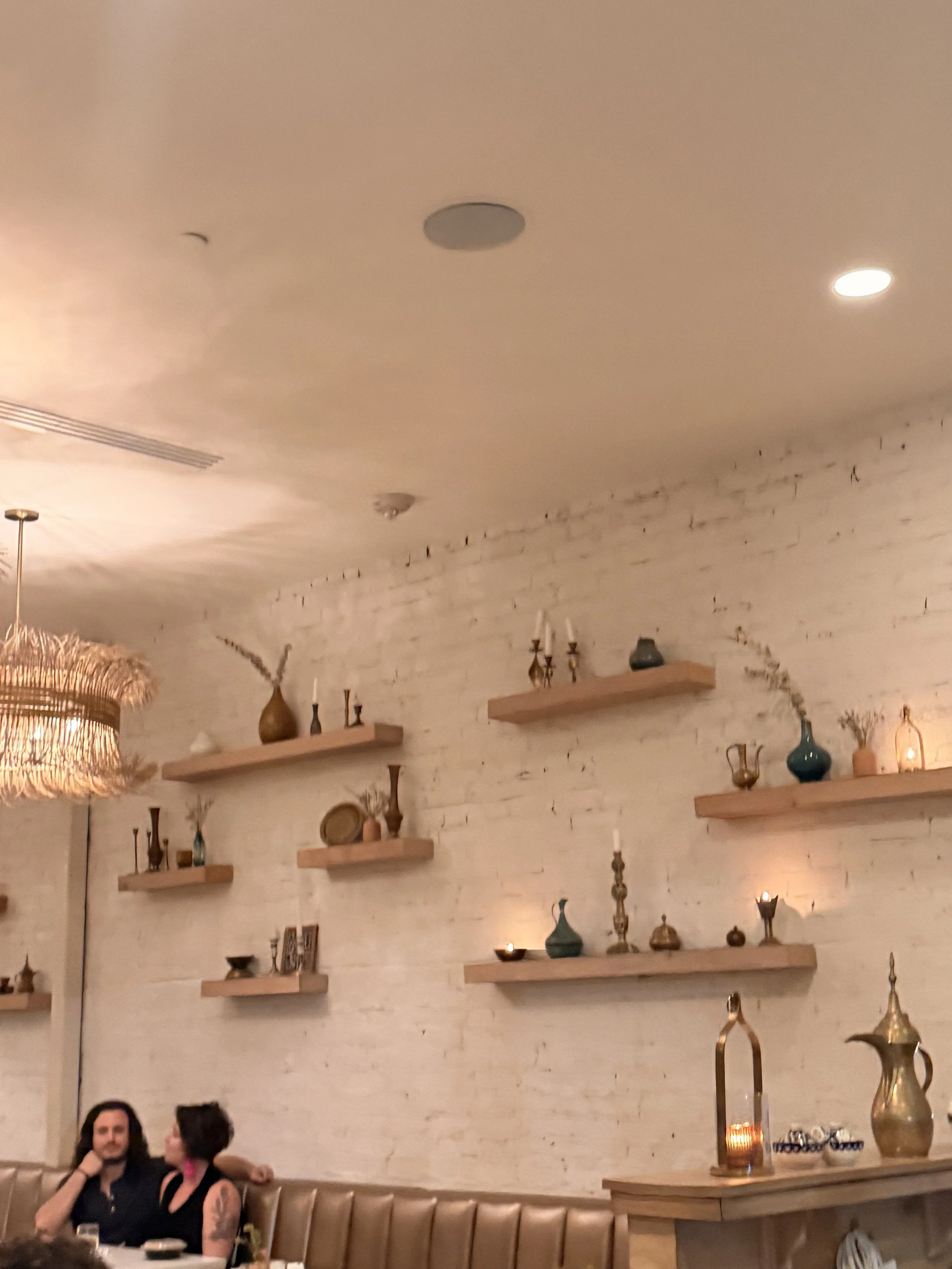
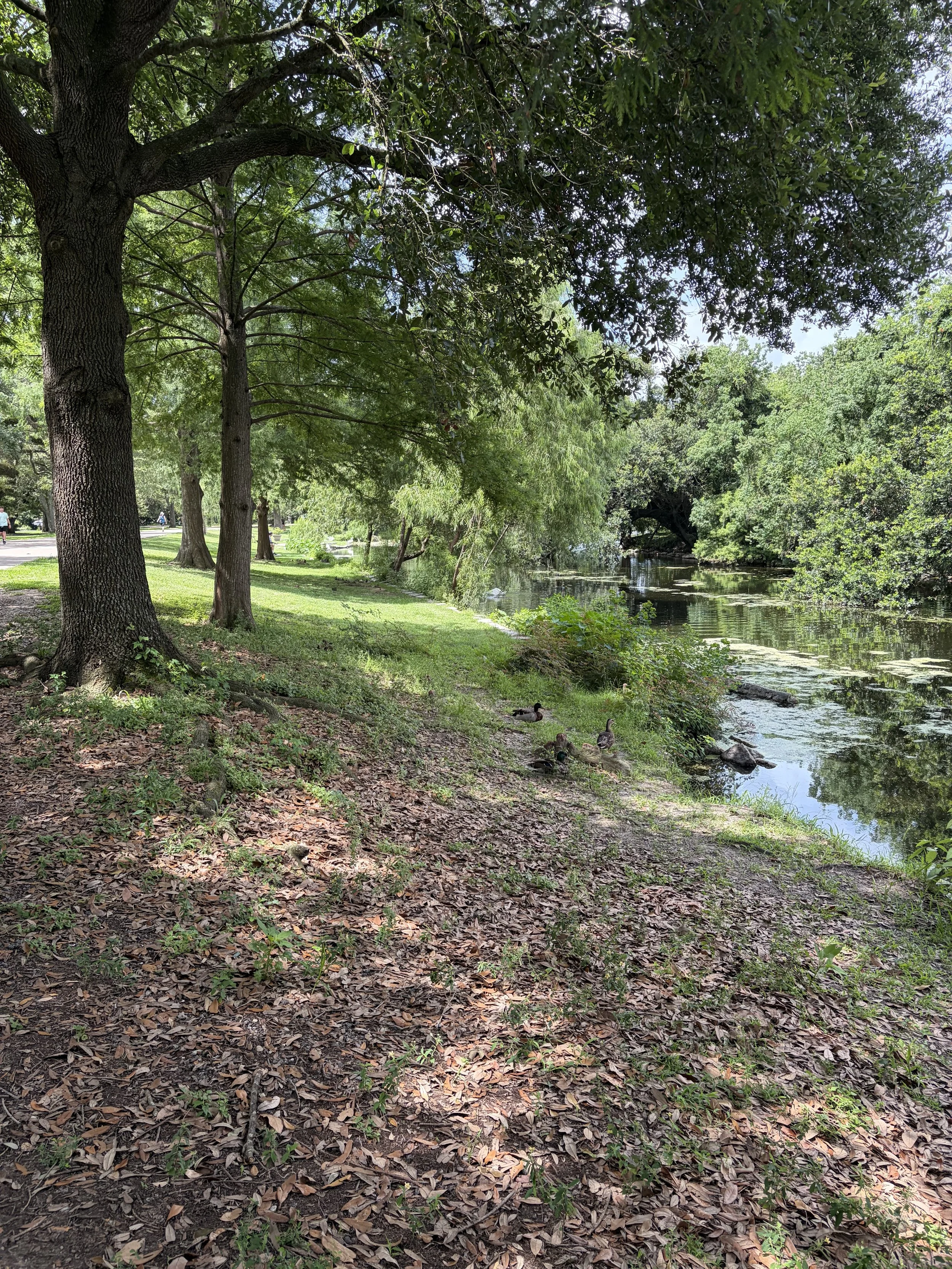
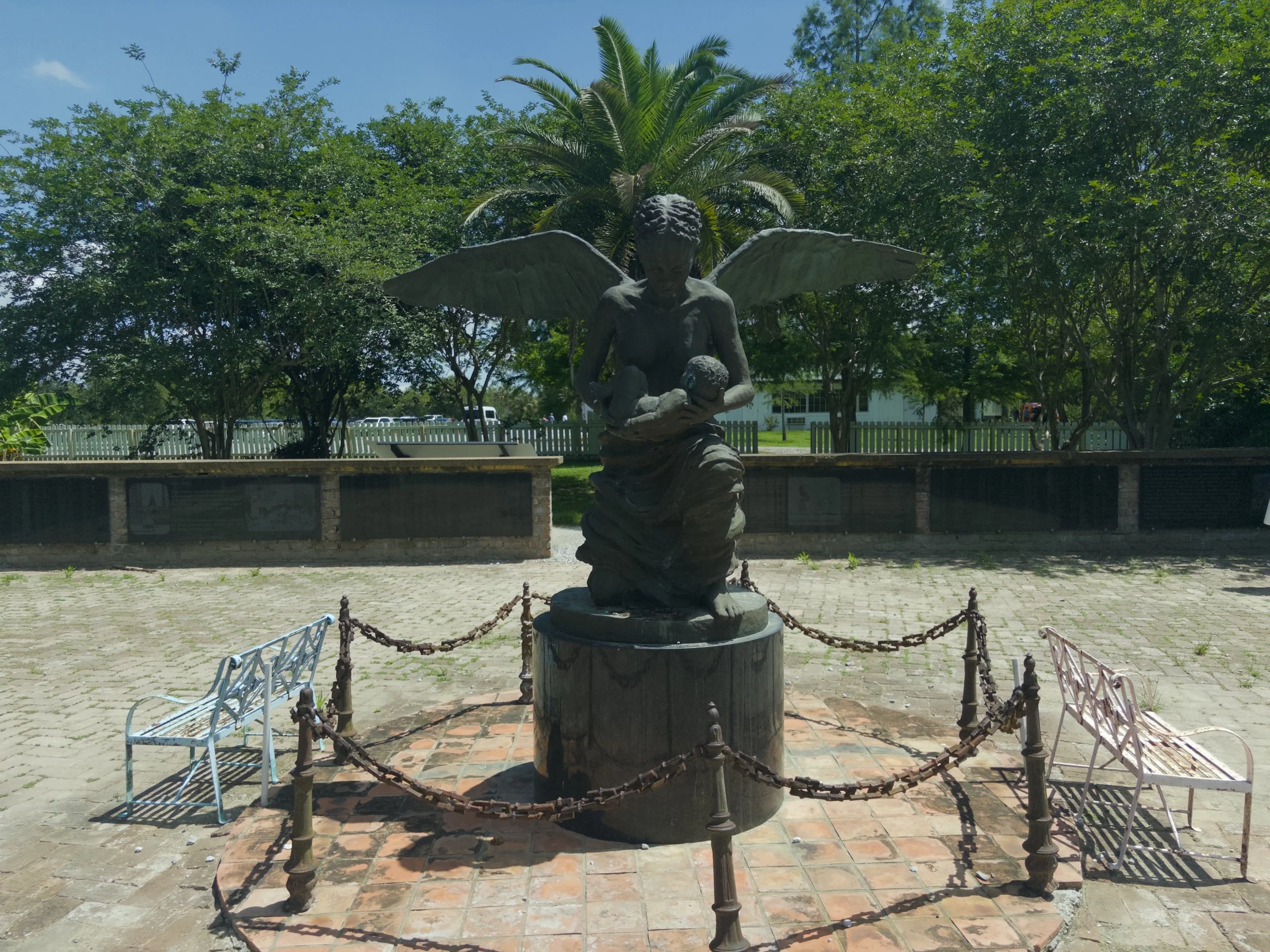
What strikes me is how extraordinary the city manages to be. How it takes such a mundane things and turns it into something interesting. Take this picture of Mallards waddling through Audubon Park for example. I could have sworn they were gossiping about us walking their space. Shotgun houses painted lime green and lavender in the Marigny, sitting shoulder to shoulder, hanging baskets of flowers over red doors, the whole block looking like someone chose joy very deliberately whilst being in a place where much of the time there’s none. Aesthetic restaurants — warm candlelit rooms with brass pitchers on white brick shelves. Greek food in a place where Greekness isn’t a first thought. I loved walking on the rail tracks cutting through flat afternoon heat with the city spreading in every direction, but just for a second, let me be a kid. Chinese-inspired red lanterns glowing from dark ceilings in the club. And of course the swamp light at the edge of still water where the reflection of thought through some hanging sunglasses and the sky's reflection become the same thing, especially in such a heavy place as the Whitney Plantation. None of these images feel separate from each other here. They accumulate into something that is harder to name than beauty, closer to truth, but imbued with immense horror in the same breath.

“America has only three cities: New York, San Francisco, and New Orleans. Everywhere else is Cleveland.”
— Tennessee Williams


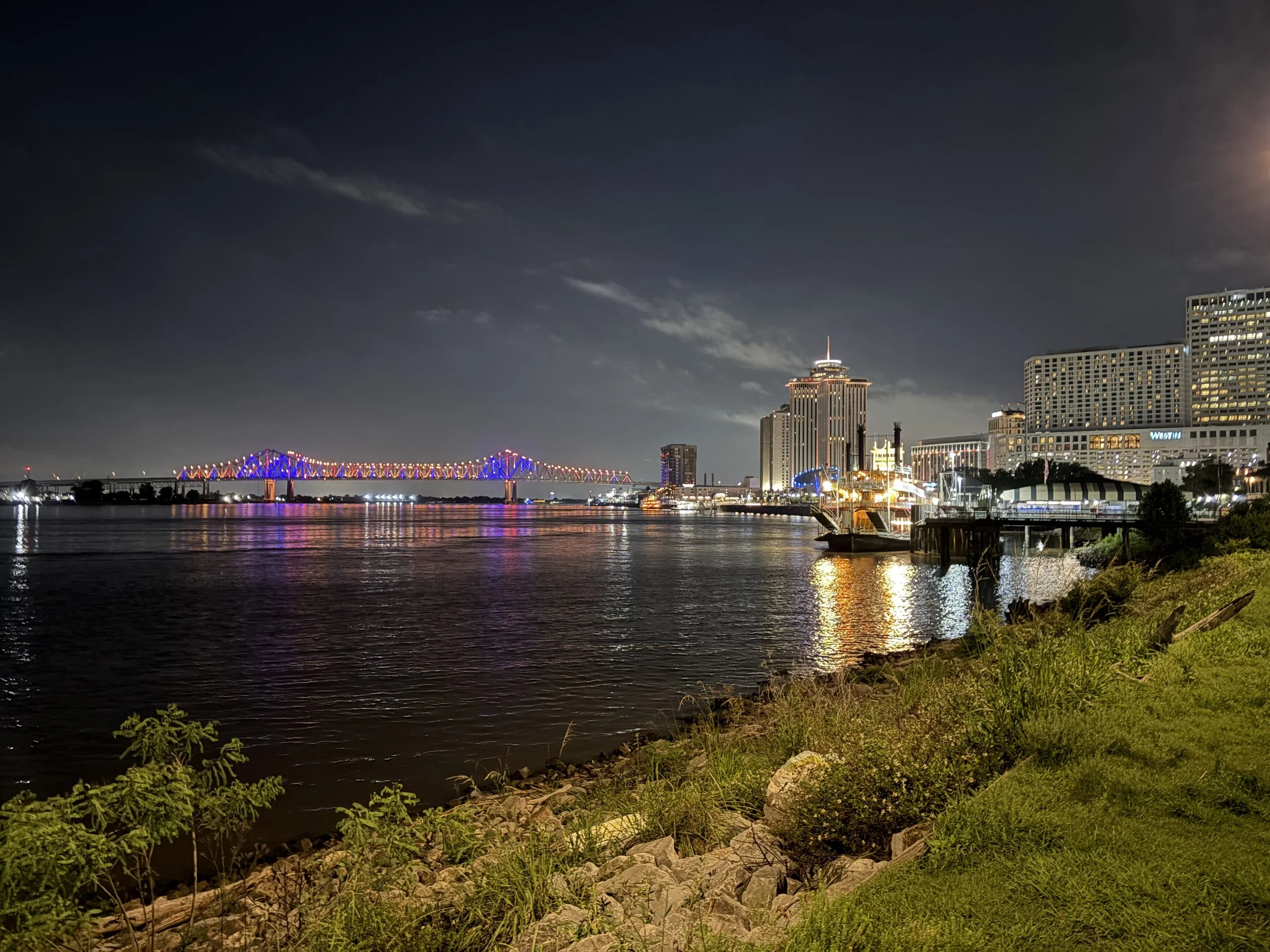
Underneath all of it, I will continue to remember the hands that built New Orleans. What I want to keep returning to though, is the immense peace I’ve felt while being here. Of course, nothing here is resolved, but the peace of a city that has survived this much and still insists on the table being set, the food being extraordinary, the music going while rain comes and goes contains an enormous positive weight. There is a sovereignty in the way people move through New Orleans, like they have learned something about the relationship between pleasure and survival that the rest of the world is unaware of. I felt it eating in that house on Lake Shore, I felt it standing in Preservation Hall with the sound moving through the room like water, I felt it in the small, quiet moments, listening to the waves and the cries of Edna on Grand Isle, and watching the bridge light up at night on the levee. I have felt that peace in every moment I’ve been here and I will cherish that feeling until the day I die.


I came here with books, for the books. But now, I leave here having walked through them. And with a profound understanding for why the books were written here in the first place. New Orleans is a city that’s been imposed upon those humans that were forced to make meaning out of the absolute circumstance of limitations. And sure, maybe I am reaping the benefits of those limitations. But having absorbed the history I am happy that I am finally able to understand what makes this city an amazing city. And the truth is, it really just is itself. The city of New Orleans.

The Blue Side of Jazz

My extreme fascination with music has taken over many parts of my life, listening to on average 200,000 minutes a year of music (thank you Spotify), which amounts to almost 139 days of music. A statistic I wasn’t aware of until I somehow accomplished it- maybe I need to go outside more. A large part of this obsession is based on familial priorities of music, as my dad owns an extensive record collection, which I have repeatedly told my brother I insist on taking when he passes. But beyond these records, I find that my background in piano and ballet has heavily impacted my tastes and has created a desire to involve music in almost every part of my life. I have curated soundtracks for any scenario, awarding myself the privilege of music while walking down the street, driving, sitting, and talking to others.

What's so horrible about this obsession is how much I prefer music to people! Music helps me travel from the comfort of my home, taking me to every inch of the world, exposing me to life and culture, language, and sound. It makes me feel something unlike any other form of media or art that is available, made by humans for humans. It almost feels as though every musician or contributor has taken some of the inner lining of their soul and woven it into each piece they make. Creating an infinite loom of layered emotion and feeling that goes beyond any other form of expression, even words.

If the world was mine, I’d tell you what I’d do
I’d wrap the world in ribbons and then give it all to you
— If the Stars were Mine, Melody Gardot

Thanks to my parents, my ‘musication’ (music education) has been diverse and extremely in-depth. I grew an appreciation for classic female jazz artists like Etta James, Ella Fitzgerald, and Billie Holiday, as well as artists like Duke Ellington, John Coltrane, and my personal favorites, Chet Baker and Miles Davis. With an appreciation for any sub-genre of rock, folk, classical, musical theatre, country, and just about anything with ‘real’ instruments. Because my dad firmly believes that someone cannot call themself an artist if they can’t at least play some kind of instrument.

Maybe I like Miles Davis because of him, and all the memories I have as a teen listening to jazz with my parents in our living room on dusty old vinyls my dad collected. In these special evenings, my parents taught me poker so I could best my peers in college, and I tried my mom's Grey Goose martini for the first time (which I hated). We would play cards until my fingers were red and raw from gripping my hand with anticipation, laughing with my parents while listening to their stories from work and hoping to distract them enough to win a game every once in a while.

Memories like these are perfectly encapsulated in music; a single moment in time can be etched onto the record of our life and forever memorialized in a song or voice. Even now, as I listen to "In a Sentimental Mood" by John Coltrane and Duke Ellington, I think back to Christmases with my brother and parents in Monterey Bay, California. The feeling of the cold, crisp, foggy air and the water dripping from the intertwining mess of Spanish Moss that hung on the tree outside the patio of our home. I remember my sweet childhood dogs, Gracie and Audrey. I remember when we brought Gracie home to that house, and she couldn’t eat anything besides pumpkin and rice. I remember how I would squish my little bottom at age 7 into a large Chinese-inspired pot at the front of our home, using my blanket as a cushion. I would grab my binoculars and ‘spy’ on our neighbors, and in the background there would always be jazz and country. I remember my brother breaking his whoopee cushion the same day he received it from Santa Claus. I remember him asking me which side of my blanket I wanted on top of me when he tucked me in to go to sleep. I always picked blue.

Even now, as I am listening to this music, I am tearing up thinking about these fond memories, my heart is aching, wishing and wanting to go back. Hoping to feel how our family felt in those perfect moments of absolute bliss. Music makes me forget my childhood innocence at this time; it paints a romantic picture of perfection that I'm sure my parents and brother would break in an instant with reality.

But the divine romantic aspects of these memories are a representation of what music does to the soul. Creating niceties that didn’t exist before, drowning you in a pool of what once was and how you wish to remember it. Sometimes forcing an artificial memory in place of the real ones.

However, it is impossible to say anything is artificial about the music scene in New Orleans. New Orleans is a city of culture and jazz; music billows out from every building, filling the streets with singers, buskers, bands, and bucket drummers. The French Quarter exists as a physical box keeping in all the gooey goodness of this music. You can’t walk through any part of the quarter without hearing a trumpet, a drum, or some kind of lick you can’t quite place.

Each instrument carries a tune of its own, and each band its own chorus. Leaving you feeling enraptured with the magic of the city, as one block of music ends, another picks up where it left off. Culminating in a never-ending party of laughter, dancing, drinks, and memories.

In my time walking these streets, I am reminded of Halloween when I was 11, living in Santa Barbara with my parents and brother. I would trade candy with other kids for my favorites, as I attempted to be as practical and diplomatic as possible. I always carried extra clothes with me to school ‘just in case,’ and visited my brother in his ‘yurt’ in our backyard. I remember the summer days spent in the pool, our backyard being filled with palm trees, olive trees, and fruit trees of every kind. The blackberry bush that would stain my fingers pink after picking and eating berries until my belly was full. I remember my brother's wedding reception and how I couldn’t believe he was leaving me, and how beautiful I thought our family was. I remember the Christmas I snuck a peek at the gifts and was scolded by my parents, rightfully so. I remember my brother teaching me how to skate on his long board, and I remember him asking me which side of my blanket I wanted on top of me when he tucked me in to go to sleep. I still picked blue.

The ecstatic beauty of music keeps these memories alive, living for me, replaying in my head every time I have ever felt homesick or missed my family. The music has followed me in every home I have ever lived in, in every place we stayed together, and every tragedy of each move was overplayed by the vinyls and love. And even in my now adult years, I still get emotional thinking of how much we have all changed and grown, how much I love our additions to our family, and I am just so grateful.

I imagine these feelings are universal, in some capacity, we all waltz back in time when we walk through the quarter, or romanticize our past when we see some great big lovely mansion in the Garden District. Because in these places, these real physical places, we hear music. And music does connect us, remind us of who we are, and it places us in our current reality. Every single person I have ever met can confidently name a tune that brings them back to a special moment, person, or time in their life where everything was rose-colored and perfect. And as I wander through this great big city of music, and I look at all of the other people around me, I hope they feel as touched as I do, and I know they do.

For a place as special as this, practically vibrating with the actual drums of the city, carries the key to unlocking these memories. Isn’t this why people come here? To listen to the music? To be reminded of all those little things that make you, you?

This unique experience is so alluring and addictive, drugging you with every lullaby and voice that melts even the coldest parts of ourselves. It is this feeling in this city of jazz that brings us back out every night, hoping to feel as we once did, and have the oh-so-therapeutic experience of missing, longing, and loving.

That is why so many come here, why I came here, to visit the music and hear it in the most outrageously named bars and clubs. Trekking to the ‘Spotted Cat’ and the ‘Snug Harbor,’ desperately hoping to walk down memory lane, and to do so with my fellow humans in a dark, lit room, swimming in smoke and tears. Watching those who seem blessed by God to artfully pluck their instruments or play the piano with such grace, I fear I am watching something alien at work. The fear is overridden by that universal experience, the hope of being reminded, of being given the time and space to process all that we have gone through, in a room together. I always picked blue.

A City Passed Its Prime, Still Searching

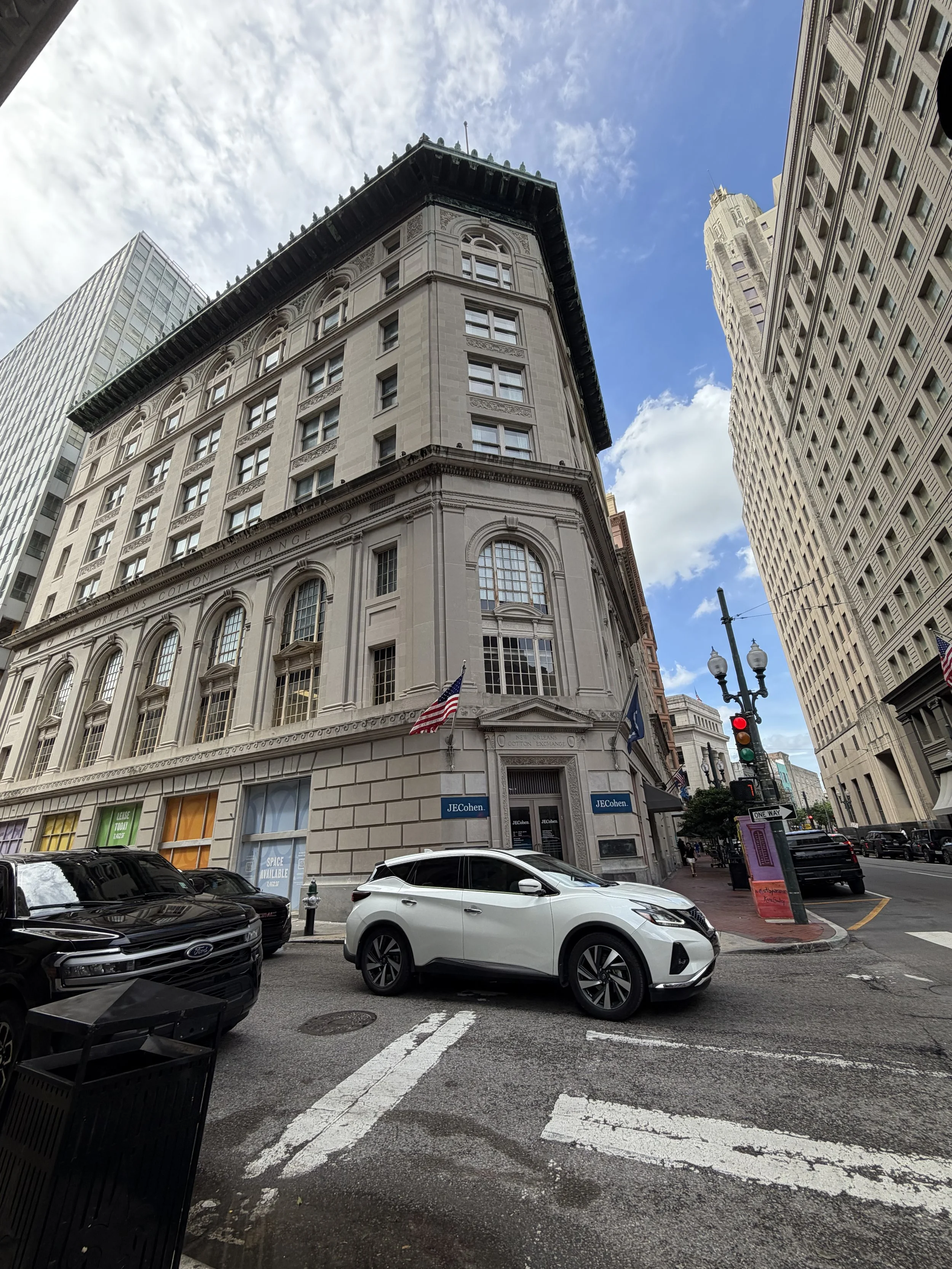
Learning about the history of New Orleans, the city has had its peaks and valleys. From being a military fort full of undeveloped swamp land, to one of the most visited places in the United States. However, I believe that its prime has long since passed. It is evident walking along the Mississippi River starting in the oldest part of city, The French Quarter with its iconic iron railings and historic homes, through Canal Street buzzing with life, to the Central Business District full of tall (by historical standards) buildings with engravings that label a building as a cotton trade center for example, and passing to the Lower Garden District full of colorful Mansions. Yet, as you keep going forward in time, the neighborhoods become less recognizable and less important to the history of the world. New Orleans, in its prime, was a wealthy city, one of the most important cities geographically, as the end of the Mississippi, it was packed with steamboats and tradeships, and it exported indigo and later cotton. Yet, this peak was brought about by taking advantage of others, first the Native Americans, and lastly the enslaved people. The massive wealth from the indigo and cotton plantations built the French Quarter and the Garden District. The Central Business District was the epicenter of the Slave trade until the Civil War. Once Slavery was abolished, New Orleans faced a blow that it still hasn’t recovered from. Today, the city still doesn’t have a diverse economy, relying heavily on tourism and entertainment to keep the economy running. These older, wealthy areas are living in the shadow of what they used to be.

The city has felt like it has been searching for itself since the Civil War, with a desire to hold on to the past and what is familiar while also trying to make a new identity of progress and rebuilding. This is why so many novels of self-discovery and searching seem to take place in New Orleans. The Moviegoer follows the main character and narrator, Binx, who is on a mission of self-discovery. Binx is from the historic Garden District but chooses to live away in Gentilly to escape the “old atmosphere”. The search, as Binx calls it, is him having a kind of existential crisis where he is comfortable but doesn’t know how to deal with his life. He tries to break up the everyday mundanity of his life by going to the movies, talking to other people, and taking advantage of his female secretaries. Still, he connected to his past, the scar in his shoulder from the Korean War, his visits to his aunt, and the privilege that is given to him because of the historical importance of being high-class and white. He lives in the shadow of what the white, wealthy class should be: polite, stoic, and respectable. By the end of the novel, he decides to abandon his search slightly by settling down with his cousin (not blood related), Kate, but he still has some direction and ambition, deciding to go to medical school to help with Kate’s condition, which felt like bipolar disorder to me.

Am I, in my search, a hundred miles ahead of my fellow Americans or a hundred miles behind them?... On my honor, I do not know the answer.
— The Moviegoer by Walker Percy

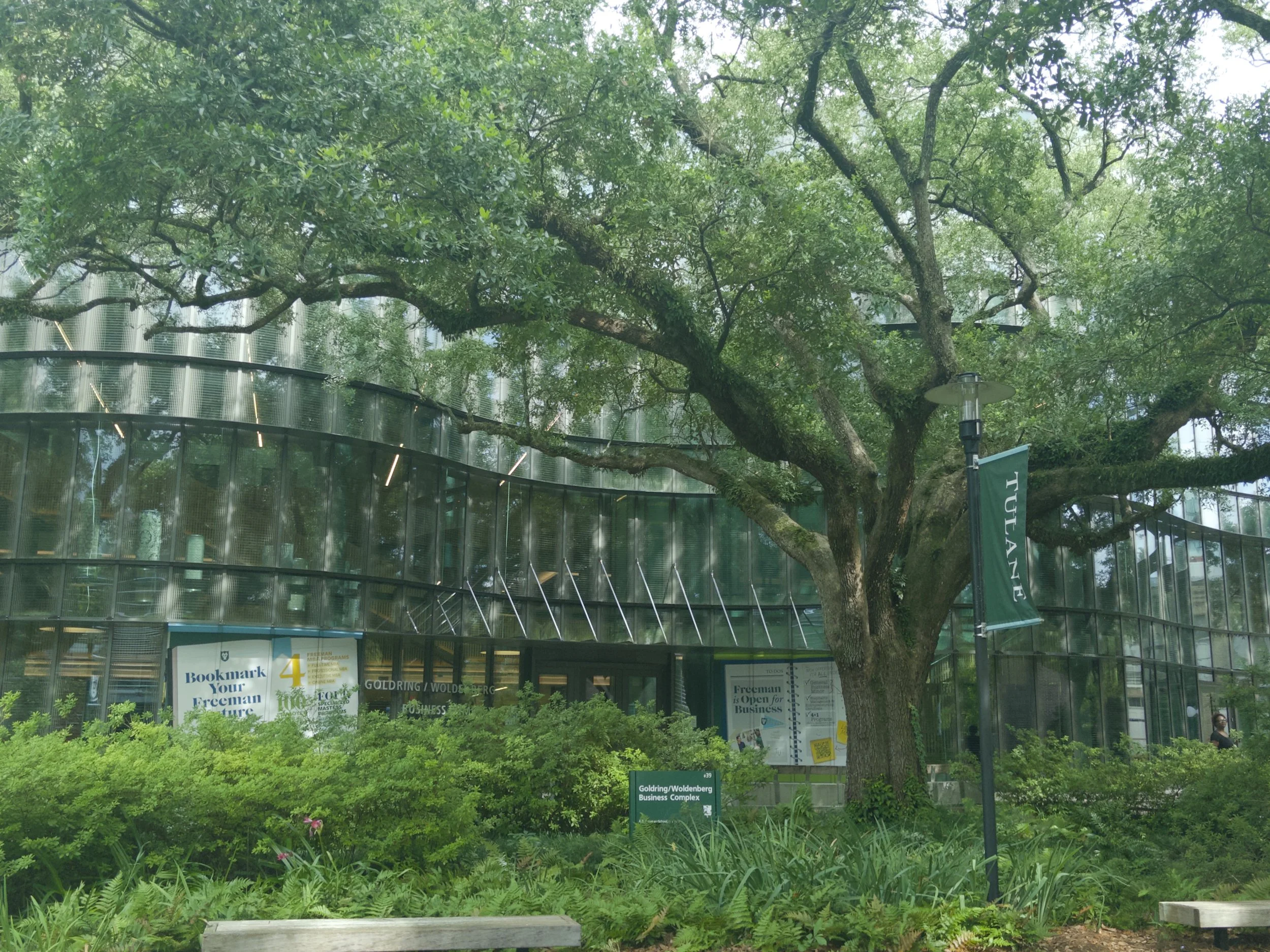
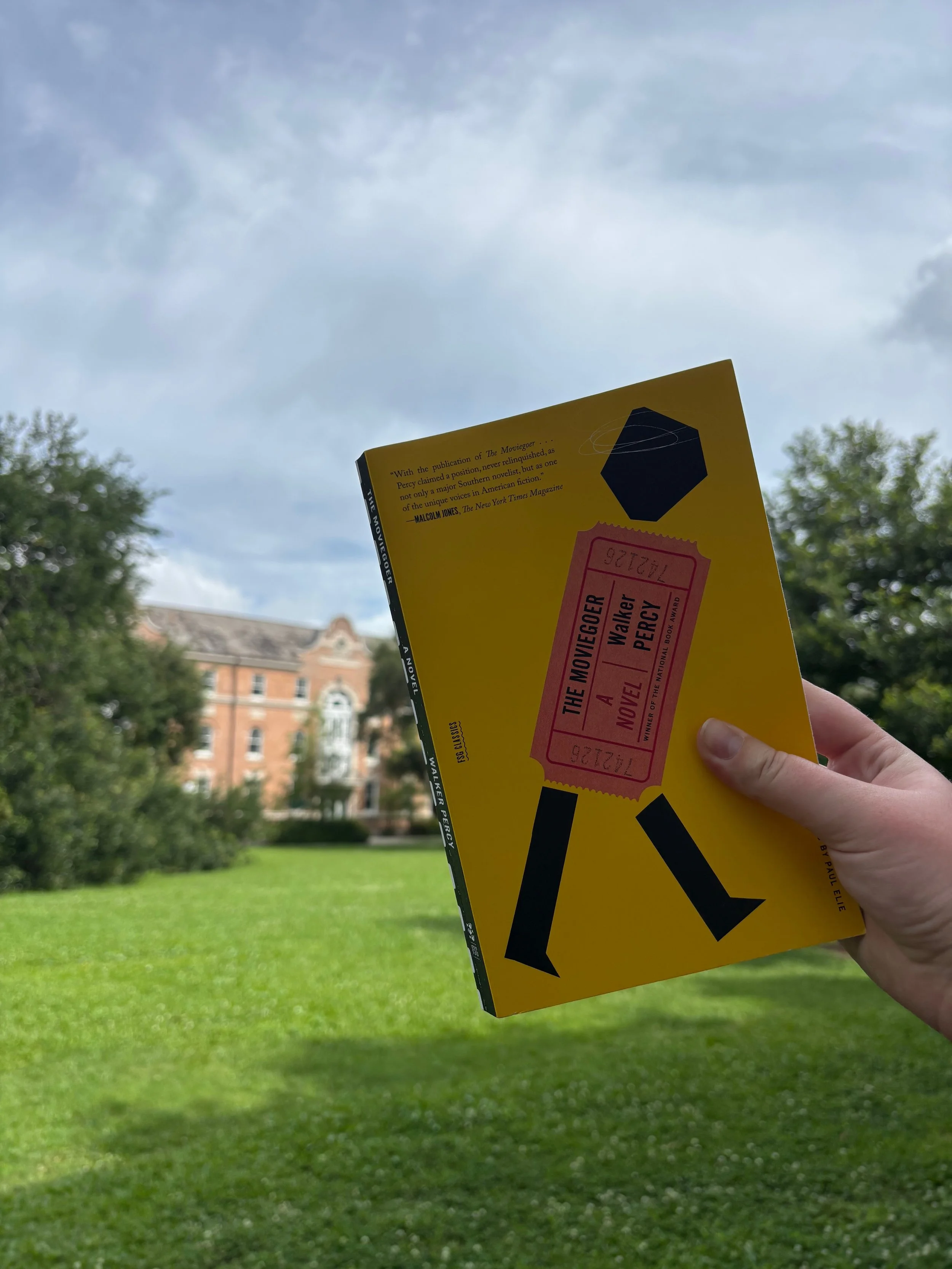
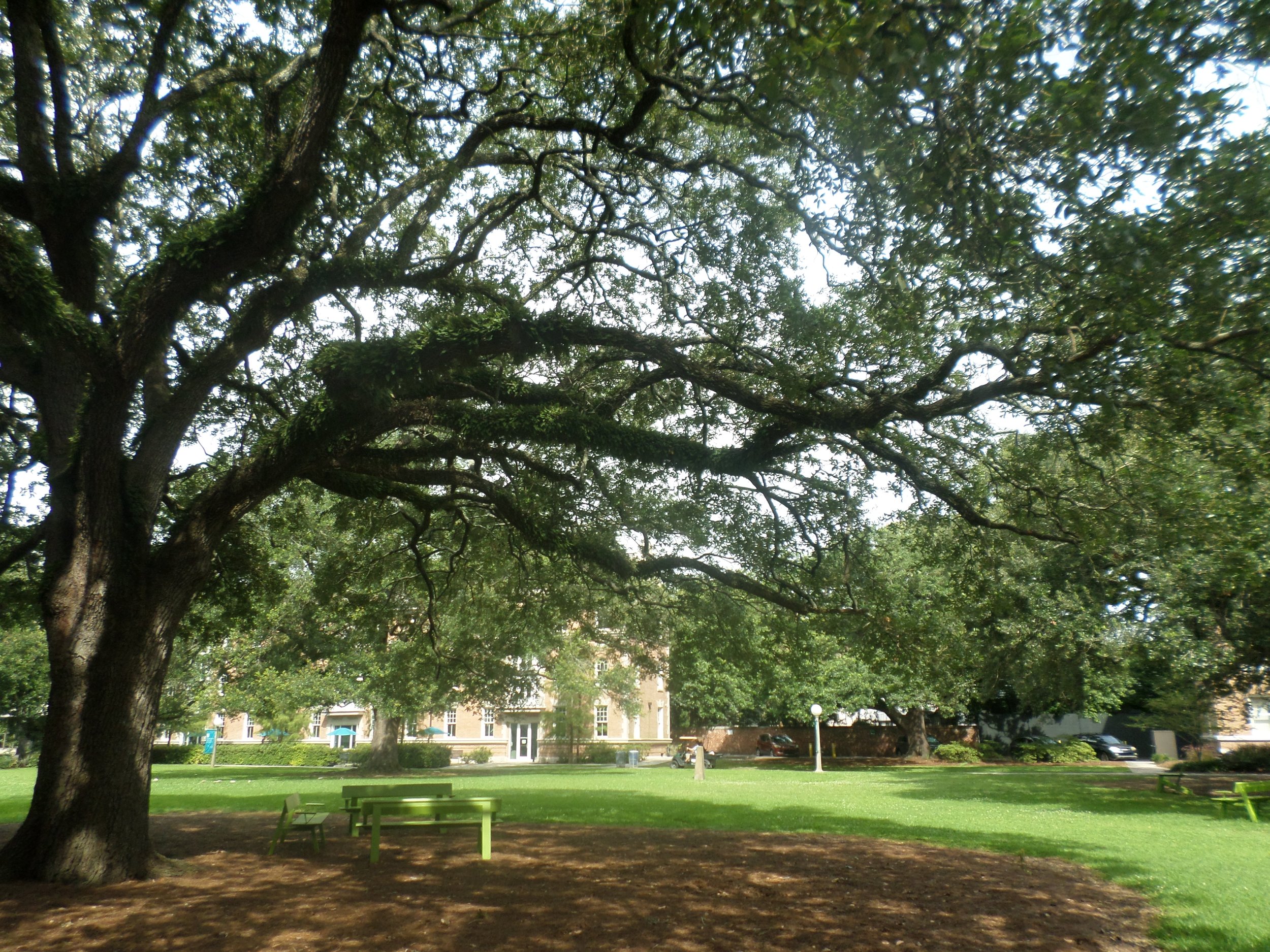
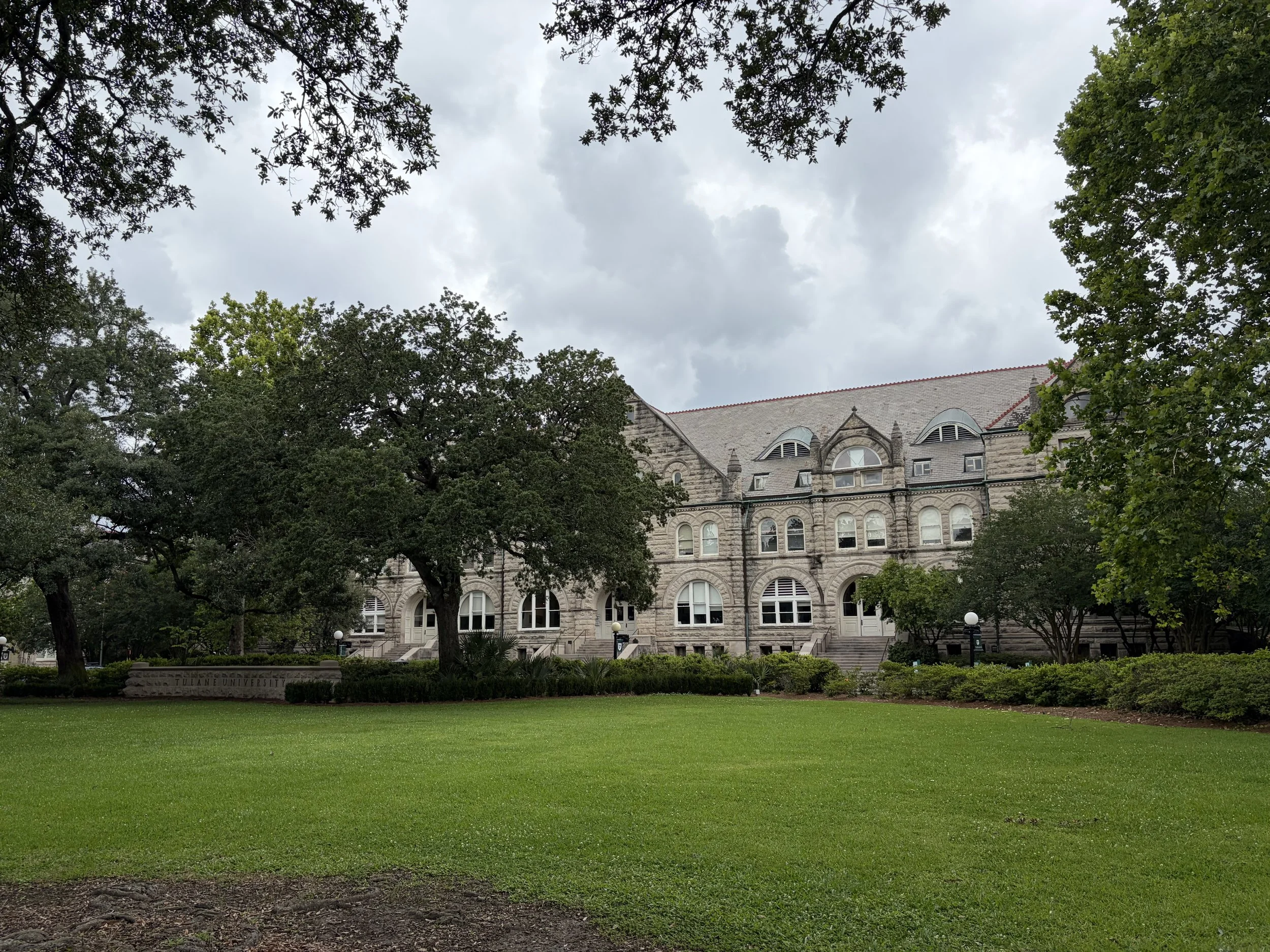
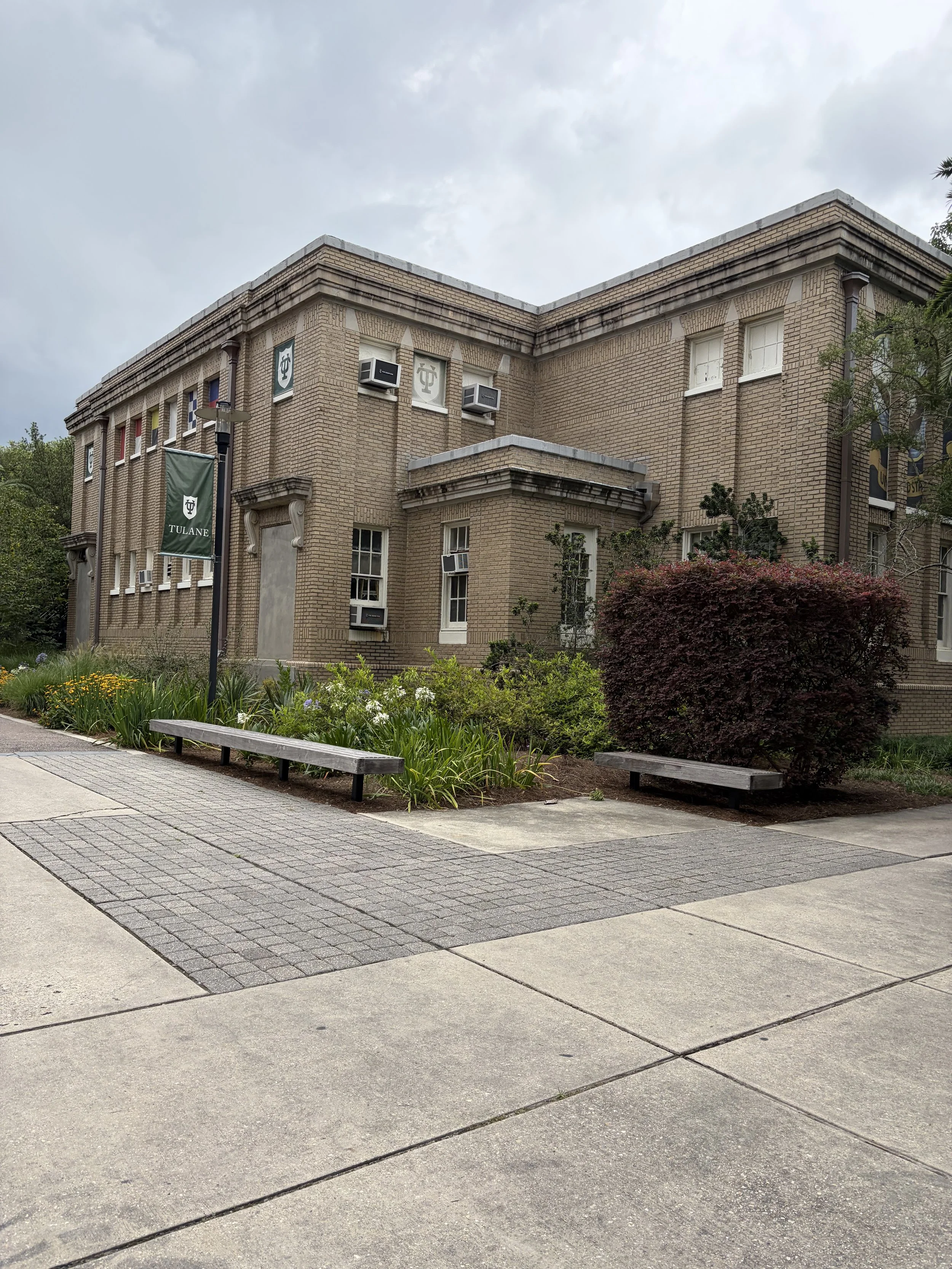
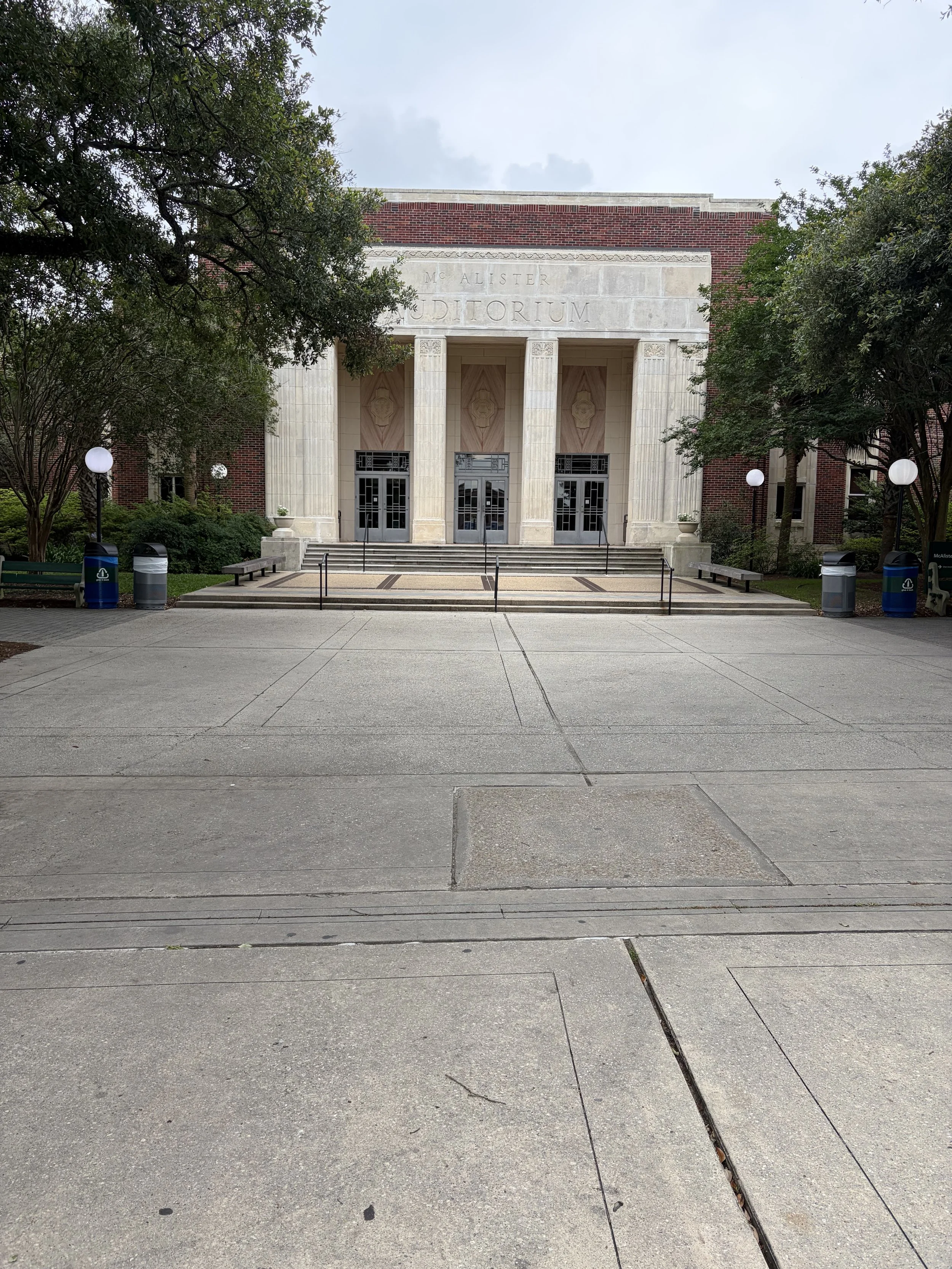
Tulane University

In a way, Binx’s search is extremely intertwined with the search of New Orleans. The city started in the historic cities of the French Quarter but has grown outward in all directions to Lake Pontchartrain, Algiers, New Orleans East, etc. Always moving away from The Quarter but still connected to it as the city enters. New Orleans tries to be more than just the French Quarter with places like The Superdome, college campuses like LSU and Tulane, and industrial space where NASA and oil refineries are located. Like how Binx has failed relationships with his female secretaries, New Orleans has many failed ventures like Jazzland, rebuild attempts after Katrina, and Cancer Alley. Both lost their prime to war, Binx with the Korean War and New Orleans with the Civil War. New Orleans also has its own version of periliage, being one of the only US cities to have strong ties to France, Spain, and historic America, and full of rich culture and historical significance. It is also built on the back of taking advantage of enslaved people, similar to how Binx openly admits to interacting with people for purely selfish reasons. Today, New Orleans has settled down into its tourist image with tag lines like “Beinget, done that”, tourist traps lining Canal Street, people busking for money, and self-proclaimed psychics charging absurd prices near Jackson Square. But the scars of the past aren’t forgotten.

These two existential explorations connect to my own existential questions and search that I still struggle to tackle. My search is for what to do with myself after college. I have no idea. I know that I would like to try my hand at stand-up more professionally and audition for community theater, but you need a steady day job before that’s financially possible. Although I don’t watch movies or build concert venues to broaden my search, I bury myself in academics and extracurricular activities. I don’t believe normal people double major, practice Taekwondo, audition for plays, do open mics, choreograph dances, work a student office job, and work security over the summer. I think the reason I pack my schedule to the brim is that I don’t want to have time to think about the future because the next day requires my full attention. I don’t believe I passed my prime, but I am living in the privilege and shadow of my parents. My parents are the reason I don’t have to worry about paying tuition; they will make sure I always have a home to come back to. If I become a full-time comic and I fail miserably, I don’t have to worry about my next meal because I have the privilege of parents who are emotionally and financially supportive. Like Binx moving out of the Garden District and New Orleans expanding, I don’t want to live under the shadow of my family as someone who peaked in college. Also, if I do become successful as an artist, it will happen because I don’t have to worry about when my next paycheck is.

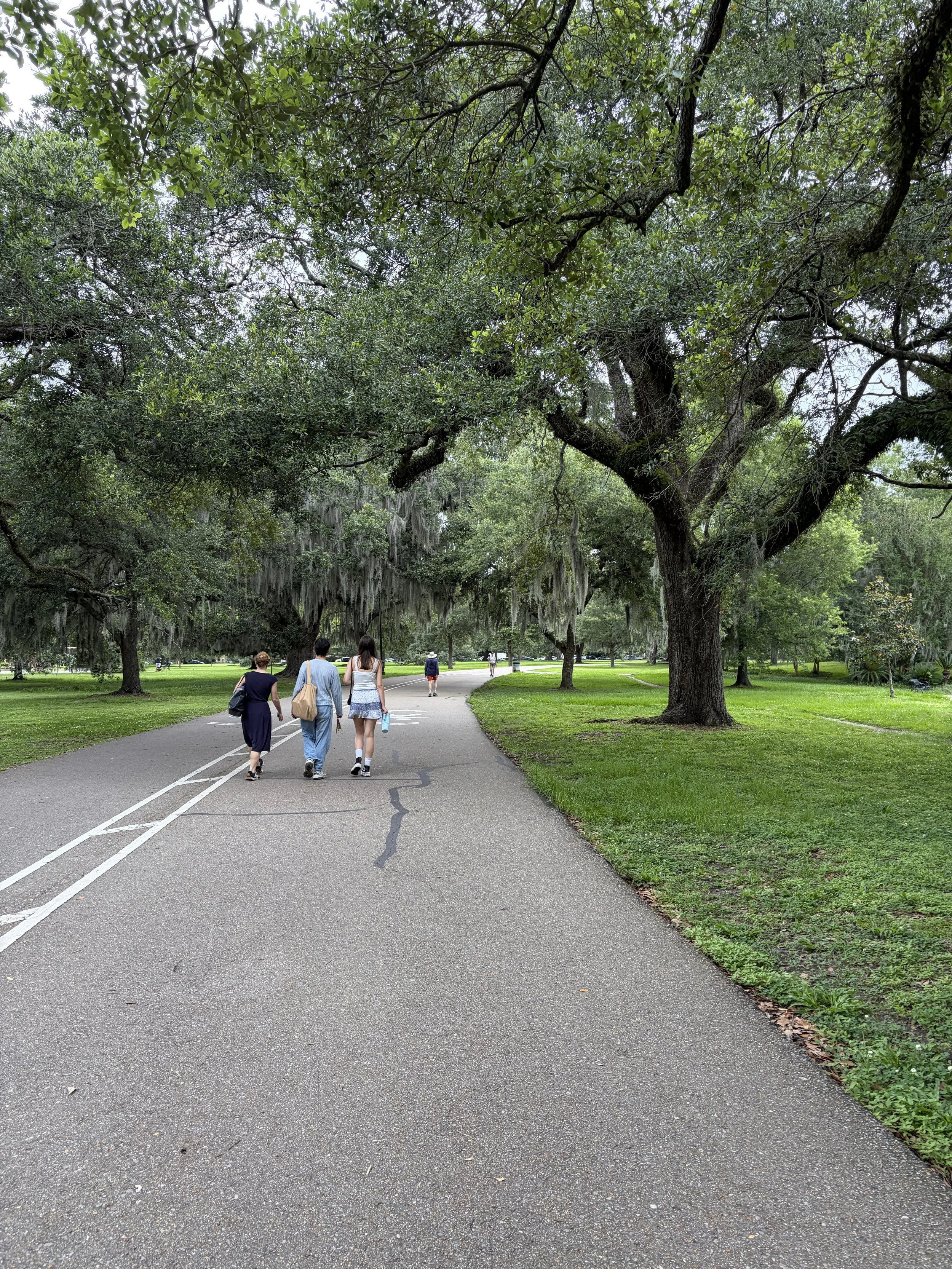
Pictures Taken in the Audubon Area, Where Part of The Moviegoer Takes Place


Binx and I both have the privilege of being comfortable in life, but we both struggle with ourselves and search for ourselves in other places, only for life to be the best option. New Orleans and I are both still searching and using what’s best of the past to move forward in the future.

The Archives of History

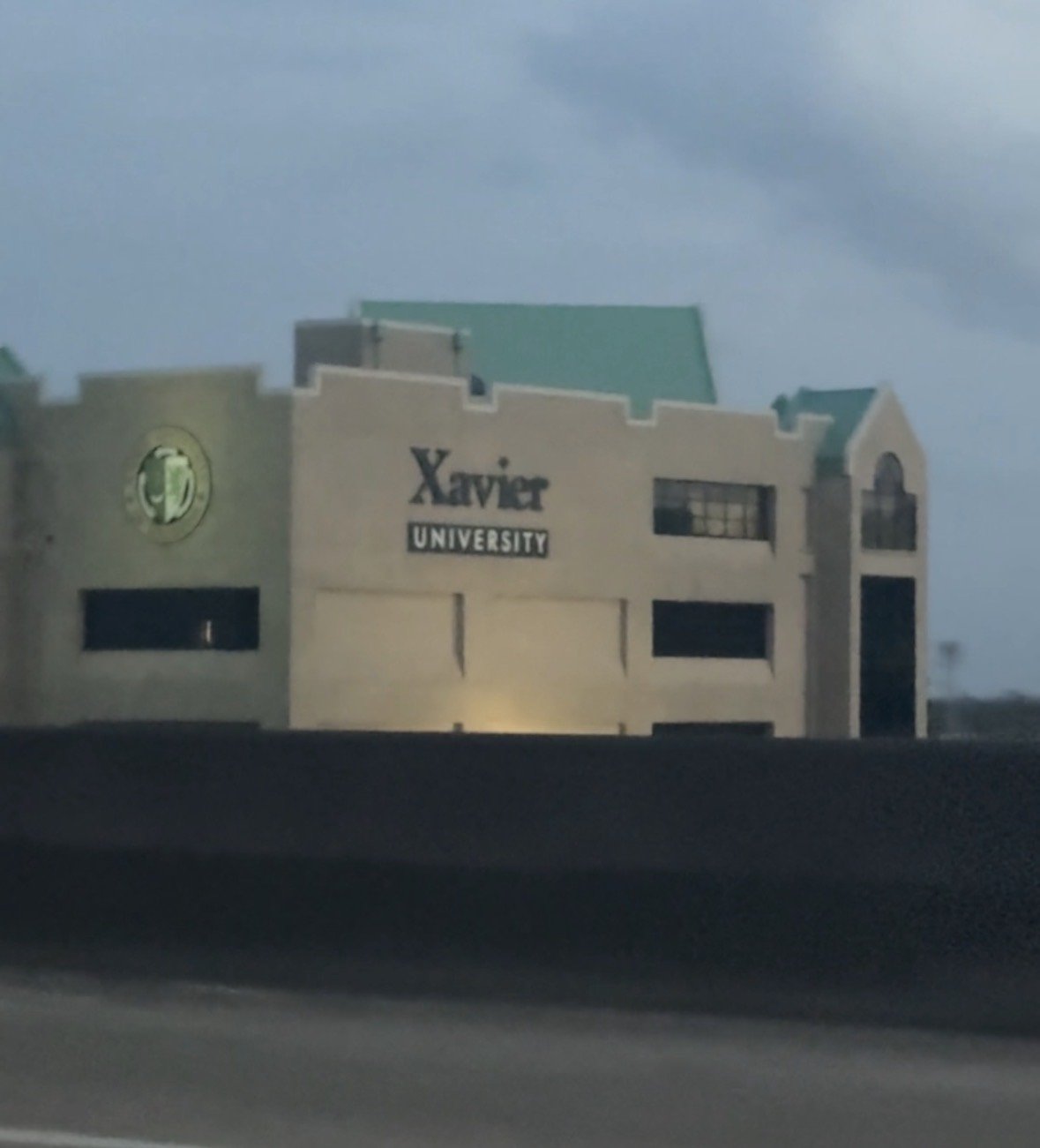
My mother graduated from Xavier University. She loved Xavier. Everytime we drive past Xavier University I feel this sense of pride in that THAT is where my mother had her education. Where she took on the world and conquered. It felt so surreal to even see where my mother flourished, it always felt like this foreign place. 

Xavier Uni

My family overall was actually rooted in New Orleans. I don’t know the exact origins but my family has largely been based and centralized in most of the South, especially Louisiana. Our literal history is here and to be completely honest with you, I have no clue. I am not cognizant of my history and to that, I don’t like that. And that's when I understand the importance of archiving. As we drive through streets of the 9th Ward and see the countless housing projects that have been abandoned and set adrift, I start to understand why the historical importance of this city matters so much. I start to see why memorials have been laid throughout, why there’s statues nearly on every corner. Knowing the countless houses but also historical buildings that were destroyed and dismantled from countless hurricanes. I get the severity of ensuring that Hurricane Katrina and Hurricane Ida were relentlessly documented and recounted for through numerous documents, first hand testimonies, and heartbreaking debris. I completely understand the responsibility that this city feels that it carries to each and every citizen that has once inhabited it. And simultaneously, I understand the want to capture one’s ancestral and familial history through yearbooks, photo books, letters, cards, and so on. 

Meeting Family in NOLA

My Great Grandmother!! Mama Hill

As I meet some of my family - my great-grandmother, my auntie, her husband and a niece - I realize that there is so much history that is unsaid and has been untapped. Seeing Mama Hill (my great-grandmother) in person, I realized that I truly didn’t know much but even then I felt a responsibility to know. Yet so much time has passed and so many years have expired that I feel I don’t have much time left. And then I think what happens if I don’t explore that, if I don’t hear those stories. Do they just all disappear? Does it all just go down the drain? And then I think of the stories of every family, of every grandparent, of every ancestor and the history that pervades and exist all through time. It’s befuddles me to think about it all and sometimes I have to shield myself from my mind spiraling. Truly, this is the thought process that comes to mind everytime.

Anyways, I thought about this constantly as I read Coming Through Slaughter. Racing through pages of firsthand memories but then to find songs that were played, short little memories of those that knew Bolden best or briefly, reels that were played from interview tapes, timelines pulled from the histories of hospitals, words from Brock and Willy and memoirs too. A colorful description of his life that depicted the brilliant, the terrible, the chaotic and the tragic. I am not a fan of biographies nor am I a fan of autobiographies but I deeply respect what it took to flesh Buddy out and to give this fully realized depiction of what Buddy was as a human. To see firsthand how he clearly devolved and experienced his tragic downfall. But without the archival of history, what would we have known about Buddy?

And for this to be fragments of his life, fictionalized at that, the line is clearly blurred between what’s real and fictional? What much has been said through history that was simply conjured up from imagination and then spread as if the Bible? What has been said from one perspective only to be made the only perspective? Something that I know can be applied to war, to literature, to politics, et cetera. 

Buddy Bolden Mural

And so as I walked through the Central Business District, I found myself walking down a street and lo and behold, Celeste notices the popular mural of Buddy Bolden and friends much to the amazement of Laura and I. This gorgeous mural possesses these beautiful, darkly purple hues and gold lining. It’s a beautiful mural painted by Brandan Odums’. But something I thought interesting was something our Professor brought up. The fact that Brandan painted this mural with his friends in mind and actually recreated the mural (because it was destroyed due to a hurricane) with their faces in place of the other band members. And though it’s a small thing and actually quite harmless, I found it dreadful the thought that those band members may have just had their only contributions to history erased and cast aside. Albeit, I don’t think these are the only recollections of that ‘band’ but even then I don’t know their names nor where to even start besides Buddy. Just a morbid thought I had, this idea that despite all the archives in the world, you could still be erased from history in a flash. It terrifies me deeply. 

On the other hand, as I read Coming Through Slaughter, I couldn’t help but think about the layers of this city that exist and the layer that is slavery and white supremacy that exists on the very grounds that we lay our feet upon. And how you truly have to sift through archives upon archives and divulge in documents upon documents of that nature in order to really find something pertaining to the hideous events of that period. To see those documents from Solomon Northrop knowing the tragedy of his life, it crushed me. It wasn’t without our professors insistence, the documents that he searched through extensively that we would have even know about the slave ones that existed in the Central Business District and all throughout the French Market. 

Who would have known that a statue so prevalently known throughout New Orleans was destroyed and replaced at the corner of some train stop without literally searching painstakingly through endless documents. It’s the archival process that truly fascinates me because who keeps hold of it all. What is deemed important and who is deemed important enough. Who is worthy of being captured and archived so that their name truly becomes immortal through time. Who and what thought it necessary that Buddy Bolden's life be immortalized through this fictionalized account of the life of a jazz pioneer? Clearly, enough people. 

A Court of Throne's and Color

A Court of Throne's and Color

I'm not going to pretend to understand Mardi Gras, but I really enjoy the colors of it.

Maybe that's the most honest thing I can say walking through New Orleans. The colors don't ask for comprehension. Purple: Justice, Green: Faith, Gold: Power — they simply land on you like a verdict.

There's something about watching a parade move through a street that certifies those colors. Before the floats, before the brass and the beads catching light mid-air, a street is just a street. Although, I’d also argue that one should consider knowing the history of said street if it was built in New Orleans. It could be anywhere. Yet, it’s here. Then the parade passes through and the whole block becomes Somewhere. The street becomes Somewhere. The colors did that. The spectacle did that. The history of the colors did that. And after standing inside of it, I can’t unfeel it.

What does it mean that a city like New Orleans needs color? Why does it need Mardi Gras? I think my original qualm with my misunderstanding of it was that it didn’t make sense to have abstract colors and beads and float and music and food just for the sake of celebrating. It didn’t make sense to me. It didn’t make sense that it scheduled its excess into a liturgical calendar, crammed all its desire into one Tuesday, then (most likely) woke up the next morning and let someone draw a cross of ash on its forehead? So I did some research: The word Carnival translates from the Latin carnelevamen ~ farewell to flesh ~ a last indulgence before forty days of fasting and penance. French and Spanish Catholics carried that tradition across the Atlantic, planted it in Louisiana's particular mud, and watched it grow into something the Church probably didn't anticipate. Kings and queens. Royal courts. Hierarchies celebrated in public, decorated in sequins, legitimate and absurd at once. 

The Rex Organization formally codified the colors in 1892: purple for justice, gold for power, green for faith. Justice and power named by the same organizations that, at that time, barred Black people, women, Jews, and Italians from membership entirely. The irony doesn't require commentary. It just sits there, in the color. 

I keep thinking about the pointed mask and where that silhouette has been in this country. The Catholic capirote dates to the Spanish Inquisition, the pointed cone becoming the preferred form because the tip was thought to direct the penitent's prayers upward — shame reaching skyward, someone who had sinned coming publicly to account for it. Then the shape travels. Gets absorbed into The Birth of a Nation. Gets mass-produced and worn by men who used it not to seek mercy but to terrorize people in these very streets. Commentators link the Klan's visual identity directly to the folk traditions of carnival, circus, and minstrelsy. The same cultural lineage. The same instinct toward costume and procession and the anonymity of the crowd, turned into something unforgivable. This is why as I walked through the Mardi Gras museum I had a strange sense of unease. Seeing the people of rural Louisiana celebrate on tractors with beer, colorful masks and pointy hats – though I doubt even they understood what they were celebrating. Because if they did, they would know, none of the colors were welcome or prompted to be shared with those who actually were.

Another example of this is the Mystick Krewe of Comus which remained closely tied to Confederate ideals after the Civil War, including ex-Confederates in their parades, and the second krewe was founded by a club working toward the same goals as the KKK. The royal court, in turn, was not a metaphor in their eyes. It was an actual power structure with a throne and a very specific list of people not invited. There was a Robert E. Lee statue here for decades, presiding over a traffic circle like he owned it. It's gone now (thank God), but just the ideologies that these “courts” were built on a semblance of misplaced pride makes me shiver.

I should specify though that what I’ve been feeling walking through the streets of New Orleans isn't anger exactly. It's the sensation of the layers, the mixation of cultures, and of course all of the colors my eyes have been inputting that didn’t seem to exist until I got here. The feeling standing on ground that has been everything at once, and seeing the ignorance peel through the city that still holds so much beauty.

The Zulu Social Aid and Pleasure Club was founded in 1909 precisely because the carnival parades were segregated (crazy I know). And Black New Orleans didn't wait to be included, despite the historical relevance of Mardi Gras being rooted in racist, albeit English ideals. It built its own court, its own royalty, its own spectacle within a tradition designed to shut it out. It reminds me of the founding of HBCU’s in the South and other Black organizations that have built and designed specifically because one group didn’t want to be inclusive. I’ve actually had the unfortunate encounter of someone telling that they HBCU’s should “no longer exist” because things are integrated now, and it “served it purpose.” This is why I am glad that The Mardi Gras Indians sew suits by hand that take an entire year to make, and that they built a culture that is entrenched in preservation of culture — and even acknowledging the help a separate group grave to Black people by paying homage to Indigenous Americans who sheltered and aided runaway enslaved Africans. Now we are walking through the colorful streets that once legally excluded them, purple, green, and gold beads and all. And the preservation of this tradition, including showcasing it in The Backstreet Museum makes it all the more colorful.

I imagine arriving back into the city just as the street cleaners were sweeping up after the last parade passed (Moviegoer, pg.218). All that color from the celebration placed on a curb. The city, exhaling. I can see someone stepping out of an Ash Wednesday service with a gray smear on their forehead, sitting in their car for a minute before driving anywhere having indulged and splurged in celebrations the day before. I can imagine them not really thinking about all the color they experienced. Not really looking out the window to consider that what they’d just celebrated may have simultaneously been ostracizing. But nonetheless, they still celebrated — and went to church the next day, still dizzy from the stimulation of yesterday's juicy colors. And weeks from now, they’ll go to work — forgetting about the parade — yet still embellishing and appreciating the colors, regardless of history, of New Orleans. The Robert E. Lee statue is gone. But the systemic inequalities are not. The parade continues. Purple for justice, gold for power, green for faith. What that means now, who it belongs to now, is not settled. But I find, with the colors and richness of New Orleans, I'm not in a rush for it to be.

This Malaise Thats Settled Over The City

Canal Street

I have a couple of thoughts about the Moviegoer, a novel written in 1961. A recurring thing I’ve noticed actually for these novels, set in a time long, long ago. Something I’ve actually had to get used to now, that objectifying of the black male to just that, the “Negro”. “Negro this” and “Negro that”. The Negro being minimized or reduced to just someones plaything. It’s obviously symptomatic of that time and era, clearly. But it catches me off guard when every protagonist written in this past century possesses this higher sense of self or standing in relation to the Black Man. This is not something plaguing novels set in New Orleans specifically, this is just emblematic of that time and place. I understand that. But hearing Mercer's sad tale of inhabiting this small space between usefulness and non-belonging. It's quite disturbing and it's like he possesses this dumb aloofness where we all silently pity him and point and laugh because he is this ‘other’ (courtesy of Andonis) and is beneath Binx, as if a sad circus animal. Rings true when I see something like…

“He liked to think that Negroes have a sixth sense and that his Negro had an extra good one.”

Moving on. How is it that every novel we have read has featured some aimless, existentialist, confused protagonist who wants to upend the societal expectations set upon them since birth but still end up becoming almost entirely resigned to their fate? If I had a nickel for every time it happened in the books we’ve read thus far, I’d have like 3 nickels I think. But this is the most existentialist and middle-aged crisis of them all. But it really intrigues me as to why New Orleans seems to be the safe haven for both the eccentric and depressed. So much so I even took a screenshot of something I read because it was just so morose and saddening to hear.

“For years now, I have had no friends. I spend my entire time working, making money, going to movies and seeking the company of women.”

There is no bright light in this statement. I sense no positivity or any hint of life and this goes on for a great majority of the novel. This leering and noting every woman's physical stature and whether or not they had a sizable caboose or not. I kid you not, he comments on so many women’s hips in this novel that I couldn’t help but feel as if I was reading through the eyes of the author himself. (I think I know what his bodily preferences were…..) But, my god, what a drab and boring way to view life and I couldn’t help but feel such immense pity for this Binx. Who has no sort of purpose or possesses any bout of inner happiness. He begins the novel exactly where he ends the novel. Sort of just….there. In the streets of Prytania, passing down Canal Street, going through Lake Pontchartrain, living in Gentilly and visiting Elysian Fields forever, it seems. But rather than the calming, drowsy nature of Grand Isle, this time there’s this droning, gray, everydayness to New Orleans or Elysian that will clearly drive you insane from utter monotony.

Which is utterly fascinating. Because the backdrop of New Orleans is actually quite the opposite to Binx’s morbid depiction of life and how the everydayness of routine seeps into one’s livelihood and wreaks havoc to all that comes near. And it's this that paves the way for the ever so close search of life? A search, “anyone would undertake if he were not sunk in the everydayness of his own life.” This search to avoid the mundaneness of his own life, but why in the city of New Orleans? Why does this continue to happen? Edna suffered a similar fate. Always tiptoeing the edge between livelihood and eternal peace or life on land and life beneath the water (suicide). What is it about this culturally dense, culturally abundant city that renders people confused about the purpose of life? You’d think that you’d never encounter a problem or find issue with life if you were strolling down the streets of Canal or living in the Garden District. But Binx taps into this concept that I actually found to be quite profound. That this ‘search’, being aware of it, allows for the possibility of the search to be successful, for you to ‘be onto something’. Whereas not being aware or onto anything at all means falling into despair. You are the everyday man, someone who is dead. You are so sunk into everydayness that the possibility or an idea of a search is simply preposterous and is never once conjured up in your brain to be something worthy of thinking about.

Pirates Alley

Case in point, this sort of interaction that Binx recounts about William Holden and this young fellow he runs into. But let me remind you, we are bookpacking. To be reading a passage and suddenly you're able to stick an image with a corresponding landmark or name. It’s a wonderful feeling. To read about Binx traveling up Esplanade, passing through Pirates Alley, towards Canal but then being able to visualize a map in your mind of where he may be, is second to none. I know the cobblestone they are stepping on, the awnings that lay overheard, the wrought iron railings that decorate the sky almost. I can hear the conversations that are being had in open passageways, the passersby on trolleys down Canal Street and otherwise. So imagine all of this while the interaction is underway. Hearing this young man size himself against Holden only to believe himself inept, undeserving and worthless. Only to have “....won title to his own existence…by refusing to be stampeded like the ladies from Hattiesburg.” I just thought it stunning that we all try so much to validate our existence be it through social media, one’s physical presence or in being perceived positively. It’s something we all tend to do subconsciously and it truly can’t be helped. But for it to be described so effortlessly, in that “....he is a citizen like Holden; two men of the world they are. All at once the world is open to him.” I freaking love that. It’s just so accurate. Something as simple as an interaction from someone we deem superior somehow validates us and makes us feel that we finally have a right to live? How enlivening but simultaneously saddening that is. To feel we NEED that validation from someone, ANYONE. I feel Edna needed this as well? To an extent, Louis too.

This malaise that Binx is so mortally afraid of ONLY to fully submit himself over to that same damn fate at the end of the novel having completely done away with his ‘search’? Much like Edna who herself gives up and willingly. I just don’t understand it.

Resilience

I’m damp from the rain, sweat sticking my hair to the back of my neck. It’s been a long day. I’m looking forward to going back to the hotel, showering, and rotting in my bed with a cup of tea — but we still have one stop left. Little did I know that this would end up being one of my favorite stops of the trip. We’re at the Backstreet Cultural Museum, an unassuming building that stands on the corner of two residential blocks. You wouldn’t suspect such a plain building of housing the most colorful, spectacular clothes you’ve ever seen. In fact, as I looked up at the parade outfits of the Mardi Gras Indians (as they’re primarily known, though our museum guide said they actually call themselves Black Masking Indians), I felt less like I was looking at clothing and more that I was witnessing some brilliant work of art. I do believe that clothing can be inherently artistic, but this was something entirely beyond. These outfits clearly weren’t created for function. The joy was in the process, in spending hours and hours meticulously crafting something new every single year. I’m getting ahead of myself, but I just found the entire thing so cool. Every year, the Mardi Gras Indians make a brand new suit for themselves, always homemade, always more intricate than the last. They wear these outfits in parades throughout the year – which I had the pleasure of actually seeing in person too. The entire thing just felt like such a celebration of culture and so fun and just cool, for lack of a better word.

I guess after learning about all of the trauma and horrors inflicted on Black Americans, it is so cool to see a museum dedicated not just to suffering, but to joy and resilience. Its founder, the late Sylvester “Hawk” Francis, dedicated so much in order to create this museum and maintain it, and after visiting I could see why. I guess New Orleans has just got me thinking about resilience a lot. It’s been happening since we first got here, driving into Grand Isle and seeing all those colorful houses on stilts like a cluster of oddly shaped tropical birds. The homes were, of course, built this way to withstand hurricanes and flooding. Some houses clearly had done a better job than others — there were several that had fallen into disrepair — but I liked to think about all the houses that must have been built and rebuilt. Instead of just giving up and going somewhere else, the locals on Grand Isle, and the general Southern Louisiana region, recognized they had something worth fighting for. They rebuilt. The houses now are stronger than the ones before.

All across New Orleans, I have seen this same resilience. The ten of us piled into a van earlier this week to go on a tour of the Lower Ninth Ward and New Orleans East to map out The Yellow House. On the way, Andrew pointed out the Caesar Superdome, where thousands of New Orleans residents had sheltered for days in abysmal conditions. We drove past swaths of greenery interspersed with shotgun-style homes, some new, some that definitely had been victims of hurricanes past. All that nature hadn’t always been there, our professor explained. It was as a result of hurricane damage that many homes had been demolished, owners unable to pay for repairs or rebuilding, leaving these lots empty for months, years, even decades. The lush greenery was the earth finally winning the battle that had been waged against it for years, but it’s not only nature that rebuilt itself. The people of these communities managed to survive through the devastation. Physical destruction is different than the destruction of memory. The communities that were destroyed were part of why Katrina was such a tragedy, but it also created a memory worth rebuilding. Those memories didn't leave, as The Yellow House makes clear, just because people had to cross state lines or leave their homes. Broom remarks that only her grandmother, an Alzheimers patient, is able to truly let go.

Is this the only condition, this unknowing, under which one should cross over state lines, leaving your familiarity behind? Is this the only way to properly leave home? - The Yellow House, pg 293

What I'm about to say might sound like a frivolous comparison. In fact, it definitely is. However, it’s been on my mind, so I’m going to compare it anyway. While this is nothing like losing my home, community, potentially even loved ones, I’ve been going through a breakup while on this trip. A pretty rough one – the kind that shakes your entire sense of self, your entire future, leaves you grieving. Memories become the only thing left. While it’s silly to compare the death of my relationship to the genuine devastation and horror caused by Hurricane Katrina, I will say that seeing the amount of resilience here has made me reflect. People who have been through horrible experiences and traumas have been able to rebuild. Not always easily, especially at first. Broom's entire family essentially moves in with her brother right after Katrina. After surviving the destruction, the family must be in discomfort while they figure out what to do next. However, there are small moments of joy that intersperse this tragedy in this time, such as when their neighbor Herman raced a track star for everyone's amusement.

We were all tickled by how seriously he had been, to believe he might actually win! His performance brought levity to a grave, sinking reality. For the time it took Justin to beat Herman, no one thought about the Water. - The Yellow House, pg 296

In both The Yellow House and what I saw with my own eyes, I was struck by people's adaptability. They have found a way to create community and joy, to celebrate and not only survive but thrive. In the grand scheme of things, no matter how impossible my own life seems at the moment, people have been through so much worse and gotten through it. The human spirit is so capable of resilience, of joy, as I witnessed in the Backstreet Cultural Museum, the Second Line parades, books like The Yellow House and the real communities they are part of. There is something so inherently beautiful about that, something comforting and almost a bit hopeful.

This probably (definitely) isn’t my best blog post. It’s a bit all over the place honestly. My thoughts are still fractured when it comes to this topic, and I have difficulty distilling all of the reflections and feelings I’ve had into actual words. I guess, long story short, New Orleans has shown me so much — it has shown me some of the worst of the worst of human cruelty, of oppression and destruction and heartbreak. But it has also shown me resilience. It has shown me how revolutionary joy is and how strong the human spirit can truly be. I wish I had some grander conclusion to arrive at here, but I don’t. For now, I'm just thinking.
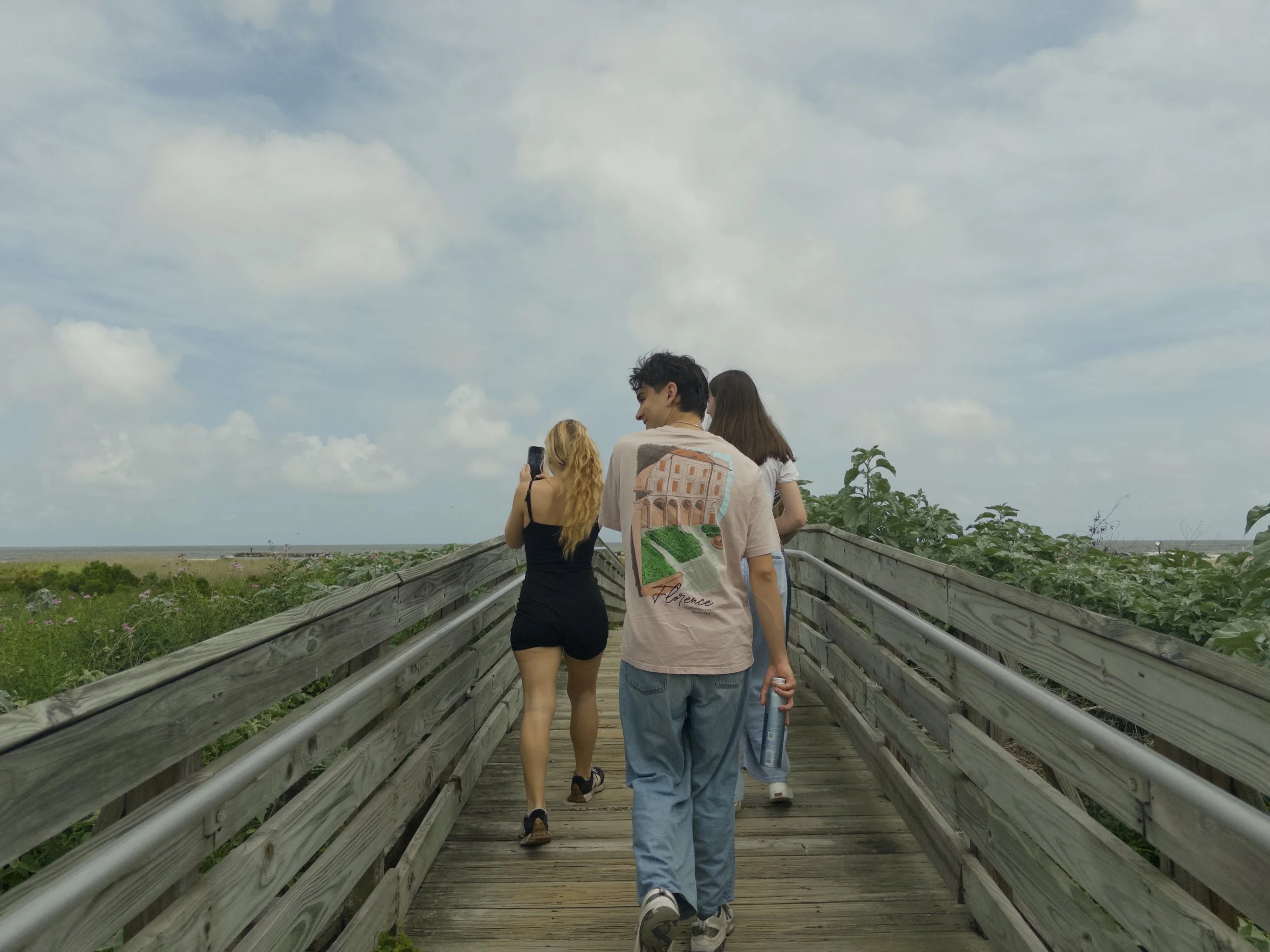
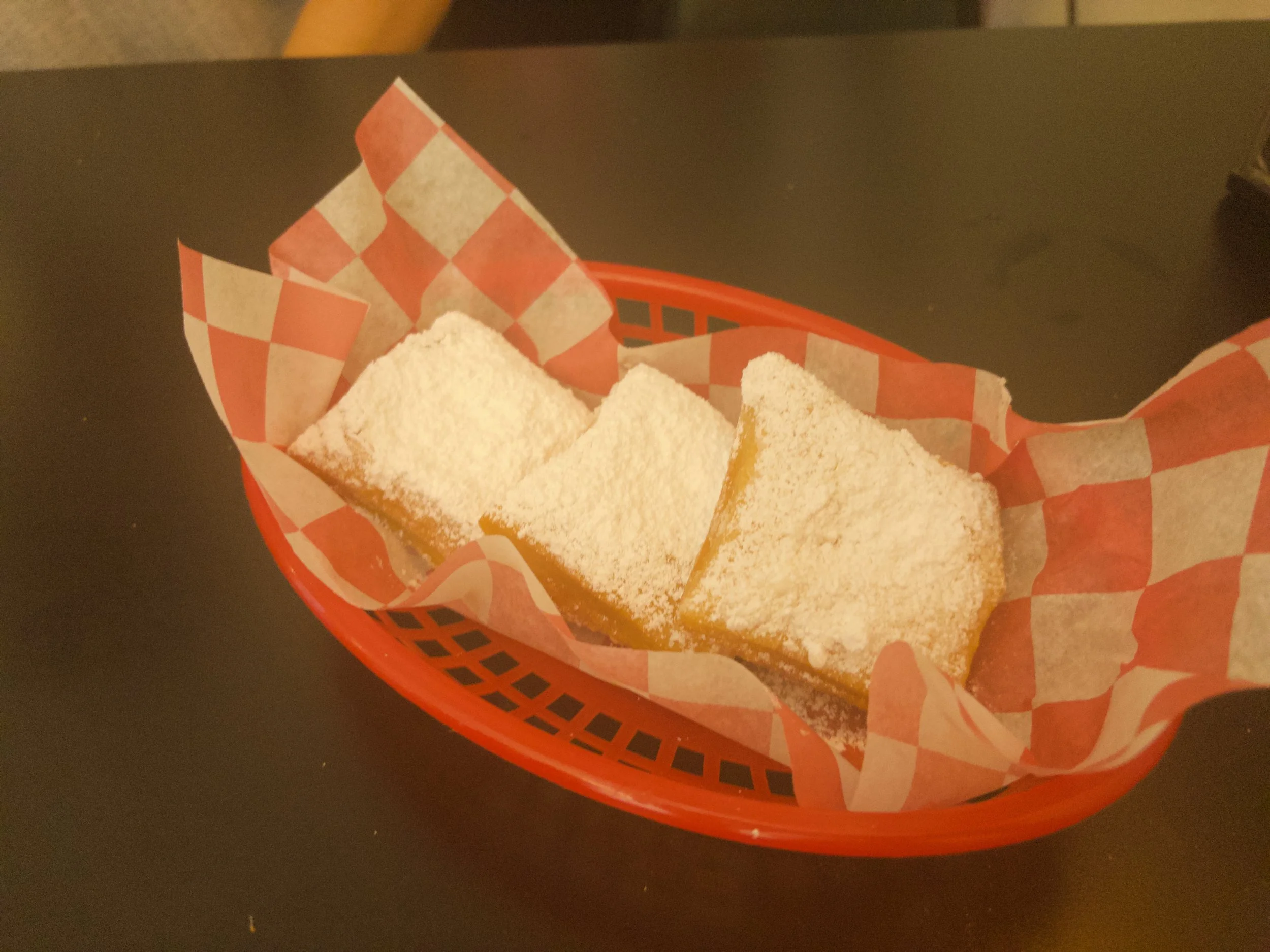
One of the houses in the Lower Ninth Ward surrounded by this lush greenery.

A moment from the Second Line Parade we went to.

Map


I’ve had the privilege of visiting seven of the fifty states of the United States of America: Nevada, Rhode Island, Massachusetts, New York, Connecticut, New Jersey, Illinois, and now Louisiana. Most of which have been for educational purposes. Of course, my experiences in each of these locations aren’t the same. Their landscapes, histories, cuisines, populations, and cultures differ, some more greatly from others based on regional differences. Each state is indeed unique, yet they are still united under not only the same (troubling) governance, but shared history, shared triumphs and losses, and the shared identity as “Americans.” This blend of cultural, historical, and regional differences is what makes the American experience so beautiful in my eyes, yet tragic in those whose definition is limited to that of one perspective. 

The United States was not built upon the sole identity of the white man. The United States was colonized by Europeans who terrorized the Indigenous Peoples of the Americas, stealing the same resources, land, and knowledge they deemed “uncivilized” to form their own civilization in North America. For nearly four centuries, the transatlantic slave trade fueled the economy of the United States, extracting labor, blood, and life from enslaved African people for wealth. And today, the United States is hunting down and concentrating people into detention centers, stripping them of their communities, their homes, their families, their humanity, for they believe their immigration status, the same act of immigration that forged America, is what makes them unAmerican. 

America contradicts itself. 

It prides itself on being a country for “liberty and justice for all” and it's often seen as the country for opportunity. And to some extent it is. As an American, I have greater access and opportunity to pursue my education, various career paths, as well as greater access to medical resources, food, water, and to travel if I wanted to. Yet this access wasn’t simply given, it was often fought for and still today this access is limited and being diminished, from the end of affirmative action to SNAP and Medicaid budget cuts and policy changes. America prides itself on being a leader of justice and opportunity, yet it deprives not only its people, but people of other countries from those same rights. Other countries don’t have the same opportunities and justice not purely from their own doing, but from the interference, manipulation, and imperialism of the United States. We see this with Trump claiming to liberate Iran from oppression by threatening to make it a living hell on Truth Social or with our tax dollars being used to fund the bombs that have damaged and destroyed 97 percent of schools in Gaza, furthering Israel’s genocide on the Palestinian people as reported by the UN Independent International Commission of Inquiry in September 2025. 

America contradicts itself and as a result, my experience here feels contradictory. To be an American feels both right and wrong. Admiration for my experiences here, and disgust for the foundation they were found upon and those they continue to support. 

Why do I mention this? 

Well, this contradiction has become ever so present in my experience here in Louisiana, in New Orleans. As I walk along the streets of the French Quarter, the Garden District, and the Central Business District, I can’t help but romanticize the experience of being in a new city. I’m a tourist in this city. I’ve gone on a ghost tour, visited the most popular beignet chains like Cafe Beignet and Cafe Du Monde, entered tourist shops, and taken countless pictures for the aesthetic. Yet the same streets I admire carry the history of harrowing enslavement and oppression. They are the same streets that met enslaved people with immense uncertainty for where their lives would lead. They are the same streets where one of the largest slave markets were located, where human beings were viewed and sold like livestock for their Blackness, where mothers were auctioned off from their children, where freed men like Solomon Northup were imprisoned, severely tortured, and torn away from the liberty the white man’s ego could not bear. They were the streets whose liveliness was sustained by the labor of people enslaved to the plantations of Louisiana. Liveliness sustained by 20 hour shifts on plantations like the Whitney, during the most extreme climates, plagued with the most brutal punishments and disease, where death was grace and life was pain. The same streets where the bodies of enslaved people, who led the largest slave uprising in the United States, were severed and placed on spikes down the Mississippi River and in New Orleans. 

“Distance lends perspective, but it can also shade, misinterpret.”

Sarah M. Broom, The Yellow House


I am a tourist in New Orleans, my lens was and still is distant, but as a bookpacker, I’ve been able to sit with the history of this place for much longer. This history sticks with me as I walk the French Quarter, as I read our next book, and as I write this very blog. It guides the pen that maps my experience here, an ink saturated with this contradiction. The contradiction of the past and the present. The wrong and the right that saturates American soil.

In The Yellow House by Sarah M. Broom, Broom introduces us to her home in New Orleans East through a map. She mentions New Orleans East is hardly mentioned in any history books about New Orleans nor maps of the city. Broom says perhaps the city was excluded from these maps for “a practical matter” being that New Orleans is, “fifty times the size of the French Quarter.” So she’s made one of her own. We used this map to guide our experience in New Orleans East. Where the Yellow House once was, were now two cars abandoned on a plot of overgrown grass. Yet, after reading Broom’s memoir, all I could see was the memory of her life here. 

On our drive back to the Central Business District, I dwelled on what my map would look like. My map would not include New Orleans East, instead it’d include East LA. My map would not include the luxury of Beverly Hills or the waves of Santa Monica, but the endless line of beautifully detailed low riders cruising down the Whittier Blvd as my mom and I rushed to get home. It would include what was once the Golden Gate Theatre, now a CVS, I’d sometimes visit after being picked up from my middle school behind it. It’d include a view of the Evergreen Cemetery where my Dad and I passed by on our way to drop off my best friend at her home in Boyle Heights. It’d include several late night concerts in downtown LA, that my Dad would buy us tickets to without us knowing. And it’d include South Central and USC. But this is where my map becomes blurred. I don’t know how to define it, how to handle this contradiction. 


Although USC is located in South Central, one can say I don’t live in South Central because I live in the USC bubble. I’ve lived on campus at Parkside and have recently moved out from the USC Village. For around 9 months a year, for two years, I’m almost always walking on the red bricks of campus. Crossing Jefferson Blvd down to USC Watt Way, walking to class or work, grabbing lunch at TCC, attending club meetings, or taking late night strolls around campus or to Illy with my roommates. USC has been the home of so many opportunities for me, to learn from amazing academics, to work on film sets for the first time, to pursue my own research, and to build a wonderful community. In the same way I admire New Orleans for its beauty, for the new experiences, independence, and knowledge it has brought me, I admire USC. But in that same light, I must acknowledge its destructive history AND its present. 

What I called home my sophomore year, the USC Village, has replaced local businesses with pricier corporate restaurants and stores that are not as affordable and accessible to the local community. Projects such as the USC Village increase the value of the surrounding area and as a result increase the price of rent for multi-generational residents of the community, forcing them to move elsewhere. Additionally, investors, seeking to build housing for the USC community, have bought out the homes of local residents with cheap cash offers. When speaking with a friend who lives in South Central, she told me how the apartment complex she lived in was at risk of getting bought out by USC but her landlord thankfully refused. My university is the beast of gentrification in the South Central community, the same issue of gentrification present within the region of East Los Angeles. Apart from housing, Annenberg Media recently reported on USC’s sale of cadavers to the U.S. Navy used to train the Israeli Defense Forces at the Los Angeles General Medical Center, just feet away from the high school I went to. It’s disgusting. 

In The Yellow House, Broom mentions the destruction of Hurricane Katrina amongst her community of New Orleans East, along with the tourism it attracts. These tourists can distance themselves from this destruction, but Broom cannot. The students of USC can distance themselves from South Central, but the residents of South Central cannot distance themselves from USC. Americans can neglect the truth, bury it away for their own comfort, but unattended history only resurrects in the present. 

As I create my own map, I can choose to live in the USC bubble or other bubbles of comfortability and privilege, but I find living in these bubbles more disturbing than popping it.

Arcadians are not Cajuns, we do not Dance Macabre

*

I know it’s not politically correct or sensitive to say stuff like “I’m so OCD” when you are just feeling particularly irked about something not being organized. With that said, the past week I have felt like Buddy. I don’t want to have an overarching blog opinion on a novel that is anything but comprehensive. The novel made me feel a million different twisted ways so I will write about it like so.


*

I can’t stop thinking about death. The concept breaks into shards and then starts piercing me. The constant morbid iconography attacking me from every building wall doesn’t help. It doesn’t help that Andrew decides to stop by a graveyard either. My grandma has been hospitalized twice in the past two days and we are now walking through a graveyard. No biggie, she is fine right now and I am having fun cracking jokes with the group. I’m good. 

We stop by another graveyard. 


It's all flat, sunken. The mosquitos immediately begin their sickening assault on us. The ones here seem to love the ankles. The group continues making jokes. The noise starts to muffle out as I stare at the giant cross across the grass. It's so misplaced and beautiful. I walk towards it without a thought in my head, despite the mosquitos, lack of sunscreen, and rotted mud. I almost trip about ten-thousand times and get bitten by mosquitos about ten-thousand more, but I make it…I don’t feel much here, and forget why I came. I snap a picture, a thunderous video, and leave.


*

I am having an amazing time! I parade around the CBD constantly with music blasting in my ears. The way Buddy Bolden speaks about music towards the beginning of the book saturates my psyche. I love the way Coming Through Slaughter is written. I relish in its sporadicity. You, the reader, are already supposed to feel confused so I never feel confused. This book comforts me even more than The Awakening. I just finished the first chapter! I play some Alannah Miles while I leave The Shop. I observe many mentions of death in the first part, but they can all be romanticized through the New Orleans eye. Jessica Lange’s final scene in American Horror Story: Coven, Erte’s Symphony in Black, pomegranates and spider lilies. That’s how I will think about death in New Orleans. I know the book is about a descent into madness, but I ignore it.


*

I walk down Bourbon and hear a snippet of the most intense and invigorating music, and then it fades out. Life and death. New Orleans is easily America’s city of death. It is also one of America’s most alive cities. Jazz encompasses both. 


We pass by the yellow house. In its place is a car. Junk yard. But there is a plant growing from it. It is growing from its dead engine. It grew from the dead engine and is now higher than the hood, higher than the roof. It will die. What will grow from its corpse? I play “In a Sentimental Mood” when I get back in the van. New Orleans arose from life and death. New Orleans is sinking.
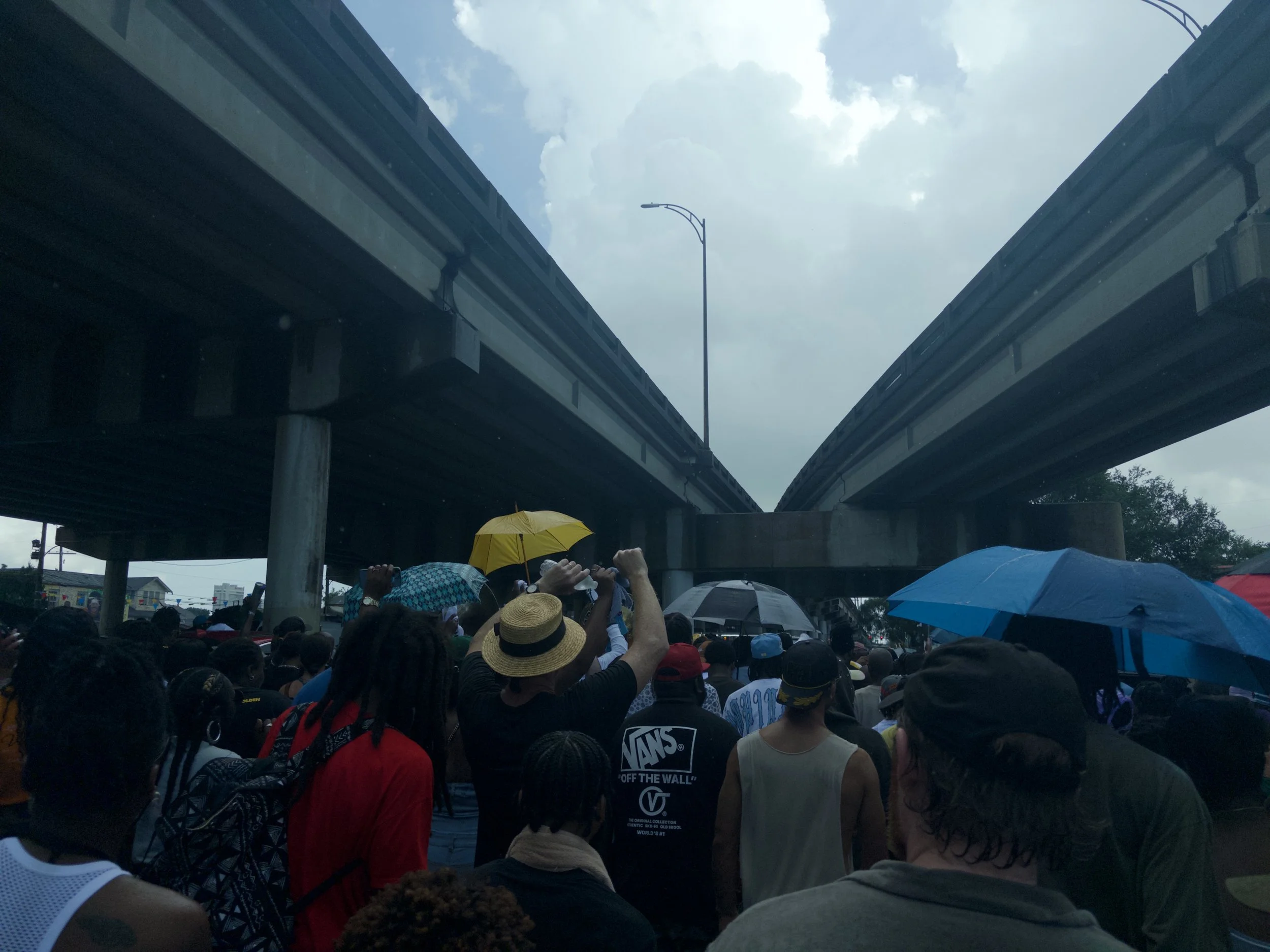


Voices said goodnight several times and the orchestra playing in the background collapsed into buzz again, a few yards away from me in your bedroom.”

Buddy loathes Robichaux because he forces the audience to listen to his planned symphonies. For Buddy, music should collapse into a buzz. For the audience, it has an unplanned start and an unplanned finish. You are forced into existence and then it fades out. Ondaatje argues jazz is the reality of life, especially for Black Americans in New Orleans, and that the formally trained violinist John Robichaux’s “waltzes,” are an idealized and pristine imagination. 

*

Above ground coffins. We walk through them again. The first few I saw were in Grande Isle, where Andrew explained that the major reason for the tombs being above ground is not actually the frequent flooding, but rather the religious influence. He continues to remind us of this in New Orleans. But he has made a point to justify the French and British ways of life, work to live versus live to work, as a result of their fertile versus harsh land. He has also made a point to say that New Orleans is America’s literary playground because of the city’s natural, swampy landscape. I find it funny that he strays from his repeated cultural ecology to be so adamant about debunking the tombs’ weather origins. I believe him though. I believe him without a second thought because he also mentions the family burials. I see this is religious because Greek Orthodox do just the same. Why does Greece have to be part of this? I’m not French, West African, Spanish, German, Irish, Native American. My identity should not be here. Each time I pass a tombstone with too many names on it I picture my grandfather’s grave in Afantou. Αντώνης Δανεήλας (Andonis Daneilas). It is below Sabbas Daneilas, who is below Andonis Daneilas. Another Sabbas Daneilas will be below my grandfather when my dad passes. Will another Andonis Daneilas be below him? I envision the comfort of resting with family, whatever that means. But I am not religious or spiritual, I don’t believe in a soul’s resting place. I can sign over my body for medical practices. I’ll be a good person. But what if I meet the fate of one of the USC cadavers sent to the IDF? They don’t deserve my body, they disgust me. I don’t want to be tested on by anyone. No one deserves my body. My family deserves my body. I’m a bit nauseous.


*

Mississippi in the middle of a dry spell

Jimmy Rodgers on the Victrola up high

Mama’s dancin’ with the baby on her shoulder

The sun is settin’ like molasses in the sky


*

Edna and Buddy are similar. They both get consumed by New Orleans and slide down into madness. Edna’s decline had represented the inability for a woman to both live freely and be viewed as sane in a restrictive society. The French lifestyle taunted her, tossing vulgar books around, making her feel like she could be free with her sex and her time. But we know she couldn’t. Buddy’s is more literal and physical. He is debilitating. The city gets to him, with its heat, its alcohol, and above all its inescapable lust. Bellocque takes photos of Buddy, Bellocque takes photos of the Storyville whores. Buddy describes these mattress whores. Buddy describes himself.
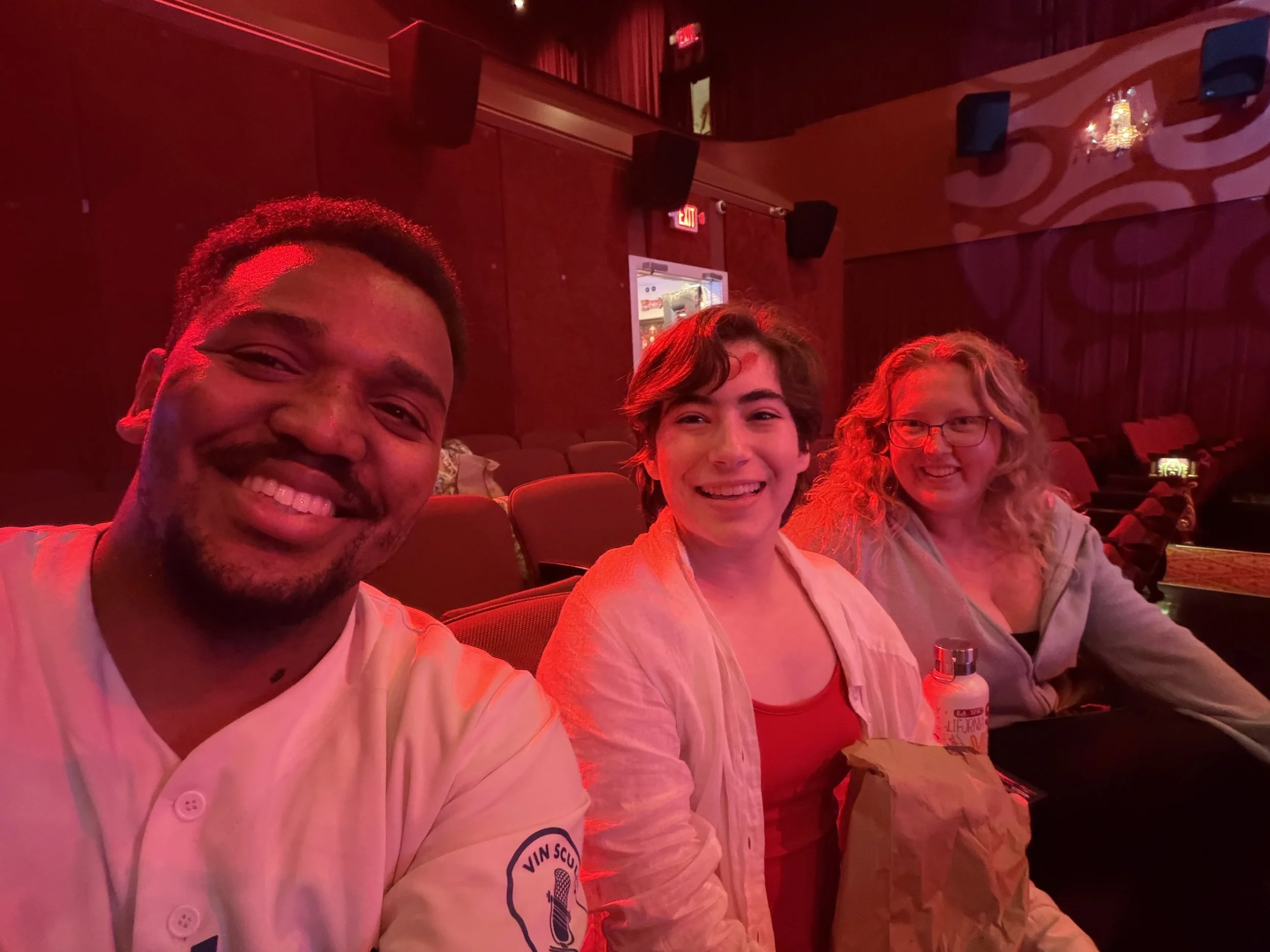
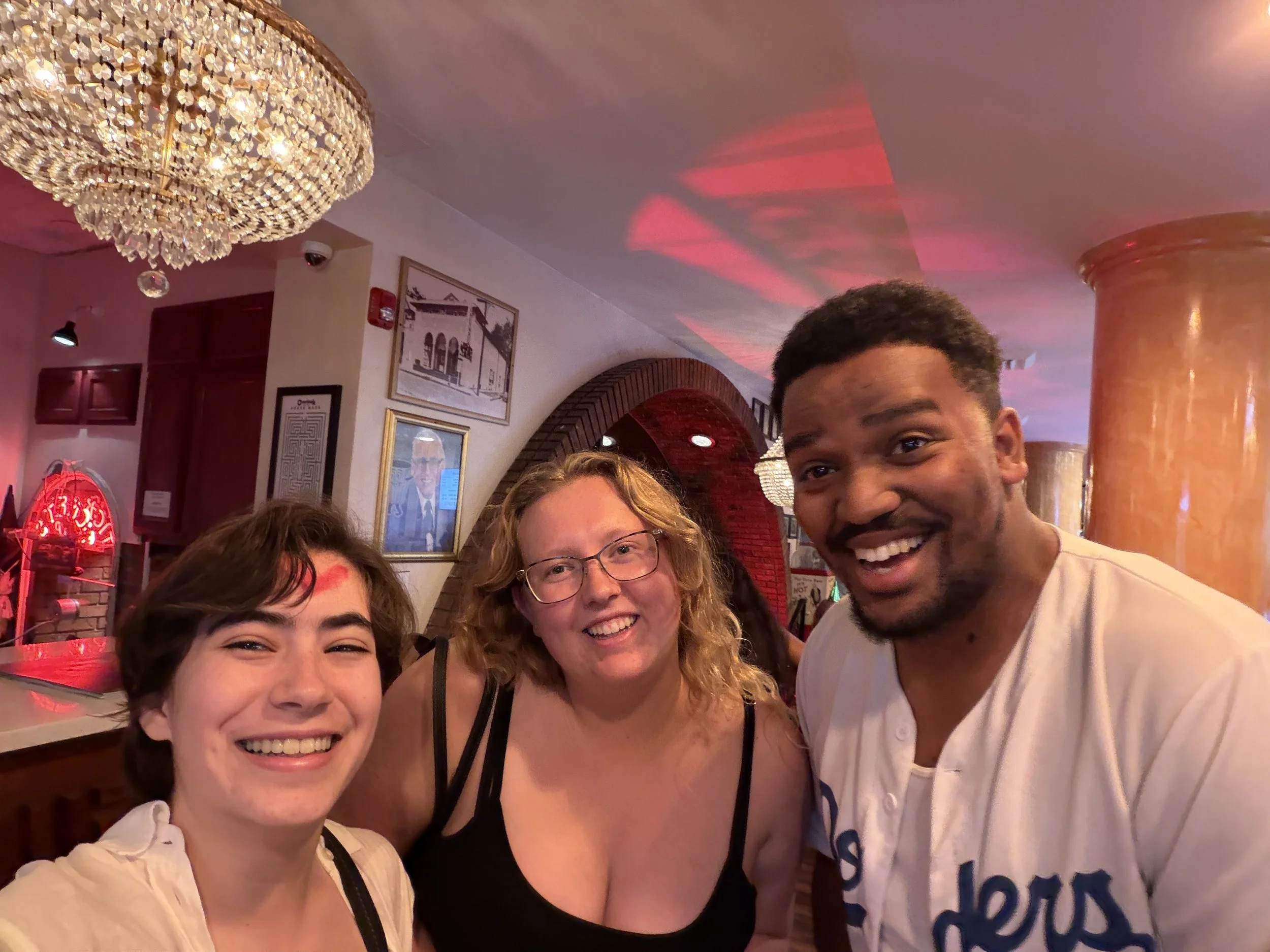

And the ones not caught yet carrying their disease like coy girls into and among the rocks…those who are lame thrusting their fat foot at you, immune from the swinging stick that has already got them swelled and fixed in a deformed walk, gypsy foot gypsy foot…their bodies murdered and my brain suicided…my brain tonight has a mattress strapped to its back”

Buddy views sex as harmonious. Its musical physicality combines both the brain and body. So viewing the women he has experienced he sees the present and future for himself in them. Their body and his brain.

I previously came to the conclusion that I would not revel in my connection to Edna. I saw our flaws and decided to work on myself. I do the same with Buddy. I will confront the part of this trip that scares me and why I walked over to that cross. 

I see a dead racoon on my walk to Tulane. An eighty-minute walk. St. Charles and Calhoon is the entrance to Tulane for those taking the streetcar. This was my exit. This part of Tulane was where I grieved my friend. “Baile Inolvidable” plays in my head, as it did when I walked around sniffling about him a year ago. I just keep dancing, don't I? My heart starts beating faster and I tremble a bit entering the school. A few tears start welling but I brush them off because an old lady smiles at me. He was studying to be a vet at UC Irvine. We were close when he first came to my high school, but by the time of graduation we had just drifted off. We were supposed to meet up two summers ago, but I flaked. I don’t remember the last conversation we had. I do remember walking around the Richardson Building at night, seven days after I heard he passed away. I was gonna write him a letter. I remember the cat I saw after writing the letter. It was laying down, could have used a vet. I see the same cat. It's in the same spot it was that night. The tears do more than well up. 


I sit on the bench I wrote to him, and finish my fourth blog post. 

June 6, 2026

October 17, 2024

*

I attempt to recite thanaptosis in the southern Necropolis. Θέλω την ηρεμία μου. I instead get devoured by the macabre.