Women and the Revolution

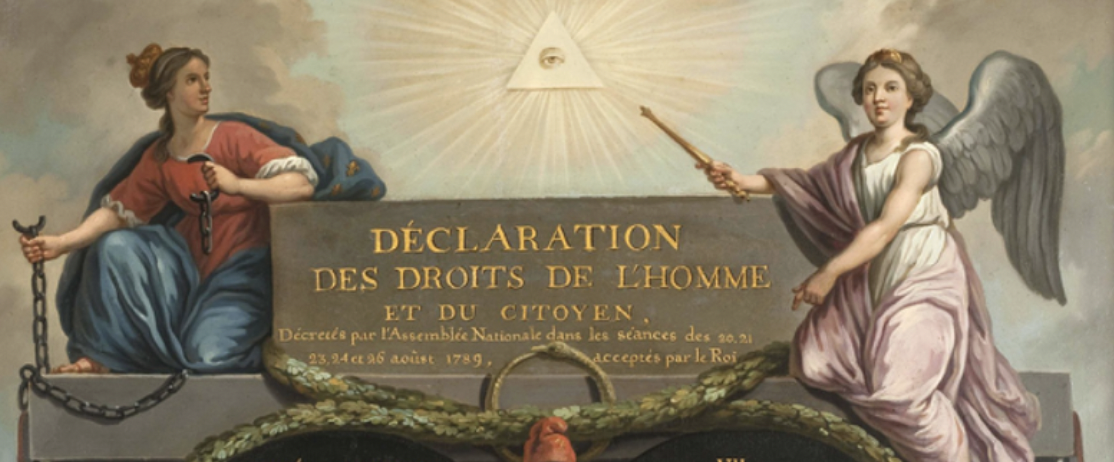
While exploring the Musée Carnavalet with Kate, I was especially interested in the upstairs exhibit on the French Revolution. The exhibition starts with the Déclaration des droits de l’homme et du citoyen.
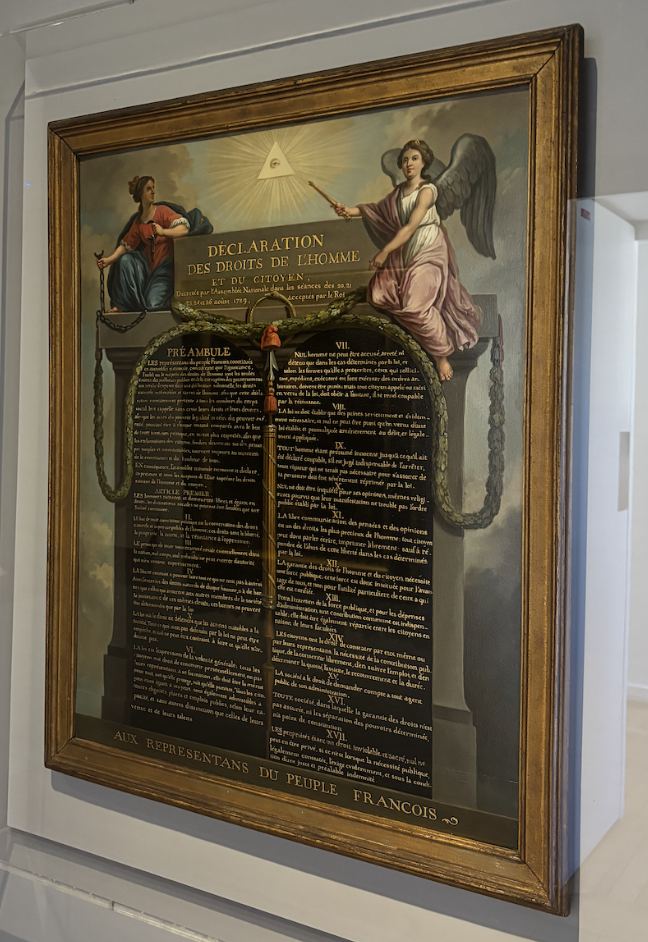
The Déclaration des droits de l’homme et du citoyen.

A woman in red, with a crown and lilies, is depicted in the top left corner. The museum plaque explains she represents the French monarchy, ”the chains of despotism have been broken.” And to her right, an angel-like figure represents the French nation, carrying a scepter of sovereignty. Finally, the bottom of the image reads: “Aux representans du peuple francois,” or “to the representatives of the French people.” 

The declaration establishes basic freedoms and human rights, and was adopted by the National Assembly in 1789. However, women and slaves were not included in this definition of “human” rights.

And while the plaque on the wall claims the chains of despotism were broken—they were not really. The abuse of the aristocracy and monarchy was gone—but society lived under a man’s rule.

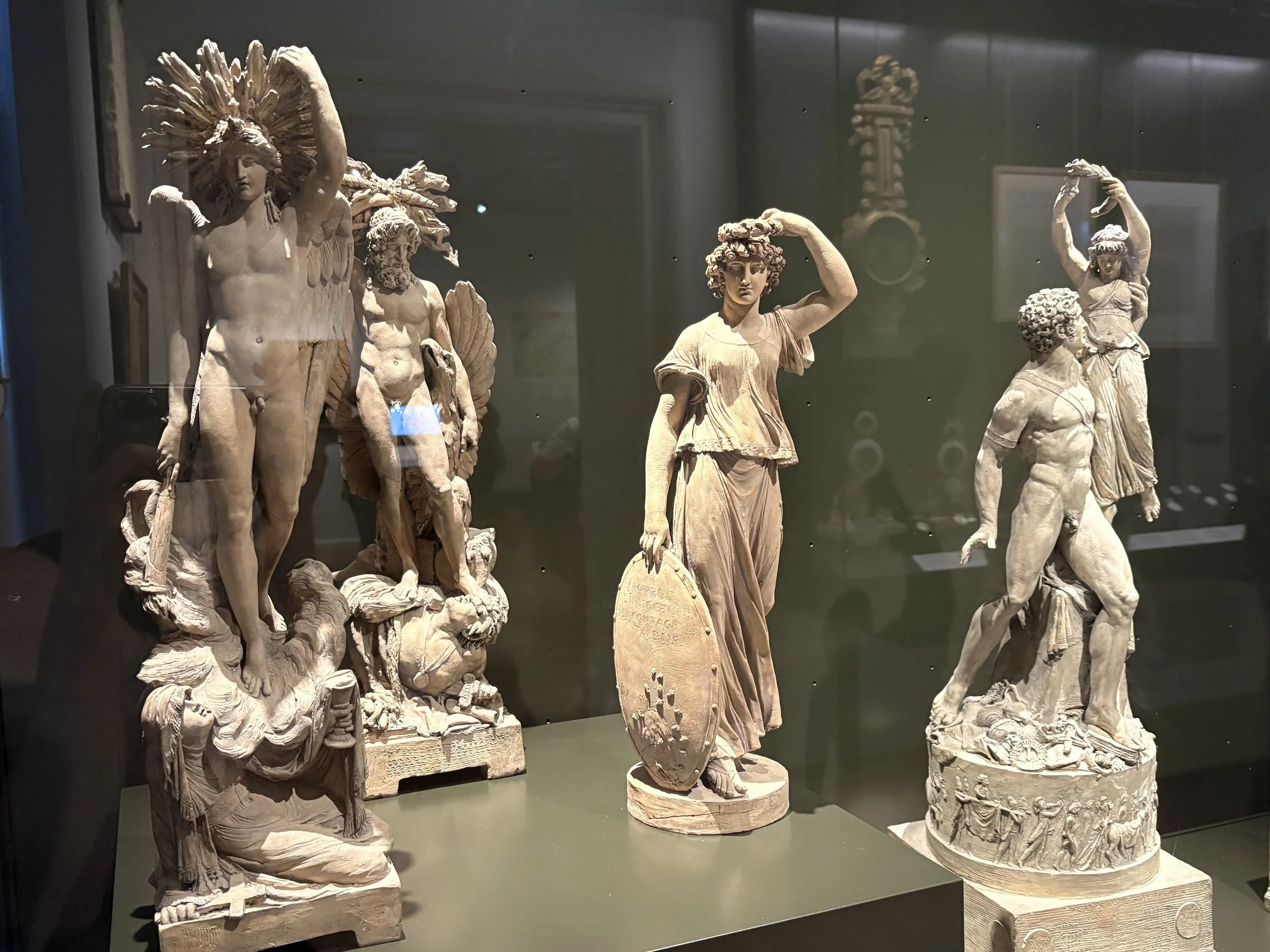
I kept walking through the exhibit, and next I find beautiful representations of free France, depicted as female characters.
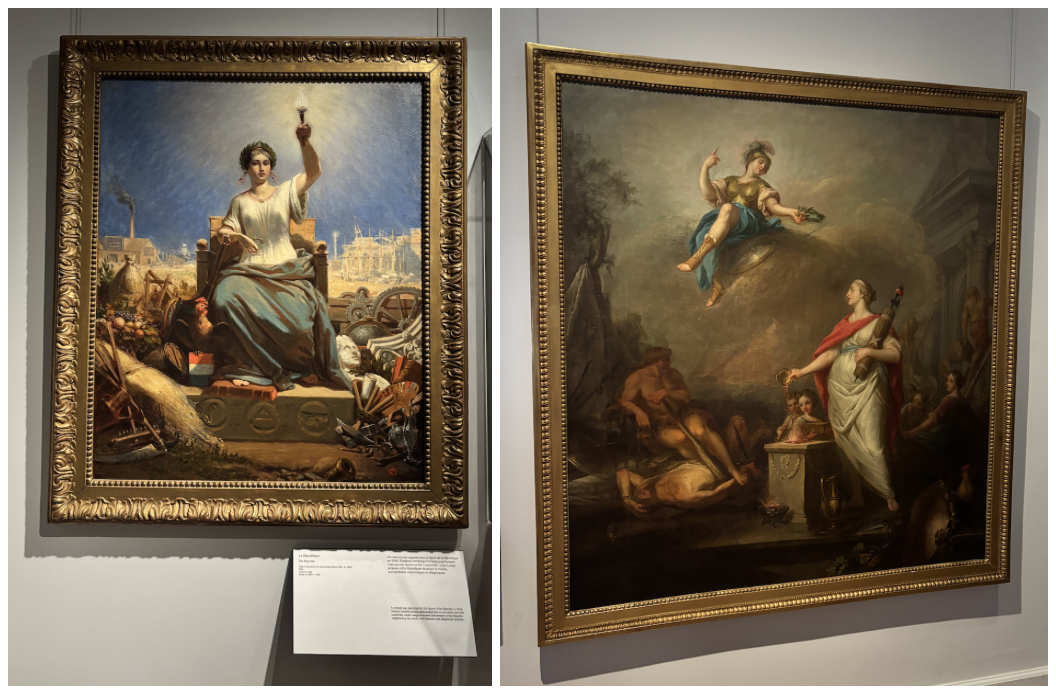
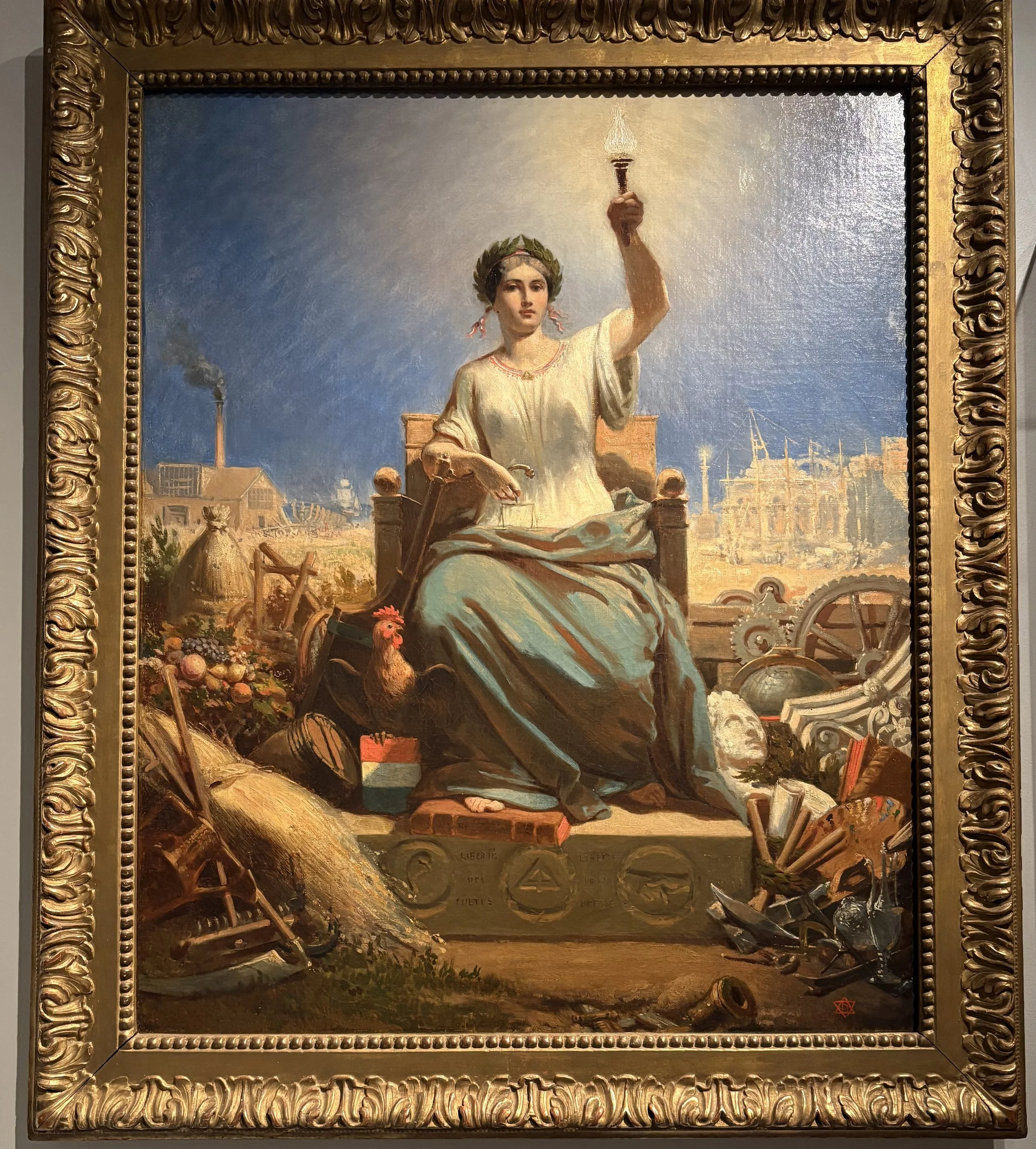
La République by Ange-Louis Janet (1848), Allégorie de la Révolution de 1789 by Jacques Wilbault (1791).

France in all her glory, all the people’s glory—is feminine. Even the French language for “France, the Republic, liberty, and reason” are all feminine: “la France, la République, la liberté, et la raison.”

This feminine representation is even represented in literature at the time, such as the poem we read in class: La Curée, by August Barbier in August of 1830. The translated excerpt reads:

“It's that liberty is not a countess 
Of the noble Faubourg Saint-Germain
A woman whom a cry makes weak 
And who puts on rouge and carmine
She is a strong woman with powerful breasts, 
With a hoarse voice, with hard charms
Who, with brown on her skin, fire in her eyes, 
Agile and striding
Pleases herself with the cries of the people, with the bloody melee, 
With the long rolls of the drums
With the smell of gunpowder, with the distant volleys
Of bells and muffled cannons
Who only takes her loves from the people
Who only lends her great bosom
To people strong like her, and who wants to be embraced 
With arms red with blood”

Barbier describes a woman reminiscent of Madame Defarge—a working class woman, one who may have participated in the March on Versailles, a radical with “fire in her eyes” who “lends her great bosom to strong people like her.” In this sense, the physical female body is likened to the glory and freedom of the Republic.

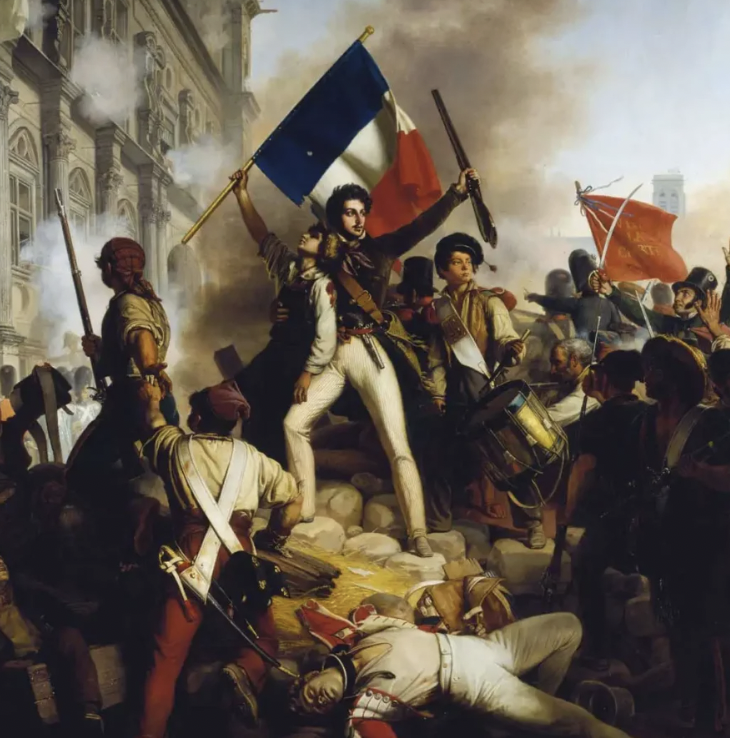
Another topic we discussed in class was how women of the revolution were often painted topless—likening the causes and goals of the revolutionaries to be the attractive side to the fight by invoking the male gaze. For instance, we saw the famous La liberté guidant le peuple by Eugène Delacroix in 1830 in the Louvre.

My question is this: if the woman was such a glorified representation of the revolutionaries’ fight, why is she still treated as the lesser sex? Artistically, she is literally depicted as a higher body than the male.

Furthermore, I could not find any displays on the women of the revolution in the Carnavalet. I could not even find any reference to the Déclaration des droits de la femme et de la citoyenne by Olympe de Gouges—an arguably important part of the revolution as well as French feminist theory. When I asked museum attendants, they told me information on Olympe de Gouges and her work would be “up ahead,” but the exhibit ahead was post-1800…and Olympe had been executed in 1793.
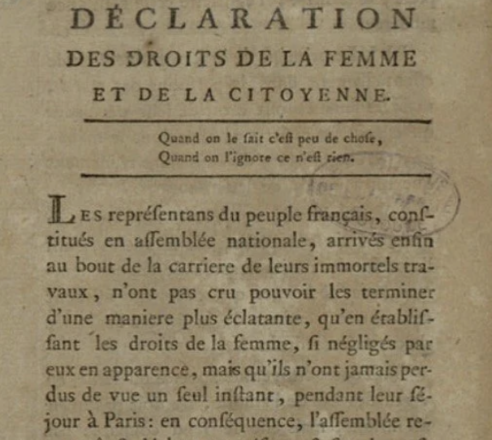
Déclaration des droits de la femme et de la citoyenne.

Olympe wrote her declaration in 1791, two years post-original declaration. Following the Women’s March on Versailles, the National Assembly and other revolutionary leaders still had yet to include women in their reforms. Actually, in November 1789, the “Women’s Petition to the National Assembly” was submitted, requesting sexual equality—but made no headway.

Olympe dedicated this declaration to Marie Antoinette, calling for her to back female revolutionaries and feminists or risk the destruction of the monarchy. Olympe also takes up a rather sarcastic, feisty tone. She begins: “Man, are you capable of being fair? A woman is asking: at least will you allow her that right?” and continues in the preamble…“the sex that is superior in beauty as it is in courage during the pains of childbirth recognizes and declares, in the presence and under the auspices of the Supreme Being, the following Rights of Woman and the Female Citizen.”

The articles expand on the original declaration by including women in the equation and offering them equality. However, Olympe also introduces some radical new feminist ideas—such as in Articles X, XI, and XVII. The tenth article calls for women to have equal rights, citing that women are equally punishable as men yet are not granted equal freedoms: “No one should be disturbed for his fundamental opinions; woman has the right to mount the scaffold, so she should have the right equally to mount the rostrum, provided that these manifestations do not trouble public order as established by law.” The eleventh gives women the right to identify the father of their children, whether or not it be their husband. Finally, the seventeenth introduces the idea that marriage must lend towards recognizing equality between spouses: “Property belongs to both sexes whether united or separated; it is for each of them an inviolable and sacred right.”

Reactions to her pamphlet were mixed. The Jacobins believed her to be a Royalist, and the press wrote that she forgets her place as a woman. Needless to say, this constitution was not adopted. And in 1793, Olympe was executed at the guillotine under the Reign of Terror. 

It is remarkable to me how such a rich, important, and equally interesting piece of history is left out of an entire floor of revolution history at the museum. Other women of the revolution whom I found in the museum were uncredited wives of male revolutionaries—such as Lucile Desmoulins and Camille Desmoulins.

In my experience, society—especially old society—tends toward the idea of the feminine as a virtuous, almost-holy figure: a representation of salvation and all that is good, especially in depictions of Liberté, Raison—and later, Marianne. Yet at the same time, that society hated women who stepped out of their place, silencing those like Olympe before any true equality could be reached—an overall historical trend. This is a true contradiction in the finest sense of the word.

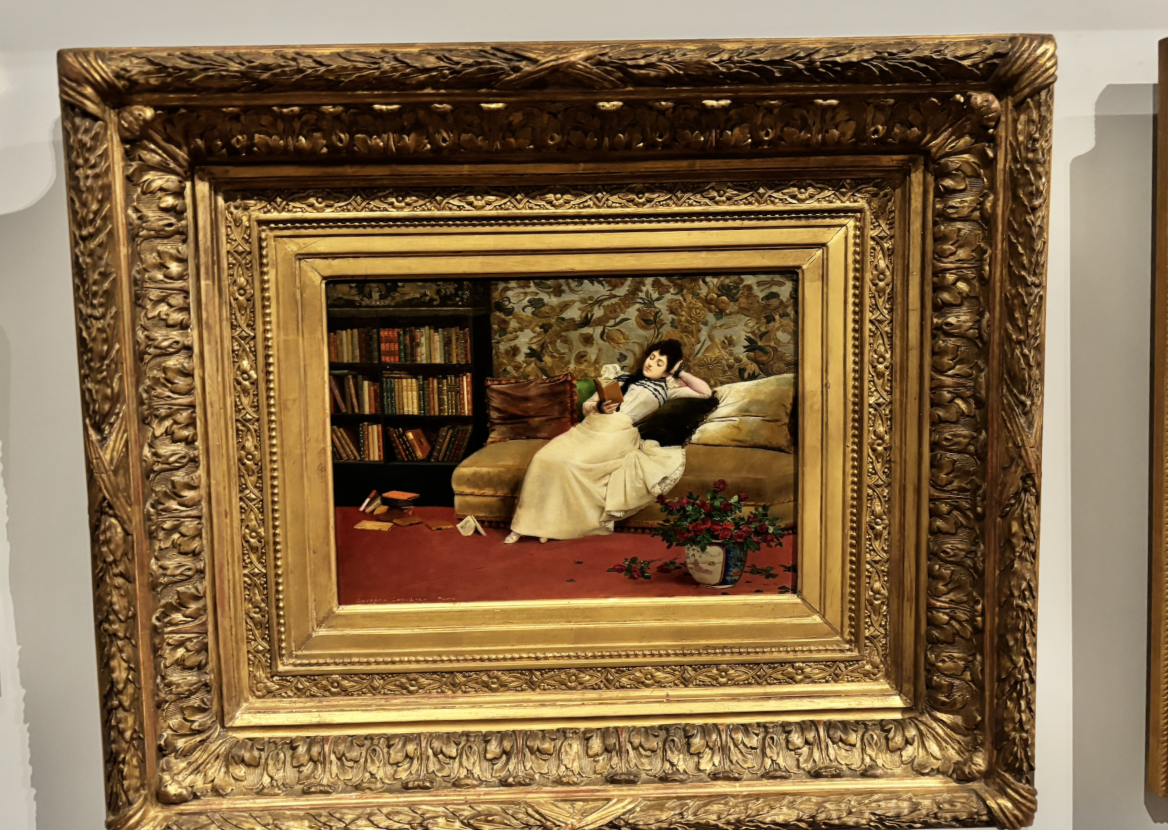
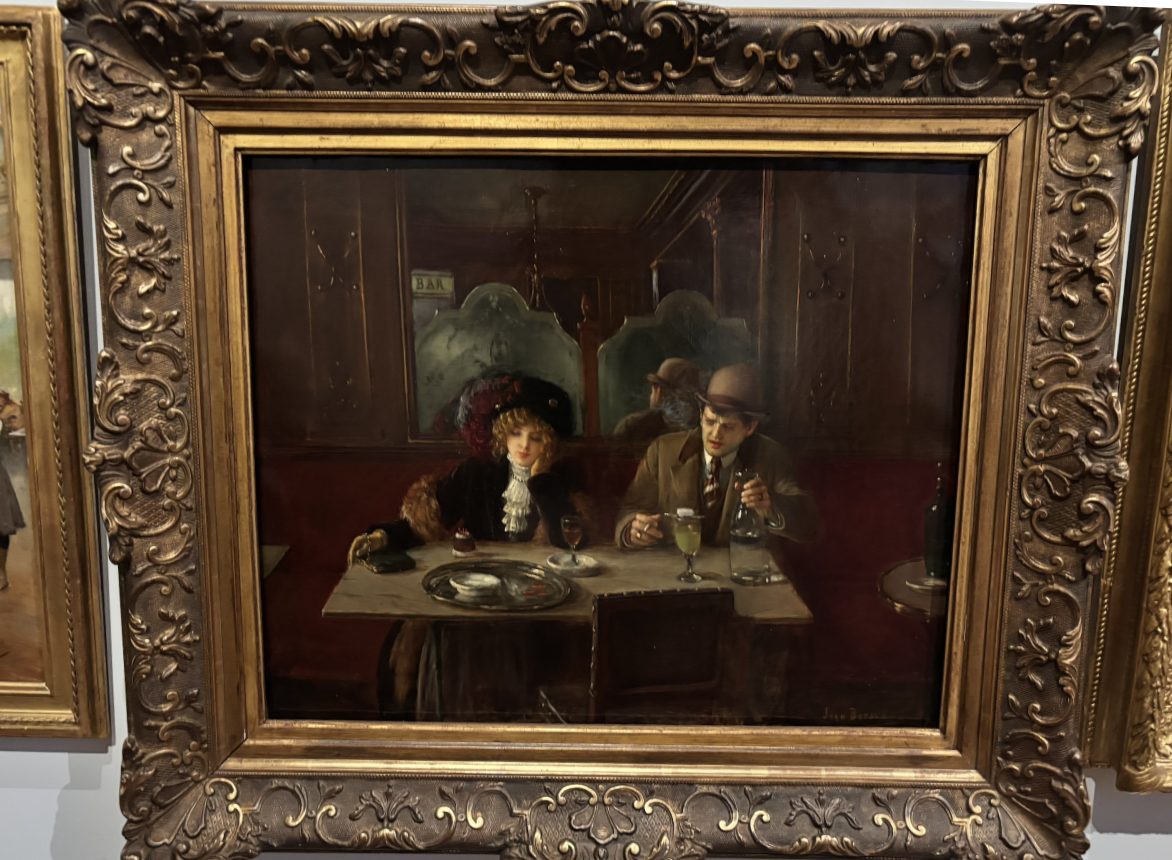
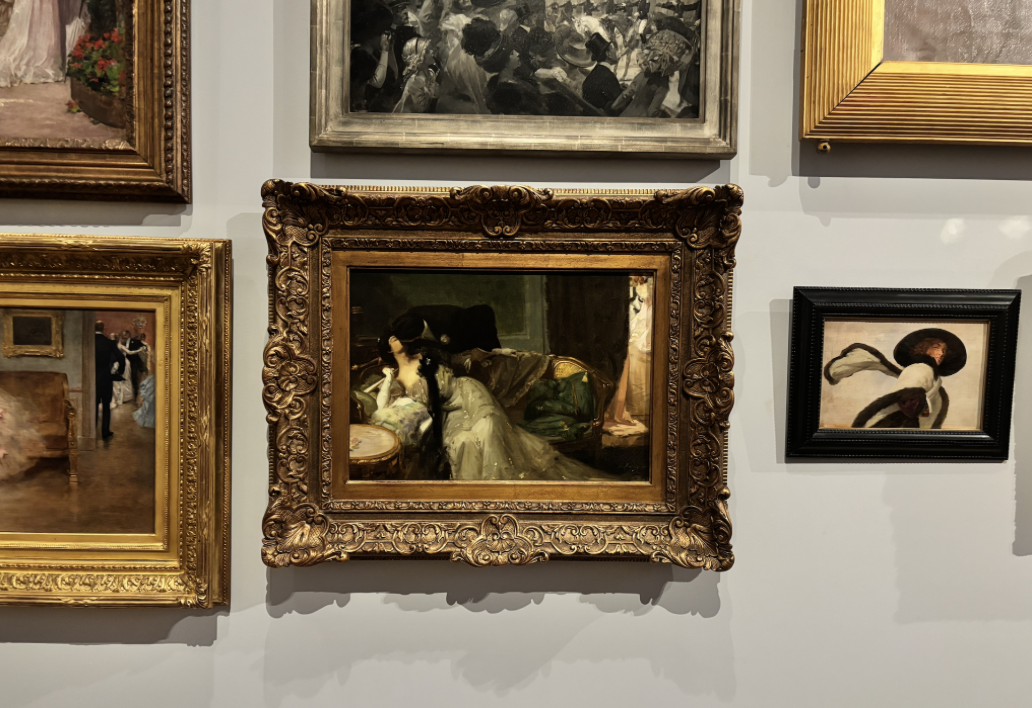
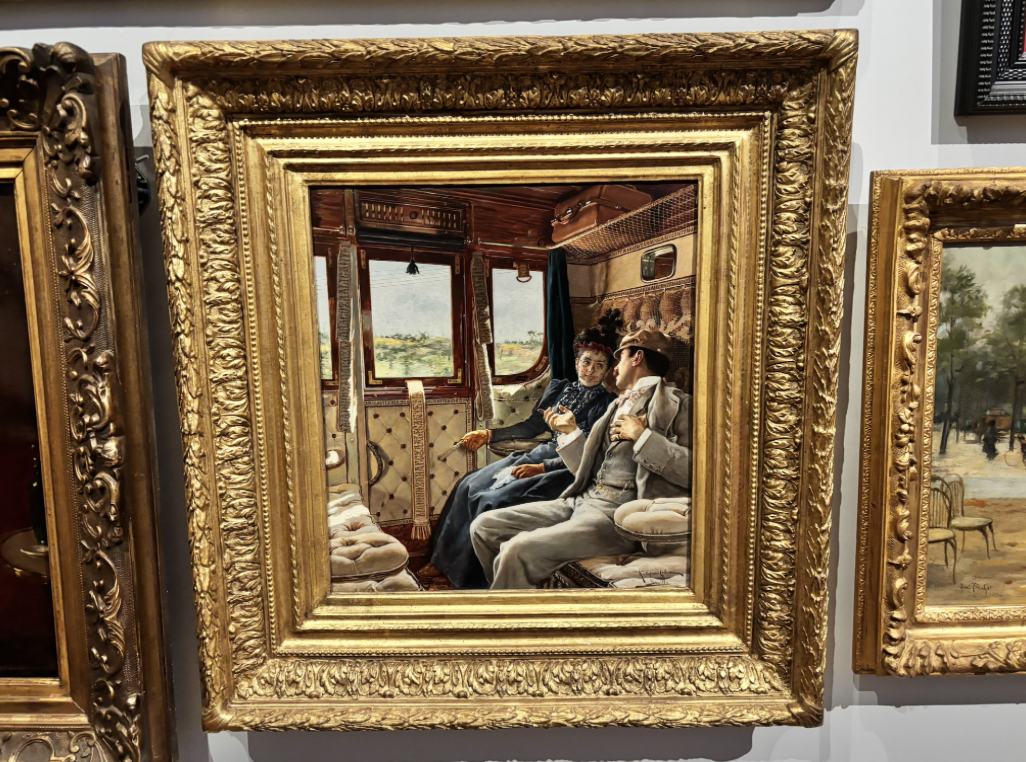
Anyways…my favorite part of the Musée Carnavalet was by far this room with these oh-so-romantic paintings! These are honestly some of my favorite paintings I have ever seen before.
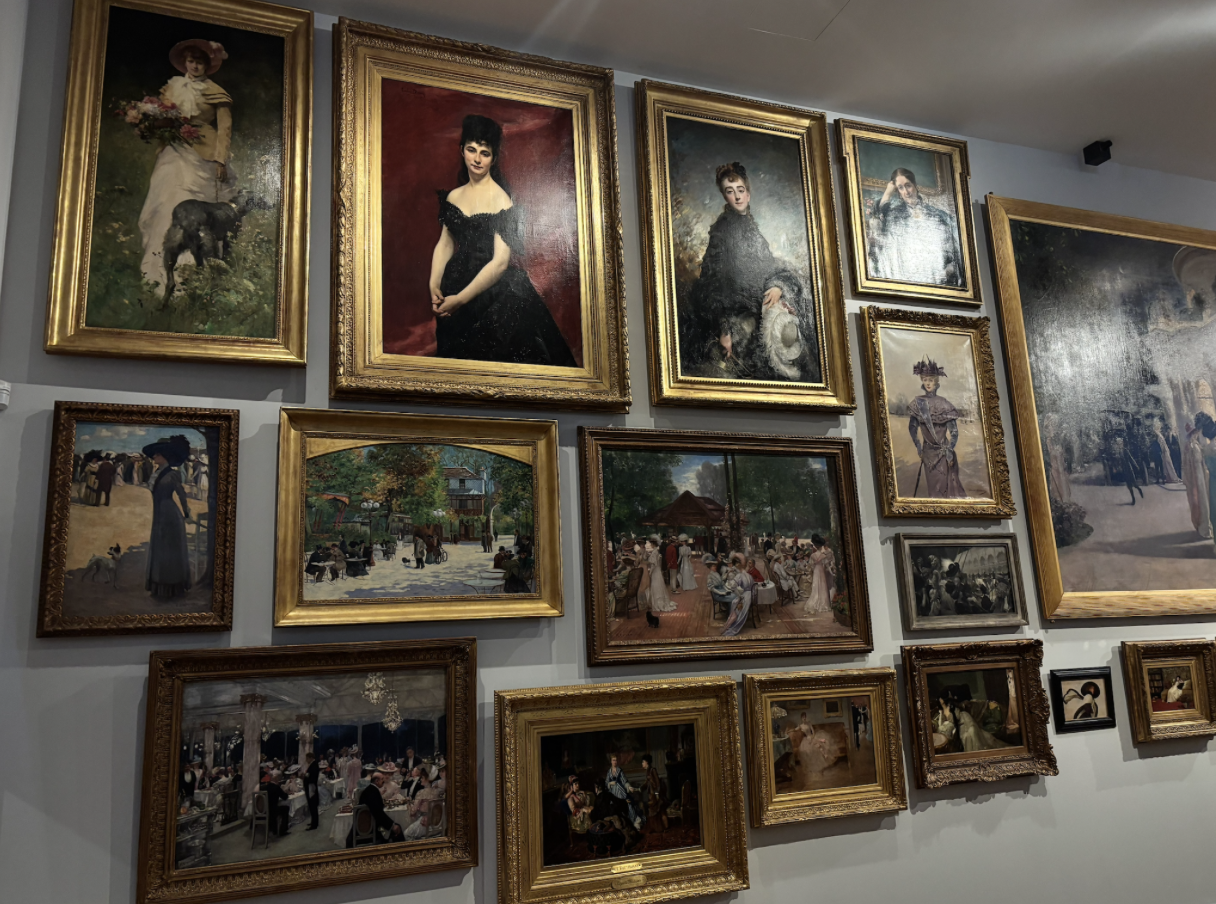
The hall of romantic paintings in the Musée Carnavalet.

Just look at these lovely ladies lounging! These are the type of painting I can look at and imagine old times under a more romantic, idealized lens.
Musings | Museums

Art is best appreciated in person. Nothing quite compares to stepping into a museum and admiring human artistry with your own eyes. The scale of the piece makes a difference–you come to understand just how much time a piece takes. The raised ridges of dried paint are mesmerizing, each stroke lovingly placed. Marble statues present a different face at every angle.

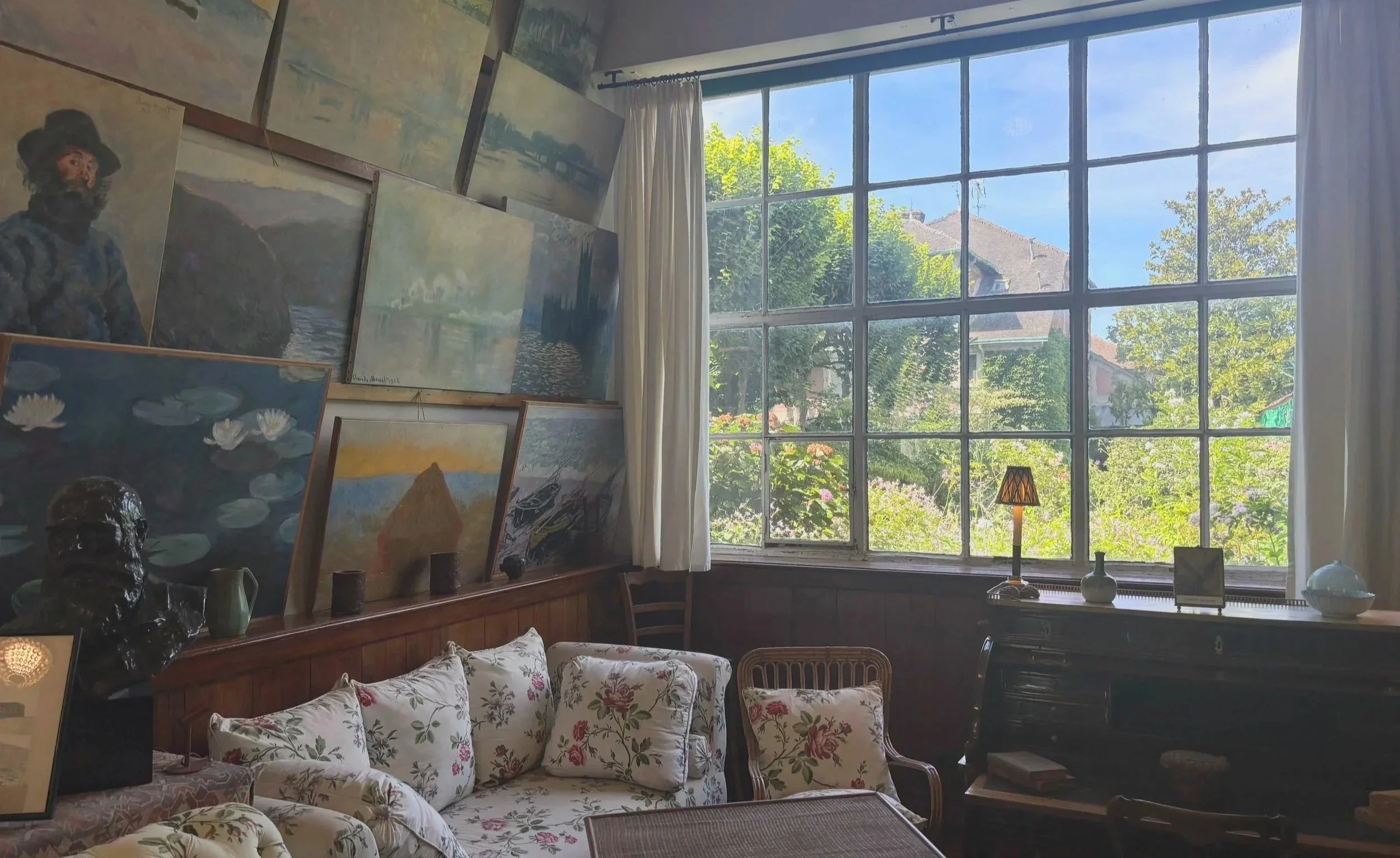
Talk about romantic… Claude Monet’s home in Giverny.

My favorite art movement is Impressionism. There is something so romantic about capturing the feeling of a moment. Of focusing more on perception than actuality. One artist might represent the blur you experience in your vision at the setting sun, or the hazy glow of the fresh dawn. Realism doesn’t necessarily mean a better visual description of the scene. I always say the reason I enjoy impressionist art is that it feels a bit like a memory, fresh enough to recall the impression of it but not the minuscule details you can observe in a photograph. In this way, art (not limited to impressionist art) is like history, where it becomes increasingly difficult to pinpoint the exact realities of an era as time passes, but we can grasp its essence through cultural artifacts and written evidence.

Art allows us a glimpse into the intimate moments of everyday life of the past. Tender portraits depict the fashion of the time. Paintings of fiery revolutionaries draw you in, urging you to rally with the crowd (hello, Delacroix!). Then there is everything else to consider–the symbols, the artist’s intentions, the historical viewer’s thoughts.

To depict a battle, one of those powerful painters with a sense of chaos in their brush-stroke is needed… the hurricane alone is truthful.
— Victor Hugo, Les Misérables

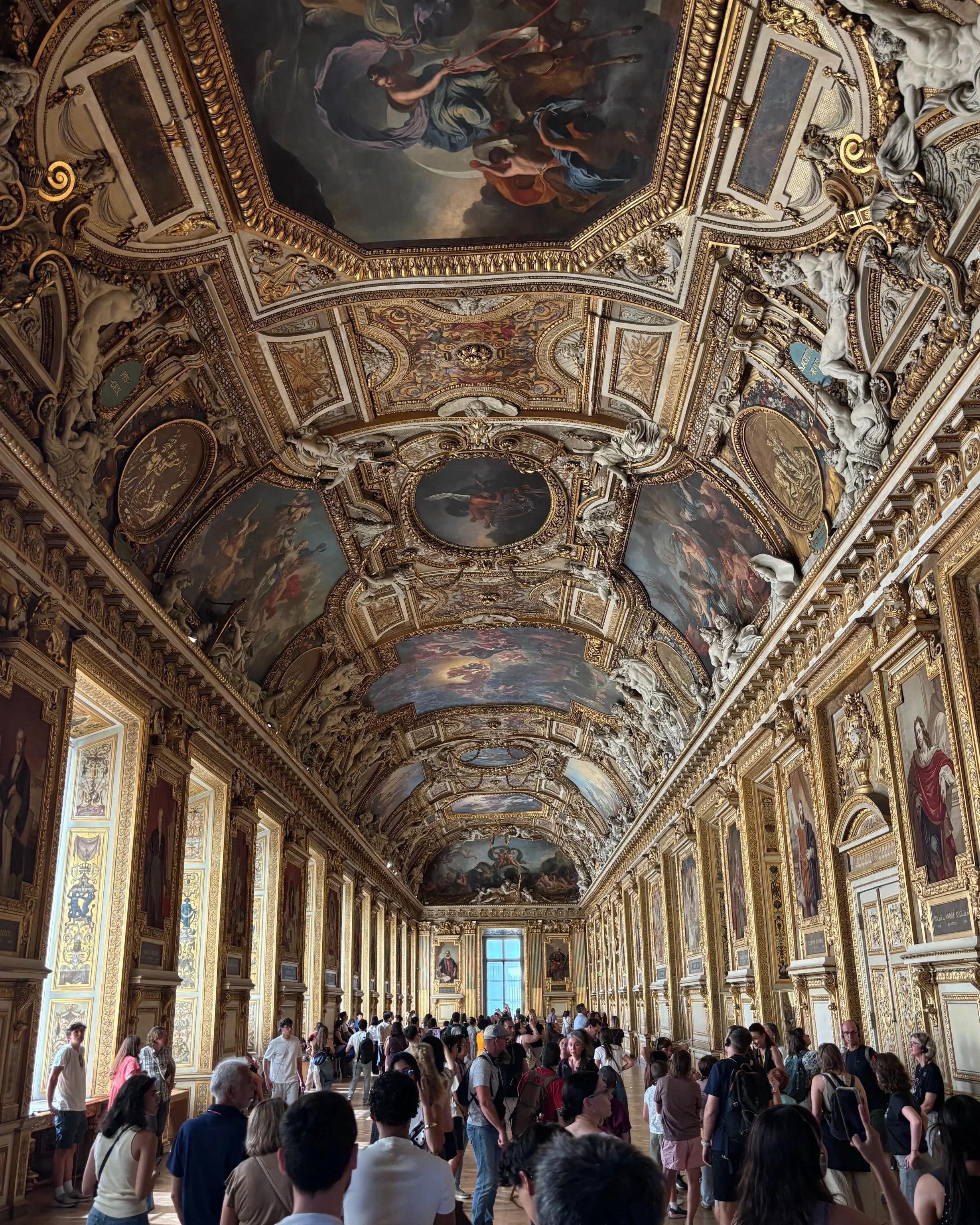
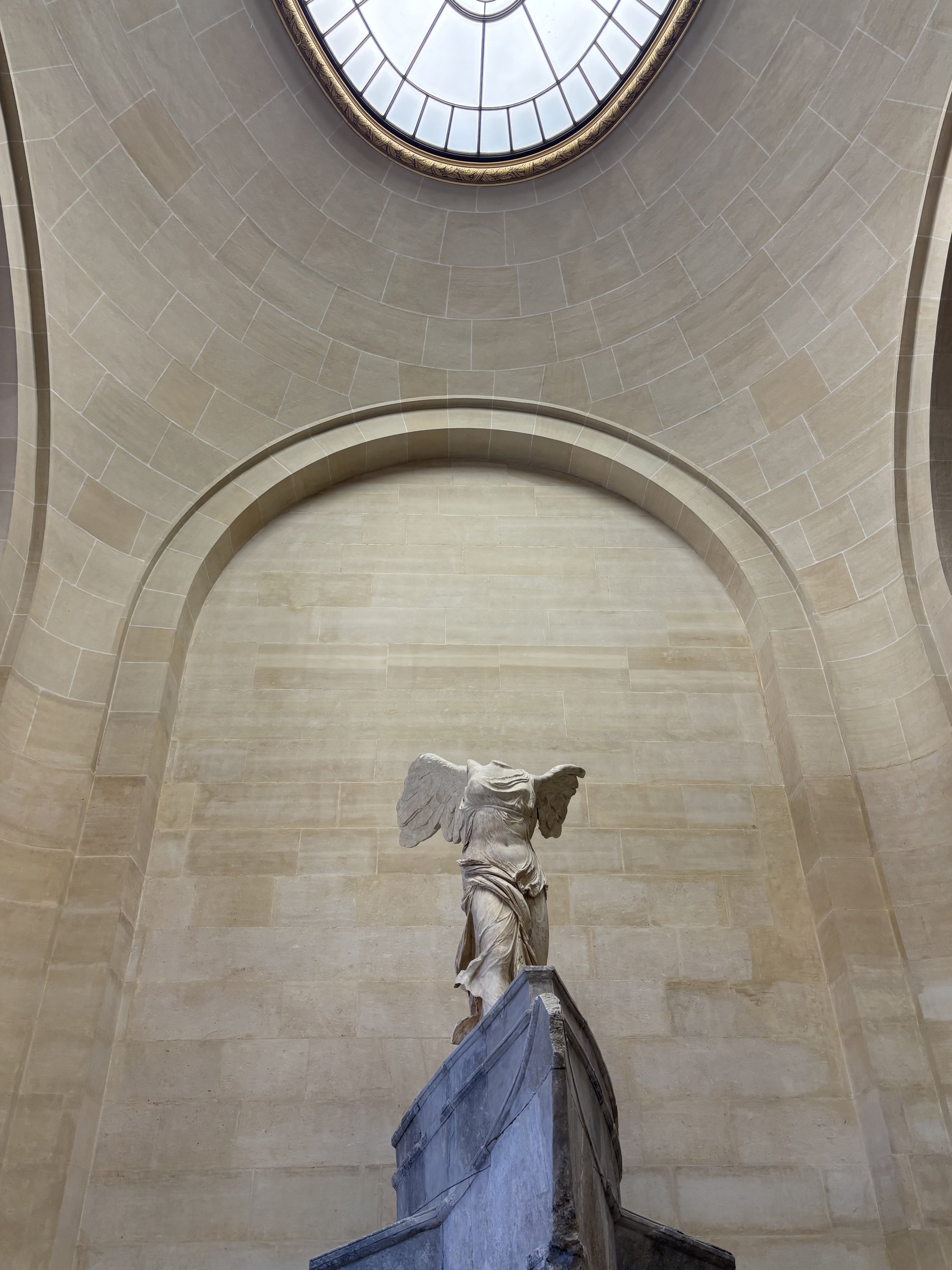
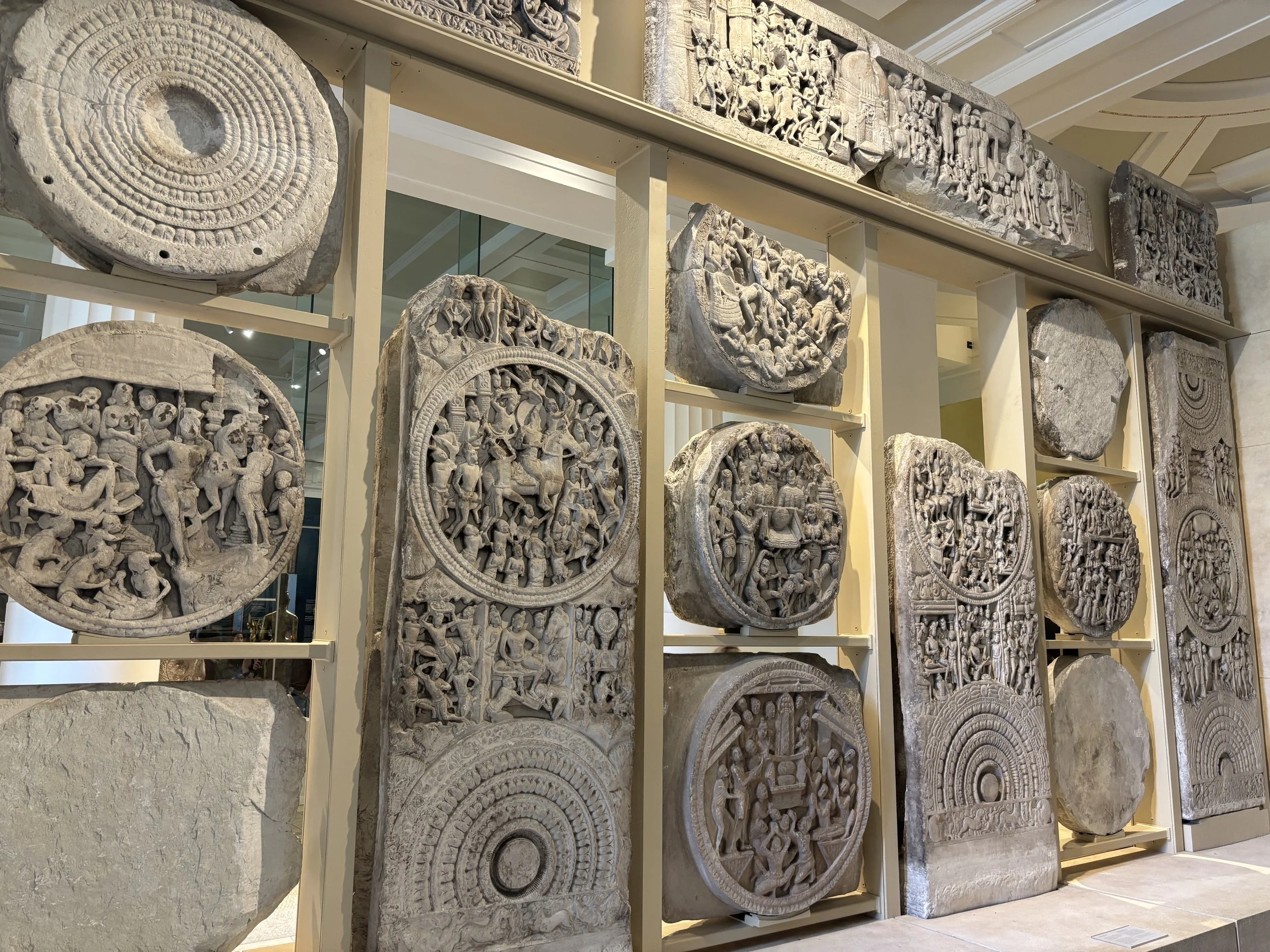
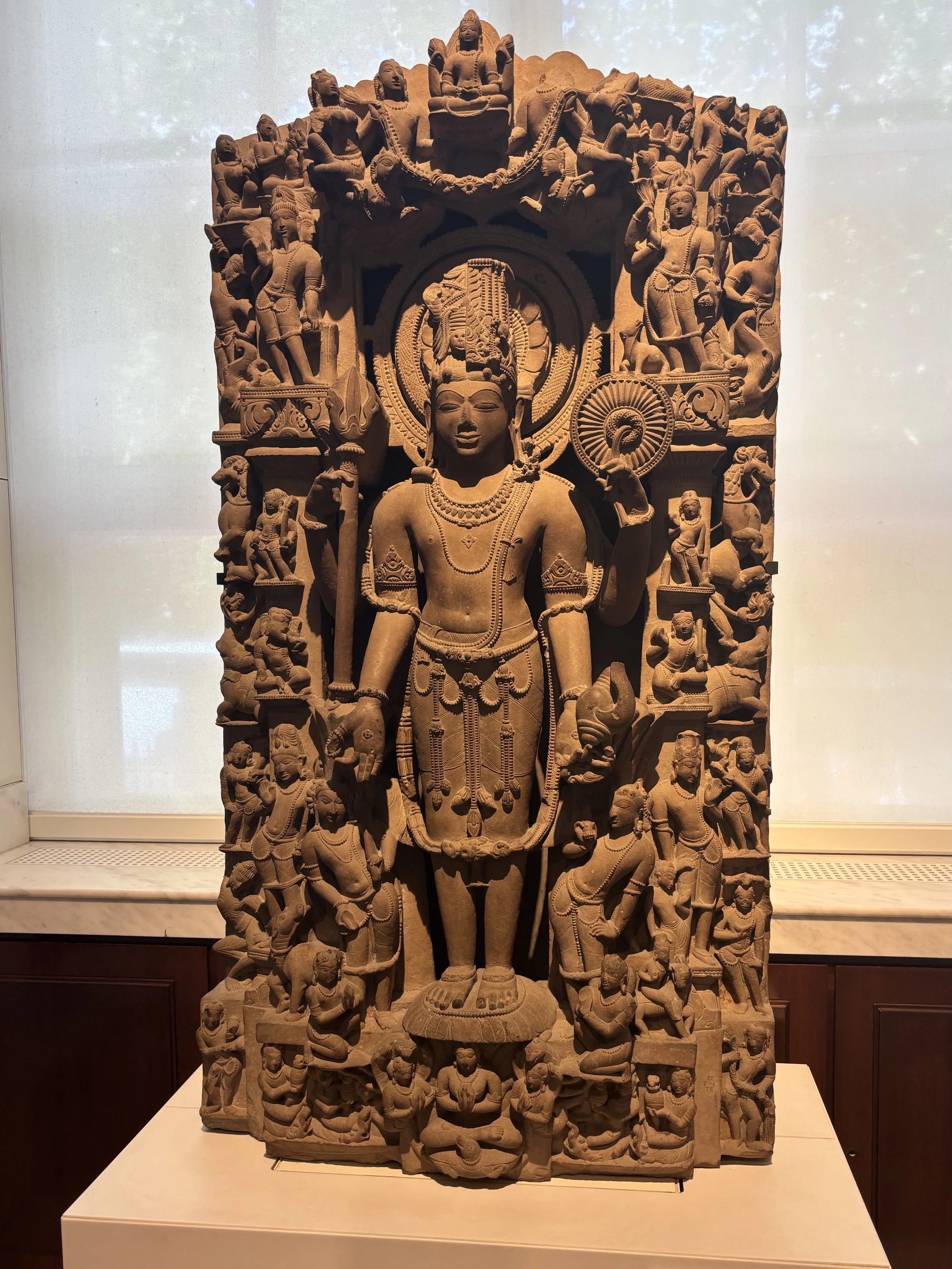
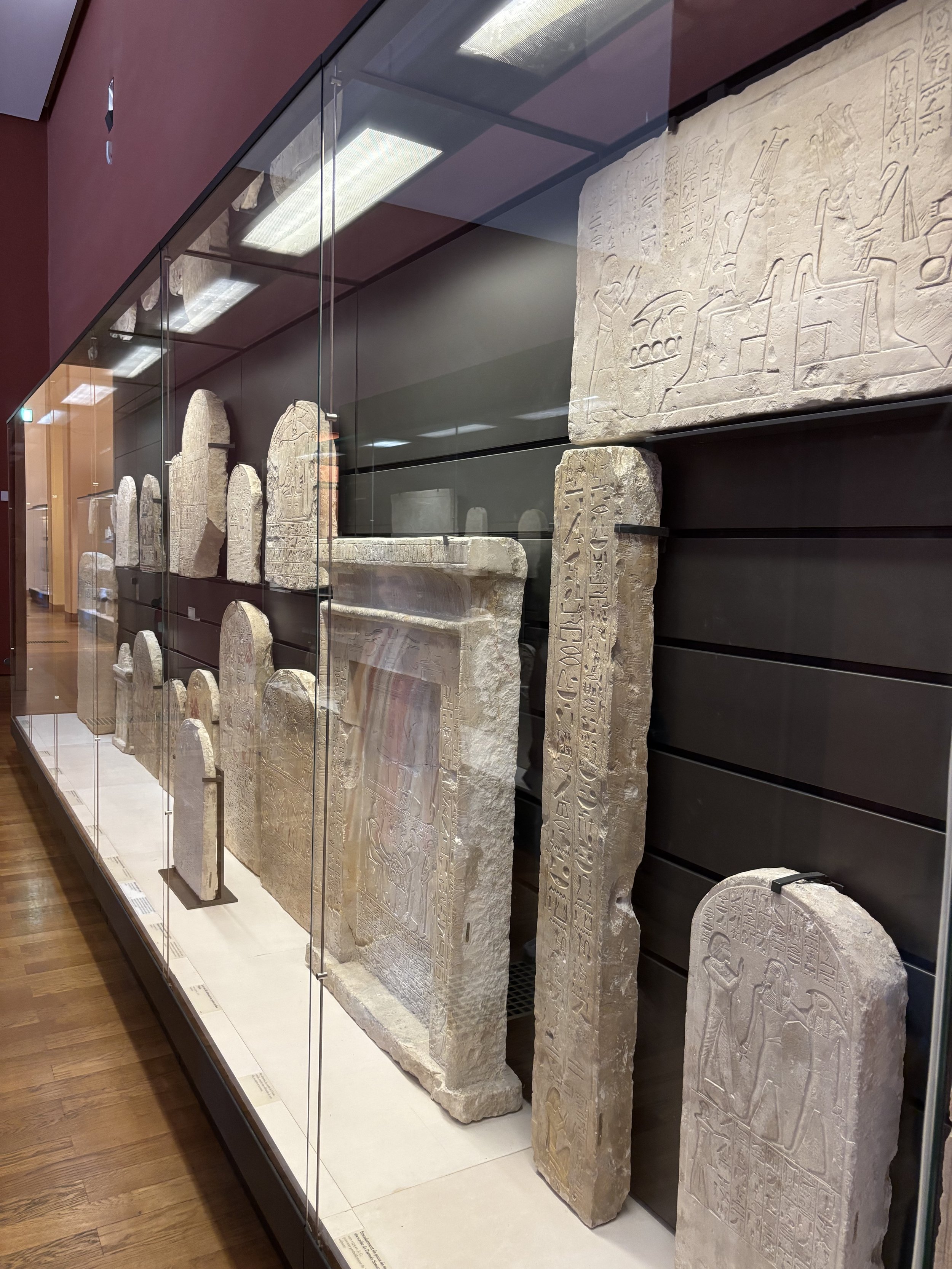
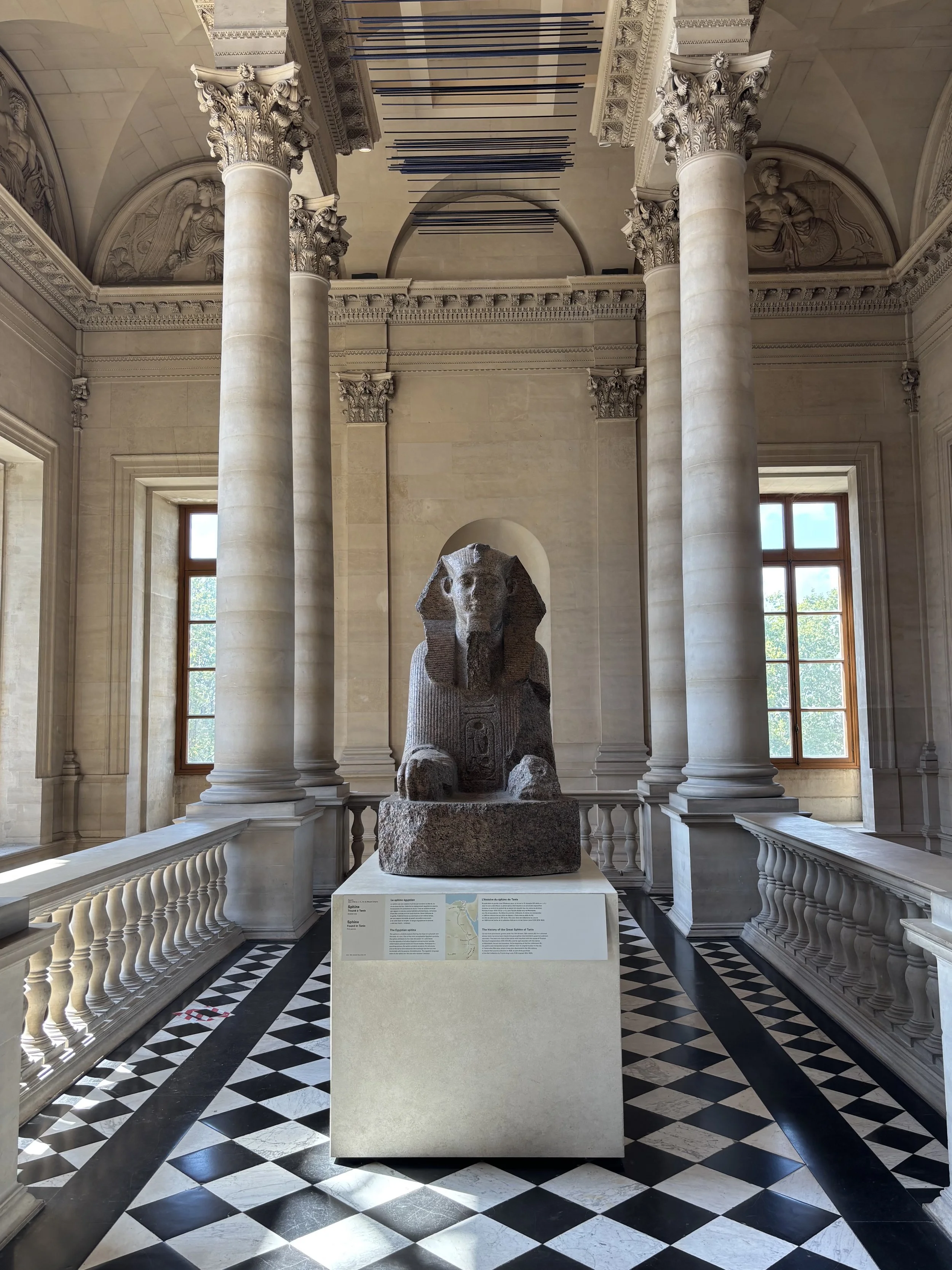
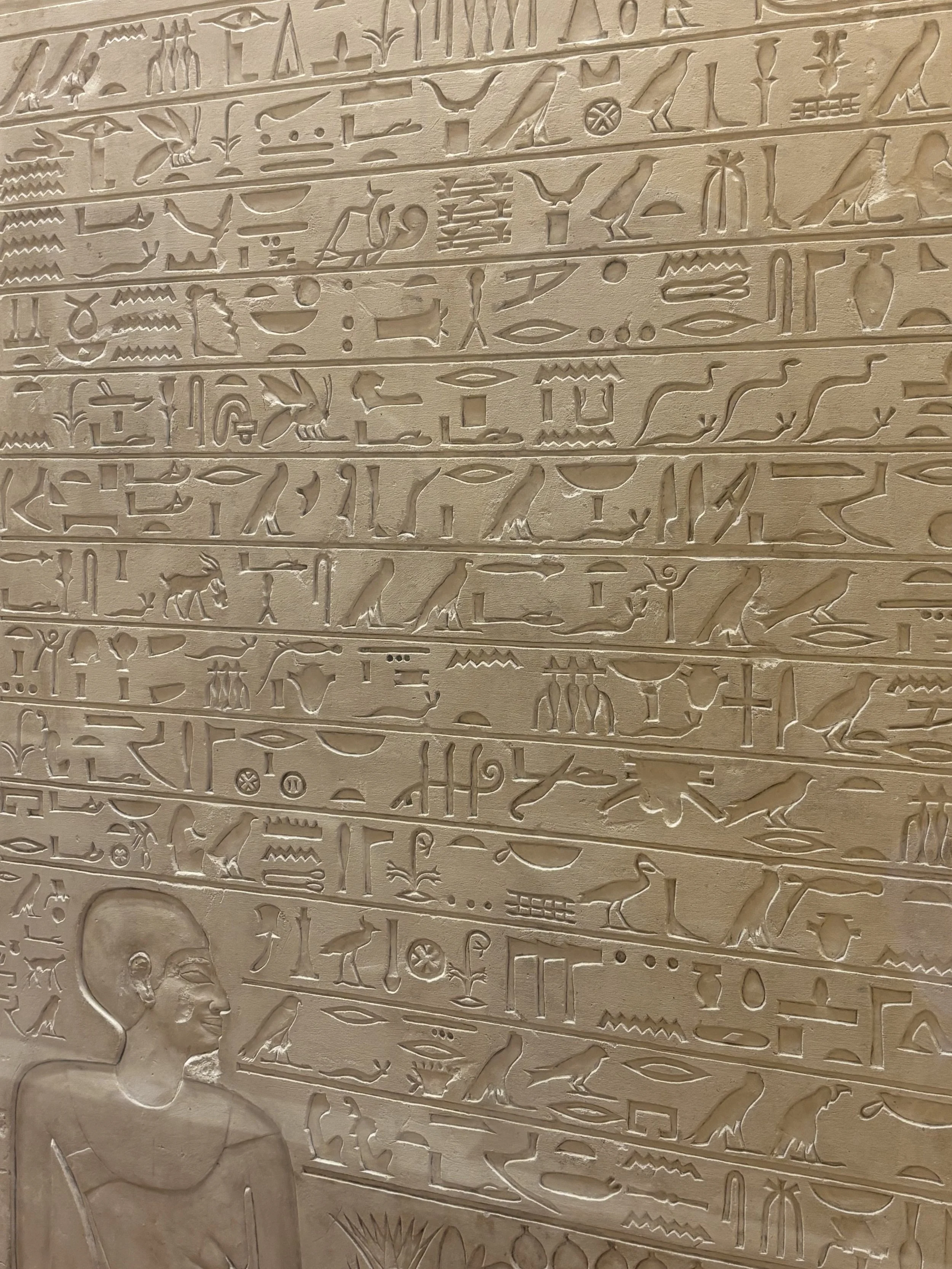
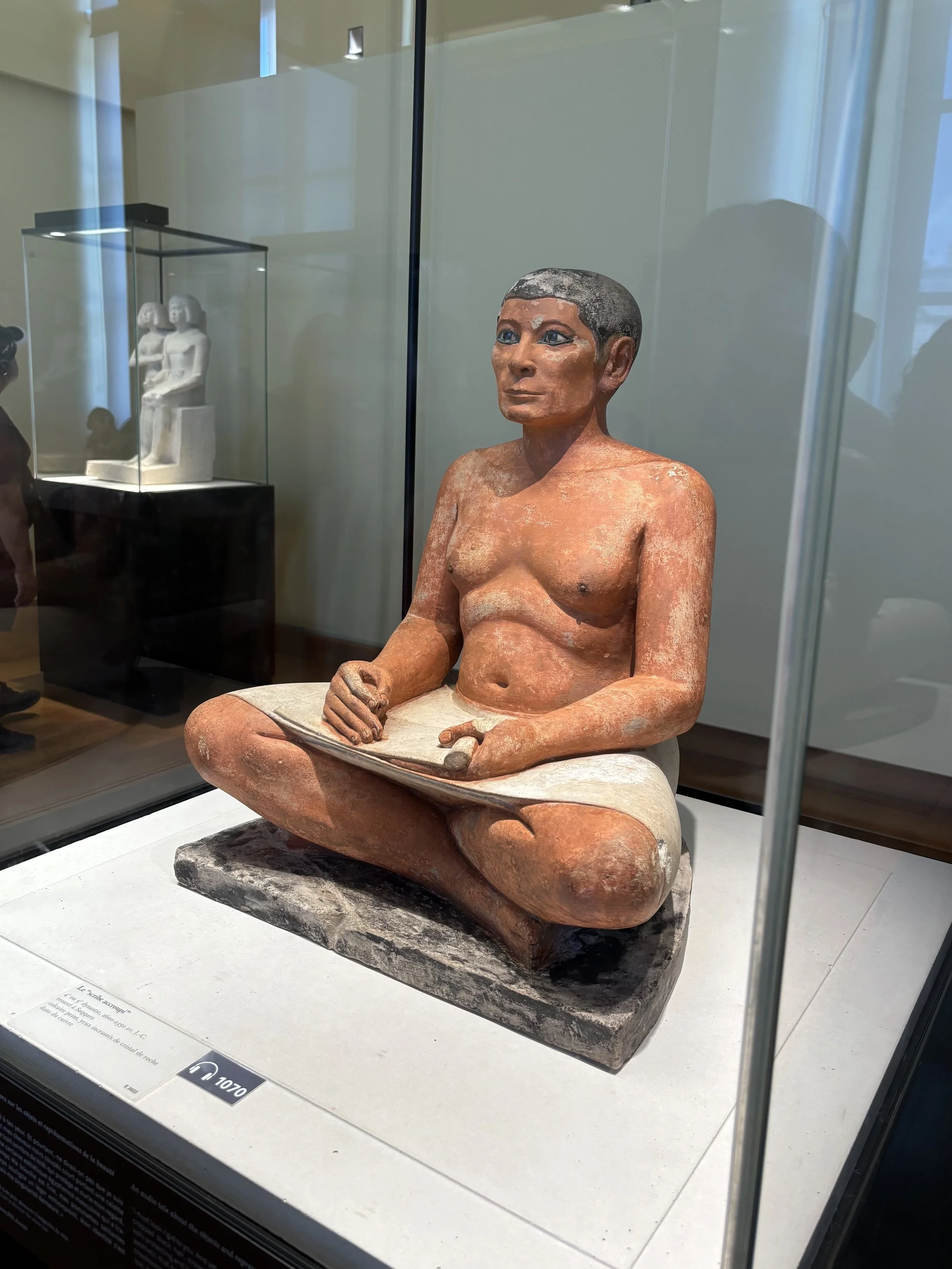
In some ways, the Louvre felt like the palace of Versailles. This makes sense given the structure’s history as a place of royal residence for some time. The milling sea of tour groups certainly helped me feel transported back to last week’s visit. The ceilings and walls in some rooms were lined in gold. In other rooms, artifacts looked out at me from glass cases. I found myself wondering, as I did in the British Museum, how many of the pieces of art were taken as a result of the wars (for the Louvre, Napoleonic) and colonial acquisitions. With pieces like the Amaravati and Parthenon marbles in the British Museum and various Egyptian artifacts in the Louvre, there is the additional consideration of the countries of origin wanting them back.
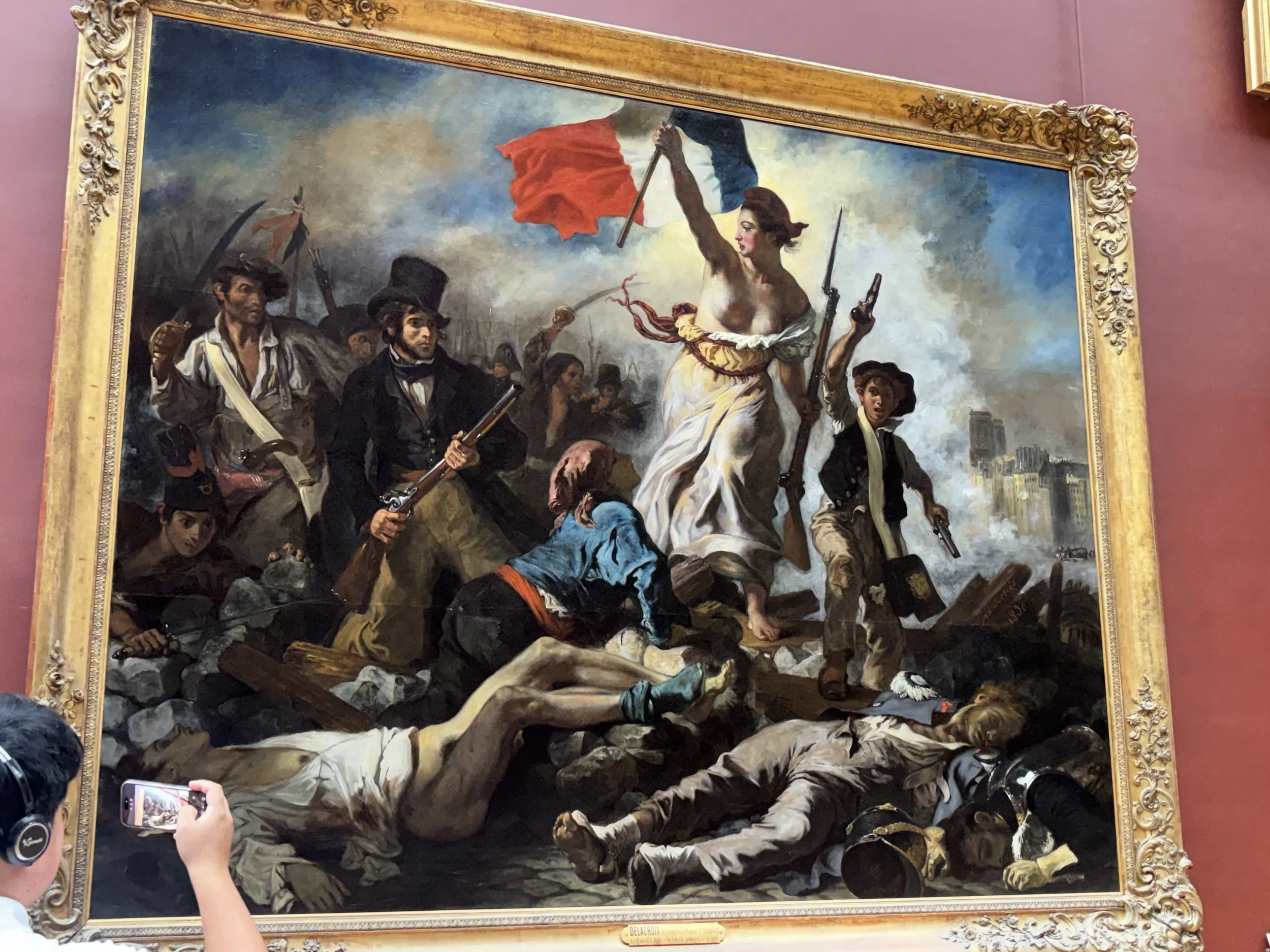
Hall of portraits at the Louvre

Reflecting on the reality that museums are really quite morally complicated has made visiting museums (particularly those that contain more imported historical cultural artifacts) a strange experience.

On the one hand, I adore exploring objects and art created centuries ago. I cannot emphasize enough the love I have for what humanizes ancient societies. So often it’s easy to think about civilizations that have since died out or changed significantly as ones very different from our own. Ancient China and modern China are certainly different. The chiton is no longer fashionable in Greece. Still, looking at the tiny sculptures of dogs and goats, or illustrations of bug-eyed birds and silly cats, I am reminded of some of the persistent charms of humanity–our ability to create, and to love, be it our household pets or the divine figures of our cultures.
On the other hand, it saddens me to think of these fragments of old, wandering and displaced in various parts of the world, so far from home. I don’t consider myself particularly spiritual, but I am deeply sentimental. There is something about the idea of relief sculptures taken from their original locations that makes my museum-induced heartache especially apparent. The idea of a complete story, lovingly chipped into the stone of a wall, fractured and separated, feels lonely. Does the rest of the relic from which the art was taken cry for the stolen piece of its body?

All roads lead back to the sins of the West.

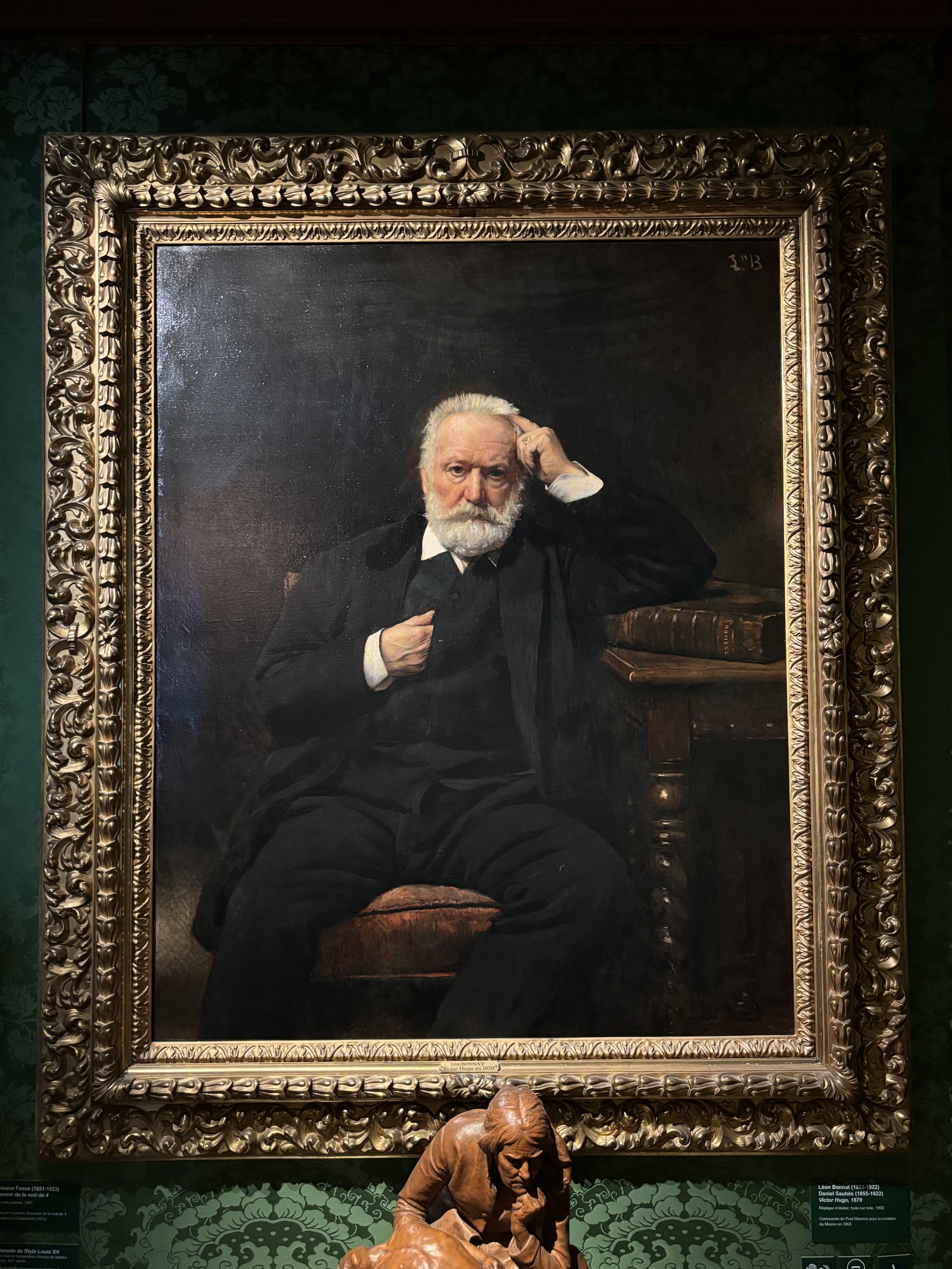
Victor Hugo definitely not thinking about the racial undertones of his novel.

In this morning’s class, I was distracted from our discussion of religion by echoes of questions I’d encountered in a prior course on religion. How do we define religion? Our very concept of “religion” is influenced by the dominant Western thought. How much does the influence of the West impact our philosophies and experiences?

We can expand this idea to encompass grappling with history. I’ve introduced this idea of “those in power.” In the museums, this is the Western Imperial forces. In the context of our readings, this interaction surfaces in various ways, including the patriarchy (gender dynamics) and the relegation of people of color to antagonistic roles. There are characters like Eponine and Madame Defarge who are examples of nonwhite and female characters in the two books who counter characters like the villanous Thenardier and the virginal Lucie. 

It is always interesting to understand how power dynamics frame the text as they do museum artifacts. The flip side is that our awareness of these contexts also changes the way we percieve things. For the museums, it is a reminder that some of the art I am enjoying is not innocent, and the methods of acquisition are worth considering. For the readings, it encourages me not to judge relationships like Marius (21) and Cosette’s (15) from a modern perspective– which I am guilty of doing quite frequently (every time I think of them…)–and to think about the ways characters adhere to and subvert stereotypes.

The lesson: there is always more to think about, and I don’t know if I would have gone to the British Museum if it wasn’t free…


poetry alert

!!

poetry alert !!


Over and Out

silhouettes and scars,

the outline of

you, out of place

and overseas

me, asking–

when are you coming home?


Today’s crumb is sweet:!

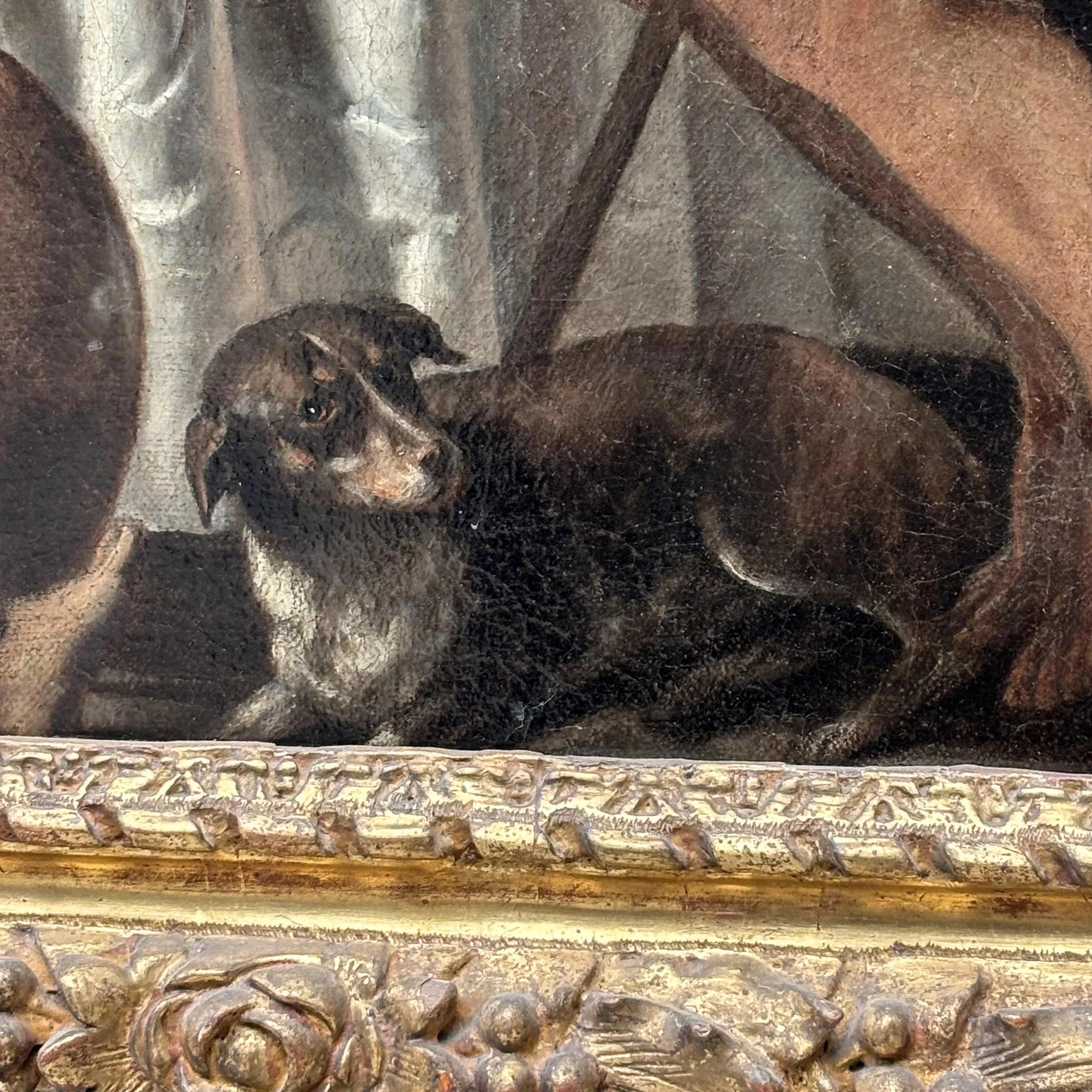
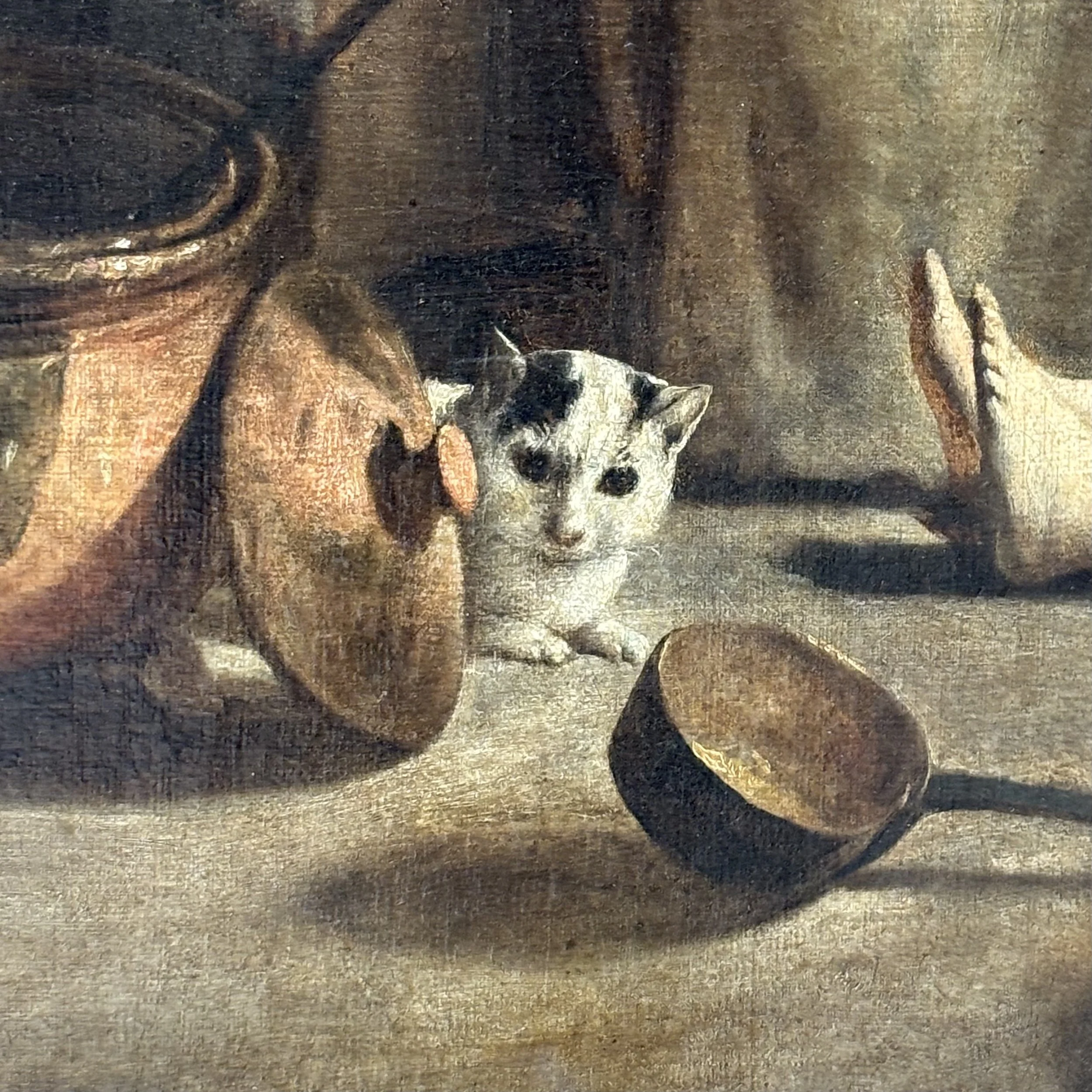
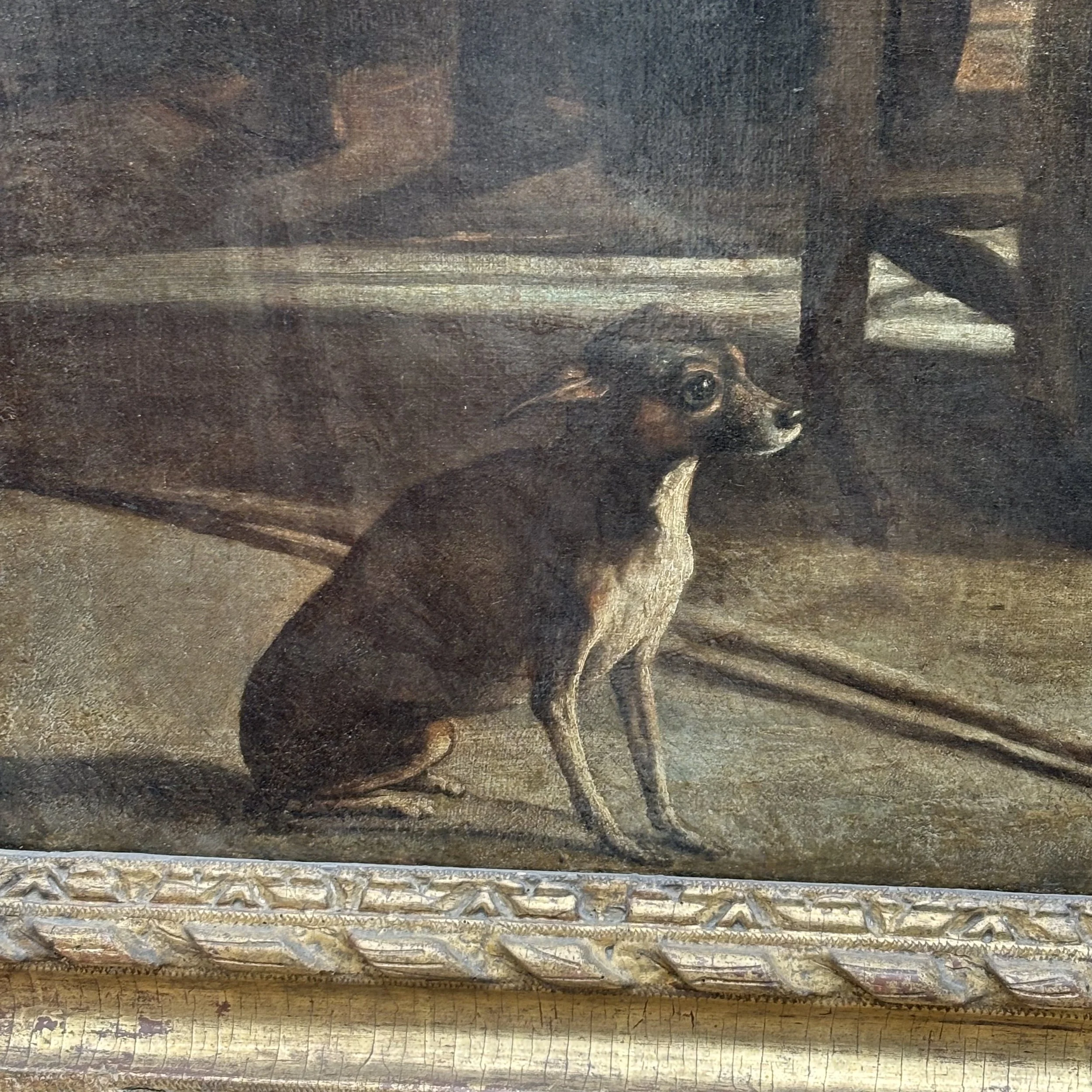
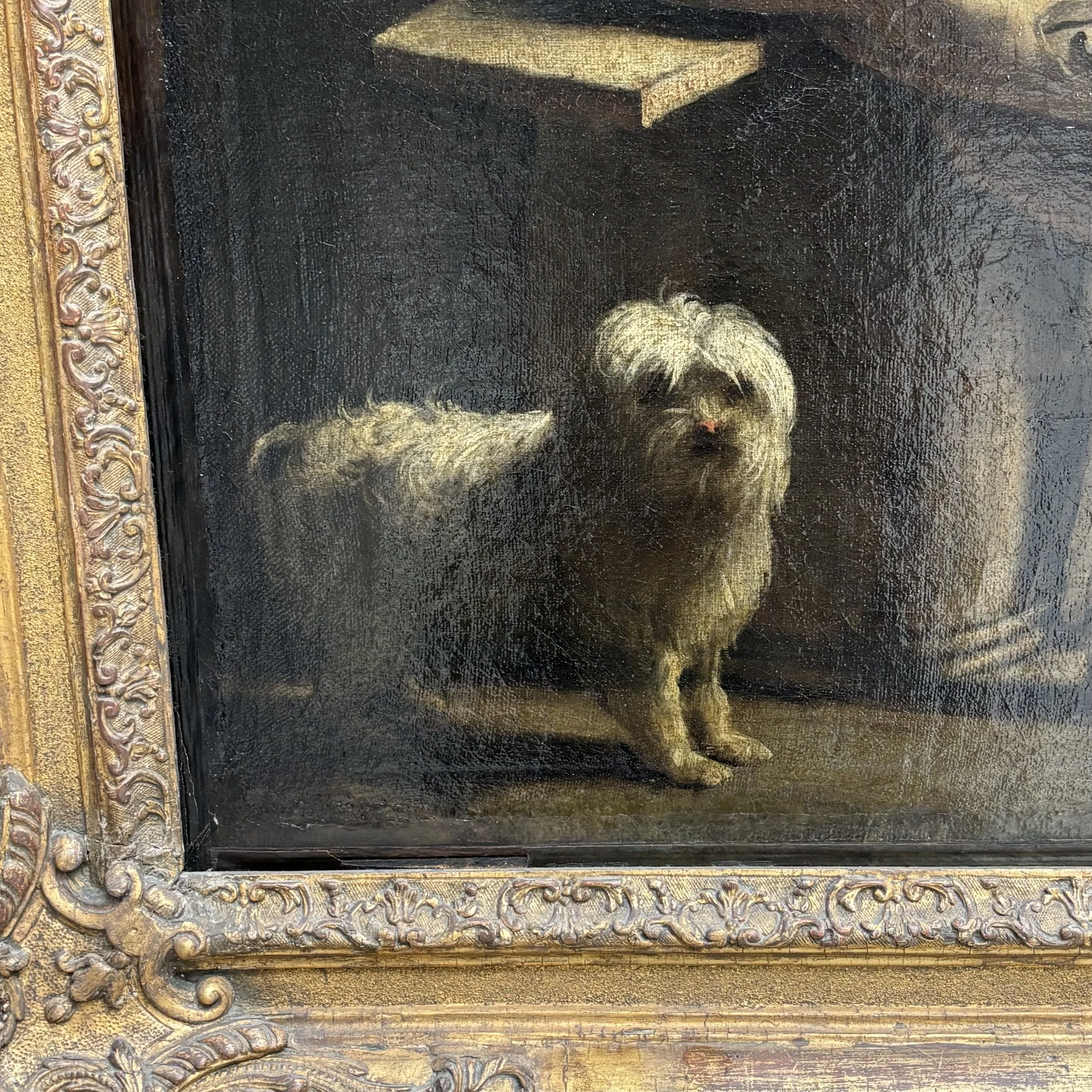
Below are some critters to heal the soul since the last two blog topics have been so dark. When I think about all the ties that connect us to the people of the past, one thing that often comes to mind is how much they also loved their domestic animals. One of my favorite museum activities is to spot all the dogs and cats in works of art. People back then must’ve also seen these fluffy friends and thought awww! so cute!!!


Progress–8.3

This fan is like the opposite of impressionist art–I’ve recorded only the events and not how they make me feel. But how can I do that with so little space and color at my disposal?! Maybe the next course of action is to paint each of these days from my hazy, pastel memories…

What Are We Really Worshipping?

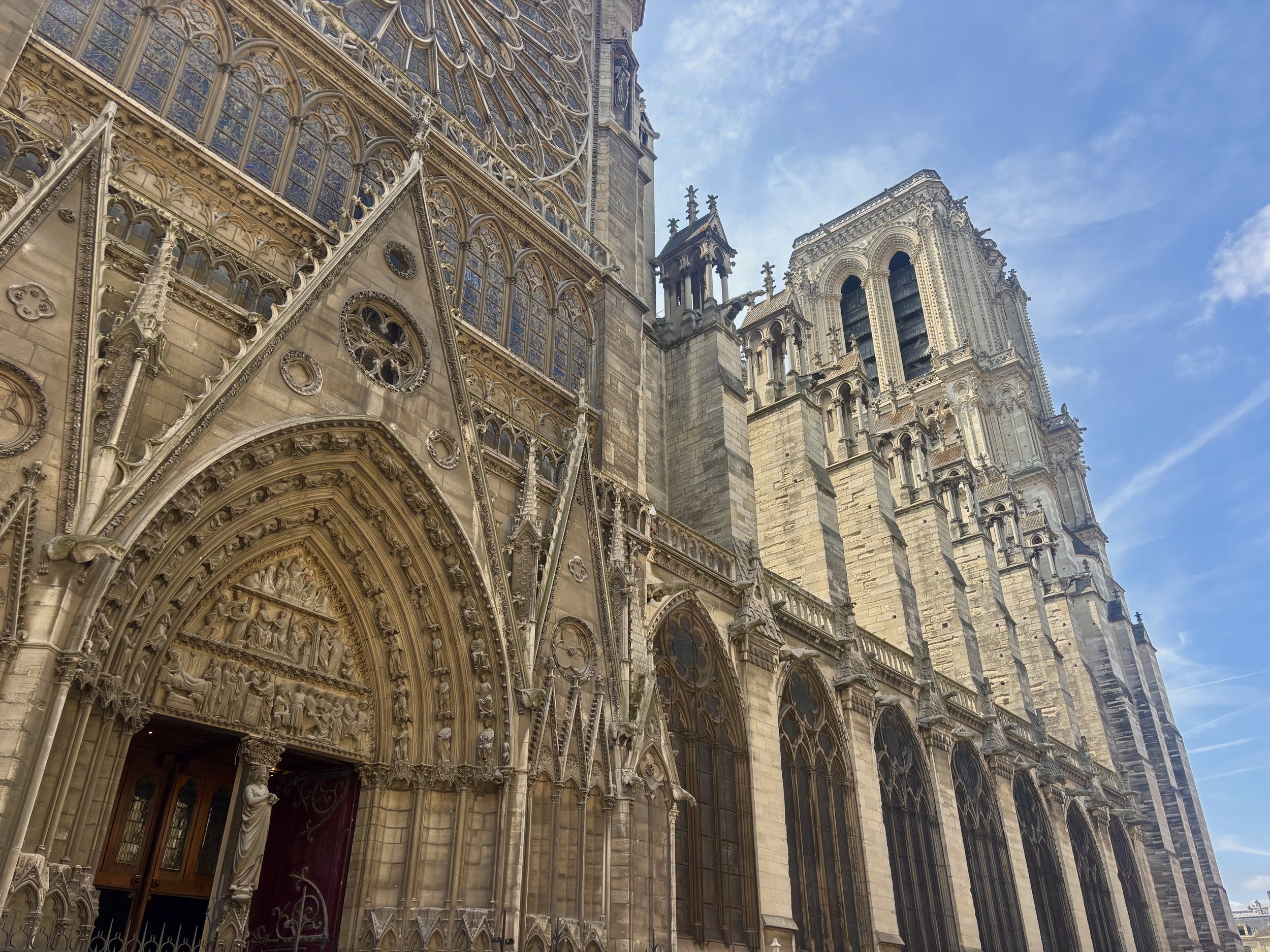
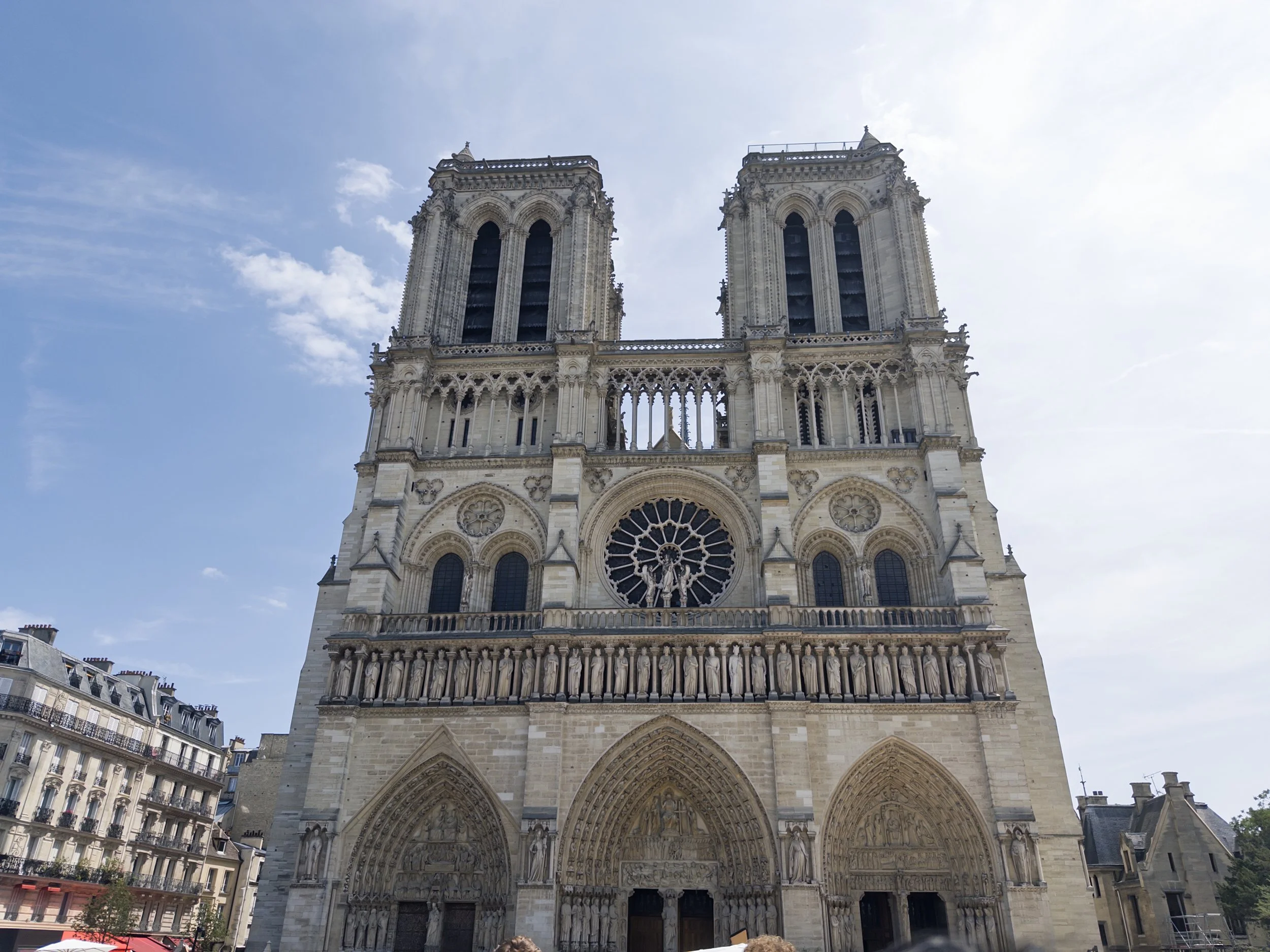
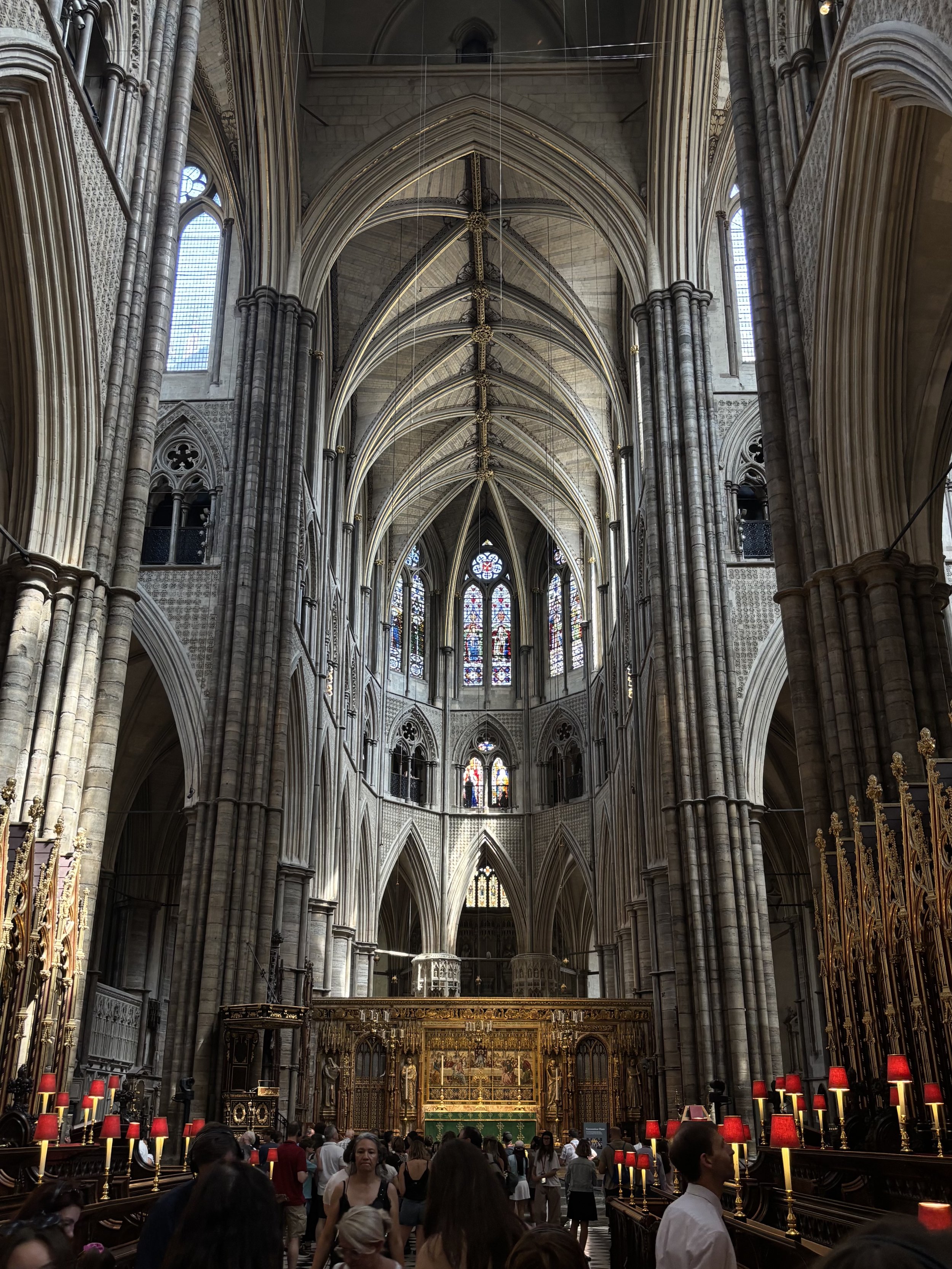
Some monuments inspire awe. Others inspire reflection. Notre-Dame did both.

Victor Hugo never asked me to believe in God. He asked me to question the institutions that claim to speak for Him.

That distinction didn't fully resonate with me until I walked into Notre-Dame.

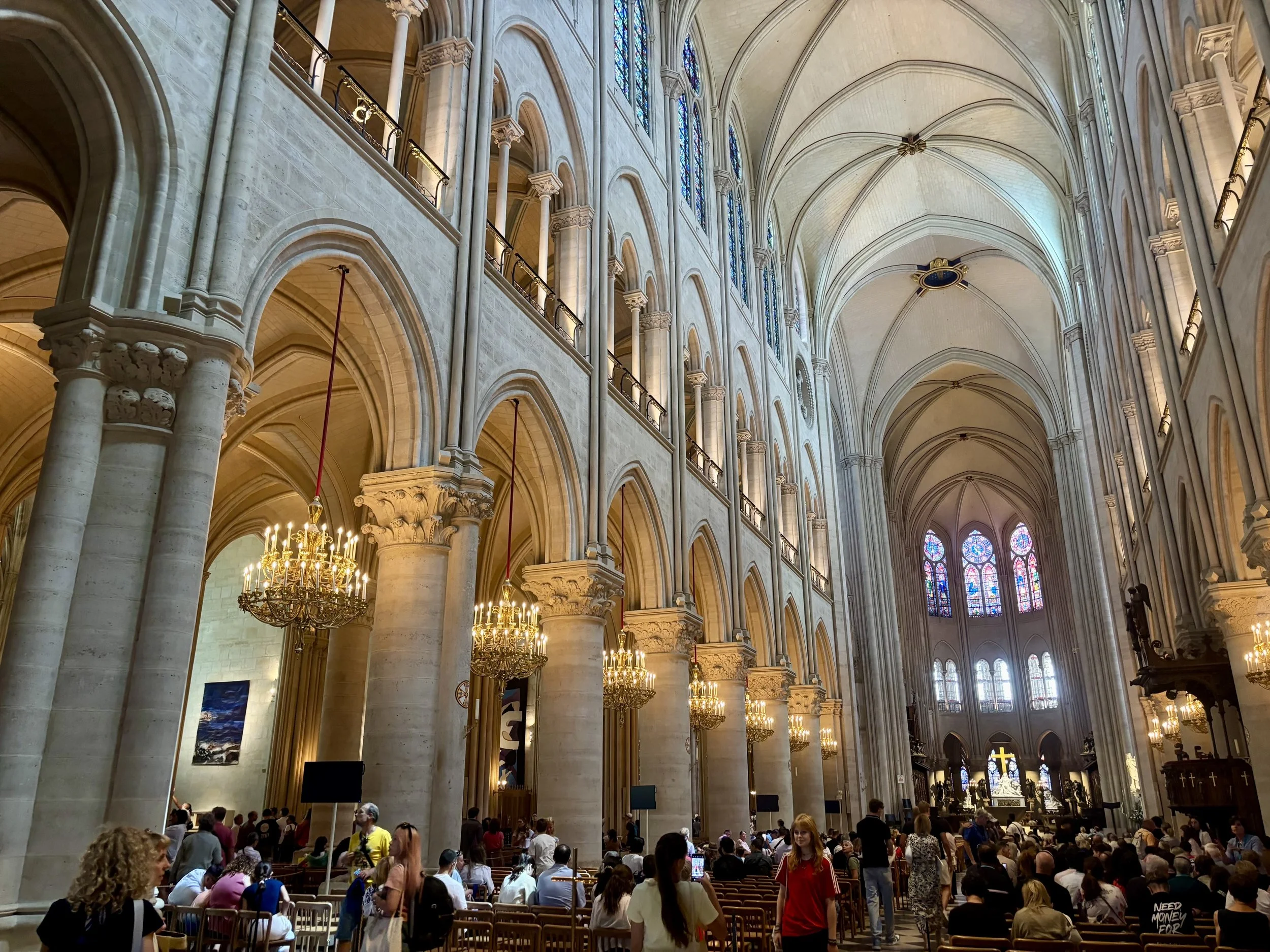
As I stood inside Notre-Dame, sunlight, stone, and nearly nine centuries of devotion surrounded me.

Stepping inside, I understood why millions of people have traveled here for centuries. Sunlight poured through the stained glass windows, illuminating towering stone columns that have stood for nearly nine hundred years. Every carving, every arch, and every pane of glass reflects an astonishing level of craftsmanship and devotion. Even as someone who is not Christian, I couldn't help but admire the cathedral and appreciate the role it has played in French history.

But as I stood beneath its soaring ceiling, another thought quietly entered my mind.

How could a Church capable of creating something this magnificent coexist with the poverty that shaped so much of France's history? What responsibility comes with possessing such extraordinary wealth in the name of faith?

As I looked around the cathedral, I found myself wondering whether admiration and discomfort could exist at the same time. Did questioning the institution somehow diminish the beauty of the building? Or was asking difficult questions actually another way of appreciating it?

These weren't questions I expected to ask while admiring stained glass windows. Ironically, they were questions Victor Hugo had already begun asking nearly two centuries ago.

Before this course, I assumed Les Misérables was simply a story of redemption. Somewhere between turning its pages and walking through the churches of Paris, those churches stopped feeling like places to visit and started feeling like places to think. I hadn't expected one of Hugo's central questions to follow me there. Instead, I discovered that he is making a much more nuanced argument, carefully distinguishing between faith and religion and suggesting that while the two often overlap, they are not always the same thing.

As I continued reading, I realized Hugo wasn't criticizing faith itself. He was warning us what can happen when religious institutions become more concerned with preserving themselves than living out the values they were created to uphold. They develop hierarchies, accumulate wealth, and sometimes become more concerned with preserving itself than serving the people it exists to help. Faith, however, is something entirely different. It is deeply personal. It is found in compassion, sacrifice, forgiveness, and the quiet choice to place another person's dignity before your own comfort.

He doesn't leave this as an abstract idea. He gives it a face in Bishop Myriel.

Although he is a bishop, Hugo presents him as someone who rejects the privileges of his position. Rather than living comfortably, he gives away much of what he has to the poor. He measures devotion not by ceremony or status, but by generosity. Bishop Myriel never asks Jean Valjean to become more religious. He simply chooses mercy when everyone else expects punishment. In that single act, he accomplishes what doctrine and authority never could: he changes the course of Valjean's life.

One passage in particular stood out to me:

To crush fanaticism and to venerate the infinite, such is the law... to purify belief, to remove superstitions from above religion... to clear God of caterpillars.
— Victor Hugo, Les Misérables

It is one of the most striking metaphors in the novel. Hugo is not asking readers to abandon religion. Instead, he argues that religion must continually be stripped of the "caterpillars" that cling to it: fanaticism, superstition, corruption, and empty displays of piety that obscure its original purpose.

Hugo wasn't alone in asking these questions.
He was writing in the wake of the Enlightenment, when philosophers across Europe were reexamining institutions that had long been accepted as unquestionable. Voltaire criticized religious intolerance and abuses of power. Rousseau argued that people are fundamentally good and that society often corrupts them. Diderot sought to make knowledge accessible through the Encyclopédie, challenging the idea that truth belonged only to religious or political elites. Across France, people were beginning to question not only the divine right of kings but also the authority of institutions that claimed moral superiority.
What makes Hugo's response so compelling, however, is that he refuses to throw faith away alongside those institutions. Instead, he asks readers to separate the two.

Standing inside Notre-Dame, that distinction suddenly felt tangible. I wasn't looking at hypocrisy carved into stone. I was looking at a monument built by generations of people whose motivations were undoubtedly varied. Some gave because of genuine devotion. Others sought influence, prestige, or power.

The beauty of Notre-Dame doesn't become less beautiful because of those questions. If anything, the questions make the cathedral even more compelling.

Walking out of Notre-Dame, I realized the questions hadn't ruined the experience. They had deepened it. I admired the cathedral just as much as when I first stepped inside. The difference was that I no longer saw it as just an architectural masterpiece. I saw it as a physical reminder that even the noblest institutions are still created by imperfect people.

A few days later, that same idea resurfaced in an entirely different way.

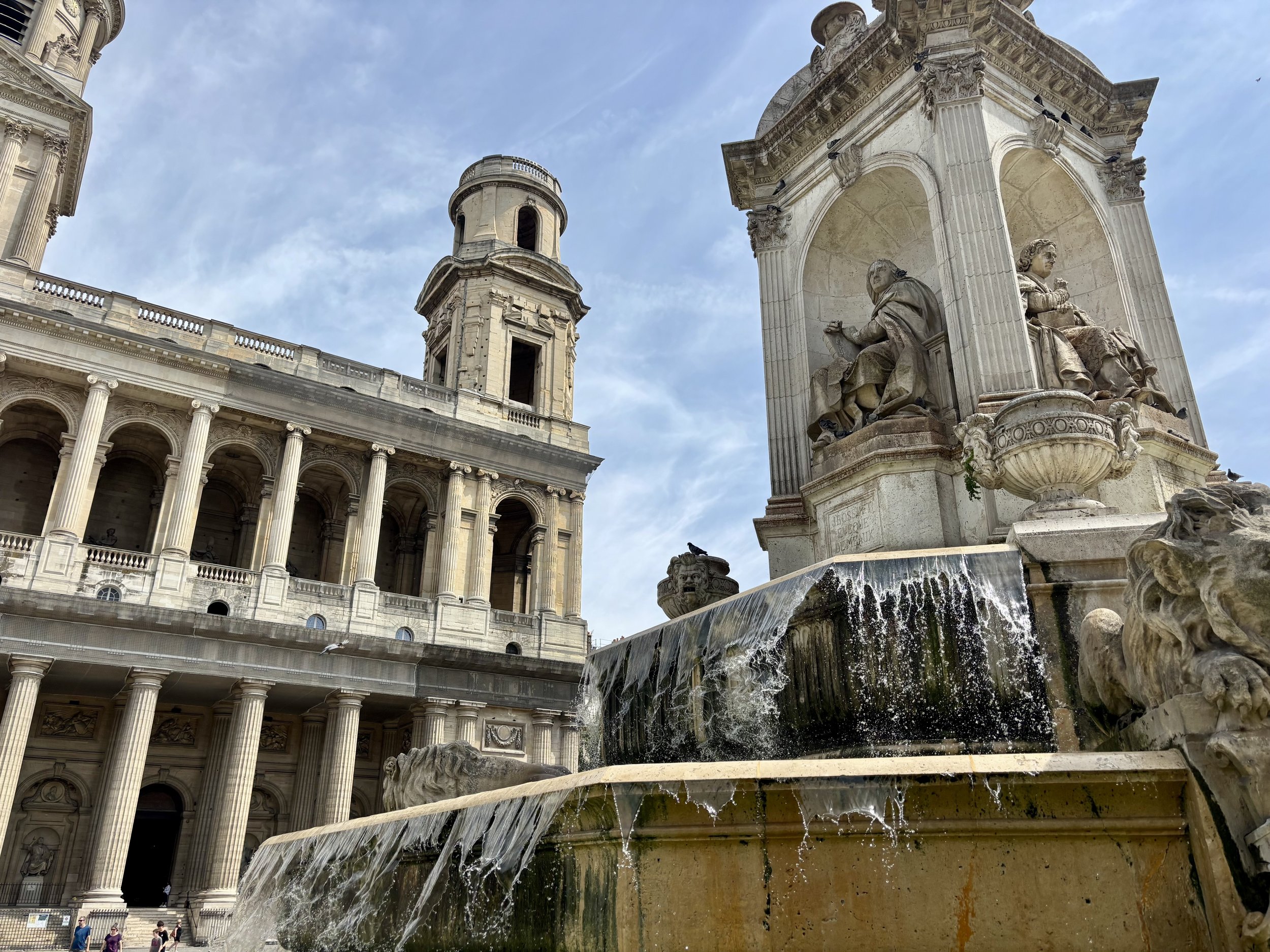
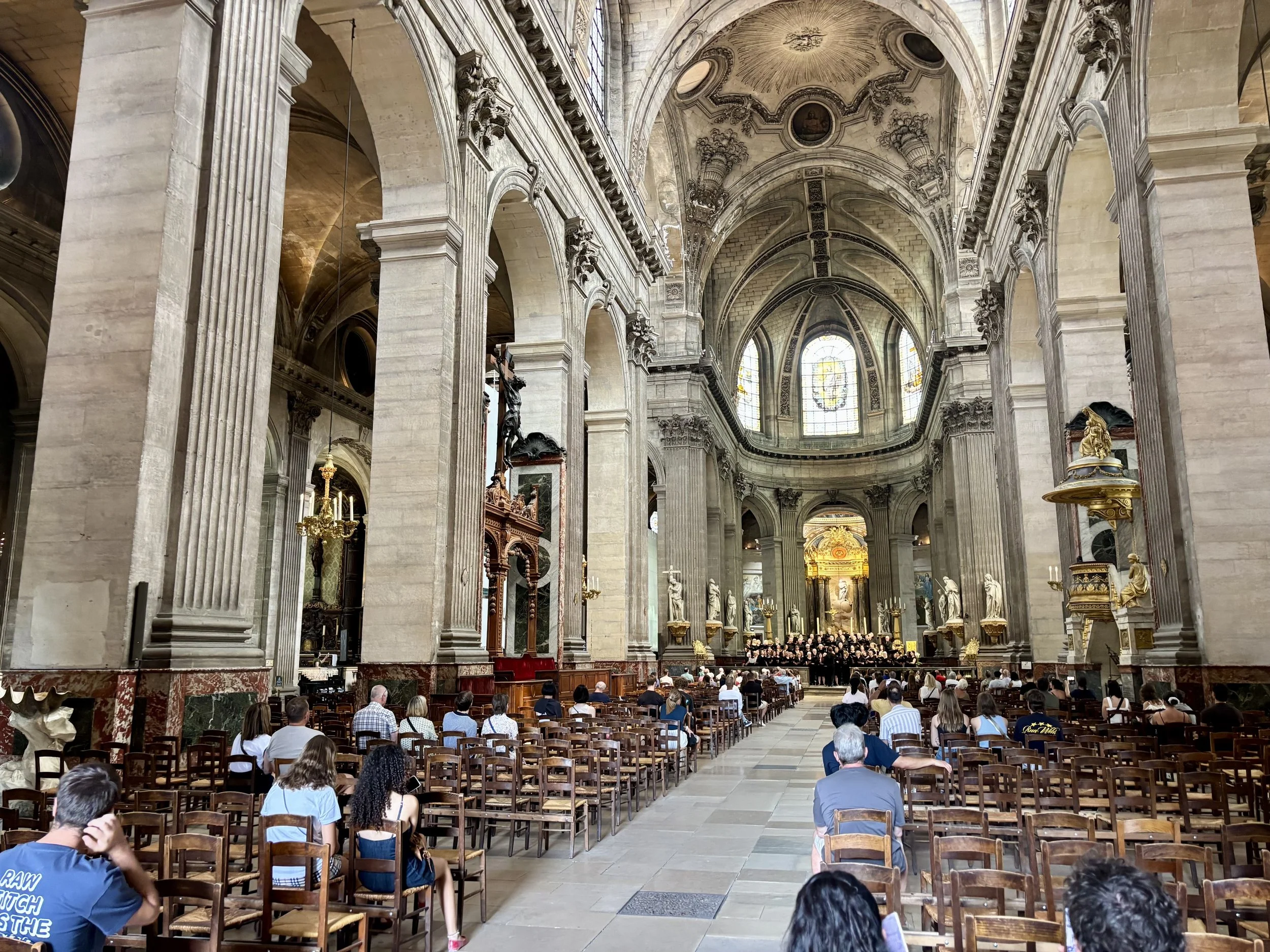
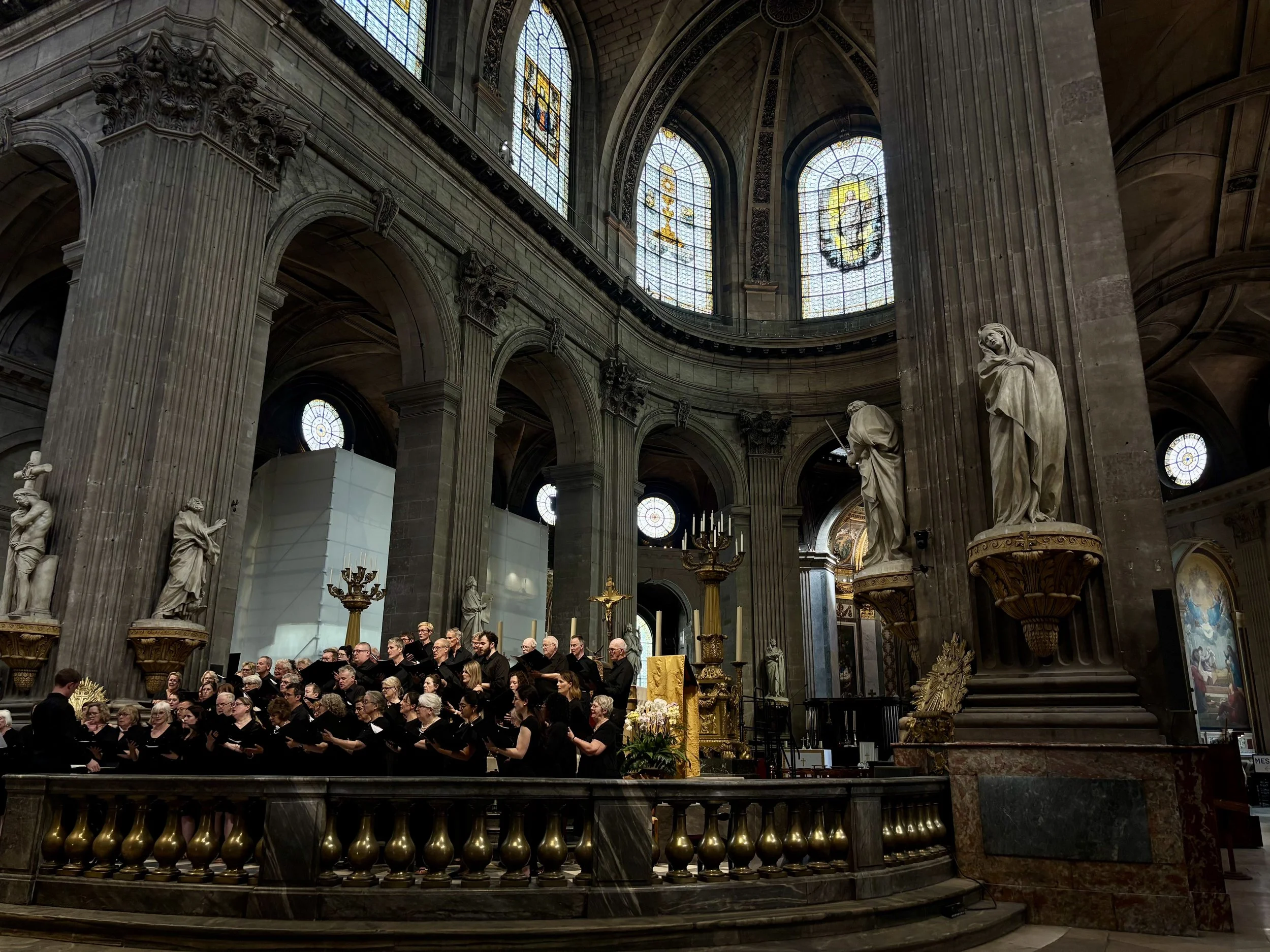
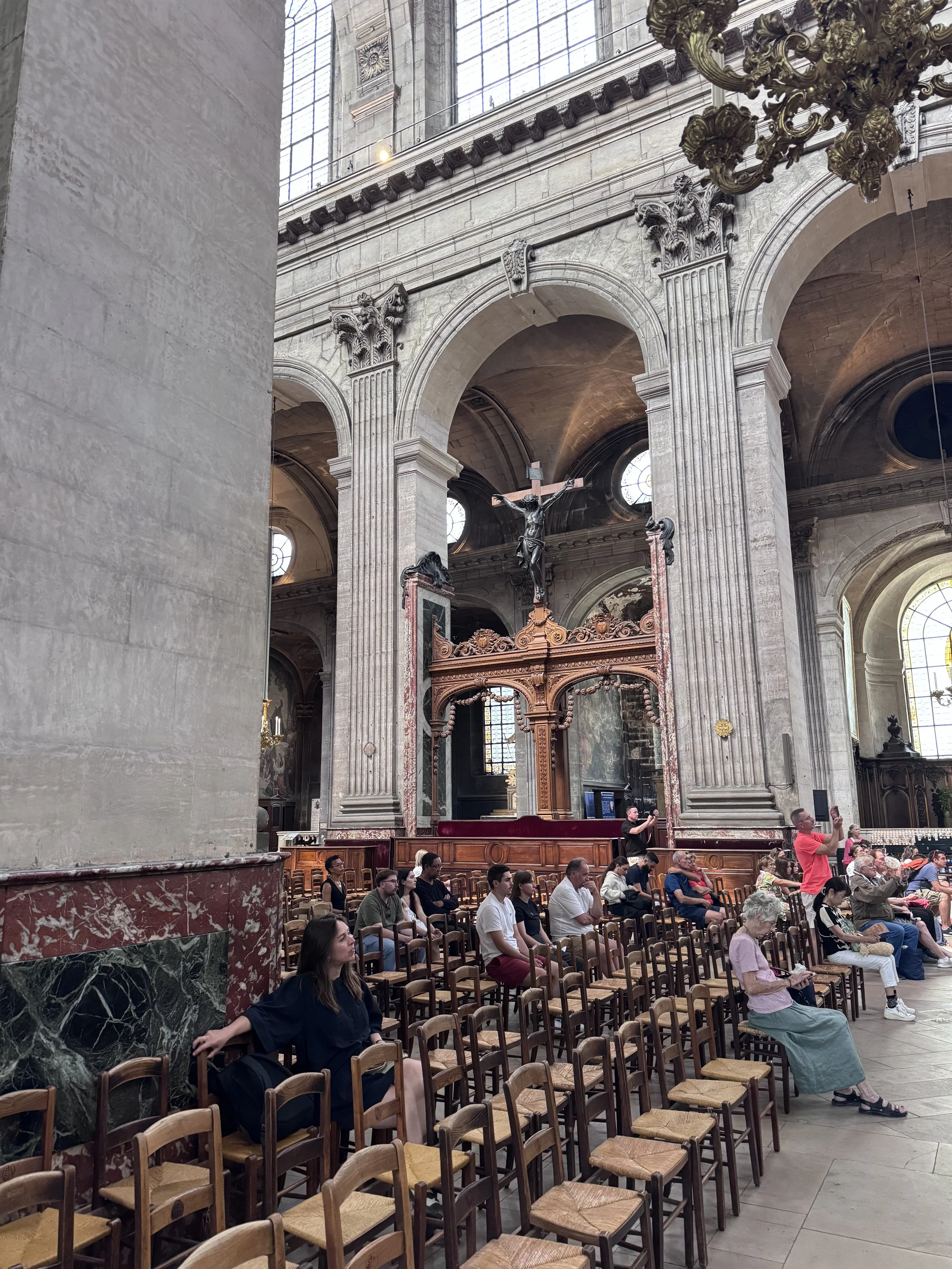
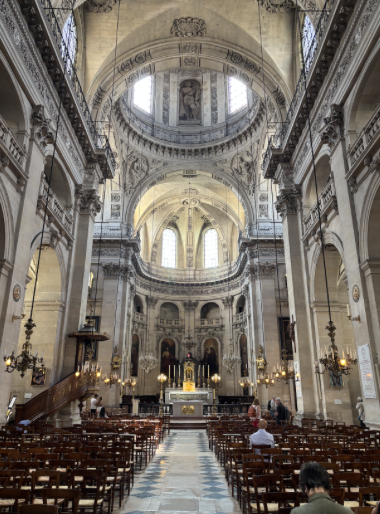
We visited Saint-Sulpice, the church where Marius and his grandfather attend Mass in Les Misérables. While walking through the sanctuary, I noticed a young couple a few pews away. The woman carefully positioned her boyfriend, motioning for him to bow his head and clasp his hands together in prayer. She stepped back, took a few pictures, looked them over, adjusted his pose, and took a few more. A minute later, they smiled, put away the phone, and walked straight back out of the church.

I found myself quietly amused.

Maybe they had prayed before I arrived. I have no idea what was in their hearts, and that's not really the point.

What stayed with me wasn't the couple themselves. It was how instinctive it has become to curate moments before we experience them. Even a church, a place intended for quiet reflection, had become another backdrop for a perfectly composed photograph.

After spending weeks with Hugo, I couldn't stop thinking about the difference between performing faith and living it.

Religion can become performative when institutions prioritize appearances over compassion. But individuals can do the same thing. We have become remarkably good at documenting experiences while they are happening. Sometimes I wonder whether we have become equally good at inhabiting them. Social media hasn't invented performative behavior, but it has certainly amplified it.

Jean Valjean becomes Hugo's clearest example of what faith looks like when it is lived rather than displayed. Throughout the novel, he returns again and again to the mercy Bishop Myriel first showed him. His compassion for Fantine, his sacrifices for Cosette, and even his decision to spare Javert all reflect a life shaped by grace rather than obligation. Hugo suggests that faith is measured less by the rituals we perform than by the way we treat the people around us.

Faith is not something that can be photographed. Hugo knew that long before Instagram did.

As I left Saint-Sulpice, I realized I wasn't questioning faith. If anything, Les Misérables strengthened my appreciation for it. What I found myself questioning instead was something much broader: how easily both institutions and individuals drift toward appearances. Churches can become consumed by opulence and prestige. We can become consumed by image and performance. The temptation is the same: to mistake the outward expression of our values for the values themselves.

That may be why Hugo's distinction between religion and faith continues to resonate nearly two centuries later. We still ask whether governments, universities, religious organizations, and other institutions live up to the values they proclaim. Hugo gently reminds us that the same question belongs to each of us. It is easy to appear compassionate, principled, or faithful. It is much harder to quietly become those things.

Notre-Dame taught me to question institutions. Saint-Sulpice taught me to question myself.

I arrived in Paris expecting to admire the places Hugo wrote about. I left seeing them through his eyes.

Victor Hugo never asked me to believe in God.

After tracing Hugo's Paris, I think I finally understand what he was asking instead.

Faith, Hugo reminds us, is never proven by the buildings we admire.

It is proven by the lives we choose to build.

A Tale of One City


It was the best of times, it was the worst of times,
— Charles Dickens, A Tale of Two Cities

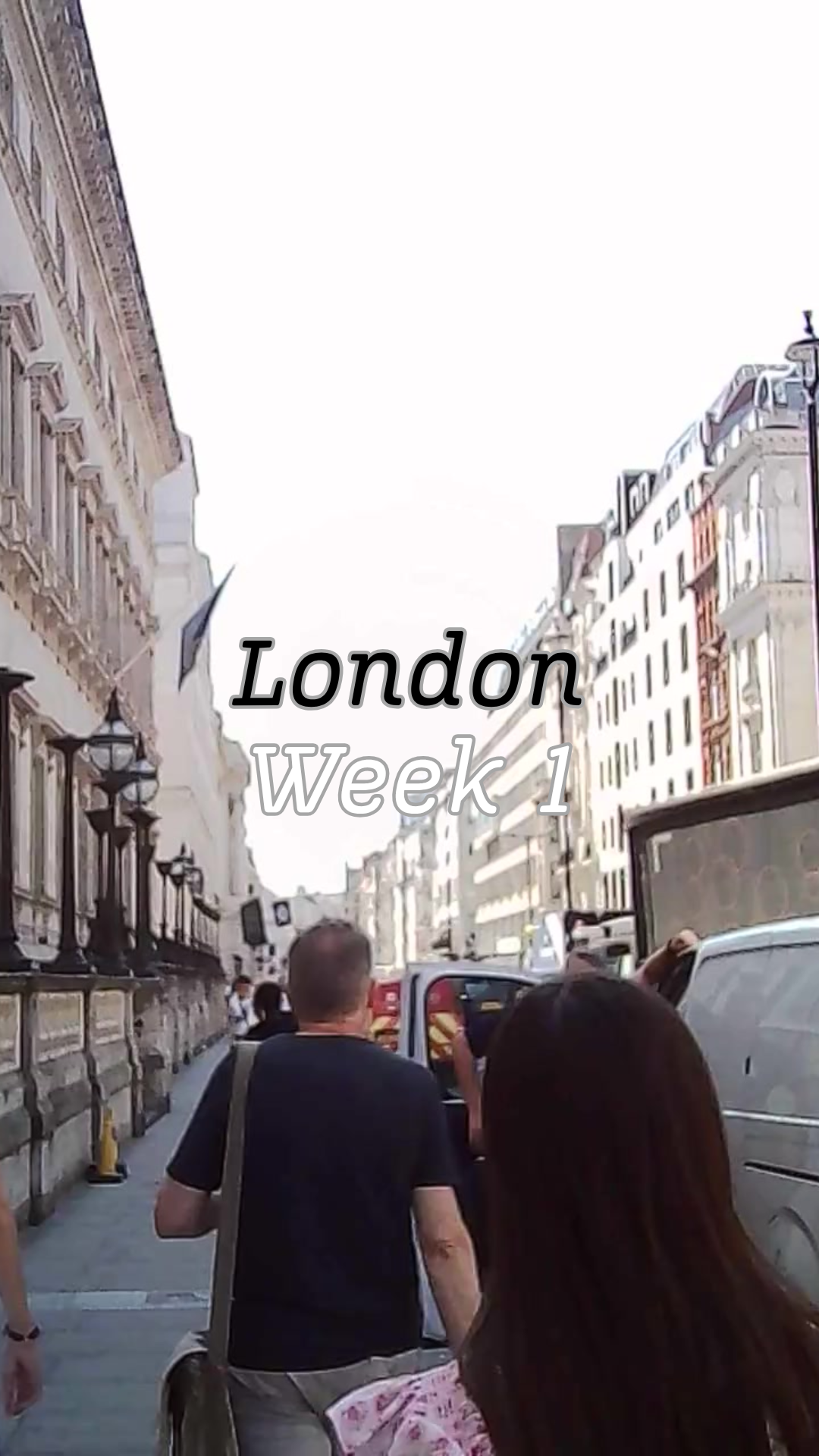
Before arriving in London, I always thought the famous opening line of A Tale of Two Cities referred almost entirely to England and France. Two countries. Two governments. Two completely different responses to revolution. After spending a week bookpacking Dickens's London, I'm convinced he was also describing London itself.

One of the biggest surprises of this class has been realizing that London is a city built on contradictions. You can walk through centuries of history in less than an afternoon, passing from places of music and art to places that tell stories of crime and punishment without ever leaving the same city.

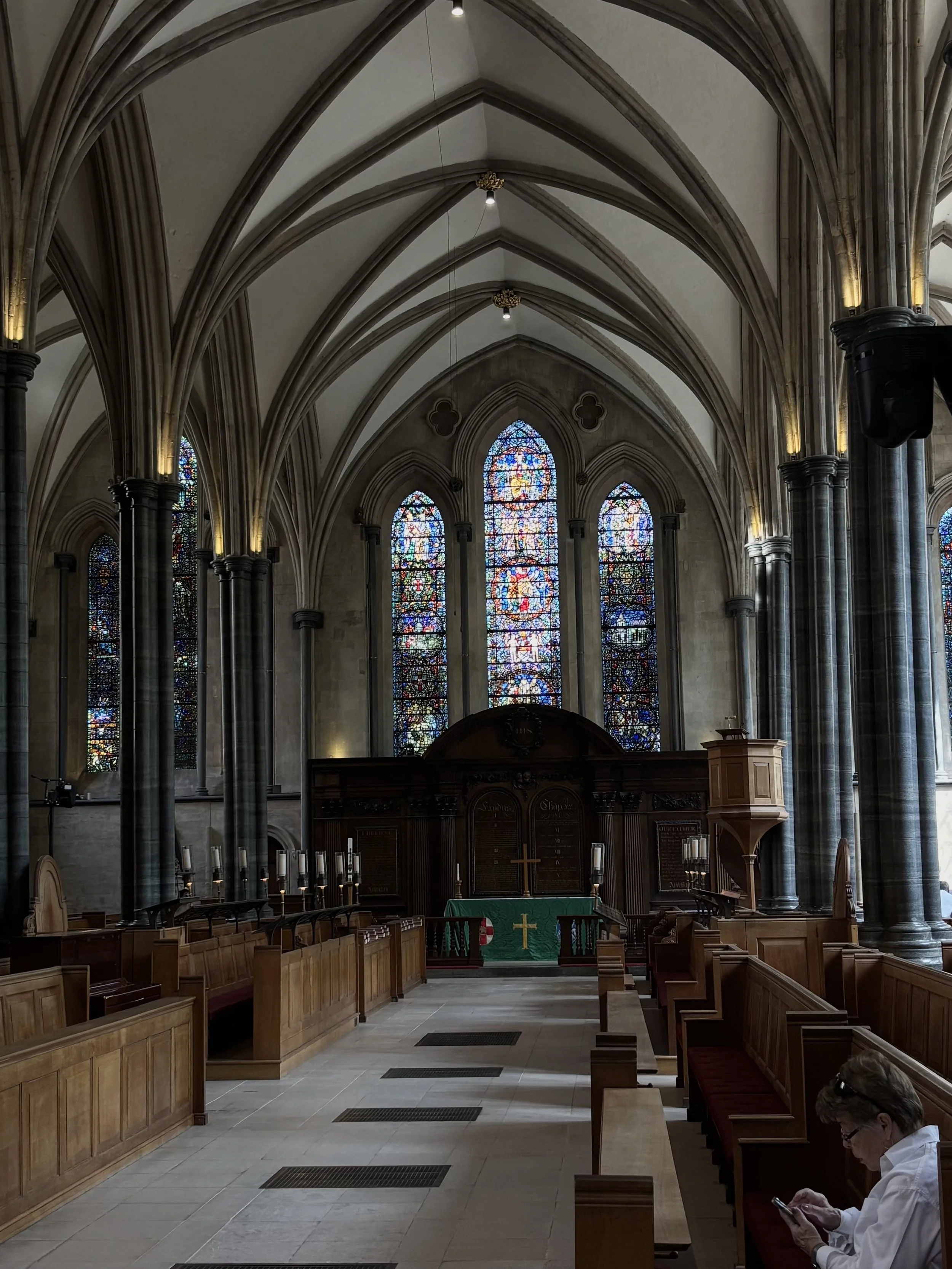
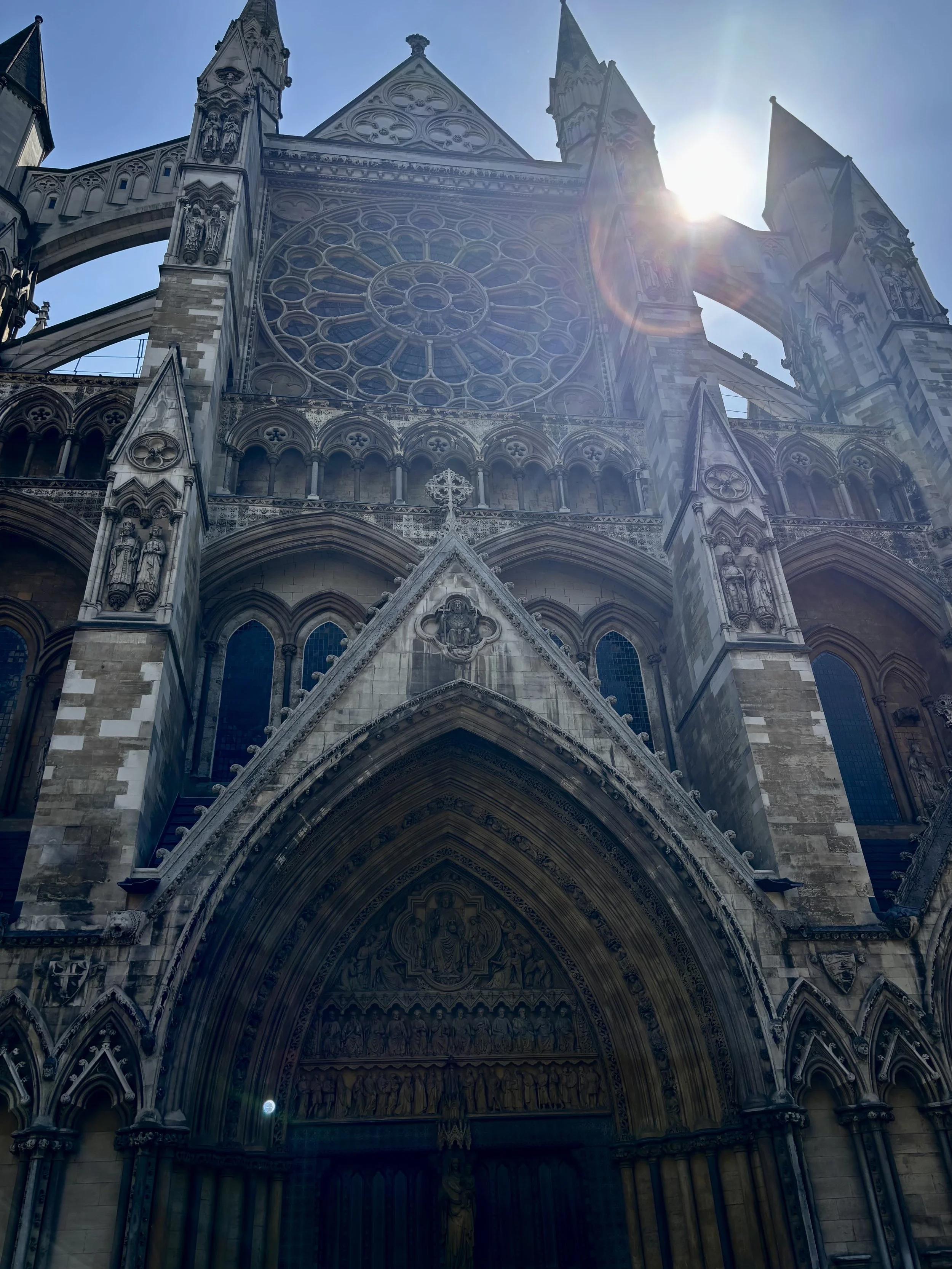
Early in the week, we explored the Westminster Abbey, Buckingham Palace, and Parliament. Everything feels permanent there. Massive stone buildings, ceremonial guards, carefully maintained parks, and traditions that have existed for centuries. Even as tourists filled the sidewalks taking photos, there was still a feeling that these places had stood through wars, political upheaval, and generations of monarchs without ever appearing to lose their composure (which it has).

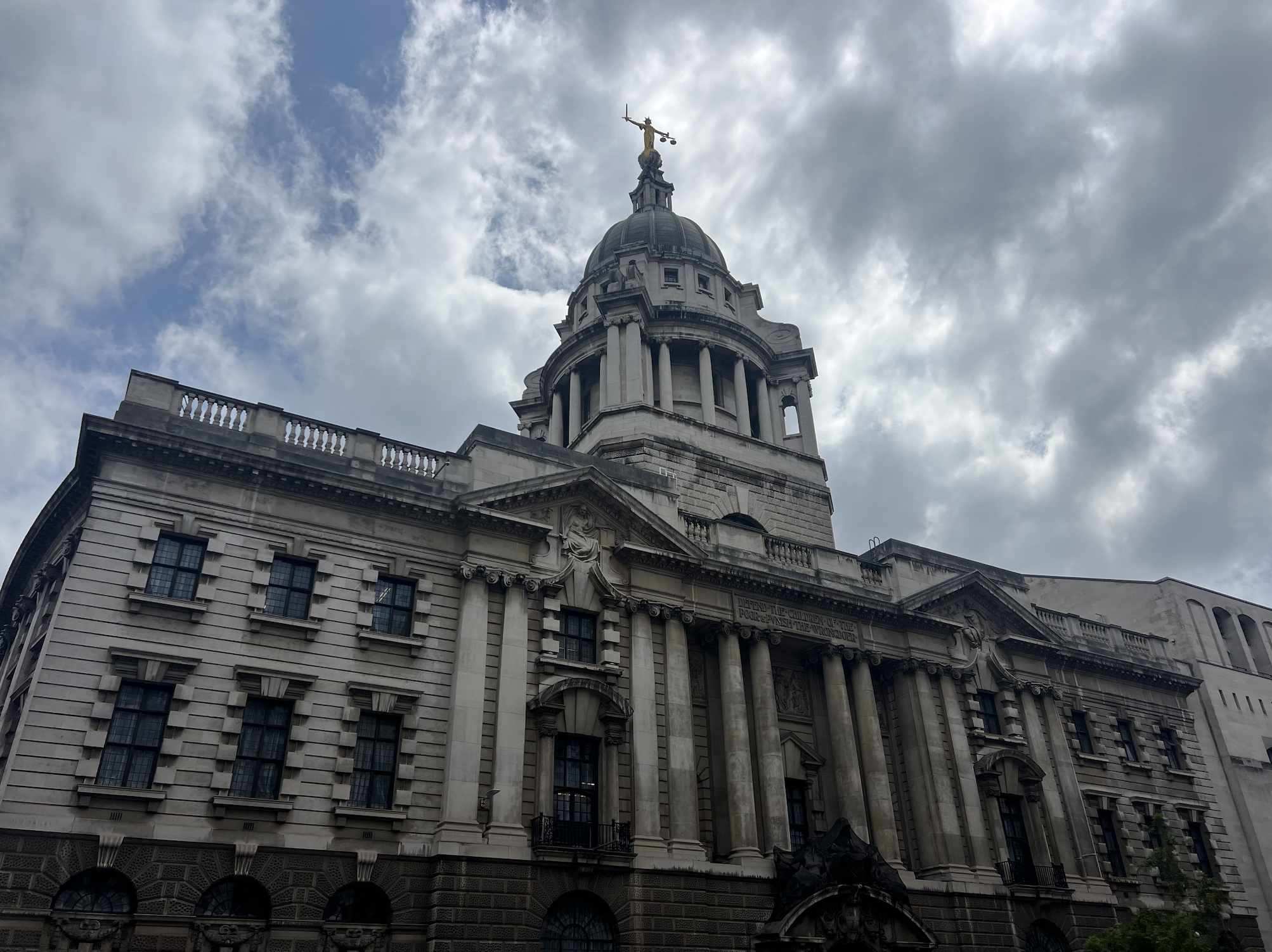
Only a day later, we found ourselves standing outside the Old Bailey, a criminal courthouse, and the Royal Courts of Justice. Instead of kings and ceremonies, these streets tell stories of trials, executions, and the legal system that Dickens so often criticized. Suddenly the city felt completely different. Yet it was still London.

That pattern kept repeating throughout the week.

Walking through the financial district, we found ourselves surrounded by glass skyscrapers squeezed between churches and buildings hundreds of years older than the country I grew up in. The Gherkin and the Lloyd's Building rise behind narrow streets where Dickens himself once walked. One moment that perfectly captured London's contradictions happened while standing beneath the Gherkin. Looking one direction, I saw steel and glass reaching into the skyline. Looking the other, I saw narrow streets that have existed for centuries (shown in the video at the bottom of this page). There wasn't a clean line dividing old London from new London. They coexist together, each making the other more noticeable. Rather than replacing history, modern London simply builds around it. New buildings compliment and reinforce the old buildings still standing. Every neighborhood feels like a conversation between different centuries. That idea reminded me of Dickens's novel.

Bookpacking isn't only about proving whether Dickens got every location exactly right. Cities change. Buildings disappear. Streets get renamed. Instead, it's about discovering how the places themselves deepen your understanding of why an author wrote the story the way they did. Standing in these locations makes it easier to understand why Dickens fills A Tale of Two Cities with opposites. London constantly presents them to you. Justice and punishment. Tradition and innovation. Old and new. Even the city itself feels like two places existing at once. But one contrast surprised me more than any of those. Despite being one of the busiest cities in the world, London is unexpectedly quiet.

Some of my favorite moments from this week weren't outside Buckingham Palace or in the middle of Trafalgar Square. They happened in places like Middle Temple, Bloomsbury, and the neighborhood surrounding the Dickens Museum. One afternoon, we sat down to read in a relaxing, quiet park. When we stood to leave, as soon as we walked around the block, we were met with the bustling atmosphere of London. Just minutes away from crowded streets, all of these spaces suddenly become peaceful. It's easy to understand why Dickens chose settings like these to give his characters moments to breathe. Amid revolutions, public spectacle, and political conflict, Dickens repeatedly gives his characters places where their personalities survive and can breathe. Walking through those quieter corners made me realize that he was doing the same thing for his readers.

Middle Temple ended up being one of my favorite stops all week. Hidden behind gates and tucked away from London's busiest streets, it almost feels disconnected from the modern city. Walking through its courtyards, it wasn't difficult to imagine Sydney Carton or Stryver hurrying arround. It also reminded me that Dickens didn't always write about grand political events. He understood quieter places too, where ordinary conversations happened and lives unfolded away from the public eye.

Bloomsbury, just outside of our apartment, became one of my favorite parts of London. Every morning we walked through quiet garden squares on our way to class before spending the afternoon exploring one of the busiest cities in the world. Those few peaceful blocks became a kind of reset button. Looking back, it feels fitting that Dickens lived nearby. Even in a city constantly moving, he found pockets of calm.

Visiting Ye Olde Cheshire Cheese was probably one of the easiest places to imagine Dickens himself. Descending into the dimly lit rooms, surrounded by low ceilings and centuries-old woodwork, it felt less like entering a restaurant and more like stepping into one of his novels. It's one thing to read of his characters drinking there; it's another to sit in a space underneath a plaque that read "This was the seat most frequently occupied by Charles Dickens" and has changed remarkably little since Dickens's lifetime.

By the end of the week, I had stopped thinking of London as simply one half of A Tale of Two Cities. Instead, it had become its own collection of "two cities."

Before this class, I assumed bookpacking meant tracing fictional characters through real places. Now I think it's more of a conversation between the place and the story. The novel changes the way you see the city, and the city changes the way you read the novel. And after spending a week walking London's streets, I don't think I'll ever read Dickens's opening line quite the same way again.

A Love Letter To Gargoyles

The Notre Dame Cathedral

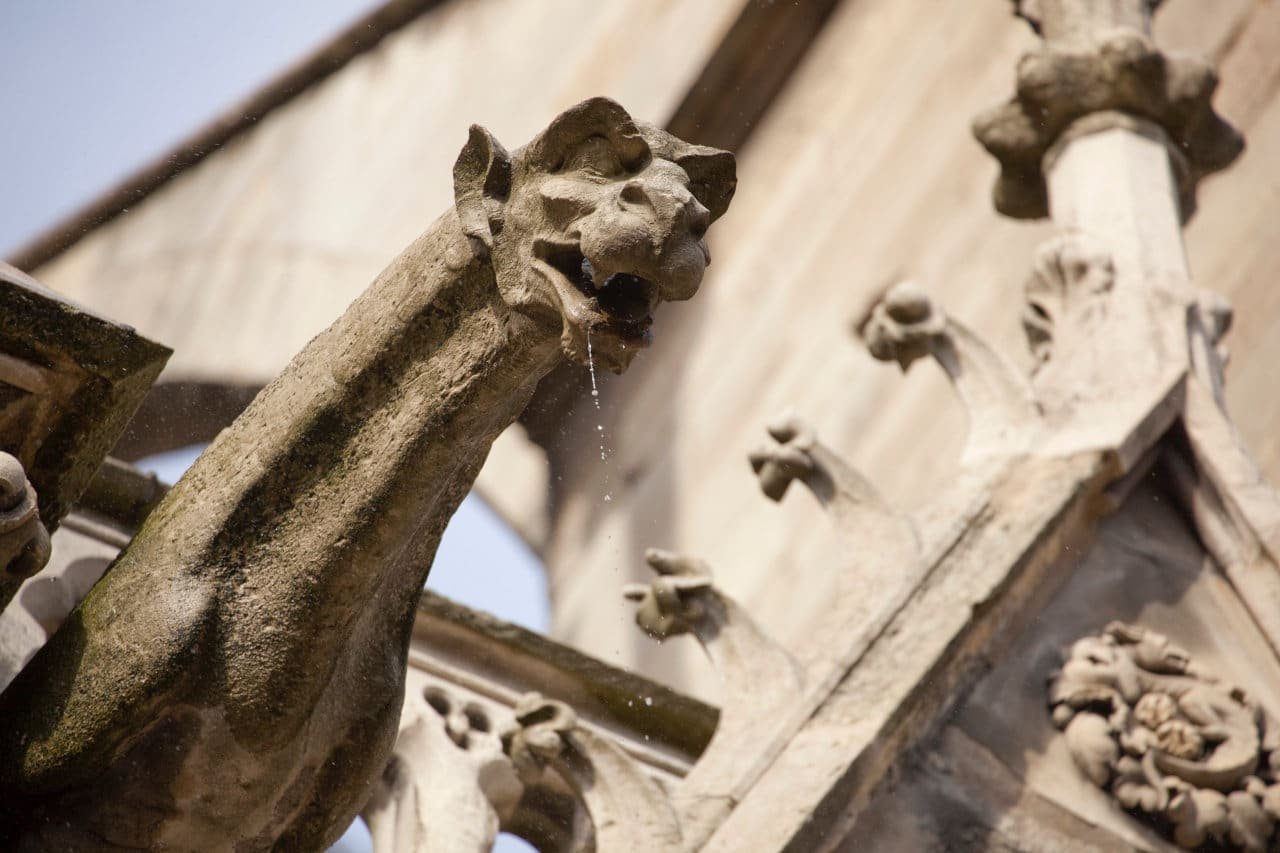
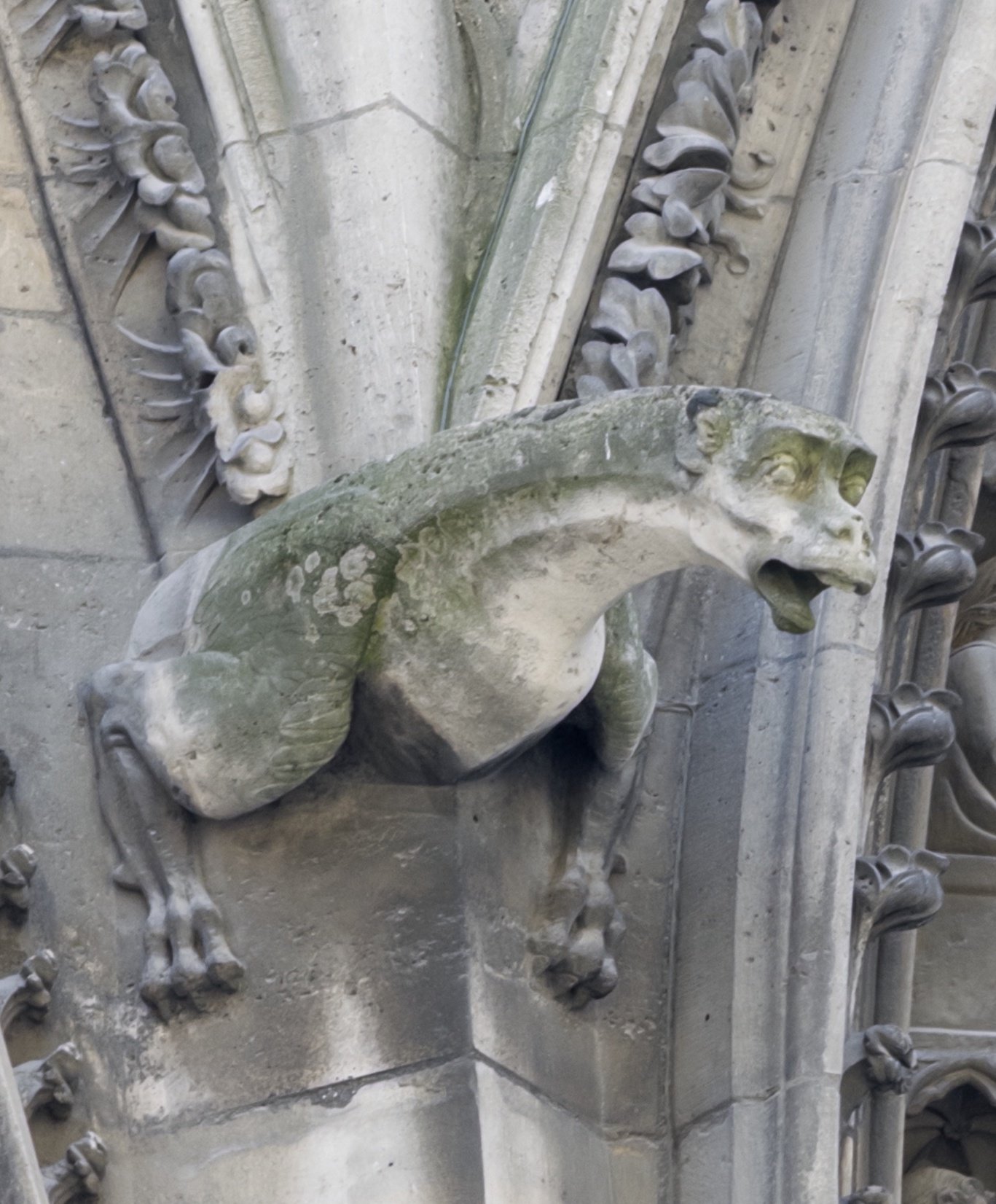
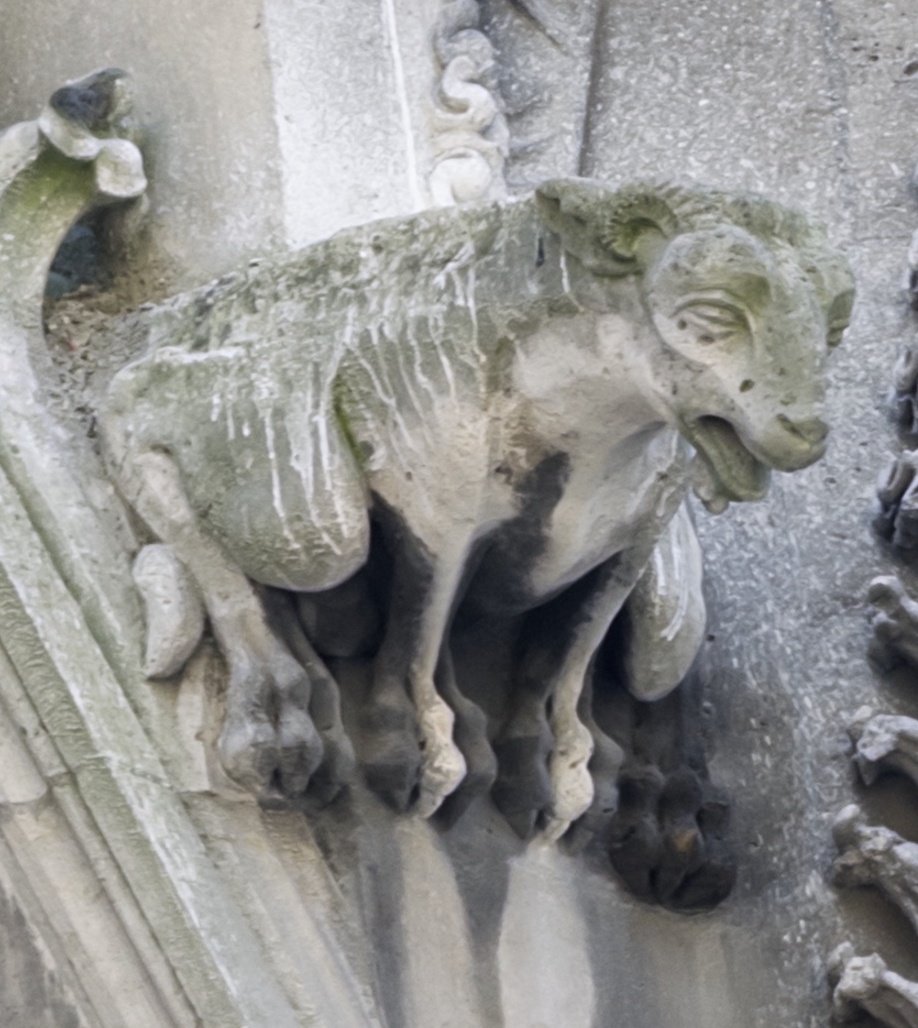
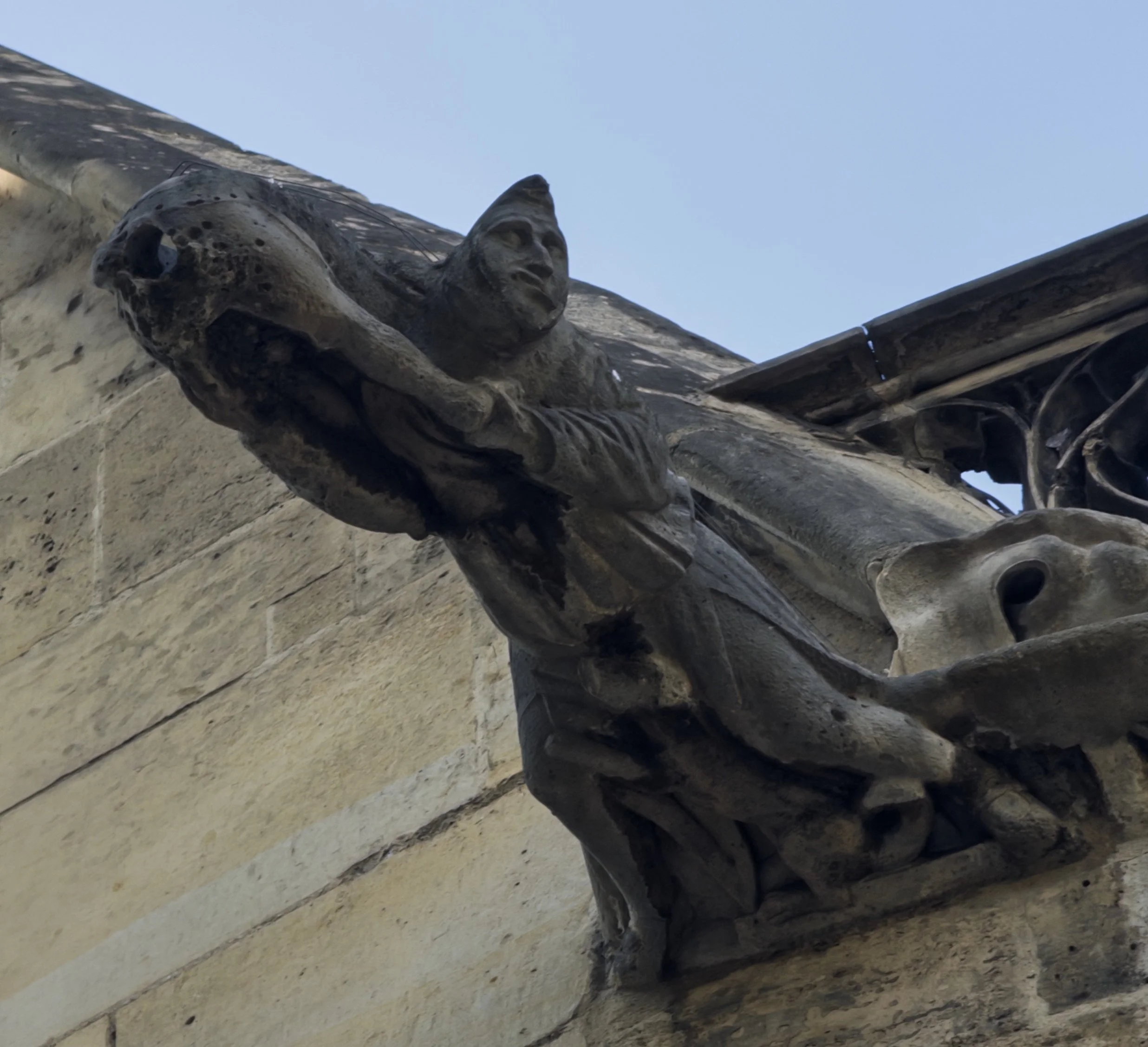
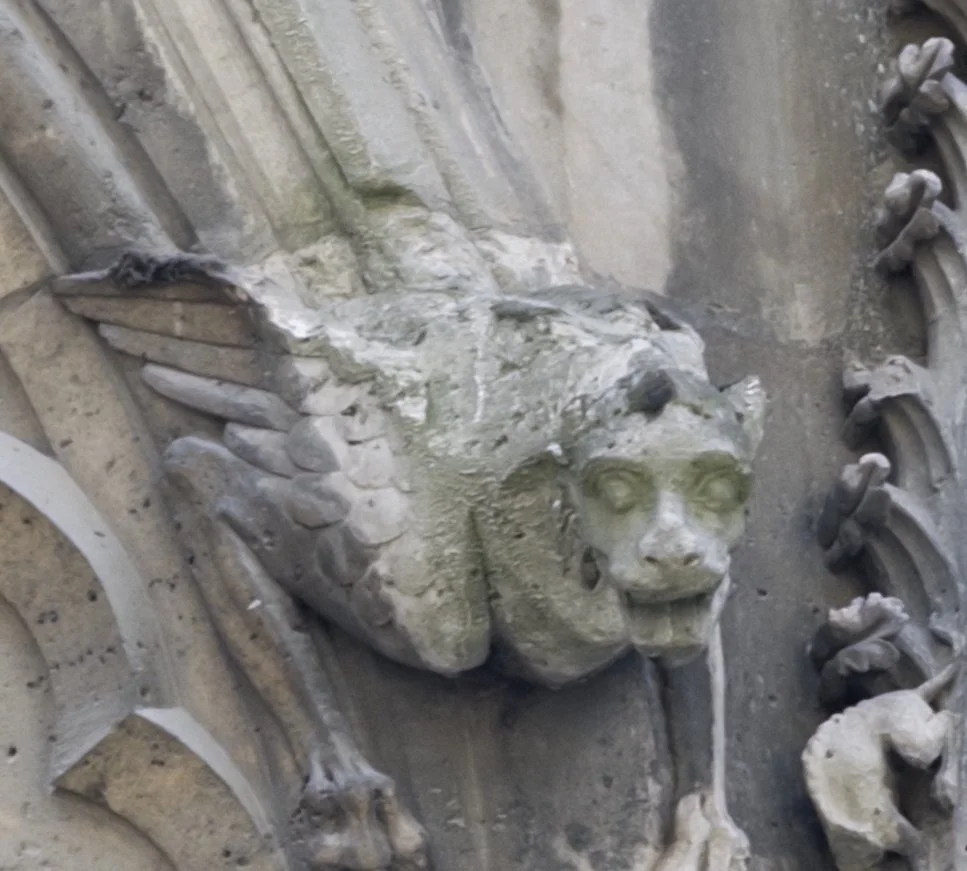
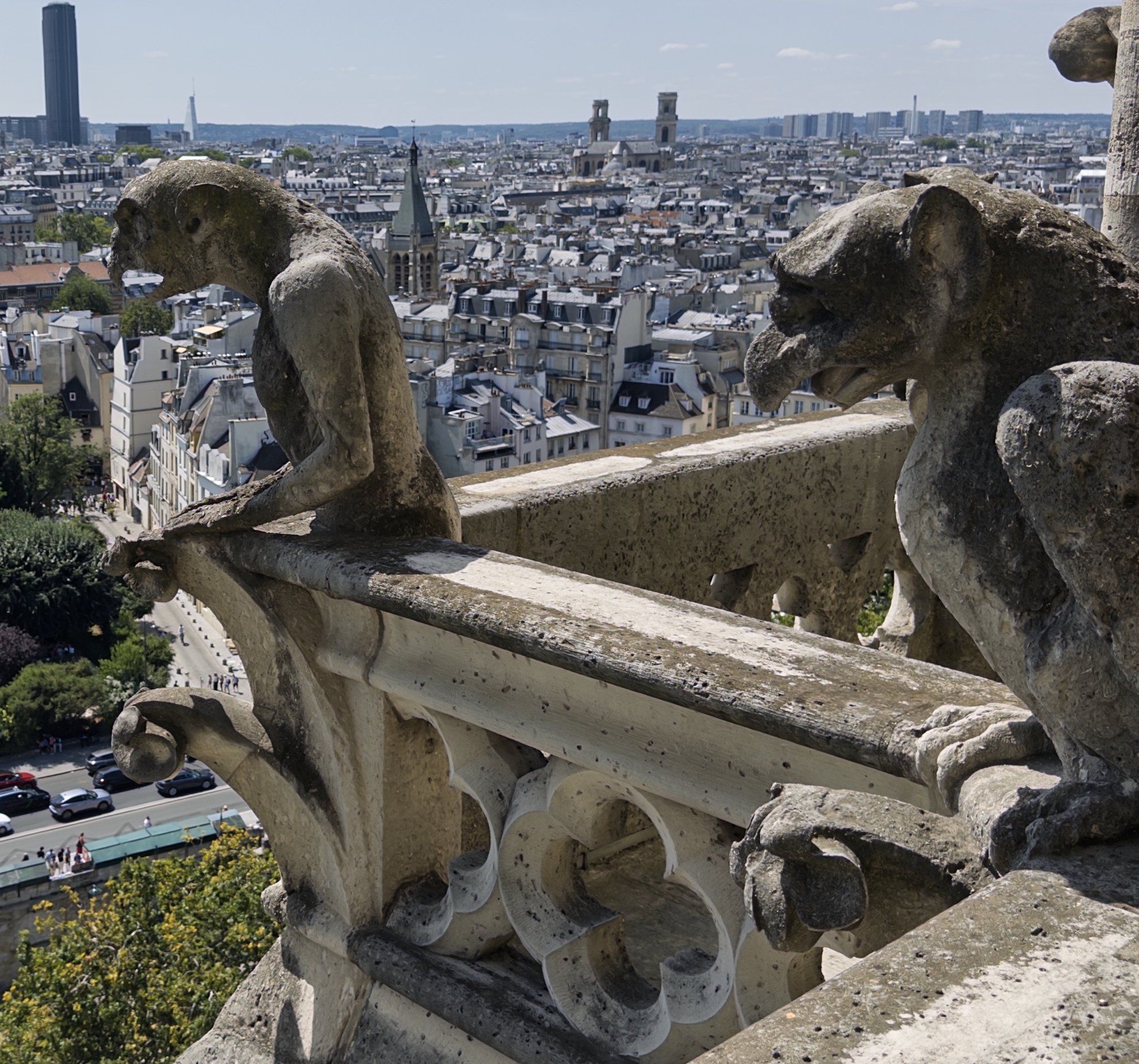
Looking up at the towers of Notre Dame, I absolutely adored looking at all of the gargoyles. From chimeras to harpies, and–my personal favorite–dragons, gargoyles have been shaped into fantastical beasts for centuries. Their purpose on paper is to serve as decorative drainpipes, carved with a spout to spit out water away from the stone walls of cathedrals to prevent erosion. It’s incredible both the engineering and artistic vision which existed centuries ago to build something not only exceedingly practical, but also fascinating to look at. (Aren’t they just badass?!)

Image of gargoyle courtesy of Friends of Notre-Dame de Paris

A beastly gargoyle at Notre Dame

However, gargoyles also serve as protectors, keeping careful watch on cathedral visitors. While their use as gutters is largely understood, their specific role as spiritual objects has been debated. Some say that gargoyles’ grotesque and menacing expressions ward away evil spirits and sin. Others argue that gargoyles were meant to strike fear into the “hearts of the pious” by depicting devilish traits. Another theory suggests that gargoyles represent the torturous fate of those who sin, morphing them into animalistic half-breeds. All agree that gargoyles have served many different purposes depending on where and when they were made (and that they look incredibly cool!)

Victor Hugo, famously, held a deep passion for architecture. His novel, The Hunchback of Notre Dame, served as his love letter to the Notre Dame cathedral and embodied Hugo’s commitment to protecting medieval architectural heritage. To Hugo, architecture was “the great book of humanity,” allowing us to remember and honor the memory of all humankind. In 1824, Hugo wrote an ode called “The Black Band,” which glorified monuments and denounced revolutionary vandalism. Eight years later, he wrote “War on the Demolishers” condemning “destruction and hazardous reconstructions.” Hugo believed that architecture and literature could draw out a narrative and bear witness to human history. Victor Hugo also loved to sketch and draw architecture, exhibiting his passion for the history architecture contains.

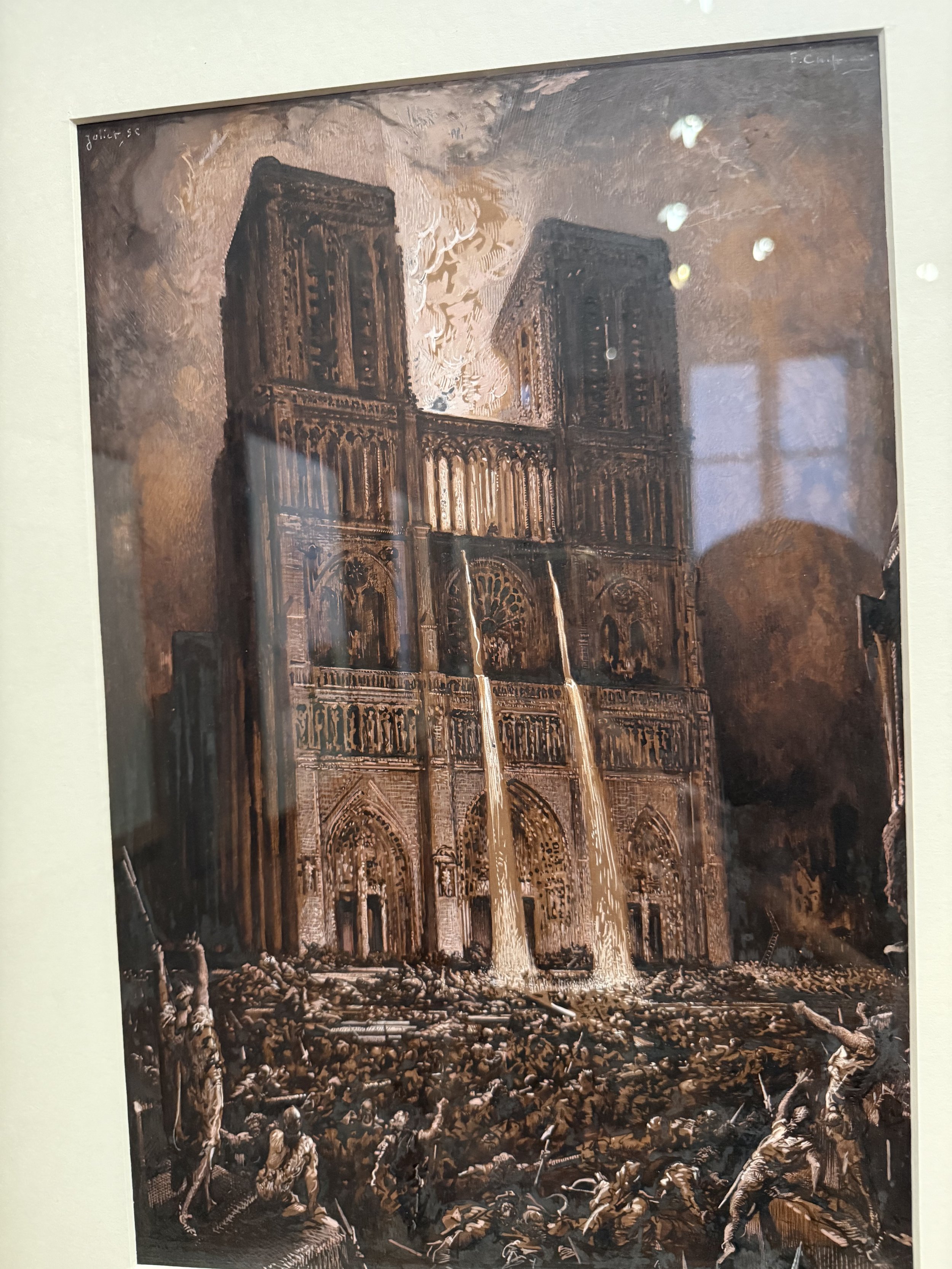
Attaque de Notre-Dame by François Chifflart. On display at The Maison de Victor Hugo.

Two monster-headed gutters were vomiting incessantly that burning shower, the silver trickling of which shone out upon the darkness on the lower part of the grand front.
— Victor Hugo (The Hunchback of Notre-Dame)

When we got the chance to visit Notre Dame in Paris, I was stunned to think I was seeing the same things Victor Hugo saw over 200 years ago. The towers were massive and the intricate carvings were mesmerizing. I have always appreciated a good gargoyle and Notre Dame has so many to boast (around 54!). Demons, dragons, humans, animals, and creature-animal-humanoid-figures galore; during my visit, I never stopped finding new gargoyles to marvel at. 

Though, at the moment, I thought I was seeing the same cathedral as Hugo, there were a few small changes that I actually had him to thank for! 

Today, the original medieval gargoyles from the 13th century are all but gone, having faced constant erosion with rain, frost, heat, and humidity wearing down the limestone. Even worse, during the French Revolution, Notre Dame was targeted as a religious symbol and many of the cathedral elements were vandalized or desecrated. By the 19th century, Notre Dame was in disrepair and almost all of the gargoyles were broken, missing, and or disfunctional. Yet, when all hope seemed lost, Victor Hugo helped bring the cathedral to the current glory we get to see now with a single book: The Hunchback of Notre Dame! 

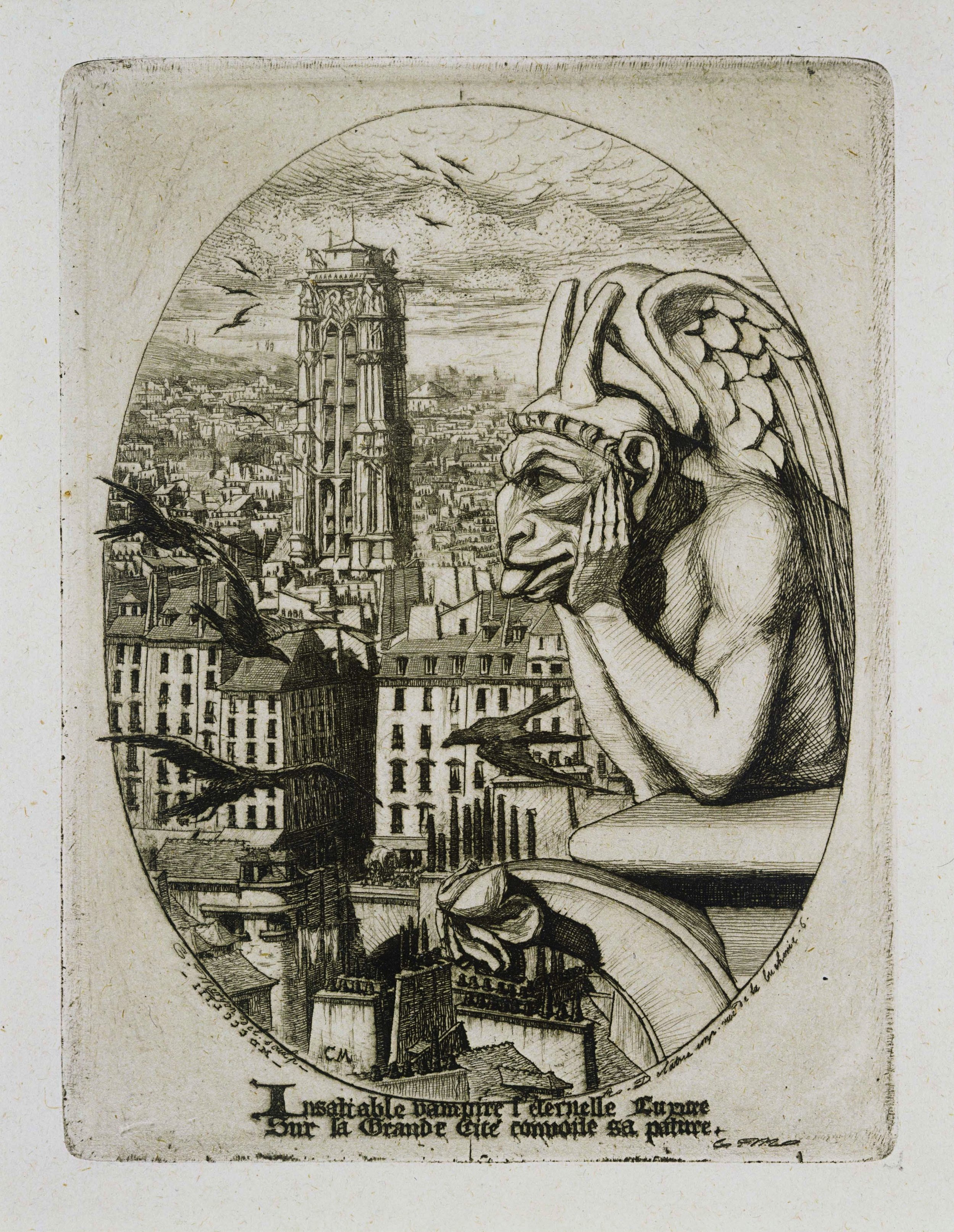
Le Stryge by Charles Méryon. On display at The Maison de Victor Hugo.

The current gargoyles we see were erected during the restoration between 1845 and 1867, which was spurred by the coverage and success of Hugo’s novel. Some of the grotesque sculptures erected by architect Eugene Viollet-le-Duc were actually inspired by Victor Hugo. Le Stryge (The Strix), is one of Notre Dame’s most famous sculptures, inspired by a half-woman half-bird mythological creature. It combines the figure of Esmerelda, associated with a witch, and that of Quasimodo, compared to a gargoyle. Even though Le Stryge is not a gargoyle (it’s a grotesque, NOT a gargoyle), I still think it looks pretty cool and it has served an important role in defining Notre Dame, and Paris’, visual identity.

Victor Hugo talks at length about Paris in Les Miserables and the collective history its stones hold. For Hugo, he has seen Paris be transformed as a “result of demolitions and rebuilding,” evolving the Paris of his youth into a “Paris of the past.” Perhaps this is where his passion for the preservation of buildings and monuments stems from, an intense appreciation for these cobbles and buildings he cherishes. To Hugo, all these places are “the very embodiment of France…for the face of your homeland is as dear to you as the face of your mother.” Even the sewers of Paris were worthy of Victor Hugo’s attention, and he saw that “history passes through the sewers.” His ability to see the narrative and human history in any structure was incredible, even a sewer could “[bear] traces of the revolutions of the globe as well as of the revolutions of man.”

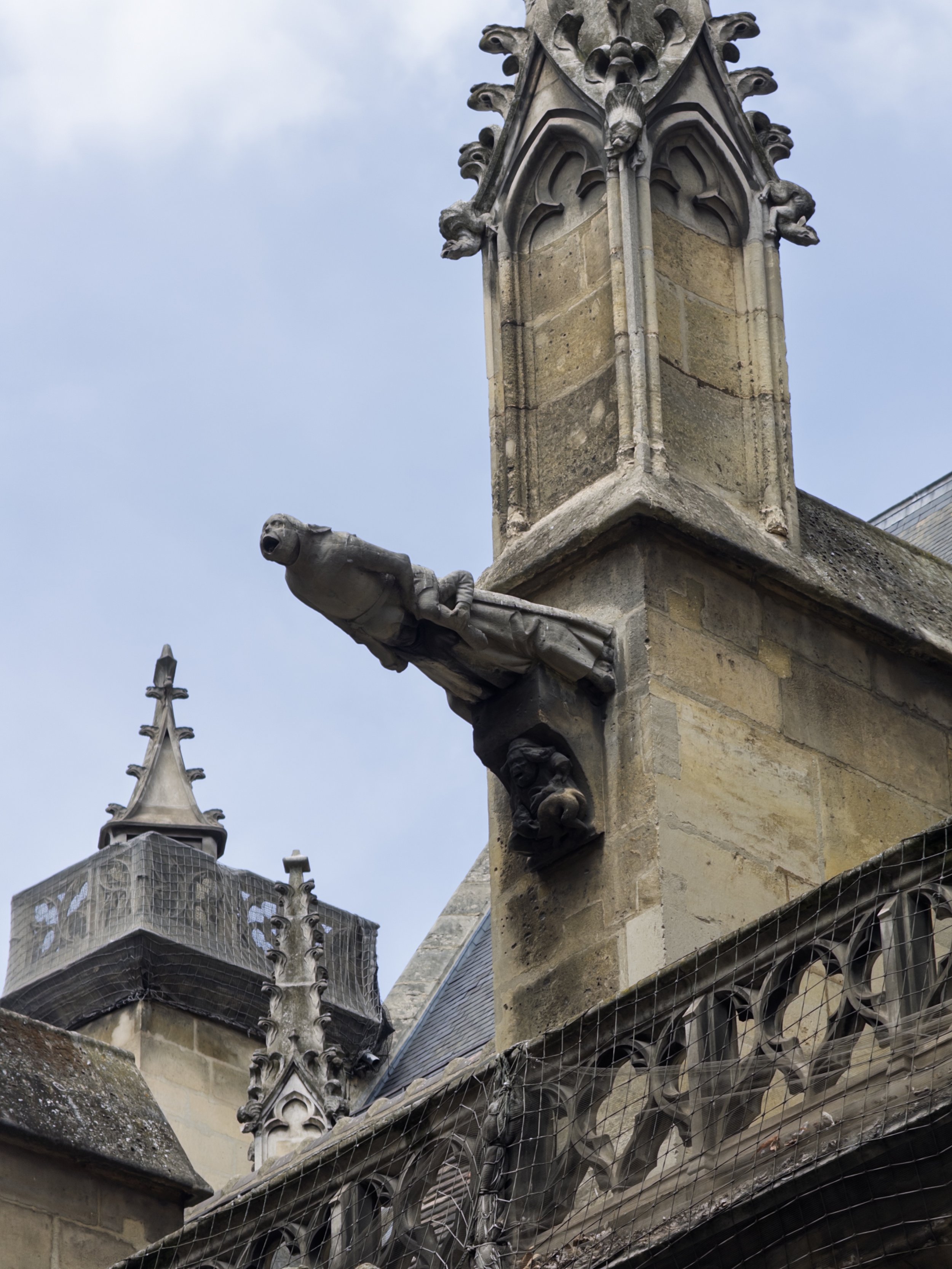
To me, gargoyles elicit that same sense of admiration. Incredibly useful and with a rich history, gargoyles fascinate me. While they can be intimidating, they can also be sometimes silly; human figures throwing up or sometimes even defecating. Personally, I love how the gargoyle beasts and dragons are always so fantastical and imaginative, like they might start moving the second you tear your gaze away from them. Craning my neck up to look at all the gargoyles with their gaping maws, I understand where Hugo was coming from with all his obsession with preservation. Architecture gives us something that literature cannot, tangible evidence of the people and histories which existed before us. While Hugo can tell me about Notre Dame, there is nothing like staring up at it, a physical connection to the author who marveled at it once before me. Hugo wanted us to see Notre Dame as more than just a place, but to consider who built it, who lived around it, who repaired it, who nearly destroyed it, and who fought to preserve it.

I like to picture what the gargoyles of Notre Dame may have seen from their position way above: The Paris Commune commandeering their home into the Temple of Reason. Napoleon marching up the steps on his way into the cathedral to crown himself Emperor. Rocks and stones piercing the stained glass windows below them during the vandalism of the July Revolution. Victor Hugo making sketches while writing the Hunchback of Notre Dame. It’s amazing to think of the history this building represents and the accumulation of stories these stony sentinels have collected over the 800 years it's been standing. Perched above Paris, these gargoyles have protected their home from revolutions, restoration, neglect, and even fire. The next time you visit Notre Dame, take a few moments to appreciate both the usefulness and beauty of the gargoyle, the coolest looking guardians of Paris. 


Who Gets to Decide Who the People Are?

Delacroix's Liberty Leading the People (1830), photographed in the Louvre. Revolutionary art often celebrates those behind the barricade. But who was standing on the other side?

Who are the people?

It is a question that sounds almost too simple to ask. Yet standing in the streets of Paris where the barricades of Les Misérables once stood, I realized it may be one of the most difficult questions any society can answer.

Our class had spent the afternoon tracing the route of the June Insurrection of 1832. We walked through streets that today are filled with cafés, tourists, and cyclists, yet beneath the pavement lies the memory of one of France's most famous acts of resistance. Victor Hugo transformed these streets into the setting of Les Misérables, where a small group of students and workers built barricades knowing they would almost certainly die. Standing where those barricades once rose, I found myself thinking less about the students behind them than about the people standing across from them.

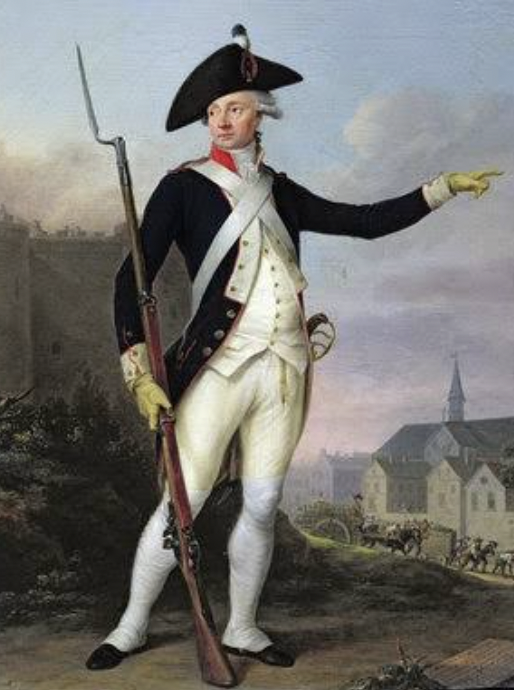
The National Guard.

Growing up, I always associated uniforms with protection. Whether police officers, firefighters, or soldiers, uniforms are designed to communicate safety and stability. They represent institutions that exist to preserve order. I had never stopped to consider that the same uniform could symbolize something entirely different depending on where someone was standing.

The Declaration of the Rights of Man and of the Citizen (1789). It proclaimed liberty, equality before the law, and freedom from arbitrary imprisonment. The challenge was never simply defending these ideals, but deciding who had the authority to define them.

Founded to defend the people in 1789, the National Guard later found itself facing citizens who believed they, too, were defending the people.

The National Guard was established during the French Revolution in 1790, shortly after the fall of the Bastille. It emerged alongside revolutionary ideals that sought to replace arbitrary royal authority with the rule of law. France had just rejected the lettres de cachet, royal orders that allowed people to be imprisoned without trial, and adopted the Declaration of the Rights of Man and of the Citizen, proclaiming liberty, legal equality, and protections for individual rights. The National Guard was created to defend those principles and protect the Revolution itself.

At first glance, it seems like a straightforward story. A force created to defend freedom. A symbol of a nation determined to break away from oppression. But history rarely remains straightforward. Just forty-two years later, Hugo presents an entirely different image. During the June Rebellion of 1832, the National Guard stood opposite the students gathered behind the barricades. These young men believed they were fighting for liberty, justice, and a better France. Many of them saw themselves as heirs to the Revolution of 1789. Yet the National Guard, born from that very Revolution, was now firing upon them.

What changed?

Initially, I assumed the answer was obvious. Perhaps the National Guard had abandoned its purpose. Perhaps the students had become radicals standing in the way of progress. But the more we discussed Les Misérables throughout the week, the more I realized Hugo is asking something much deeper than who was right or wrong.

The National Guard never stopped believing it was protecting France. The students never stopped believing they were fighting for France. The conflict was never simply about power. It was about who had the authority to define the people. Perhaps every revolution reaches the same moment: when both sides become convinced that they alone are defending the people.

The June Rebellion of 1832. Victor Hugo transformed this failed uprising into the climactic scene of Les Misérables, challenging readers to look beyond who won and ask what each side believed it was fighting for.

History often encourages us to divide the world into heroes and villains because it is easier that way. We celebrate revolutions that succeeded. We criticize governments that failed. Looking backward, the answers can appear obvious. But for the people actually living through these moments, certainty rarely exists. Governments rarely see themselves as oppressive. More often, they believe they are preserving stability. Protesters almost always believe they are demanding justice. Both frequently claim to be acting on behalf of the people. Both hope history will eventually prove them right.

Walking through Paris forced me to acknowledge how uncomfortable that tension really is. Hugo refuses to portray history as a simple struggle between good and evil. Instead, he presents competing visions of justice, each convinced of its own legitimacy. The National Guard is not depicted as inherently evil, nor are the students portrayed as unquestionably righteous. They simply represent two different visions of what France should become. That complexity is precisely what has allowed Les Misérables to remain relevant for nearly two centuries.

Leaving the barricade, I found it impossible not to think about our own time. Conversations surrounding policing continue to raise many of the same questions Hugo explored in 1832. Public trust in law enforcement often depends on lived experience, historical memory, and political belief. Some see police as protectors of democratic order; others point to moments when state authority has undermined those same ideals. The circumstances are different, and history should never be forced into easy comparisons. Yet the questions themselves remain remarkably familiar.

What has endured is something more fundamental: every generation must decide where the line between authority and justice should be drawn.

That realization made me think differently about institutions themselves. We often imagine that organizations possess fixed identities. We describe them as good or bad, trustworthy or corrupt, heroic or oppressive. Yet institutions are ultimately shaped by people, by governments, by public expectations, and by changing political ideals. The same institution can be remembered as a symbol of liberation in one generation and as an obstacle to progress in another.

Perhaps that is why Hugo's barricades continue to resonate. They are not simply monuments to revolution. They are reminders that democracy is never static. The values a society claims to defend must constantly be examined, questioned, and redefined.

Earlier in the course, Professor Chater challenged us to think carefully about the difference between a riot and an insurrection. At first, I assumed the distinction depended on violence. After standing where the barricades once stood, I am no longer convinced it is that simple. Perhaps those labels often depend less on what happened than on who is telling the story, who prevails, and who ultimately writes the history books.

Standing in a quiet Parisian street, it was difficult to imagine gunfire echoing between the buildings or barricades stretching across the road. The city has moved on. Cafés occupy spaces where students once prepared to die. Tourists wander through the neighborhood without realizing the history beneath their feet.

Yet the questions remain. Who speaks for the people? When does protecting order become resisting progress? And perhaps the most unsettling question of all: Who gets to decide who the people are?

If I had stood on that street in June of 1832, would I have believed the students were defending France? Or the National Guard?

I left the barricade without an answer.

Somehow, I think that is exactly what Victor Hugo intended.

Reflections of the Crown

Our morning seminars, excursions, and the two novels, A Tale of Two Cities and Les Misérables, have allowed us to really dive into French history. Specifically, we have explored its Revolutions, such as the 1789 French Revolution and 1832 June Rebellion. Many places we have seen throughout our experience speak to these Revolutions reasons, drives, and results. In this blog I want to talk about the French monarchy, and discuss how the royalty and aristocracy portrayed and thought of themselves in comparison to the working class people, in which ultimately at the end of this blog will give an understanding of this time before and after the Revolutions in France.

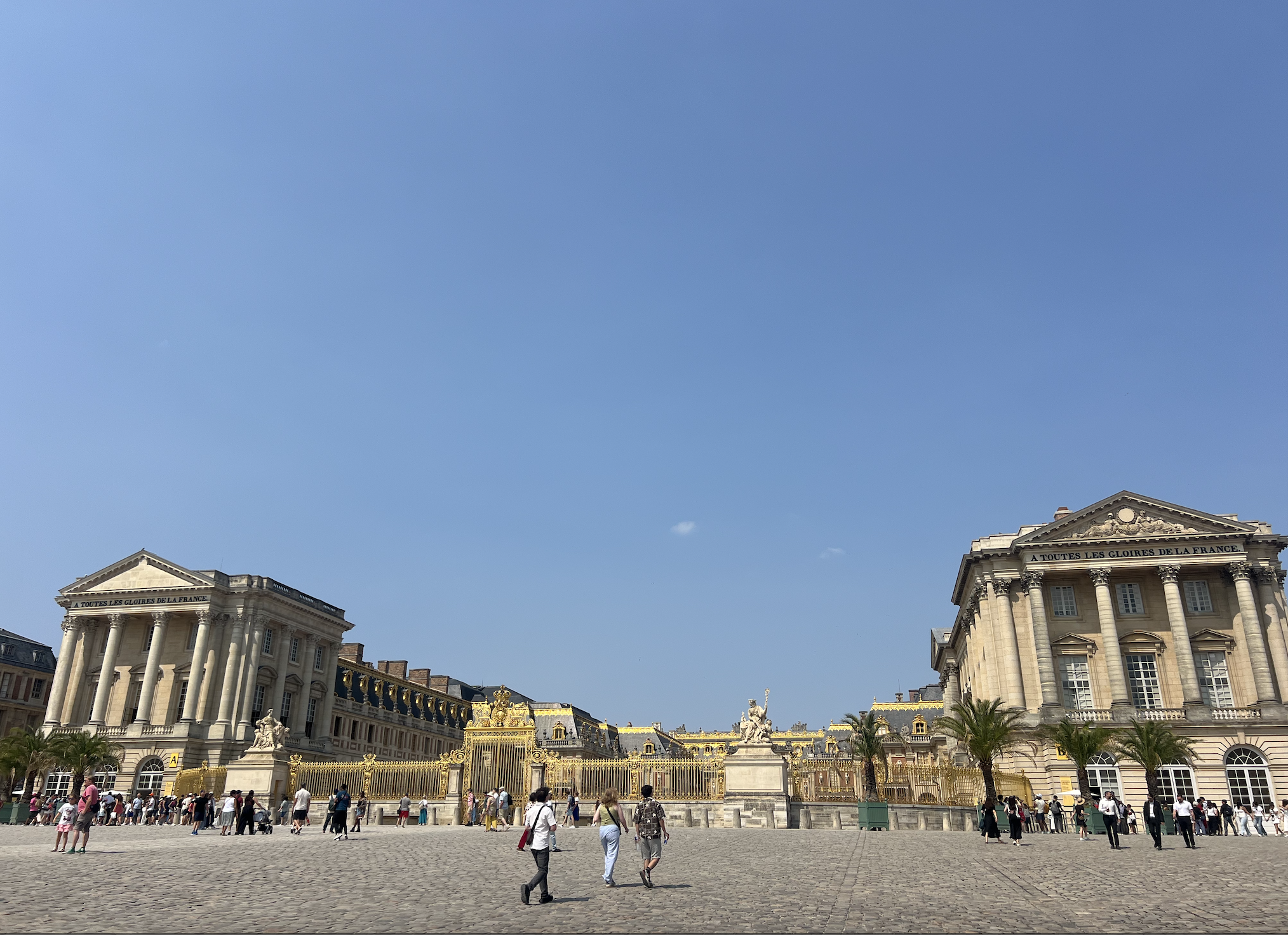
Walking up towards the Palace of Versailles

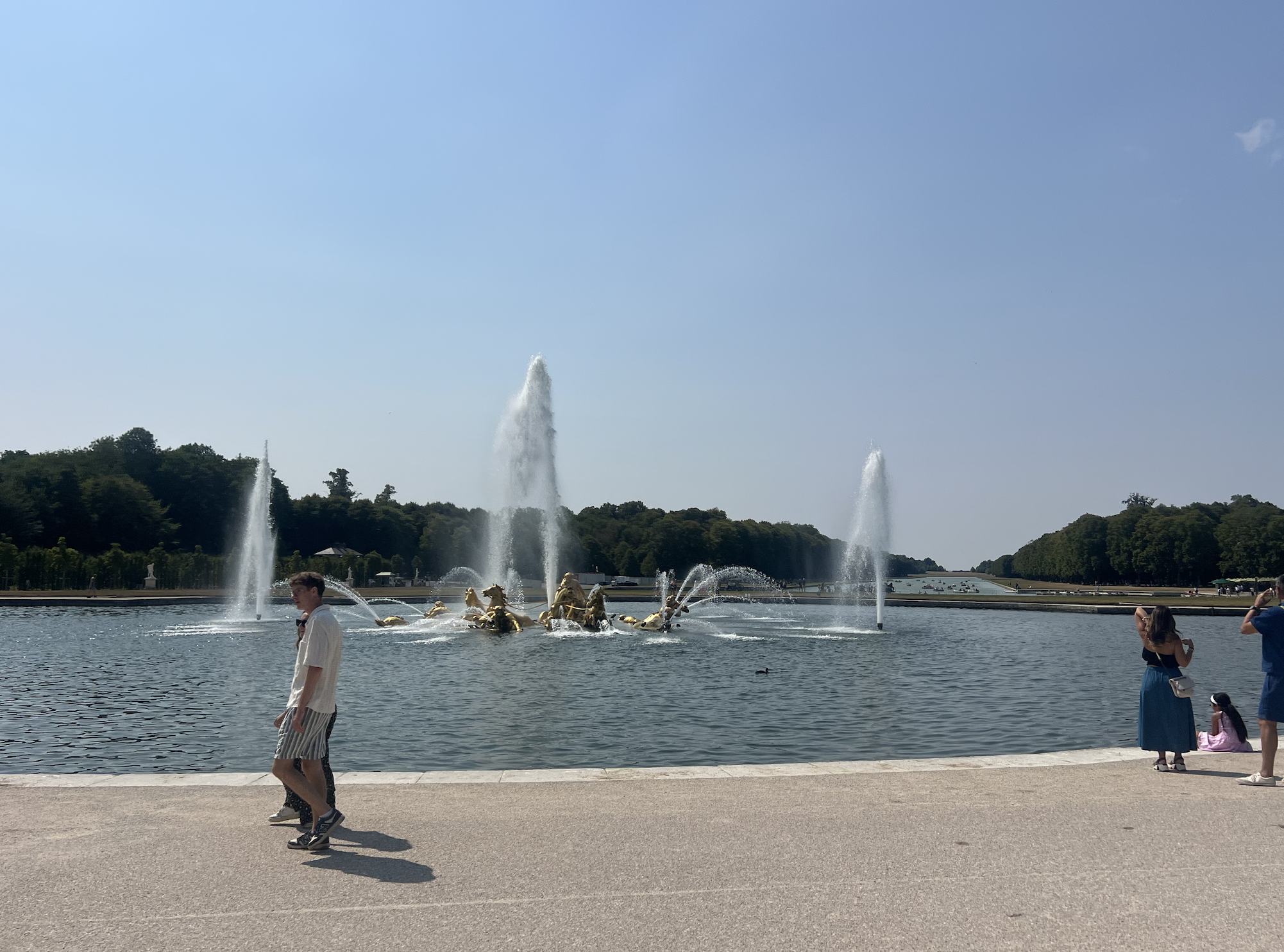
Apollo’s Fountain

One location in particular I felt spoke a lot regarding the feelings and actions of French society before and after the revolutions is the Palace of Versailles. As mentioned by Professor Andrew, it truly felt like the embodiment of everything in those times and society that the Revolutions were fighting against, particularly the 1789 French Revolution. To start, a sense of the Palace of Versailles, before walking in, can be felt through its history, which I found very interesting from our discussions and from videos I watched before and after our trip to Versailles. The core image of Versailles that we see today was created by Louis XIV. To quickly portray his thoughts on his position as king is to share his self-given title of “Sun King.” By thinking of himself as the Sun King, I learned that he was comparing himself to Apollo, the Greek god of the Sun. This was so interesting as we can see this comparison in Versailles, for example in the gardens, there is a gold statue of Apollo in the center of a large fountain, I believe this is called the Apollo Fountain. The fact that he compared himself to a Greek god showed how it was evident that Louis XIV thought of himself very highly and likely thought he rightfully had the crown and was this divine image to the rest of France. From this we can already begin to see the picture of an absolute monarchy in France. 

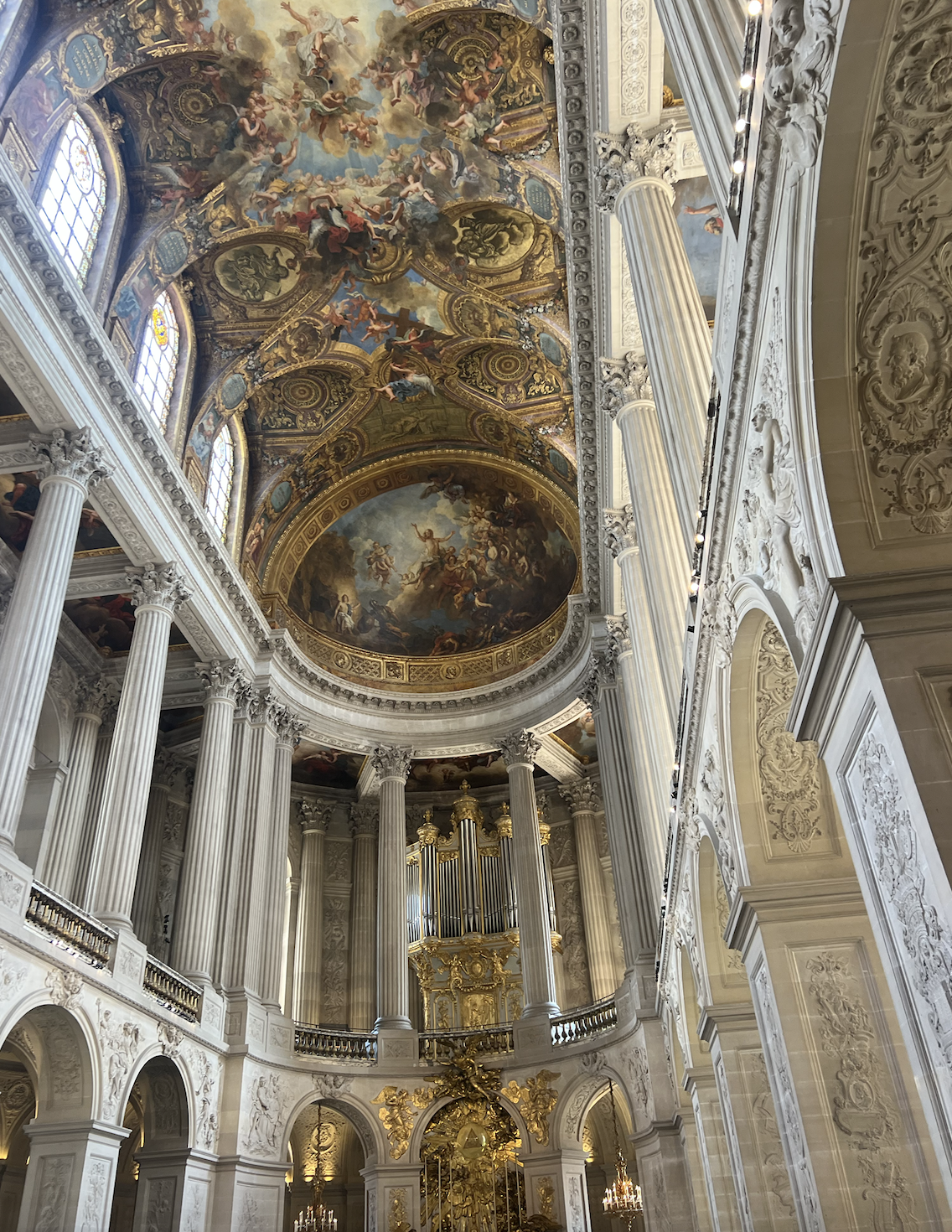
Royal Chapel in the Palace of Versailles

Looking at Versailles was incredible. There are many words that could be used to describe it, grand, over the top, extravagant, luxurious, vast, etc. Initially walking up to Versailles was an interesting experience. You begin to walk up on uneven stone, while seeing this massive palace surrounded by a tall gate slowly get closer. On this walk, I felt as if I was stepping into a different place apart from the city around us, which is likely what this building intends to do. In this way there is already this strong sense of separation between what is behind those gates and those outside. The inside of Versailles was beautiful. There was no wall in the palace that was plain, as they were covered with gorgeous paintings, detailed engravings, designed wall paper, gold borders, which was so much so that it made the big rooms of the palace seem small. The same grandness could be expressed about the Garden of Versailles. There were huge fountains, beautiful flowers, and hedges spreading so vast that it was like a maze. My feet definitely felt just how large this place is after this 20,000 step day. 

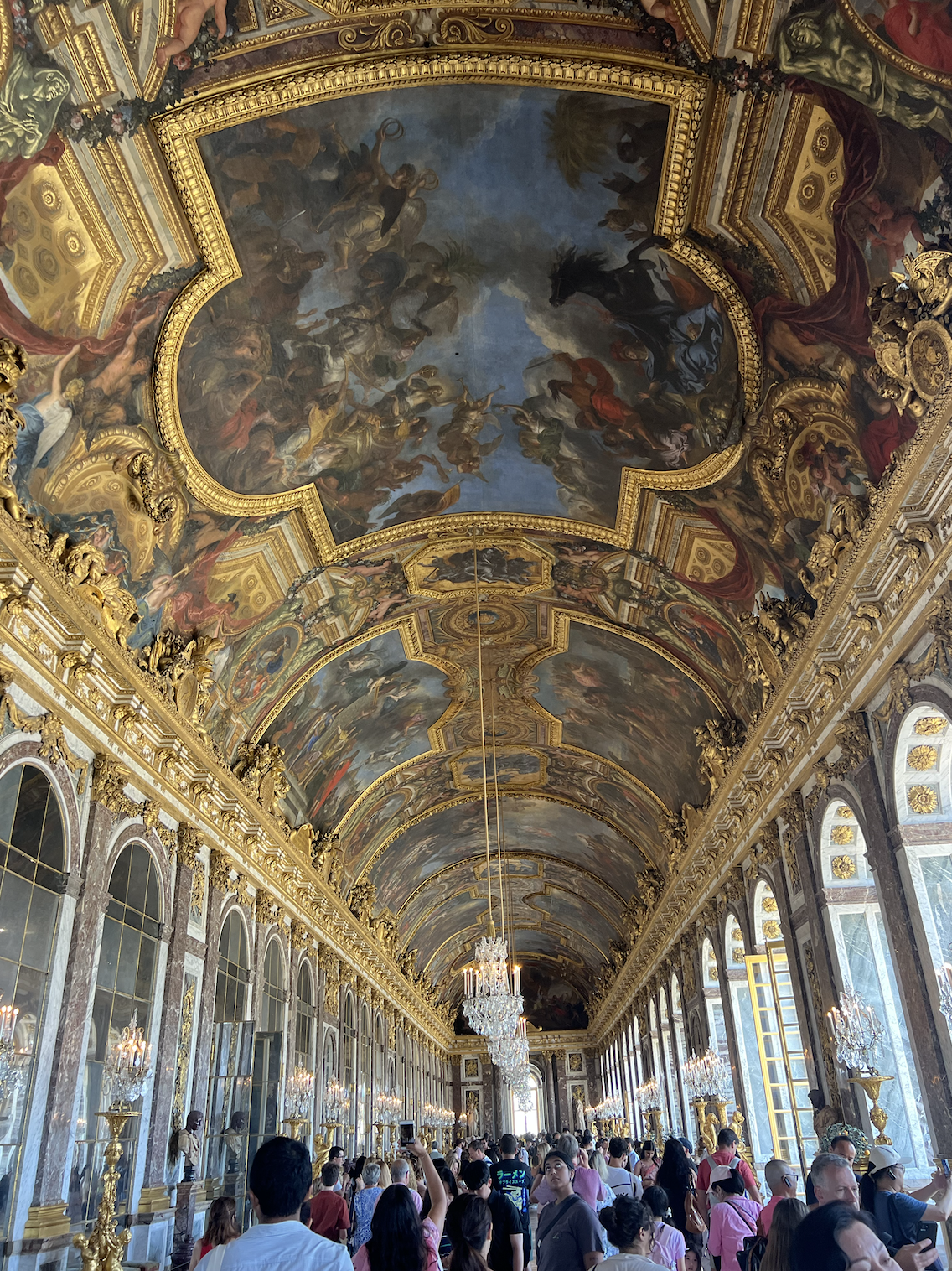
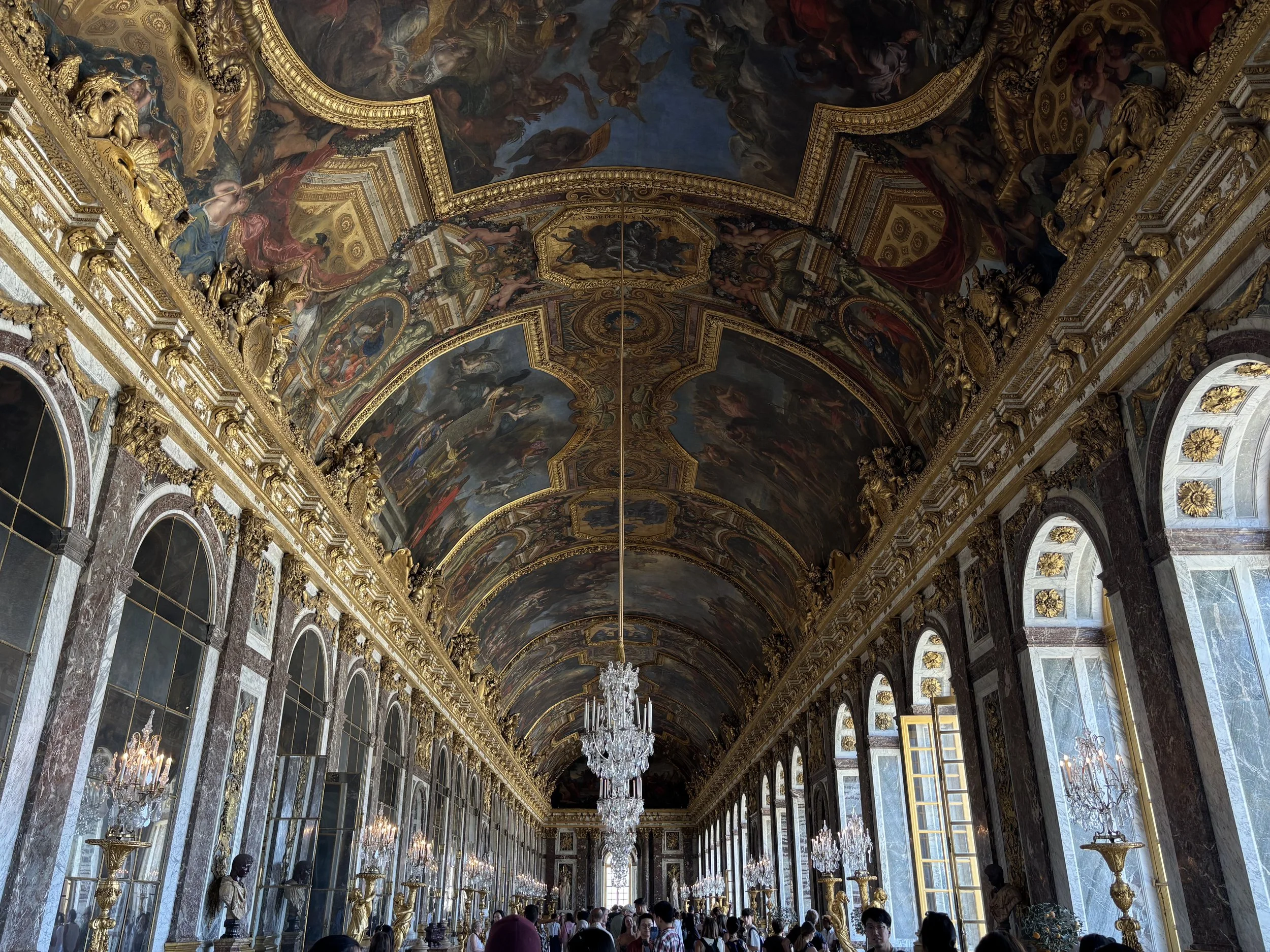
Hall of Mirrors

There were a lot of interesting rooms and objects I saw in Versailles that stood out to me in expressing the time of the Revolution and more so how the monarchy and aristocracy felt during this time. To begin, I want to talk about one of the most impressive and beautiful rooms in the Palace of Versailles, the Hall of Mirrors. This long room was the absolute embodiment of lavishness. Gold color filled this room through statues, stands, borders on the walls, and patterns on the ceiling. Emphasized by this gold were the paintings that covered the entire ceiling and hanging from them rows of chandeliers. Everything in this room was so extravagant and I found it to portray exactly what the monarchy was in this time period in which they lived lives of excessiveness while the working class lived on scraps. The vast inequality between these two groups is shown throughout this room and the entire palace, as it is obvious the level of wealth and power the monarchy held. Being in this room was amazing to see, but it had me questioning how those who could enjoy this side of the inequality without feeling a sense of guilt or sympathy for those outside who couldn't even fill their rooms with food. Therefore, one can also see just how out of touch the monarchy was, continuing to see themselves as higher beings with the right to live this way while others suffer. 

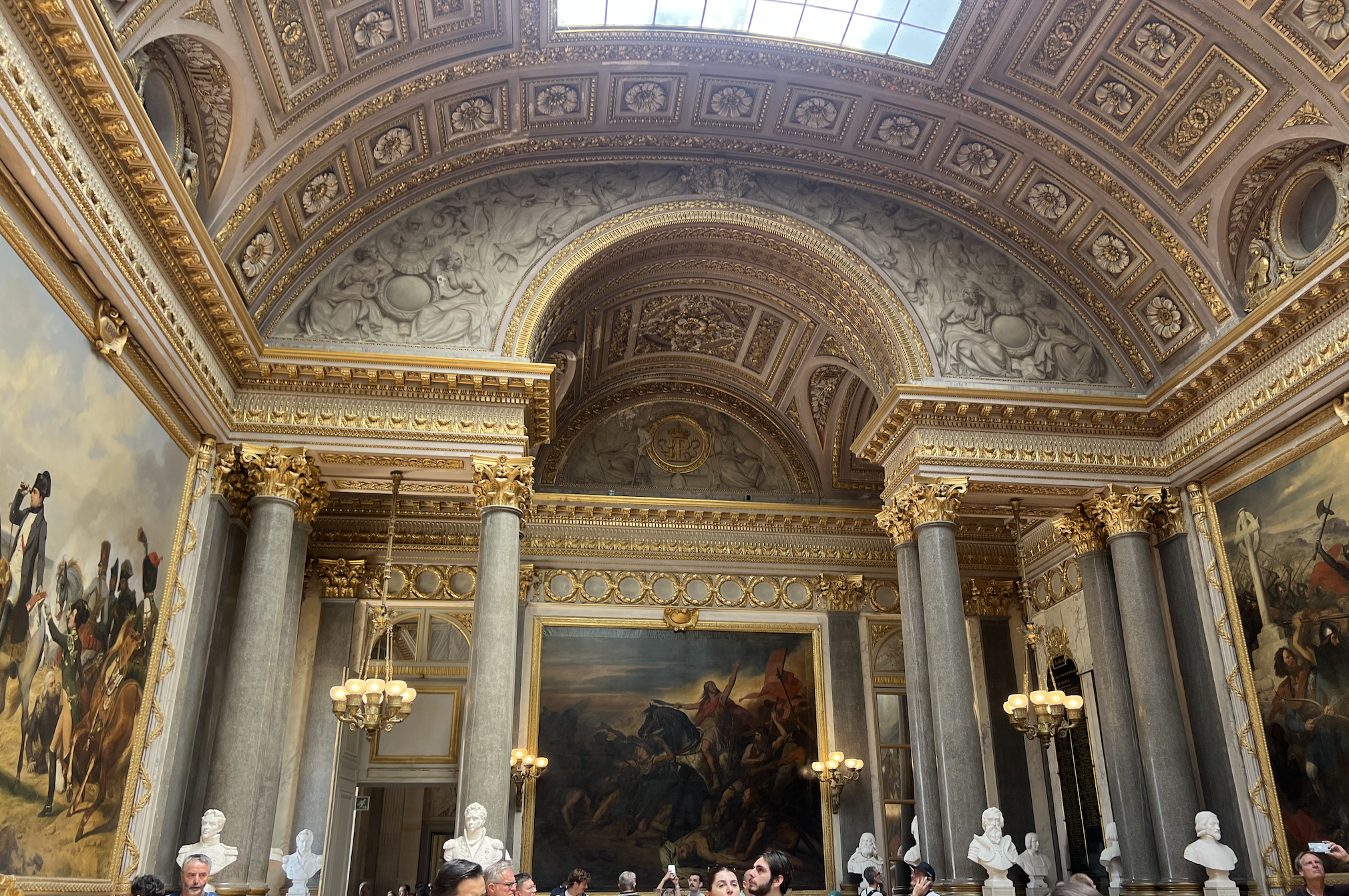
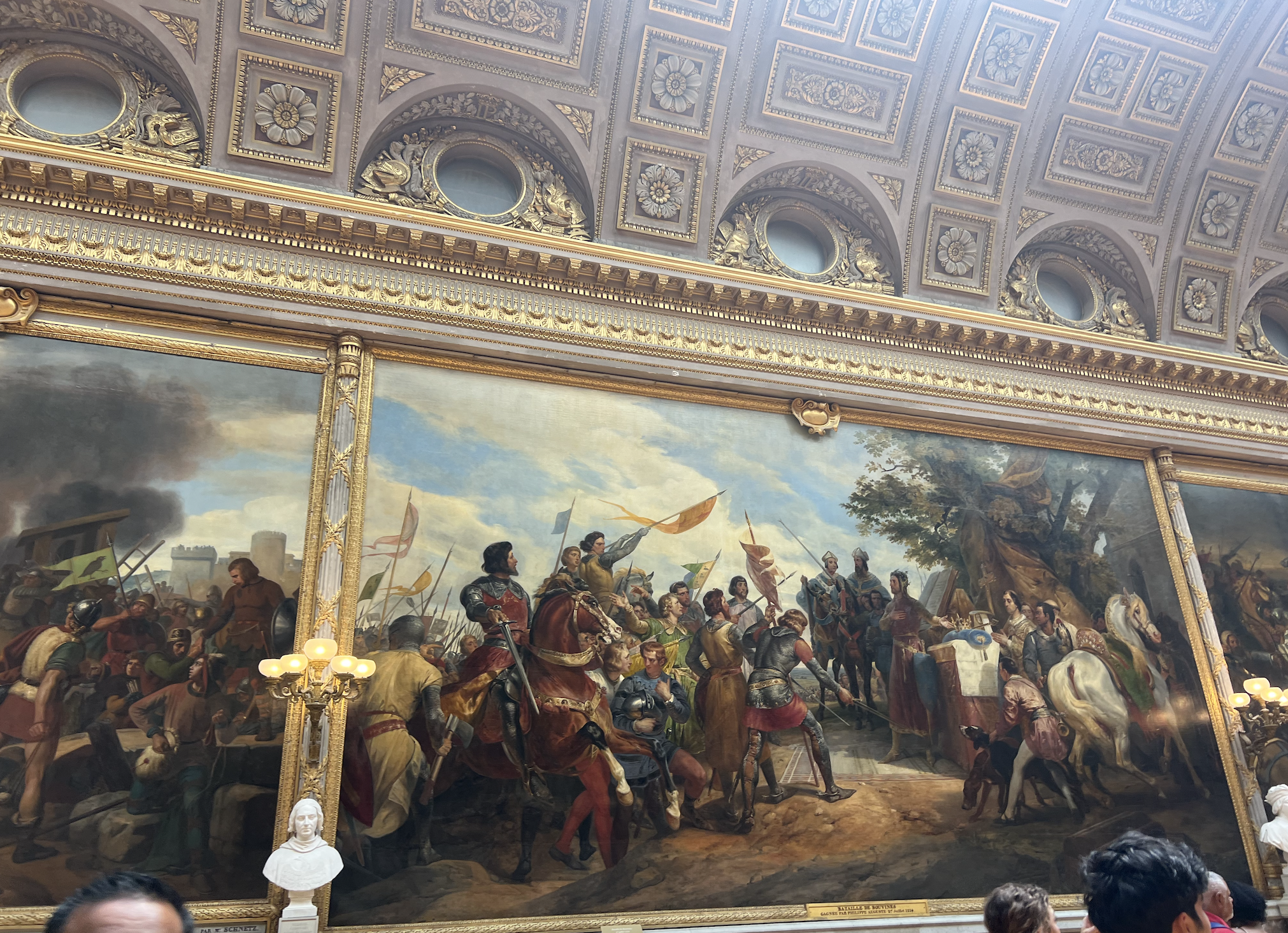
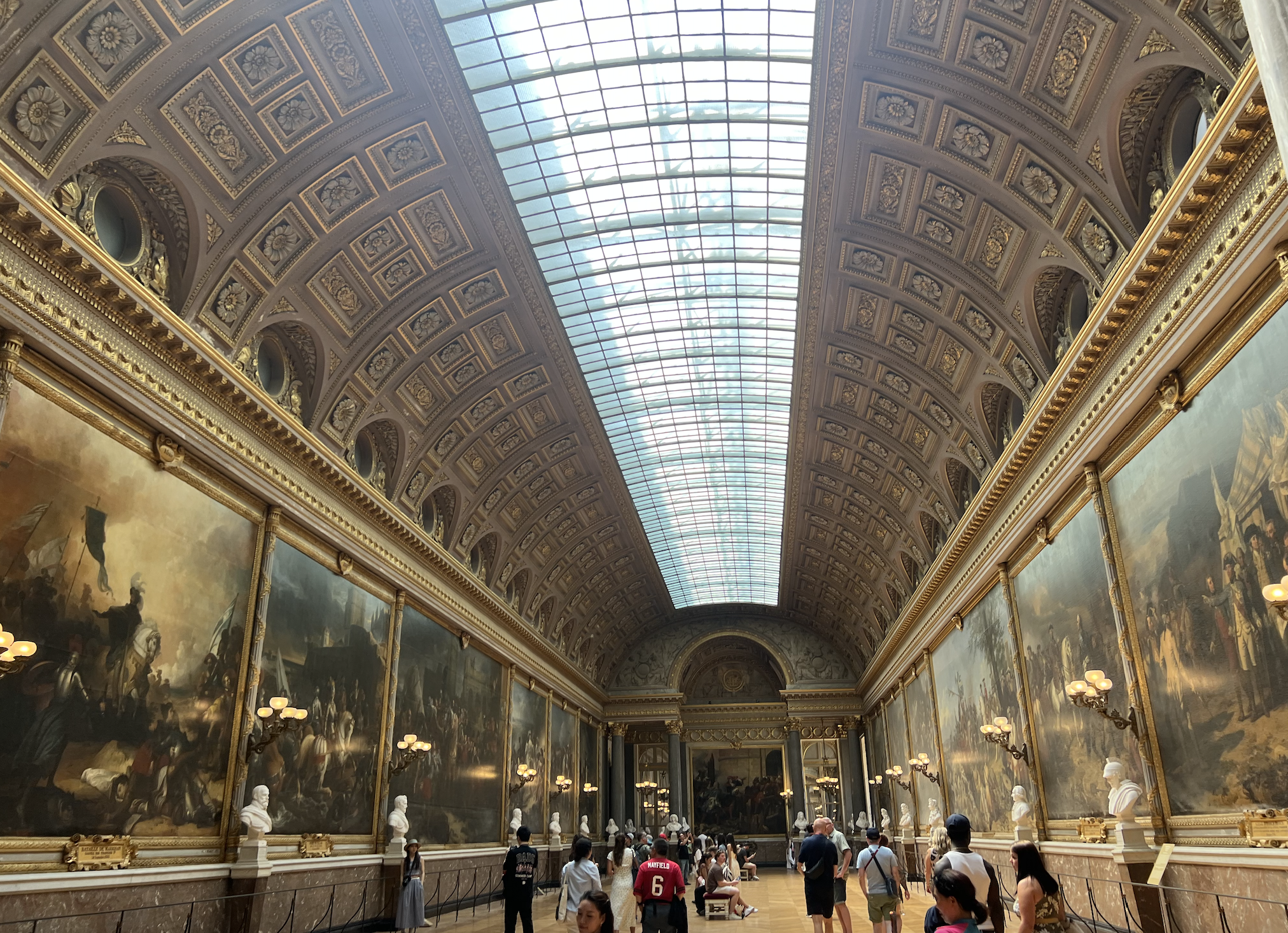
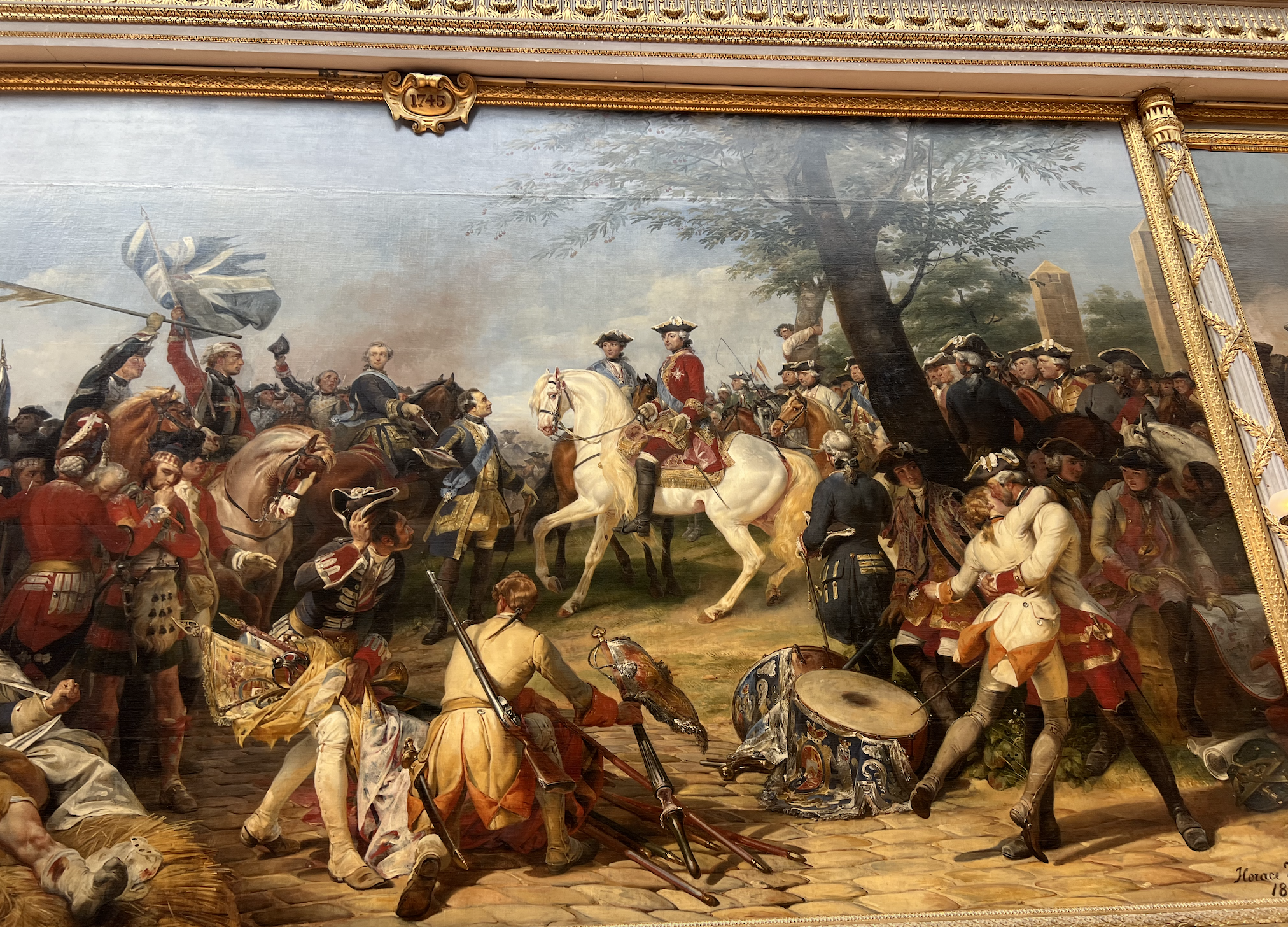
Another location within the Palace of Versailles that I would like to talk about is the Gallery of Battles. I bring this up because it was installed after the revolution, therefore it gives a sense of the status of society after these events. This is another long hall, with similar beautiful patterned walls and gold borders, but along the walls are large paintings of battles and wars throughout French history. In having this hall I believe that it shows a want of patriotism or perhaps unity and pride for France from the monarchy. This could be in response to the revolutions which seemed to uncover the gap that was breaking the country. As I mentioned, there are images of past wars which lead to the France of that time, but from what I observed there was no painting that depicted the battles or war that the people of France fought for in the Revolutions. I think this could reflect the idea that the monarchy was still unwilling to change their ideals and inequality towards the working class. So from this gallery, perhaps the intention was to unite the nobility and aristocracy only, and not the entire country. 

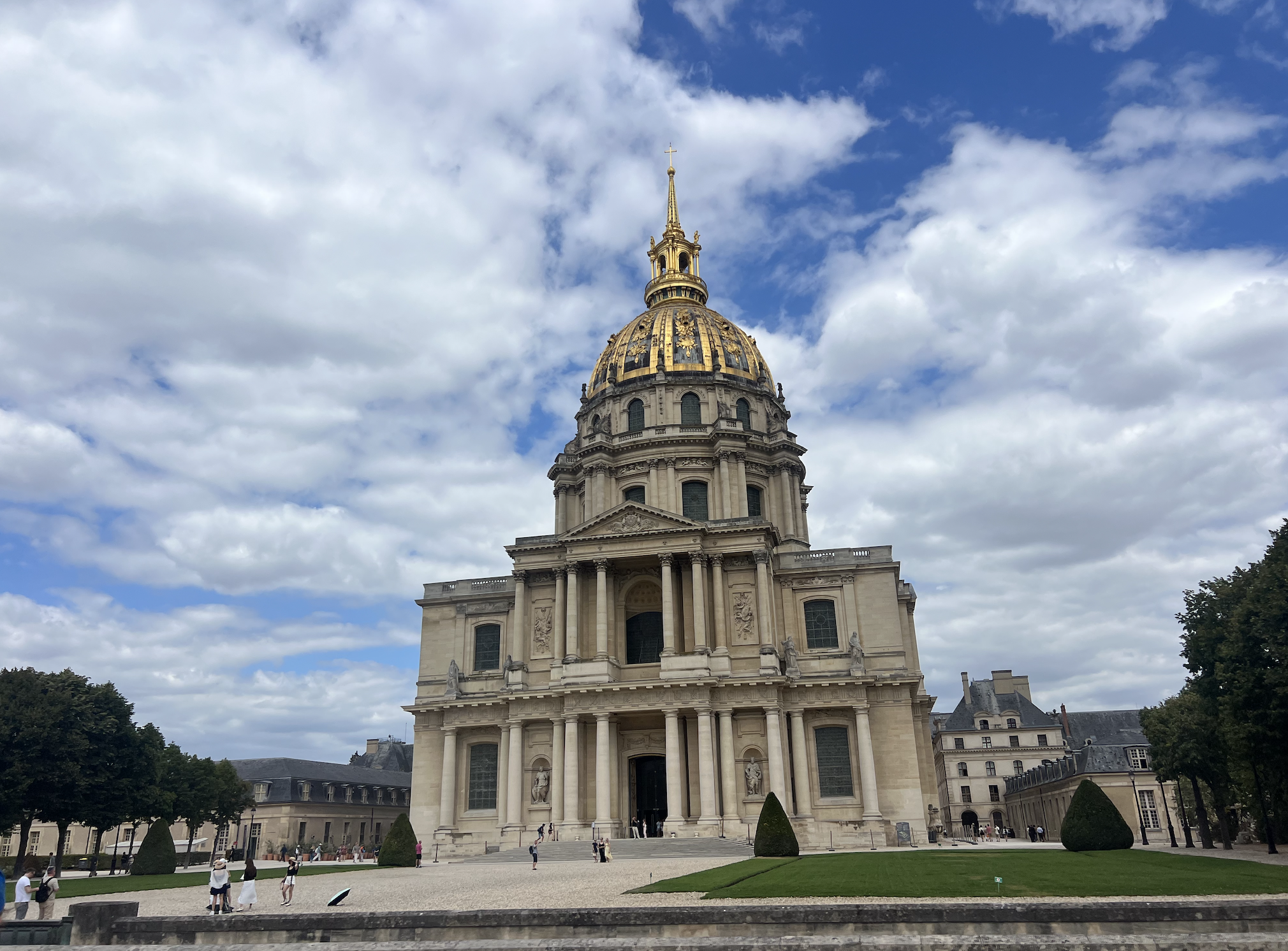
L’Église du Dôme

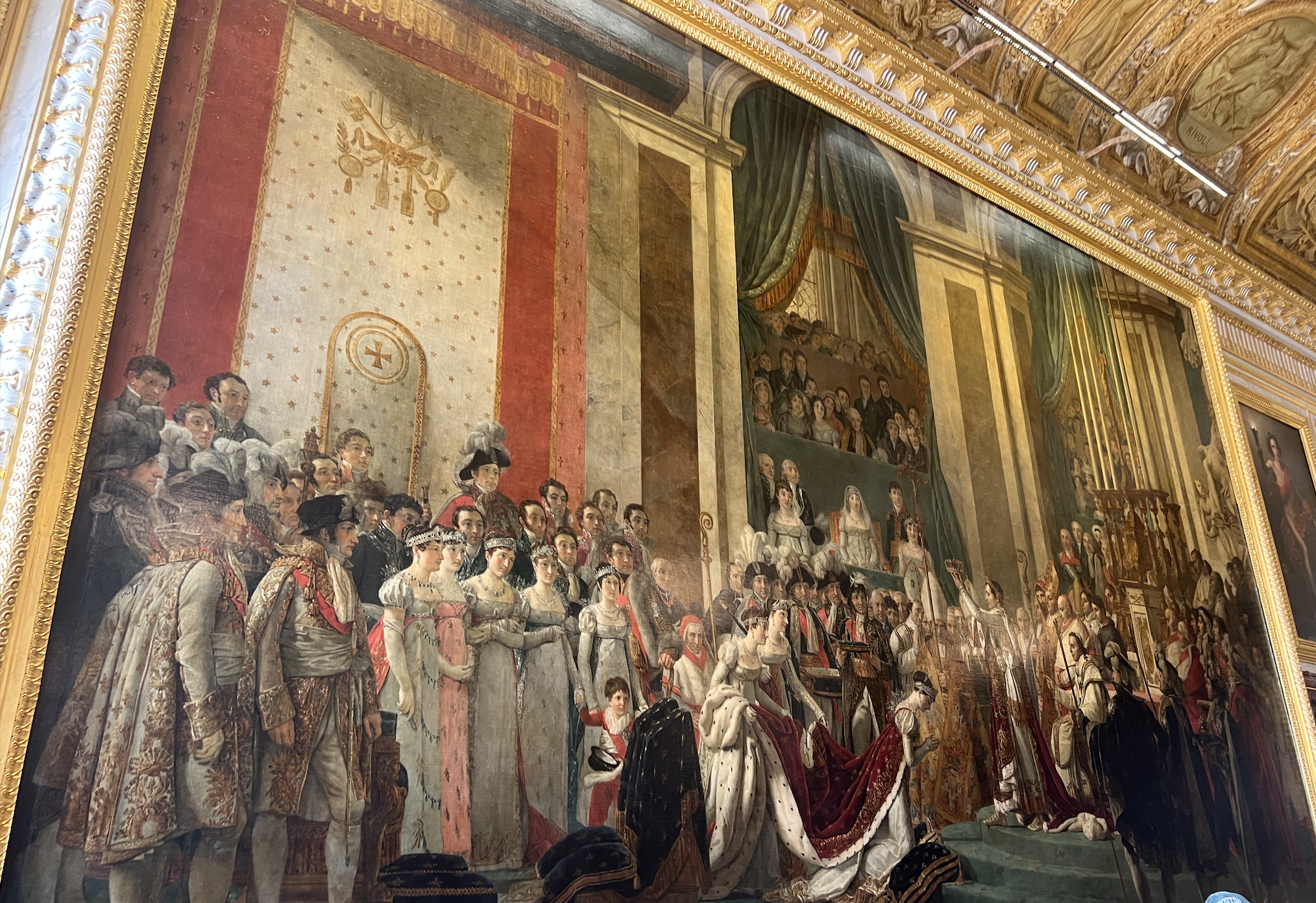
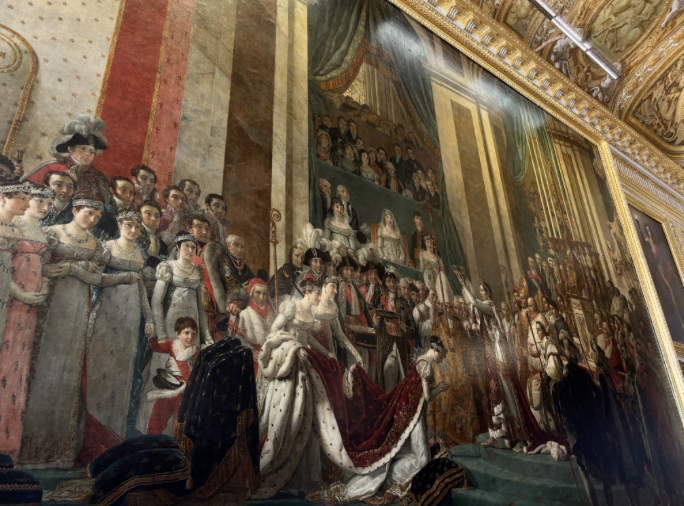
The Coronation of Napoleon in the Palace of Versailles.

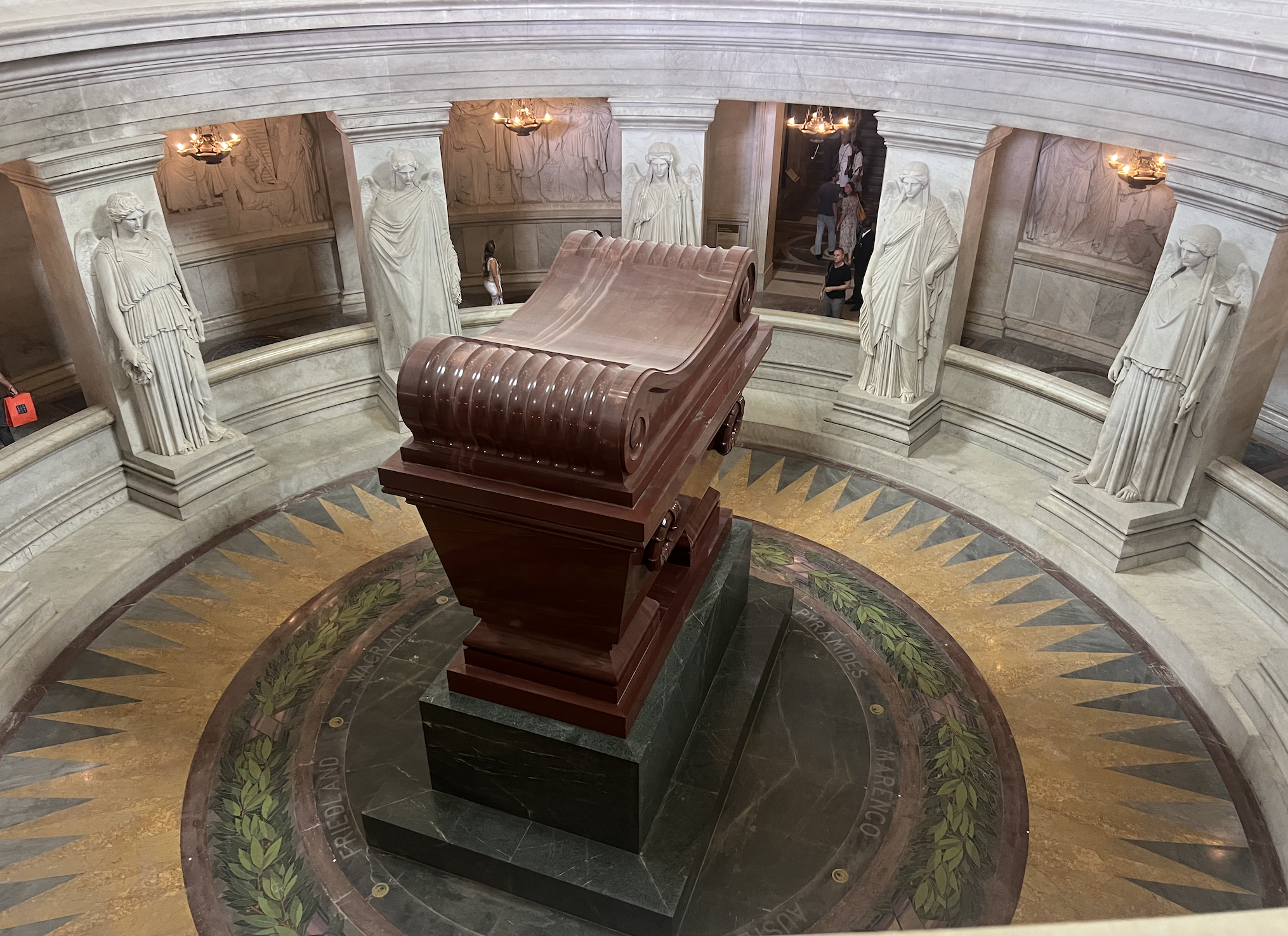
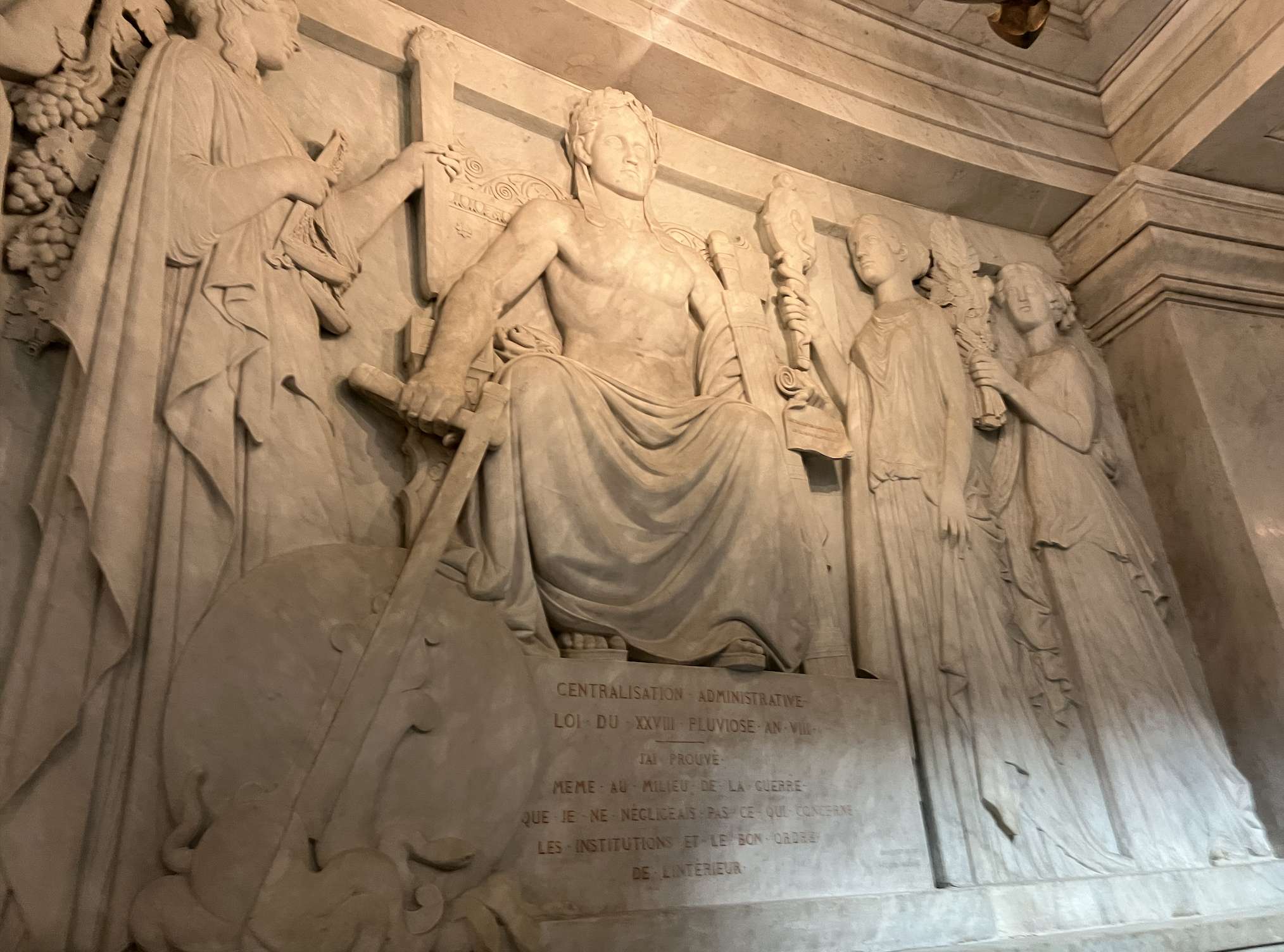
Napoleon’s Tomb in L’Église du Dôme

In Versailles and in other locations which I will soon discuss, I found one of the most interesting portrayals of French power through Napoleon. He is portrayed or portrays himself as an amazing powerful individual through intense ego. In Versailles, one painting I found which highlights his image was The Coronation of Napoleon. This painting shows Napoleon at his coronation in which he crowns himself emperor then proceeds to crown Josephine, his wife, as empress. In crowning himself he is stating that he has this absolute power and authority. I feel in doing so this shows an idea of having even greater absolute power compared to the monarchy of before. Napoleon’s background makes this interesting when thinking about what this meant for the society of France at the time. He rose from military power into emperor instead of through hereditary succession. In this way he could have been positive towards France, as a symbol of new times, or as we can see his idea of absolute power could leave France in the same position as it was before. Another location which shows how Napoleon's power was portrayed, was L’Église du Dôme, which is where he is buried. Like no exception from the buildings of Paris, it was visually beautiful. Within it, at its center, I looked down and saw the biggest tomb I have ever seen, surrounded by what I believe was a circle of angels. Walking down to see this tomb from the ground, I noticed that there are white marble carvings along the walls which in the center is Napoleon. In this marble, Napoleon is portrayed as some sort of god, or extraordinary being as he is in the center of each wearing robes and wreaths, and in some sitting on a throne, and in all the others bodies in the picture are facing him. From this, like The Confirmation of Napoleon, we can see how French political power was seen as absolute from its holders. This again separates them from seeing the struggles and lives of the working class, and continued separation for this society. 

Marble carvings of Napoleon at L’Église du Dôme

Seeing these places with the background of having read the two novels in which we were able to see the struggle, and loss of the Revolutions and of the working class people allowed me to understand even more the constant anger and inequality they were facing. It appears that in both times before and after the revolution, there is still such an obvious gap of power that is abused and misused. Today, we can still see similar traces of inequality in society and misused authority in the world, as we look out and see similar struggles and personas that mirror these times of French history. 

To the Stage

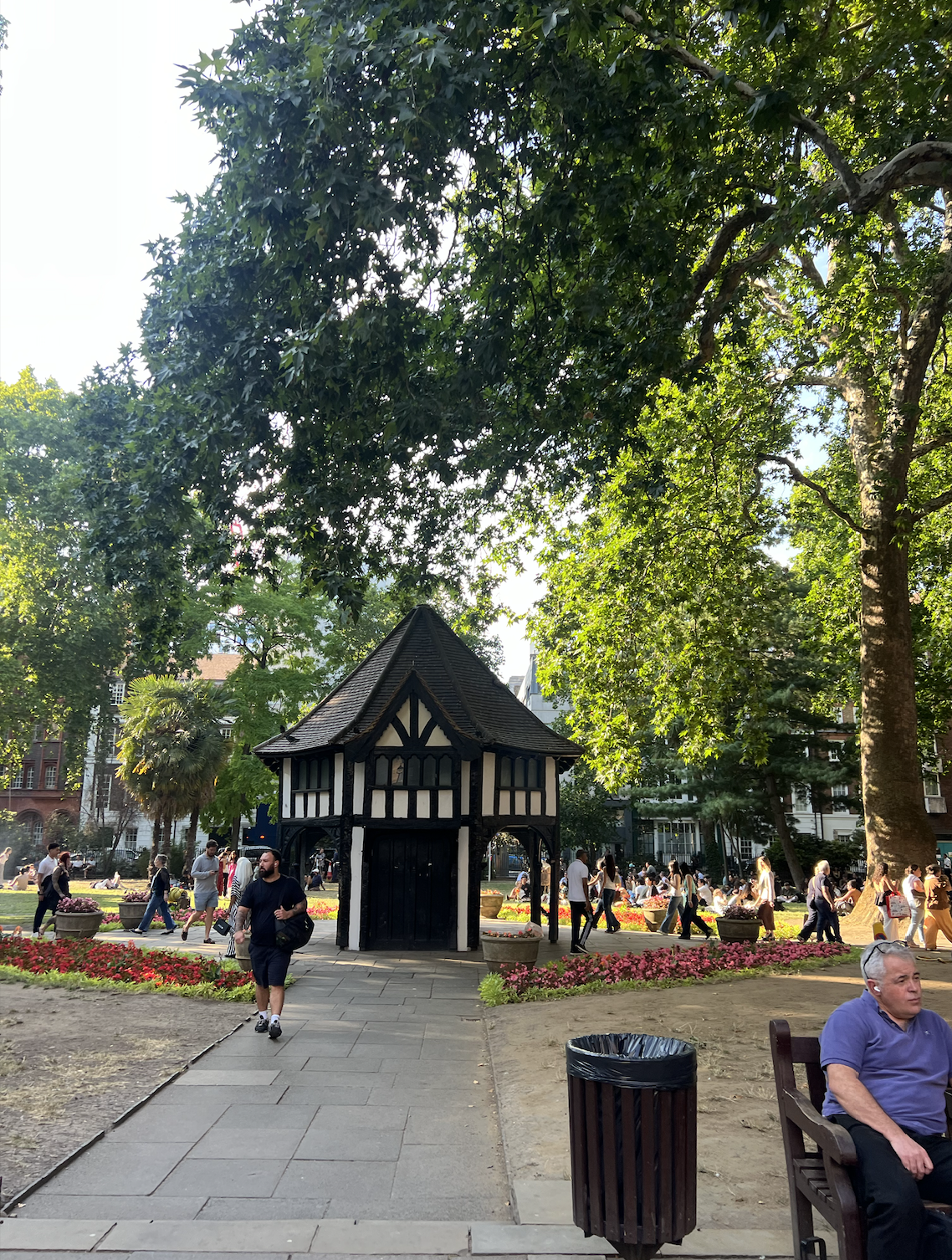
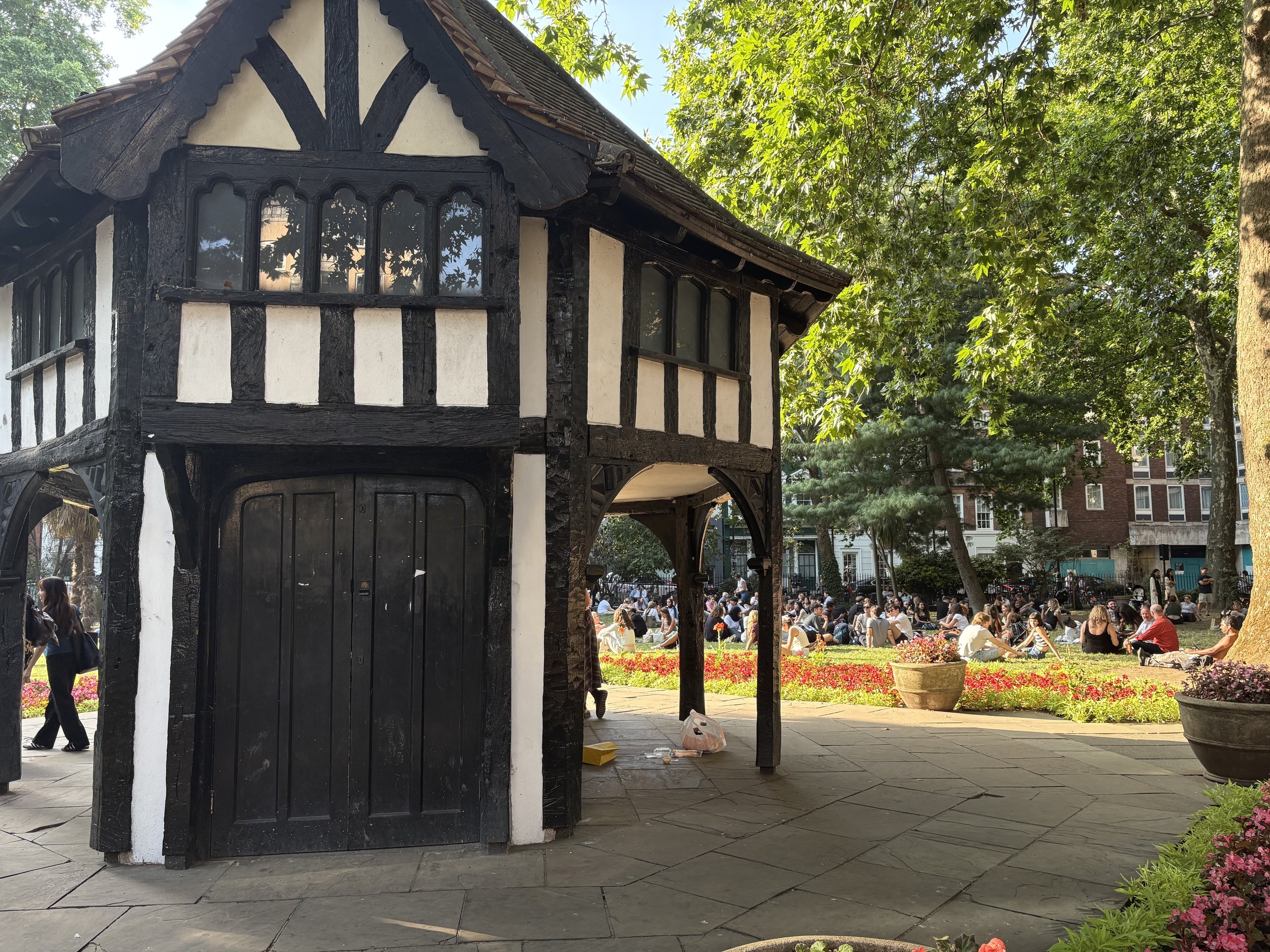
The center of Soho Square

Now beyond the halfway mark of our book packing journey, I have been so excited that I have been able to experience and see so many new things. Buildings, roads, food, and culture fill London and Paris which are new to me. One new experience in particular that I would like to highlight in this blog is that of seeing the performance of Les Misérables. I had never seen a musical before, so I was very excited for Les Misérables to be my first one!

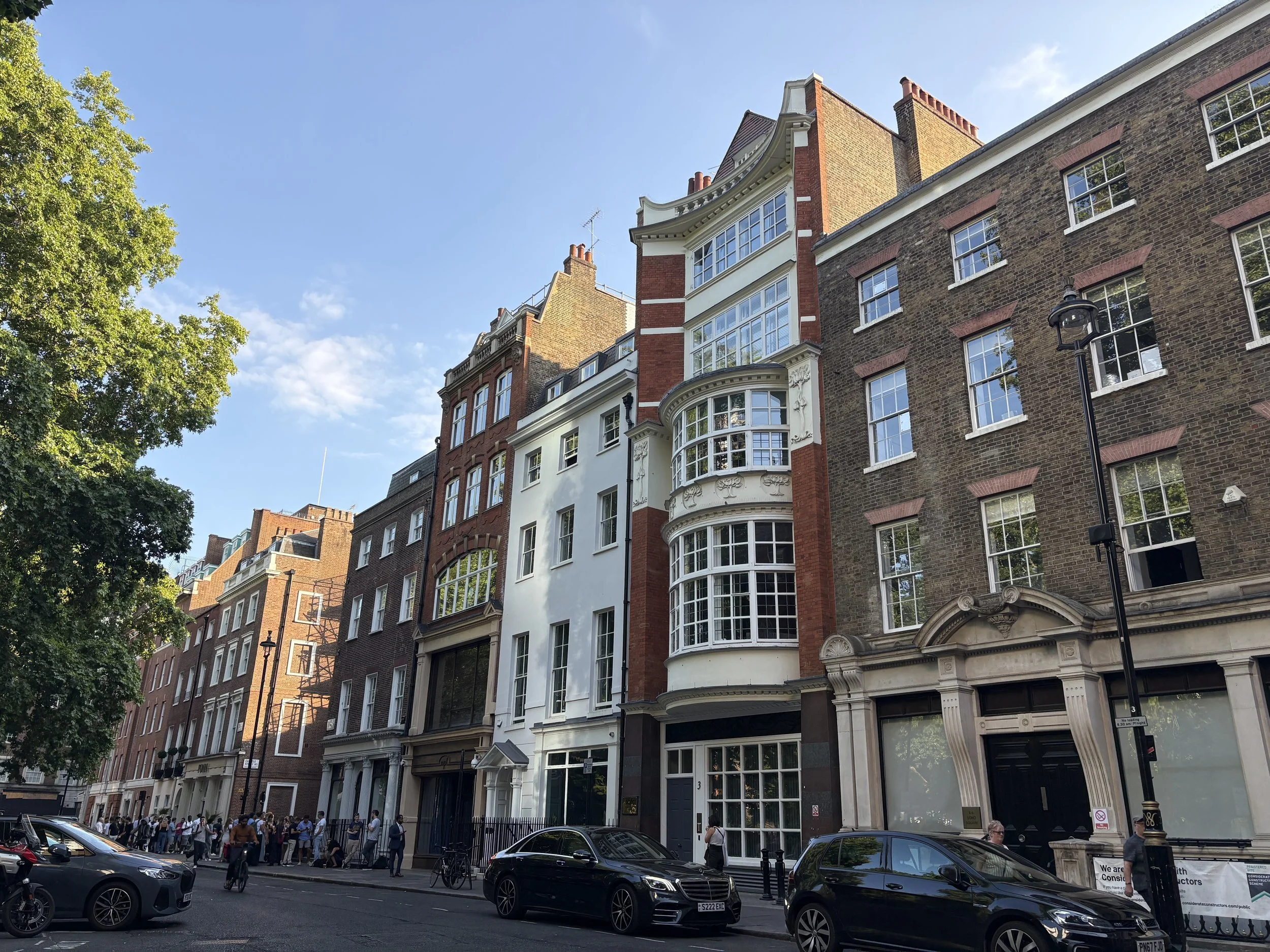
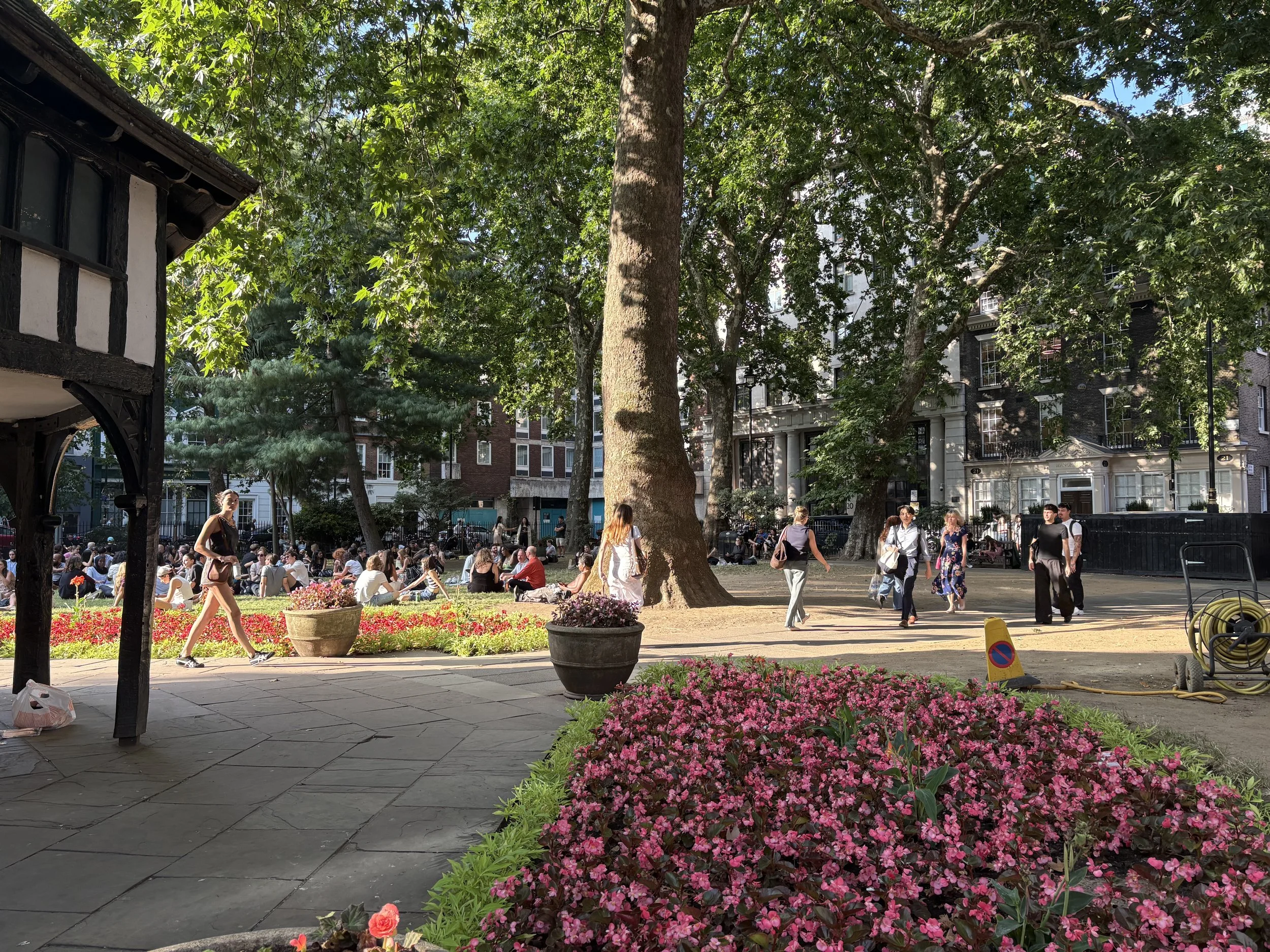
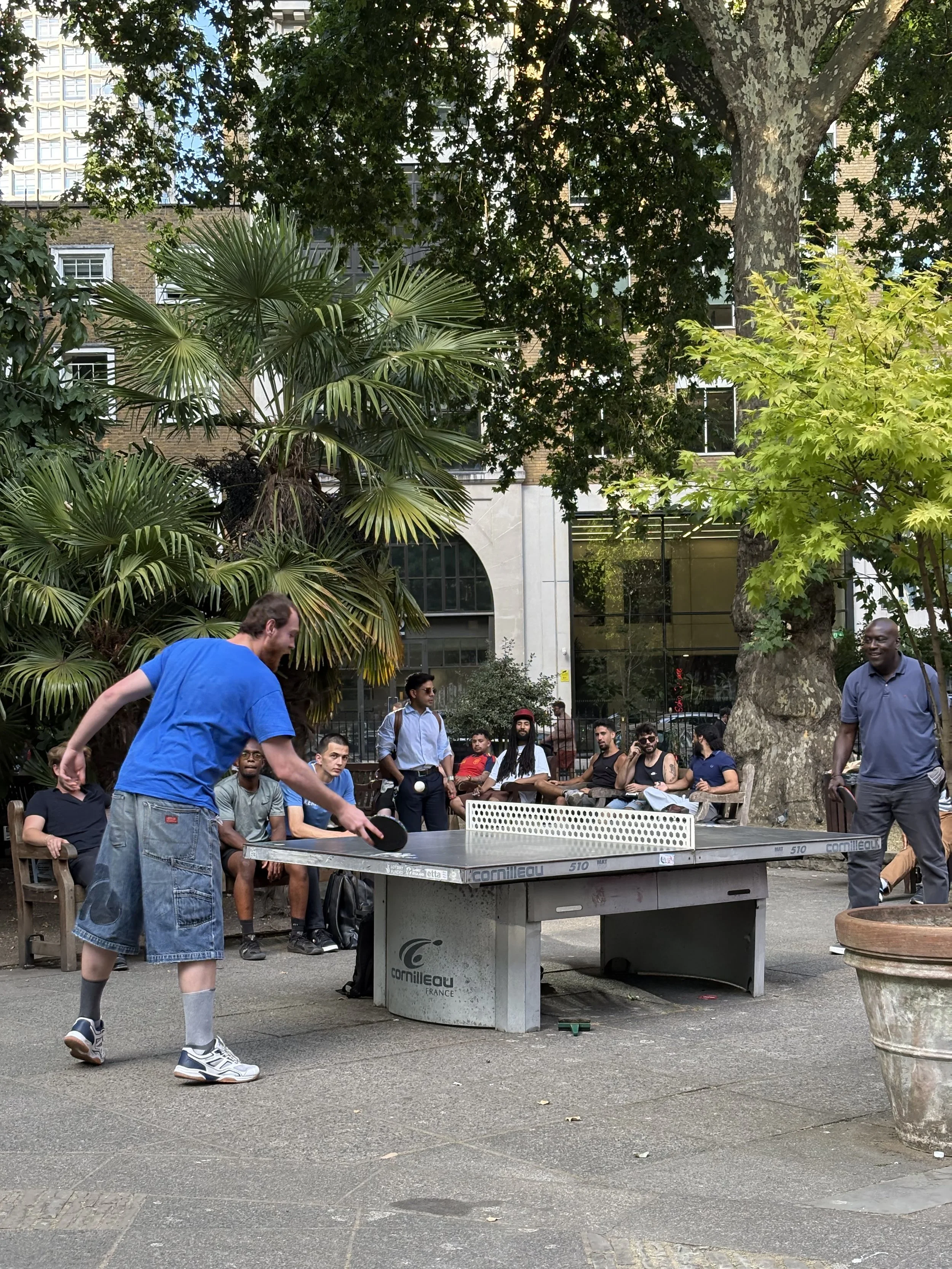
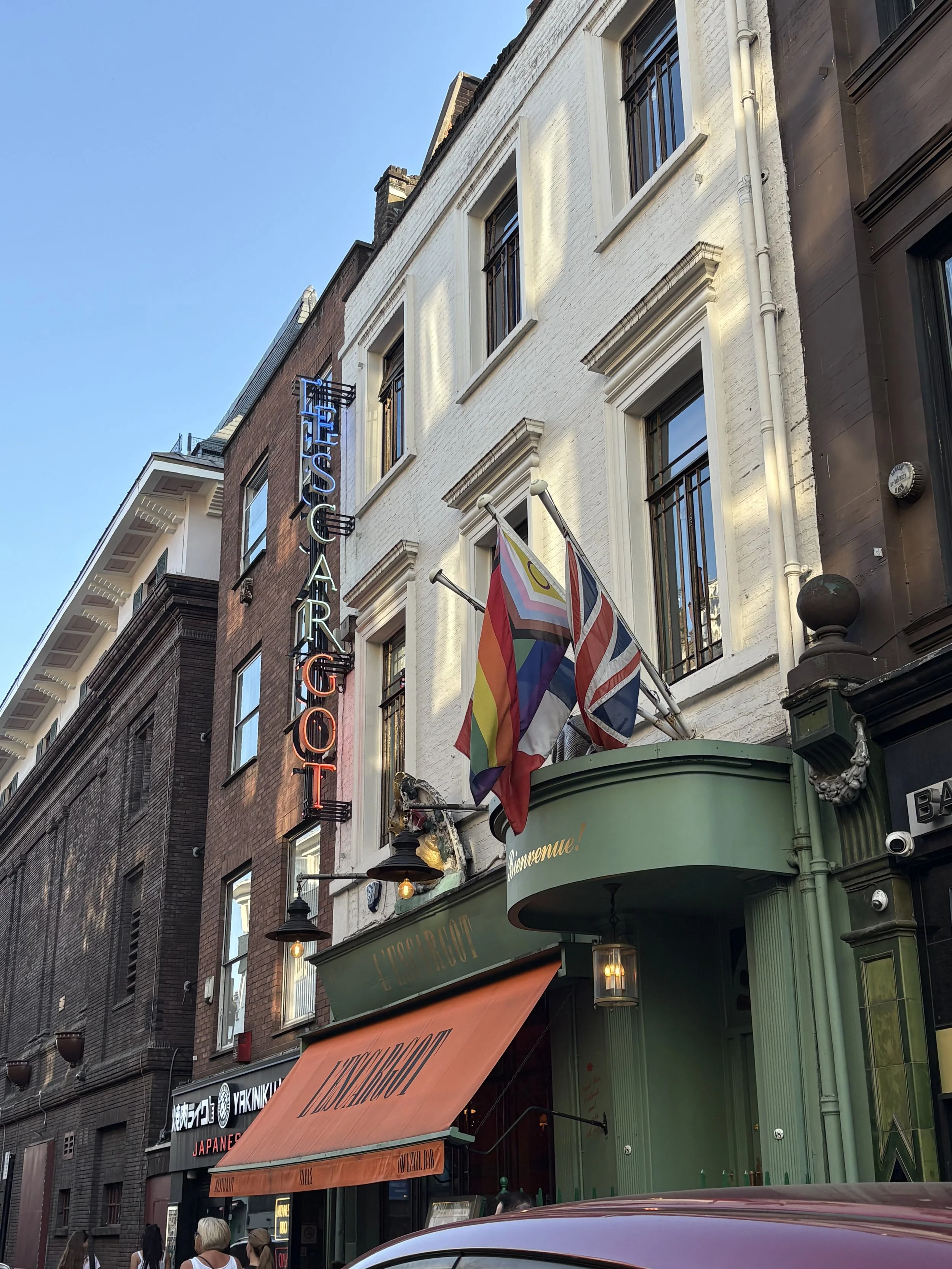
Before heading to the Sondheim Theater we met at Soho Square. This park was beautiful, surrounded by trees and its center contains a hut which itself  is surrounded by flowers and grass spaces. I feel as though what added to its beauty was how many people were there enjoying the space. Some talking, some eating, some simply taking in the scenery, and there were even a group of people playing ping pong. The surrounding area as we made our way to the theater was no different. There was such a lively energy with people filling restaurants and bars. This energy followed us to the theater as people buzzed around waiting to enter. 

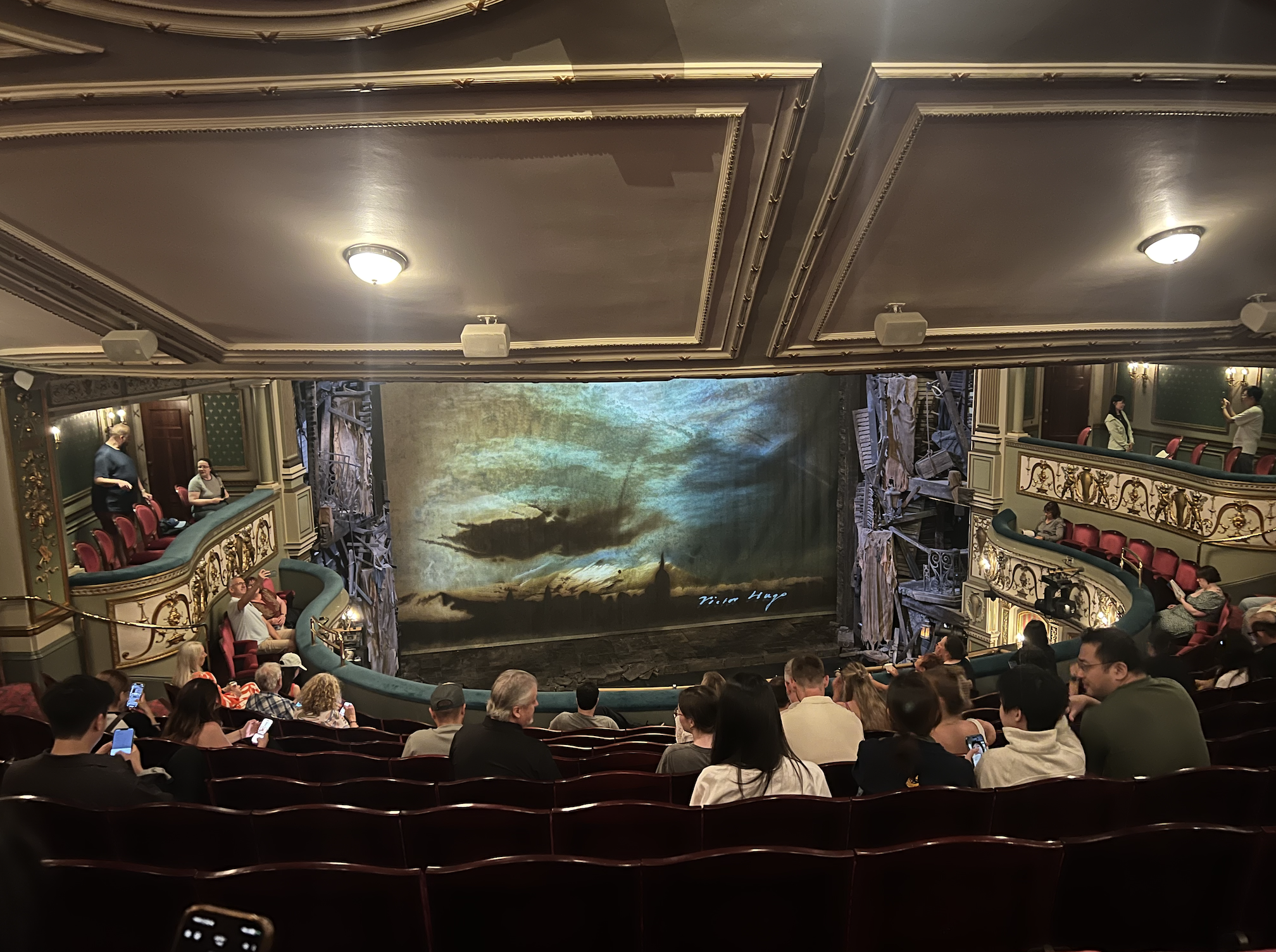
Inside the Sondheim Theater

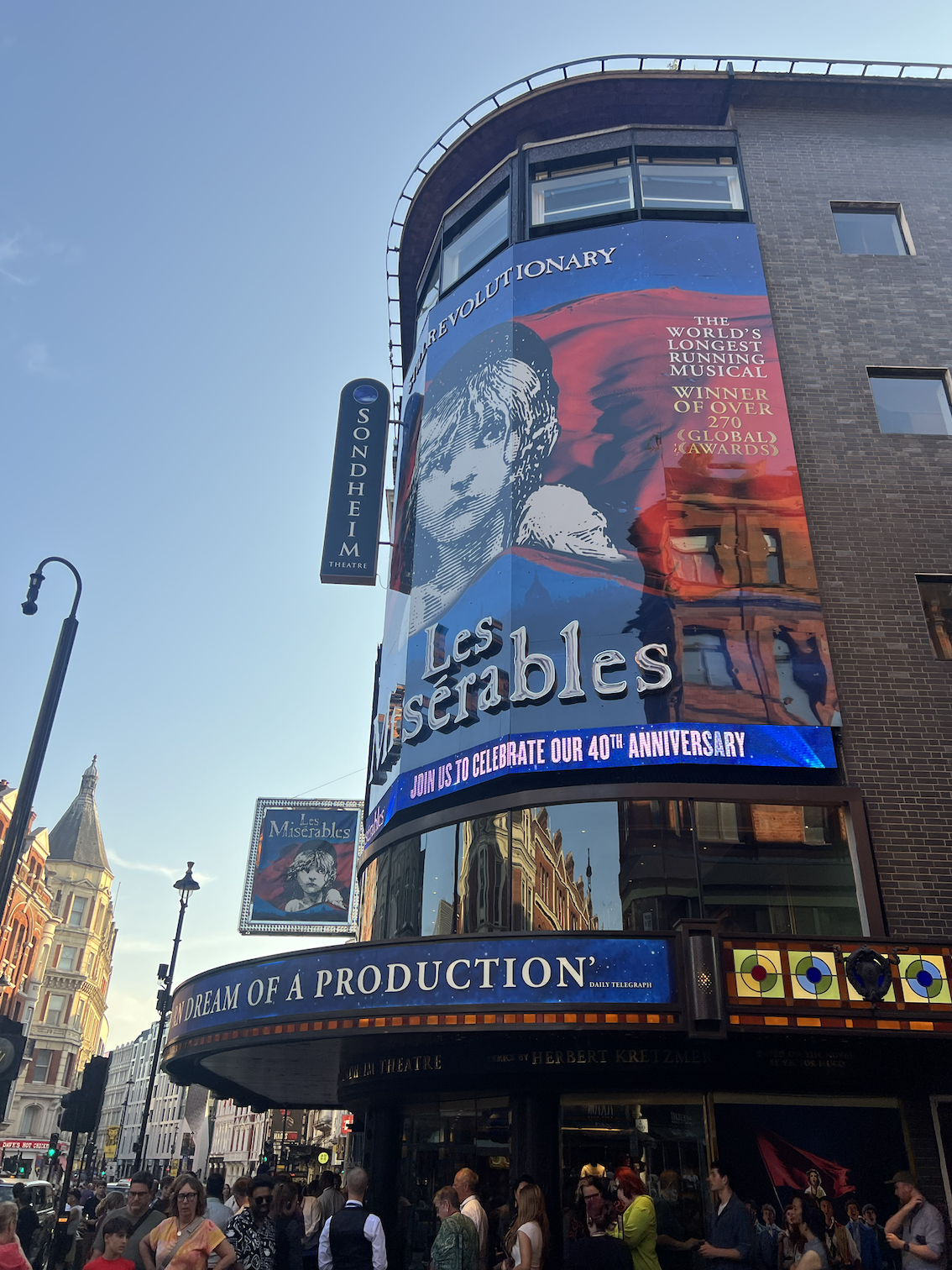
It was so amazing to look up at Sondheim Theater and see the iconic image of little Cosette holding her broom, the words “ Join us to celebrate our 40th Anniversary” on the screen below, and right next to Cosette were the titles “ World’s Longest Running Musical” and “ Winner of over 270 Global Awards” as they just emphasize the incredible success of this performance. The interior of this theater contained intricate designs along its walls and sitting at the top really allowed me to be able to take in the beauty. 

Outside the Sondheim Theater

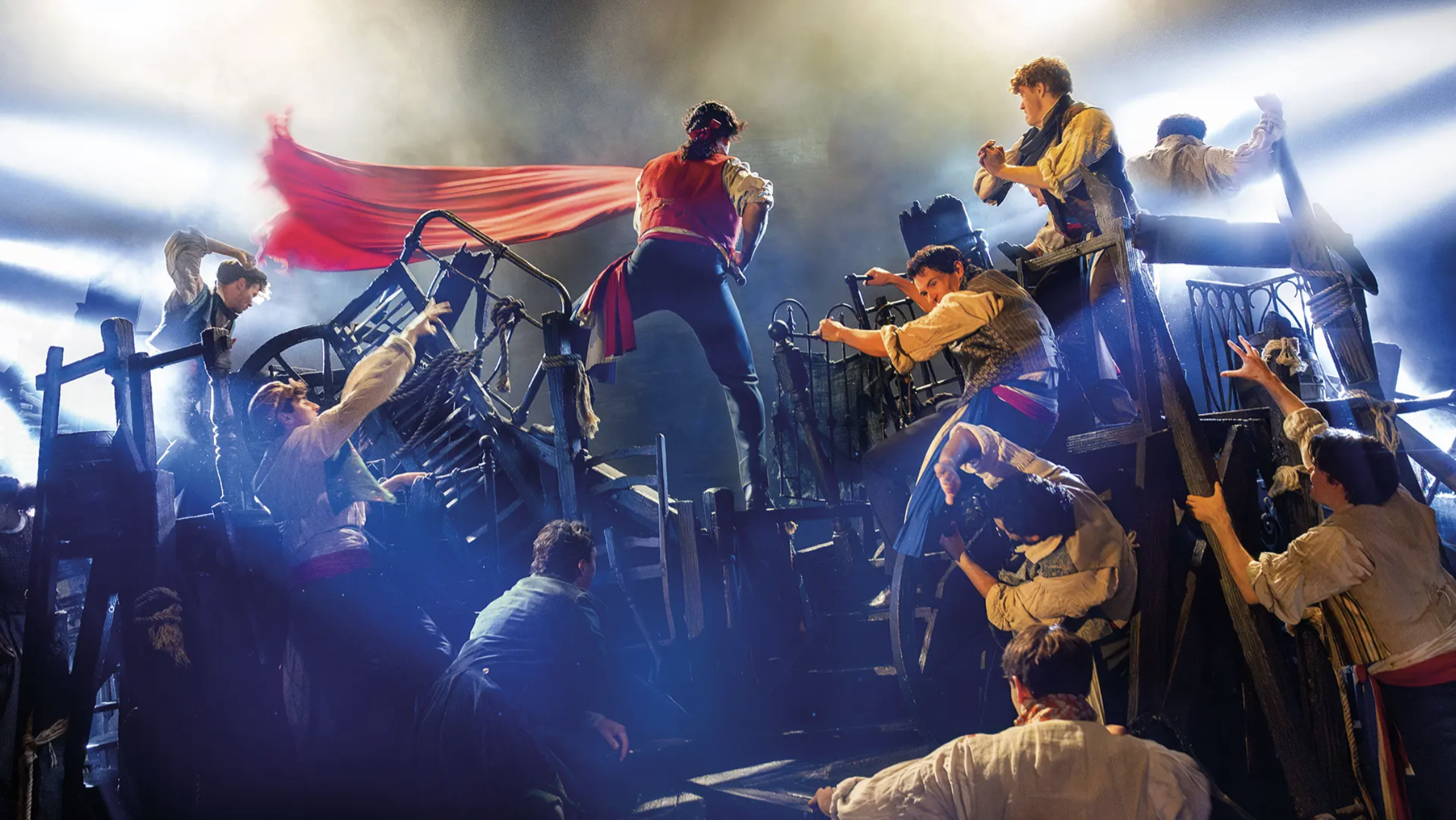
Now for the performance, I was unsure of what to expect. I mean, my thoughts going in were, how are they going to compress this massive book into a three hour show? The answer simply put, is they did, and it was amazing. The first act covers a very large section of Victor Hugo’s novel, all the way up to the development of the barricades which I thought was interesting. The second act covers the rest of the novel such as the fight and fall of the barricades and Cosette’s and Marius' wedding, the final chapters to sum up the novel. I really enjoyed both acts, however seeing the barricades acted out was so emotional and powerful. The massive barricade holding the red flag is engraved into my mind, and really puts into perspective what was happening at that time, considering that this was a play and obviously nothing compared to the real event. Of course I can’t forget the songs. I thought the songs were able to capture the emotions, dialogue, and actions of each particular scene and characters. For instance, Fantine’s “I Dreamed a Dream” was able to express how Fantine went from a life of love and happiness in her youth to a life alone and suffering. Additionally, Eponine’s song “On My Own” captured her love for Marius, which in the novel was shown through so many small and larger scenes. I thought this song was beautiful in showing that no matter how much she loved Marius, it was impossible for her to be his. I believe this song is mainly expressing Eponine’s unrequited love, but from the perspective of the novel I think this song shows how alone she was in life, as even her family thought of her as nothing, leaving her to practically live alone. My favorite song from Les Misérables was without a question “Do You Hear The People Sing?” The lyrics are so strong in making you feel the anger, sacrifice, and togetherness of society in these times and highlighting the strength it takes to stand up for a change. In the play the spirits of all the fallen characters such as Enjorlas and Gavroche walk on stage with their voices starting low and building up with each word. The words sung in togetherness gave me chills, it was so beautiful. The song was the voice of the people, those who wish for a better future, those who fight for a better tomorrow for all of society. 

Now having experienced both the novel and musical of Les Misérables there were interesting comparisons that I saw between the two. One of the biggest differences I noticed was how the Thénadier’s were portrayed, specifically Monsieur and Madame Thénadier. In the novel they are portrayed as selfish, greedy, and horrible people who not only treat Cosette badly but later in the novel also their own children. When reading the novel I was obviously not fond of their characters as I was cheering for the protagonist. However, in the musical they are shown in a different light. For example, in the scene “Master of the House” this showed the Thénadier’s in a very comedic light. Though the song still shows how they trick and steal from their customers and highlights their greed for money, it is done with a very different approach. The song was upbeat and the actors sang and danced in a comedic manner, which I thought made them much more likeable. Another difference that I noticed, which may have been just how I interpreted the novel, was the character of Eponine. As I mentioned in the musical, I feel as though she only plays the part of the girl who loves Marius. But in the novel I thought she had a much deeper and sadder story such that she went from being the shining star in her parents eyes, being pampered and treated well, to being treated poorly, living in starvation as I slightly mentioned above. However, interestingly her character stood out to me more in the musical than the novel, and I ended up liking her character much more after.

Continuing with comparisons, I want to touch on the effects of the major cuts that had to be done to compress Les Misérables into the musical. To start, I found that having read the novel before helped me to understand actions in the musical better. For instance, the scenes with the bishop were very short in the musical. The novel highlights and gives the bishop a long introduction which later in the novel I thought was crucial to understand Jean Valjean's character and the change he makes in his life. It adds an extra layer of beauty to the story. However, the musical did show the kindness of the bishop to Jean Valjean, there is just simply not enough time to deeply dive into the bishop's character. Additionally, one of my favorite scenes from the novel, when Jean Valjean reveals himself to the court to save Champmathieu from being wrongfully convicted, was very difficult to decipher and understand in the musical. Without having read the novel beforehand it is difficult to understand the intense mental battle Jean Valjean was going through which ultimately led to him accepting his past and moving forward. Lastly, in my perspective, I thought Marius' character was altered significantly. Though in the musical his actions were not completely out of character, a lot of what is discussed about him in the book is not shown. For example, his political evolution was not touched on much, thus leaving out the relationships between his grandfather, father, and family. Additionally, there was not much attention given to his complex relationship with Jean Valjean. However, his character in the musical was heart warming as his love for Cosette was highlighted, and his empathy for Eponine shown.

Les Misérables London Cast. Photography by Danny Kaan and Helen Maybank. From Sondheim Theater Les Misérables Gallery.

Being able to see the amazing story of Les Misérables in theater has been one of my favorite experiences on this trip and there is still much more to look forward to and experience!

Again, Then Again

For those of you who are not students––hello, parents––and have happened upon this blog, we had a paper due yesterday. In it, I wrote briefly about the cycles of history and its tendency to repeat itself. As a result, this word, cycles, has been swirling around in my head (pun intended).

I chose to focus on Les Misérables. The novel has a shocking volume of fantastic quotes:

To put an end to abuses is not enough, attitudes must change. The mill has gone, the wind is still there
— Victor Hugo, Les Misérables

[See the crumb at the bottom of the blog for a tangent.]

There are two main things I’ve been considering in this discussion. First is Charles Dickens’s bloody depiction of the French Revolution of 1789; the gruesome violence of the radical revolutionaries and the paved roads running with blood. We recoil from the grotesque descriptions of beheadings, but find ourselves leaning in because we, too, are entranced by the power of their passion. Madame Defarge, dripping in the blood of the aristocrats, willing to end her own husband’s life, is terrifying but magnetic in her fervor. Reading about the treatment of the starving poor by characters like the Marquis, who kills a child in his speeding carriage and tries to fix the tragedy with a coin, we begin to understand the anger.

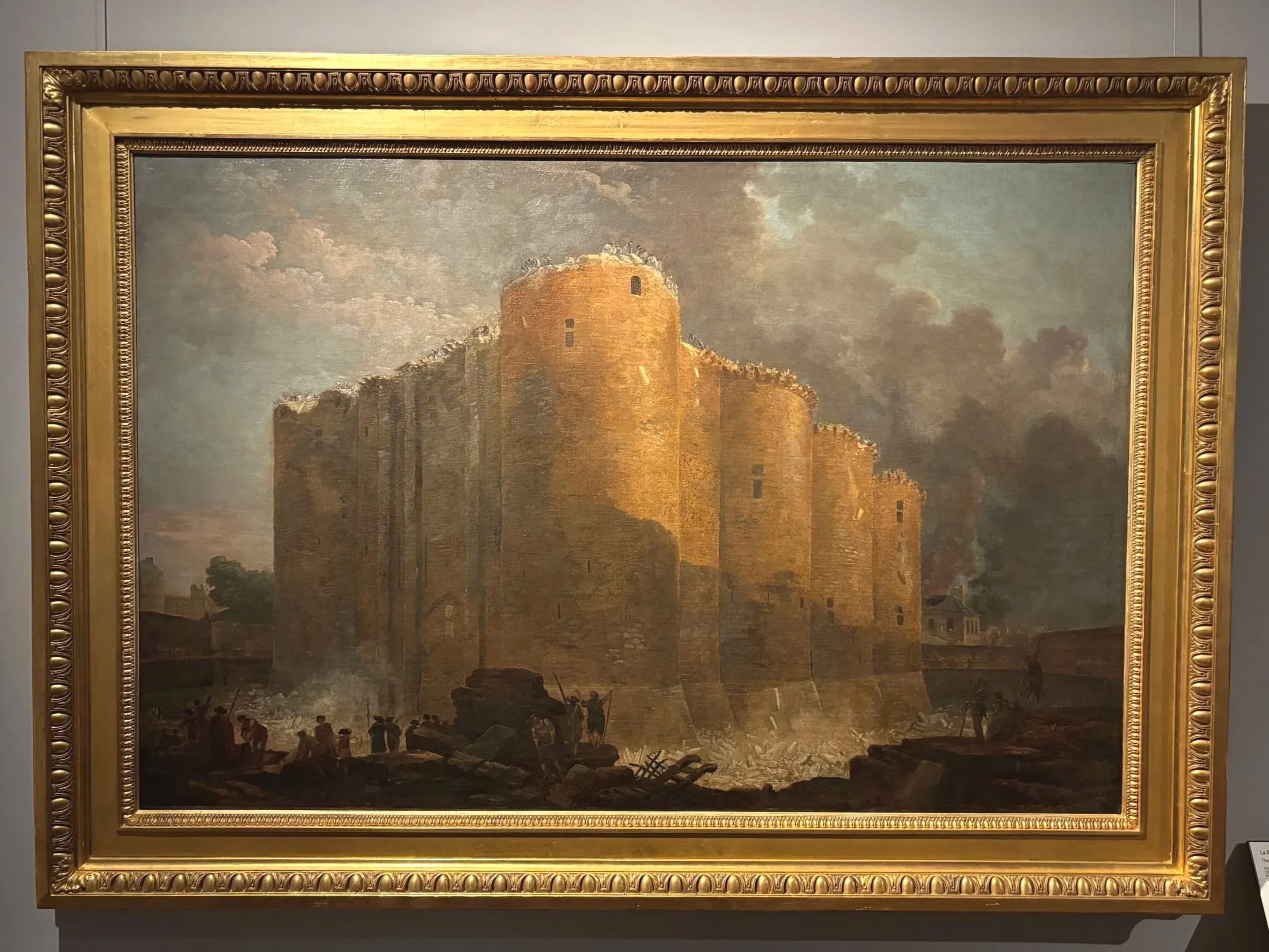
A painting of the demolition of the Bastille.

Then, there is Versailles. The harm of the Palace of Versailles is less explicit than the murder of a child or execution by guillotine. Still, it’s quite flashy. The palace itself is a behemoth that had only grown in size over the years. The opulence is absurd. From the roofs dripping in gold to the intricately painted ceilings, every inch of the palace radiates unnecessary luxury. I found the palace beautiful. I found it simultaneously ridiculous. I could not stop joking about the number of people that probably snuck in and made a home in the structure’s unchecked corners. The trek across the palace garden's infinite expanse had my Apple Watch prompting me to record my outdoor workout again and again. Walking down the endless halls, I wondered how the number of people visiting the palace that day compared to the number of residents back in the day. After some Googling, I discovered that the 30,000 or so people who visit the palace on a busy day are, in fact, more than the few thousand who had inhabited the rooms, but the hustle and bustle of the palace would still have been overwhelming. A third of the echoing footsteps. A third of the conversations. A third of the sweaty bodies pushing by in the statue-filled halls. All these people were still but a glittering fraction of the French population, most of which constituted the common third estate. That is to say, the palace was huge, and the people were tired of being trampled on by the rich.

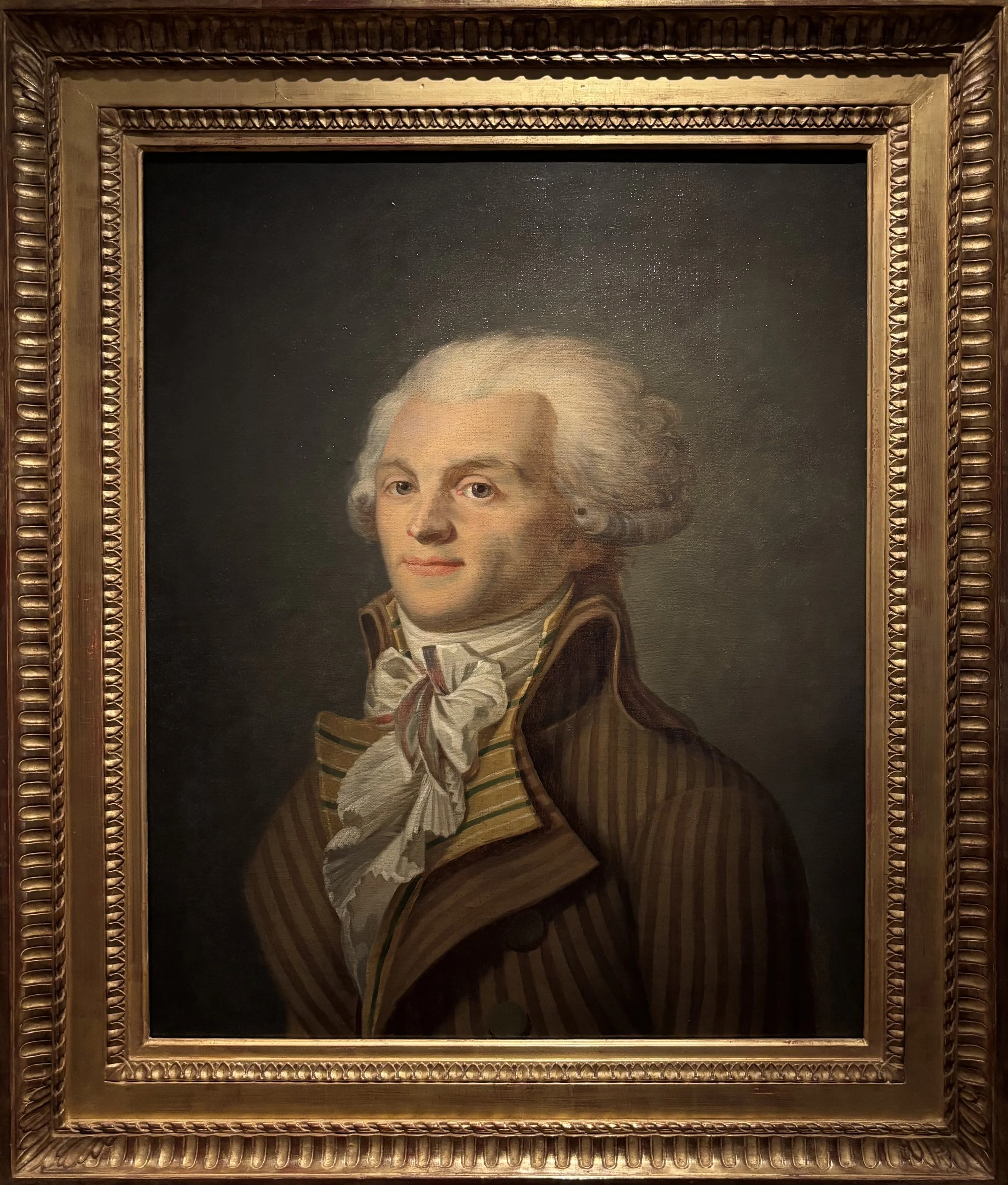
Robespierre. Buckets upon buckets of blood on this guy’s hands.

Still, reading about the gore and bloodshed, I am conflicted. When I see paintings of Marie Antoinette, I understand her role in the revolution, as a symbol of the old system. I cannot help but ask whether execution was really the path of justice. Here are the million-dollar (million-euro?) questions: When is violence justified? How much is too much?

Obviously, I do not have an objective answer to these questions. I have never been a hungry laborer in 18th-century Paris, nor have I been a suspected enemy of the revolution staring at the stone walls of La Force prison awaiting trial. Whether I would be for or against the revolution had I been alive at the time (ignoring the likely case that I would have been in China at the time––whoops) is unclear. However, looking back from my position in the present day, I can’t say I’m keen on the idea of ending someone’s life as a symbol of the previous regime. But again, the passion of the revolutionaries in the 1832 revolution of Les Misérables is truly inspiring, and I have a tender spot in my heart for each of the Café Musain students. I can imagine that people fought for love (sigh… Éponine) or for a better future, and I respect and am moved by their cause. But I find myself returning to the words of Combeferre: “Good must be innocent.”

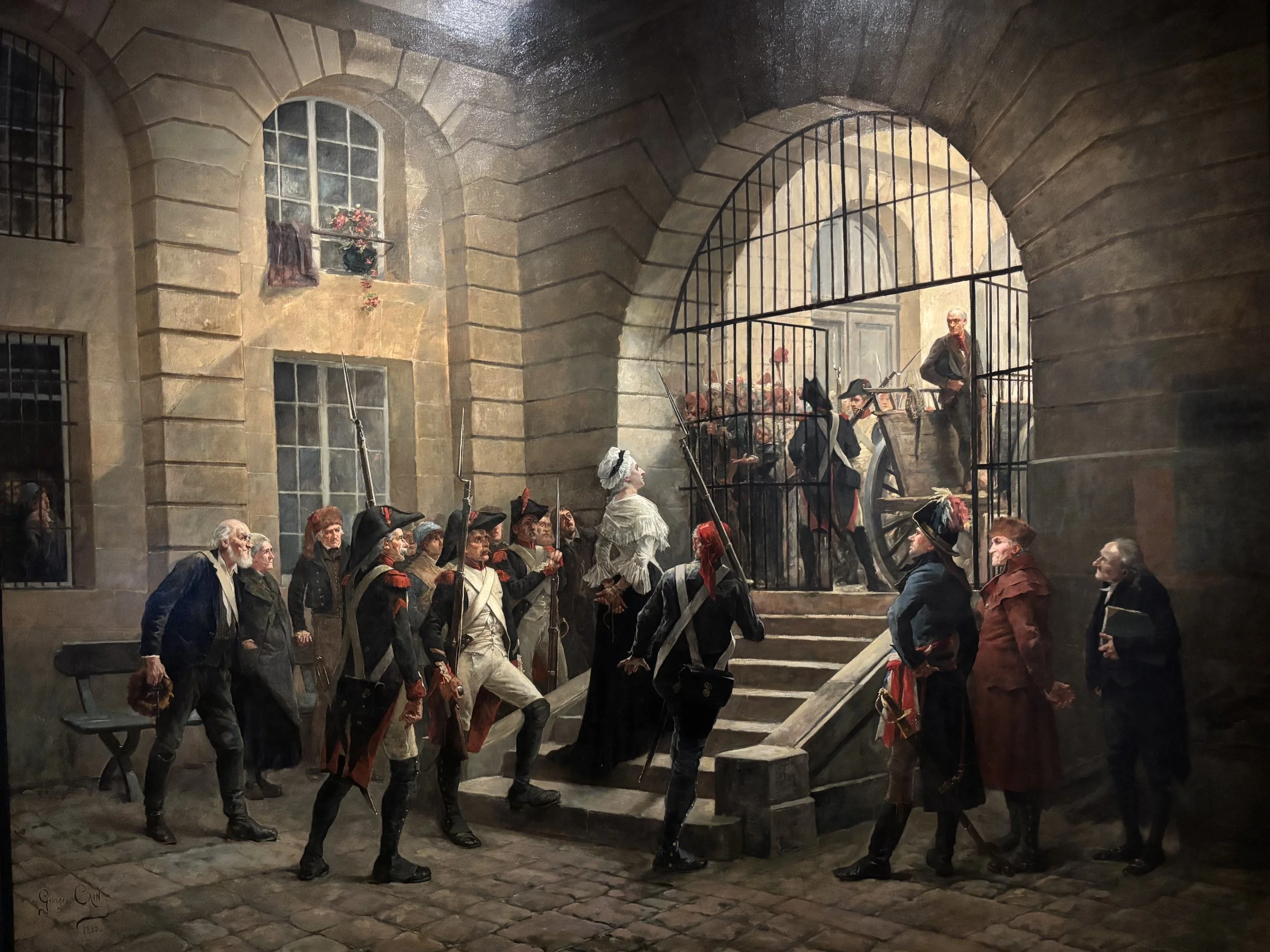
Marie Antoinette and her path to the tumbrils.

Again, it’s more complicated than that. When it comes to taking action against systems so ingrained in our societies, is a peaceful approach effective? Are we justified in responding to violence with violence? Does violence get us closer to addressing the root of the issue? Do we consider it retaliation or self-defense? What else can we expect? Sometimes, it’s not enough to be innocent, and good can exist in violence. Innocence alone could not have broken down the walls of the Bastille, or shielded the common people against the whims of the elite. Where there is oppression, there will be resistance. This is the case time and time again. And it is always more complicated than a choice between violence and peace (Violence for whom? Peace for whom?).

Crush humanity out of shape once more, under similar hammers, and it will twist itself into the same tortured forms. Sow the same seed of rapacious licence and oppression over again, and it will surely yield the same fruit according to its kind.
— Charles Dickens, Tale of Two Cities
 

poetry alert

!!

poetry alert !!


MOUNTING

one rock removed

another tumbles down

relentless avalanche rumbles

tumbrils in the town


The crumb as promised:

Thinking about cycles and revolutions reminded me of the Palestine protests in London. When I was visiting London from Cambridge last year, similar demonstrations were taking place. I observed the passionate masses marching down the streets, standing with the people suffering from the ongoing conflict as well as the historic oppression of Palestinians with the creation of Israel. I could not help but think of the demonstrations on the USC campus my sophomore year.  Free speech zones. Students detained by the LAPD. Students shot with rubber bullets. Not to say that London is some sort of protester’s haven, but, in the moment (I am unsure what happened after, as my parents and I left Trafalgar Square), watching uniformed officers stand aside and let the protesters do their thing, I felt deeply moved.

In relation to the French Revolution, the question here is similar to that of the National Guard's role during civil unrest. Are these forces that claim to protect the people really doing that? When people rise in protest, are the tear gas and muskets really there to keep them safe? Who, or what, are these forces protecting? All of these questions continue and will continue to resurface.


Progress–7.29. Onto the flip side!

Stubborn Fathers

Fatherhood is an interesting concept. We don't think about it as much in comparison to motherhood. Our society places a strong emphasis on motherhood. Mothers are meant to be nurturing, protective, and sources of support. We refer to our ancestral nations as our “motherland”. We refer to our planet as “Mother Earth”. Mother’s Day was declared a national holiday in 1914, while Father’s Day wasn’t declared a national holiday until 58 years later in 1972. Mothers are rightfully seen as the ultimate protectors of our well-being and providers of a sense of warmth, love, and security that we often yearn for. 

But what does fatherhood represent? Traditionally, fathers are the breadwinners of the family who are out at work. They are the ones bringing in the most resources for the family in order to provide stability for their loved ones. Men in general are seen as more self-sufficient and in less need of praise, love, or emotional reinforcement. Yet that does not mean that fathers are any less loving than mothers. Fathers generally still deeply love, care, and spend time with their children just as much as mothers do. They express these feelings in different ways though, probably because of societal standards and the idea of what it means to be a father. Mothers traditionally represent the love and acceptance of vulnerability that one needs to feel fully supported. Mothers are by your side in times of distress and provide you with a sense of warmth that makes home feel like home. Fathers, on the other hand, traditionally set up the structure and building blocks of the family. They are the ones you play with when they come home from work, and the ones who you view as your hero when you’re young. They are meant to be strong, inspiring, and resilient.

Victor Hugo touches on this concept of fatherhood in Les Miserables through the characters of Georges Pontmercy and Monsieur Gillernormand, Marius’ father and grandfather, respectively. In the novel, fatherhood is initially depicted in a very traditional sense until the characters’ vulnerability, emotions, and love are exposed.

Firstly, when we are first introduced to Georges, he is depicted as a man who had abandoned his son and did not want to undertake the responsibilities of fatherhood. Marius subscribed to this negative impression of his father until he was told at church that his father had been secretly coming to mass regularly to see how Marius was doing. 

“The father kept behind this pillar so he wouldn’t be seen. He would gaze at his child and weep. He adored that child, poor man!”


Victor Hugo shows a sense of paternal vulnerability. When I went into the church where Marius and his grandfather would attend mass, I could picture a father hiding behind a pillar and staring at his child in a paternal way in such a spiritual setting, trying to cherish the joyous period of youth that his son is experiencing and hoping that his son his living his best life, even without his father. It is the location best suited for this sense of vulnerability, as it is a public space where one builds their personal relationship with God.  It’s traditionally paternalistic in a sense that Georges is resilient against his own desires to fully be with his son and instead watches Marius from afar, rather than trying to reclaim him. He only hopes that his son is living happily.

At the same time, Hugo shows a different side of fatherhood, one that is deeply emotional. Georges lets go of his son, but also lets out deep emotions when he weeps about Marius, imagining a life where he could be a proper father figure. While fathers are typically portrayed as figures who provide structure for their loved ones without being driven too much by emotion, they still can share a sense of love and vulnerability that mothers also provide. Hugo perfectly illustrates this through Georges’ character and does a great job of showing the nuances behind fatherhood.

Monsieur Gillernormand is also a father figure that is portrayed in Les Miserables. Hugo depicts a relatable gruffness and harshness through this portrayal. These quotes show how traditional paternal characteristics eventually peel off overtime, and how masculinity can shield our true emotions about loved ones.


“[Monsieur Gillenormand] felt like opening his arms to [Marius], calling his name, rushing towards him; his heart melted in rapture, affectionate words swelled his breast to bursting. Finally all his tenderness came to the surface and reached his lips and, by virtue of a contrariness that was the very essence of his nature, what came out was harshness. He said abruptly, “What are you doing here?”


“Monsieur Gillenormand wrung his hands with a dreadful burst of laughter. ‘He’s dead! He’s dead! He’s dead! He’s got himself killed on the barricades! Out of hatred for me! It was to defy me that he did it!”


 Gillenormand is a classic stubborn father figure most of us know in our lives, whether it be a grandfather, father, or uncle. He is one that does not prefer to show emotion due to a societal norm of fathers being strong and unwavering. I see this fatherly nature through my own father, who I have frequent political conversations with. While understanding and emotional to a certain extent, he still holds a sense of paternal stubbornness. Gillenormand views him showing his love to Marius after years of not seeing each other as a form of surrendering his own beliefs, which was a primary cause of Marius leaving his home. Slowly, Gillenormand can’t help it anymore and his bottled up emotions burst out.

Hugo shows us how love and emotion is a natural part of being human, despite societal factors that determine our actions and expressions. While mothers are often the ones you confide in and someone you go to when you need a shoulder to lean on, and fathers are the ones you talk politics or go play ball with, they both are figures that love and care deeply, and Hugo shows that maybe motherhood and fatherhood aren’t so different after all. 


Un mémoire-mélangé

There is a concept in French literary philosophy called lieux de mémoire. It comes from French historian Pierre Nora’s Les Lieux de Mémoire. Nora draws comparison between actual history and remembered history—placing the textbook under memory’s trial. Nora defines this concept:

“Our interest in lieux de mémoire where memory crystallizes and secretes itself has occurred at a particular historical moment, a turning point where consciousness of a break with the past is bound up with the sense that memory has been torn—but torn in such a way as to pose the problem of the embodiment of memory in certain sites where a sense of historical continuity persists. There are lieux de mémoire, sites of memory, because there are no longer milieux de mémoire, real environments of memory.”

Essentially, Nora believes that lieux de mémoire—sites of memory—are places that our society chooses to hold and embody select pieces of our past. These places can be streets, monuments, houses, and so on. But it can also include textbooks and written history—the important thing is, the memory is physical. These lieux de mémoire are a sort of collective, public memory, while his milieux de mémoire would have been oral tradition, localized community memories, et cetera.

This all seemed relevant to me as we bookpack as we are literally visiting physical sites of memory—streets where our book characters walked as well as boulevards where Frenchmen of old fought for the revolution.

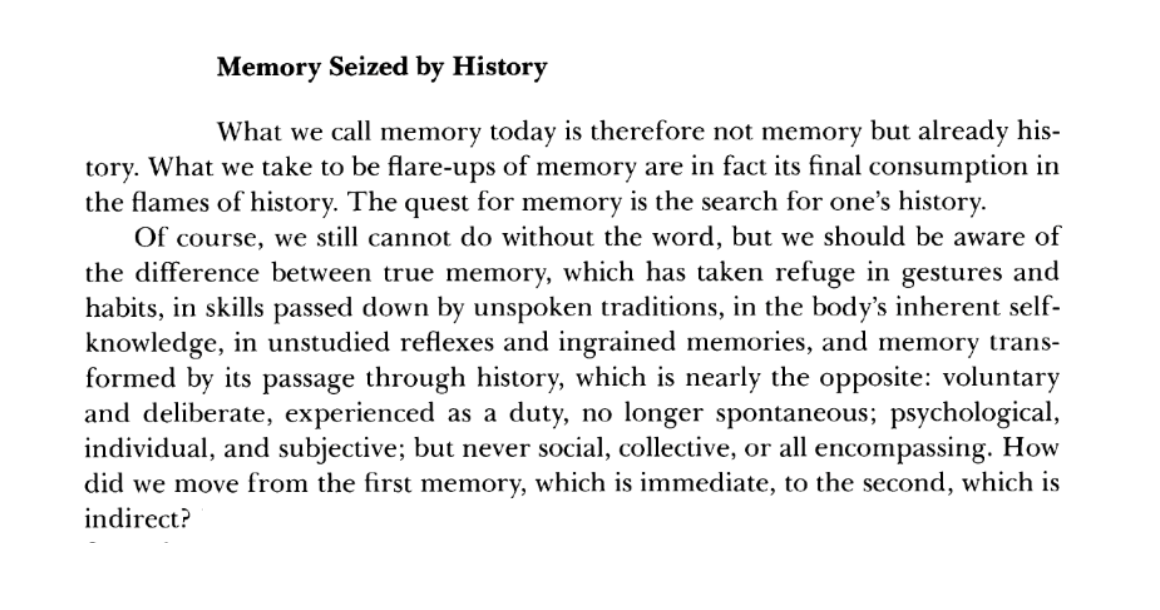
But a piece of Nora’s puzzle that particularly stood out to me in the context of our class was his ideas on “memory, seized by history.” See below:

Nora, Pierre. “Between Memory and History: Les Lieux de Mémoire.”

Here, Nora is expanding upon his introduction to the idea that living memory is a figment of the past.

And this consideration applies to the discrepancy in our understanding of Louis Philippe. In Les Misérables, Victor Hugo writes:

“Louis Philippe had been handsome, and in his old age he remained graceful; not always approved by the nation, he always was so by the masses; he pleased. He had that gift of charming. He lacked majesty; he wore no crown, although a king, and no white hair, although an old man; his manners belonged to the old regime and his habits to the new; a mixture of the noble and the bourgeois which suited 1830; Louis Philippe was transition reigning; he had preserved the ancient pronunciation and the ancient orthography which he placed at the service of opinions modern; he loved Poland and Hungary, but he wrote les Polonois, and he pronounced les Hongrais. He wore the uniform of the national guard, like Charles X., and the ribbon of the Legion of Honor, like Napoleon.”

However, in our secondary reading of “The Insurgents” in The Other Paris by Luc Sante, we see a different picture painted:

“In 1830 the revolution was declared over once the flag had been changed and the Orléanist king installed, and the republicans were invited to go lick their wounds. That king, Louis-Philippe, proved unpopular almost at once—he trampled on freedom of the press, for example, and soon swapped his ministers, most of them active in the events of 1830, for a more conservative set.”

So now we have the perspectives of both a fictional novelist who actually lived during Philippe’s reign, as well as a modern-day historian whose job it is to find facts. Their perspectives are entirely opposite. Yet in class, both Prof Andrew and I were inclined to believe the former—the fictional writer. Why?

Perhaps Nora’s argument supports our choice in belief. Nora states that true memory no longer exists—that our traditional form of remembering is long gone, aligning more so with Socrates’ and Plato’s beliefs on the creation of recorded history leading to a “semblance of truth.” Sante’s version would, to Nora, be “memory transformed by its passage through history.” A memory that can make mistakes.

But this can all get very messy and confusing. So in terms of our reading and bookpacking, I am inclined to reconsider these lieux de mémoire on a much smaller scale. Places like Versailles and Rue Saint-Antoine are primary examples of a blending of memories in the same space—peut-être un mémoire-mélangé.

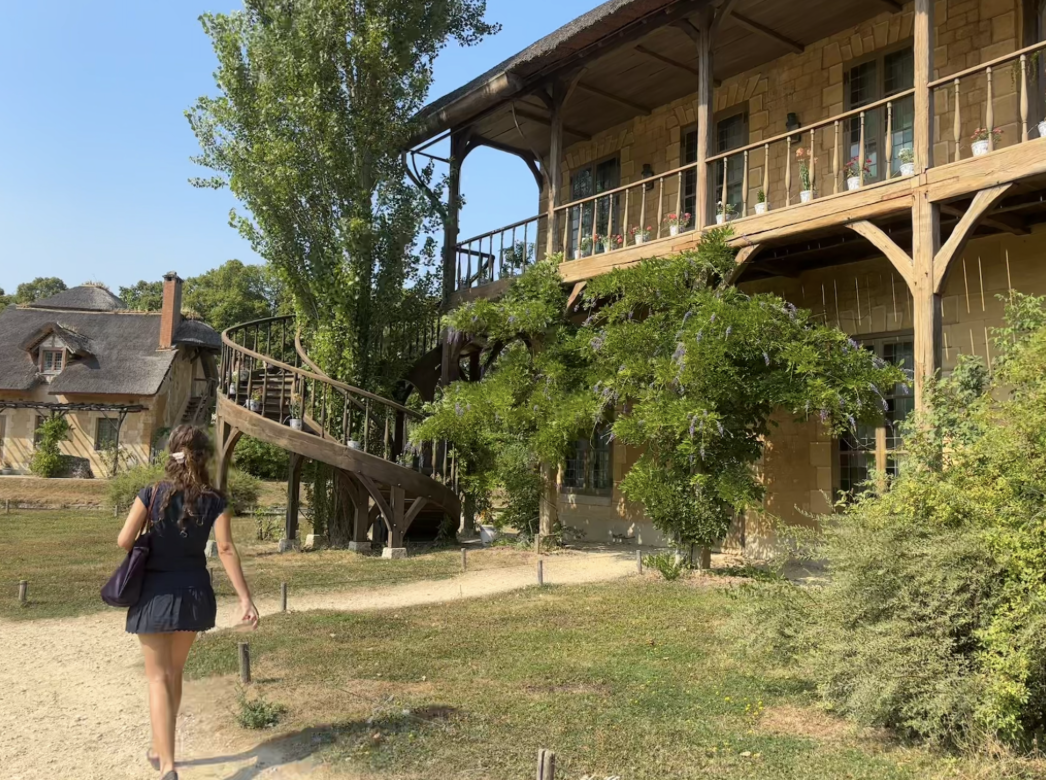
Exploring the Petit Trianon and Queen’s Hamlet.

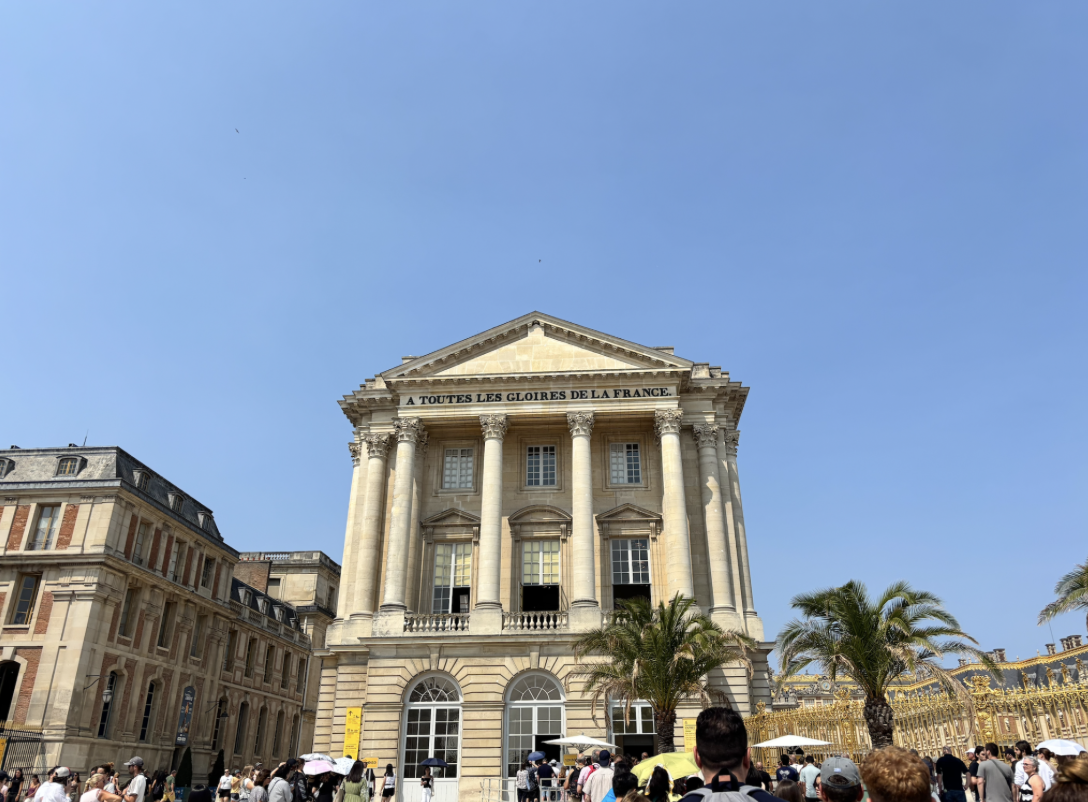
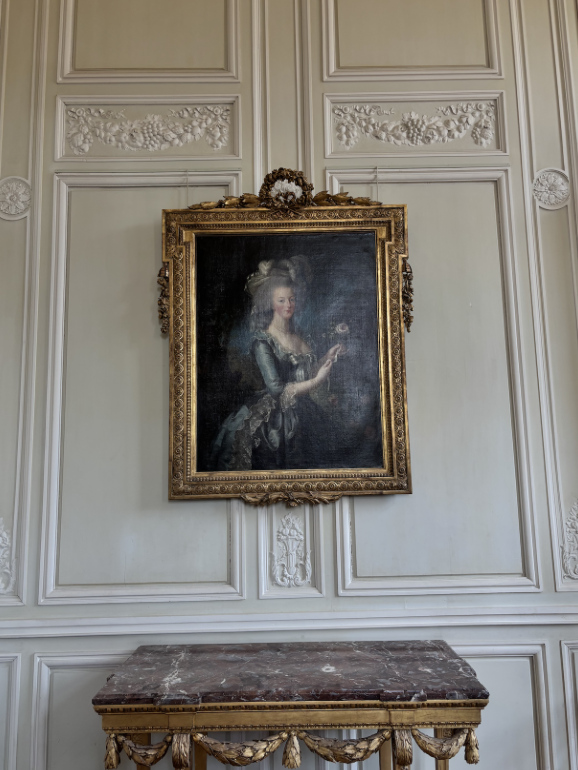
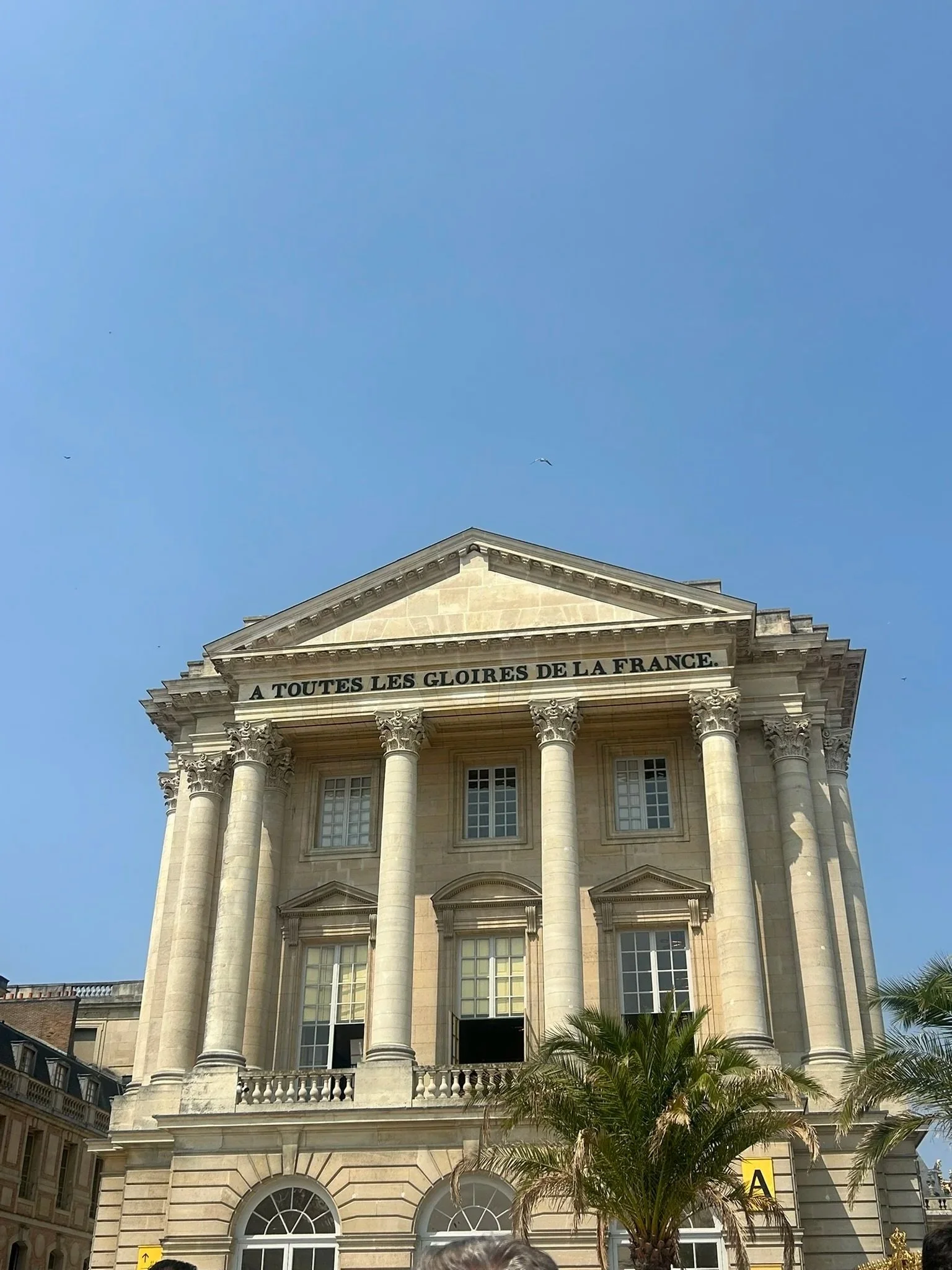
Let’s go back to the very elementary definition of un lieu de mémoire—a site of memory where collective and public memory can be physically embodied, rather than simply the retelling of the late fact within a history book. When we visited Versailles, I thought a lot about this blurring of lines within collective memory. Le Château de Versailles is so exquisite and flamboyant in architecture and design it feels unreal when walking through. There are exquisite portraits of monarchs of old, amongst those are Marie Antoinette and Napoleon. Marie, a teen-bride whose role within the country leant more towards playing milkmaid and dress-up while the poor starved outside the palace walls. And Napoleon, crowning himself and his Joséphine while the pope watches on. Yet the motto on the outside of the palace walls declares “À toute les glories de la France,” installed by the constitutional king Louis Philippe in 1833, when he converted Versailles into more of an all-encompassing museum of French history—including aspects of the revolution as well as Enlightenment. Isn’t that a sort of mémoire-mélangé—a mixing of histories, traditions, and memories in a singular lieu de mémoire?

Additionally, when we visited Rue Saint-Antoine, we had the privilege of seeing the beautiful church that Marius and Cosette were married in, the Church of Saint-Paul-Saint-Louis. Yet directly in front of the church, there is an empty space on the pavement where fontaine Saint-Catherine once stood. And in front of that fountain, the monseignor ran over a poor peasant child in his carriage. And I know there are only stories—not real historical fact. Yet oftentimes as I read my favored classical literature, the lines between fiction and reality blend for me. And for the purpose of my next statement, let’s allow this merging of reality—after all, “history” and “story” are the same in French: “l’histoire.” Standing in front of the church, my thoughts and feelings mangled and mixed as I admired the grandiose house of God where oh-so-romantic Marius and Cosette once wed. Yet picturing the absolute tragedy of an image of a little toddler being crushed by the carriage of a man who, rather than regretting his grave sin, tells the father to be glad the boy’s life is over with. How shockingly terrible, then all of a sudden I am recalling the tenderness of Marius and Cosette’s wedding, both of these contrasting memories—one traumatic, one lovely—coexisting in the same place.

On a personal scale, the blending of all of these histories within the same avenues mixes up a bit in my head. But so do my personal memories. I mix my own self up sometimes—when I am focusing on a memory, my costar’s perspective and my perspective of the experience blend and mush into one and suddenly there’s too many thoughts and tangles to work out.

On a larger scale this lends itself to the idea that we all have incredibly different experiences. One person may fall in love with the very person who broke another’s heart. Someone could be treated kindly by the one who turned another away. And, of course, some may find a grave where others, the beginning of a love story. This variance in “different experiences” is especially relevant to us in America—where certain politicians seem to operate on the basis of xenophobia in the modern day as opposed to a pure desire to help their people. And even just one person’s individual beliefs or prejudices can project onto another individual and predetermine an experience.

It is all a lot to think about…but these are ideas that have been on my mind as we bookpack and flâner our way through les rues de Paris.

Bad Farmers

This trip has taken us to a lot of churches. By my count, at least six in the last two-odd weeks. Honestly, this trip will probably be the most pious time in my life, considering it has doubled my lifetime church visits. To say the least, during our excursions, I’ve been having somewhat of a culture shock. I didn’t grow up religious, and because of that, I never had a place of worship to go to on Sundays or a Faith (capital F) to rely on. This is probably why I feel so apprehensive about the churches that we’ve seen.

Donation box in case anyone felt so inclined to contribute

Don’t get me wrong: they are (mostly) beautiful! Some minor taste qualms aside, the architecture, artwork, and grandeur of it all are pretty hard to ignore. This is exactly why so much money is spent on the upkeep of these places. Notre Dame, for example, costs 4 million Euros a year to maintain. The restoration of it alone cost approximately 800 million Euros. But this isn’t true of just the big famous churches that people flock to visit. The Church of Saint-Germain-des-Prés, for example, spent 6 million Euros on its recent renovations. It’s true that this Church is one of the more well-known churches in Paris, but it’s not necessarily a major tourist attraction. I say this all to underscore that, in general, churches spend a lot of money. And this is only on the upkeep!

While walking around, I’ve noticed that, as in any city, there are often unhoused people asking for cash to support themselves or to find a place to live. What's more interesting to me, and seems to be more of a phenomenon here in Paris (and also in London) but not in the US, is people sleeping on church steps. To enter some of these grand buildings, you pass people who are genuinely struggling to live safe and full lives. The irony is staring us straight in the face. To state the obvious, it feels wrong. Why is so much being spent on the upkeep of these buildings when there are people begging for help right outside?

A man sleeping outside the door of the Church of Saint-Germain l'Auxerrois.

In Les Misérables, Hugo riffs for quite a while on churches and their morality. He distinguishes between religion as an institution and religion used as a practice of radical charity. Bishop Myriel, for example, is arguably the moral center of the entire novel. Instead of being swept away by the status he could have had, Myriel lives a simple life and gives away all he can, up until he gives Valjean the candlesticks he needs to build his life back up. As Myriel says, “It’s not he who commits the sin that’s to blame but he who causes the darkness to prevail.” This is the type of altruism and humanity that is encouraged by religion, at least from Hugo’s perspective. Further, he explains:

"...hatred of luxury would not be an intelligent hatred. It is a hatred that would imply hatred of the arts. Nevertheless, other than for official and ceremonial purposes, luxury among churchmen is a transgression. It would seem to reveal habits of little true charitableness. A wealthy priest is a contradiction in terms."

Hugo’s criticism touches on misplaced priorities. In his view, religious wealth is justified only when it serves people rather than possessions. Yet not everyone is Bishop Myriel, as is clear from the juxtaposition of beautiful buildings with suffering just outside.

Tiny box hidden in a corner of the Place de La Madeline asking for donations for the poor

This has lingered with me as we continue to visit more and more churches. I have to believe that the story is surely not as simple as churches refusing to help those in need. Now, the US and France have different views on the Church's role as a community figure. But where my knowledge base is focused, in the US, this isn’t fully true. The tax structure of the United States allows religious entities to function as nonprofits, meaning that they don’t have to pay taxes. Many economists conceptualize the tax-free status of nonprofits as a subsidy that the government provides to organizations for the benefits they provide to the public. Charities like Feeding America provide direct services and are substituting for the government, which is why they are tax-exempt. Yet, while it’s a common argument that churches do significant charitable work, which justifies their tax exemption, this isn’t necessarily true. Unfortunately, only a tiny minority of congregations engage in social service, with the median amount churches spend on social services in the US being $1,200, or around 2% of a church’s budget. In this way, it has consistently been shown that charitable choice initiatives (which aim to provide even more public tax dollars to religious entities on the grounds that churches are substituting for government services) are empirically unnecessary and normatively unfair.

However, all of this is about the US and its long and complicated history with religion and charity. But what about France? Well, in France, religious organizations are also exempt from taxes. However, any church built before 1905 is owned by the state, which then allows religious groups to use it free of charge. So that money preserving Notre-Dame isn’t a religious subsidy; it was, at least officially, a cultural endeavor which Hugo would ostensibly approve of. Learning about this was quite interesting to me, because it became clear that France does not expect religious organizations to act as social service providers and substitute for the government. The irony I initially felt was partly due to importing American assumptions about the role of churches into a country that has instead assigned that responsibility to the state. And, in fact, France’s welfare system is one of the most comprehensive in the world. A 2020 OECD report finds that France tops the list of welfare spending, putting over 31% of its GDP into social services. Conversely, the US spends only about 19%, expecting nonprofits to fill the gap.

I do not consider myself to be unaware that different places function differently in terms of welfare, religion, and government. However, I am still quite surprised at just how differently these ideas are treated in France and the US. And while I do strongly believe that it is the government’s responsibility to provide for its people to the point that homelessness becomes a thing of the past, the pang of irony I feel when walking into these grand churches may not go away anytime soon. France may deem that responsibility the State’s rather than the church’s, but the same question remains: what do our institutions, religious or secular, owe to the people most in need? Hugo would probably argue that the distinction ultimately matters less than the outcome. Whether charity comes from bishops or bureaucracies, a society should be judged by how it treats those living at its margins. As Hugo says, men are like nettles.

With even the minimum of care, the nettle would be useful. Neglected, it becomes a nuisance. My friends, remember this: there are no such things as bad plants or bad men. There are only bad farmers.”

Fish and Chips or Coffee and Croissant?

Before arriving in London and Paris, I expected two cities that were both representative of the deep history and rich civilizations of Britain and France, two of the historically most powerful nations in Europe. I expected old and historical buildings, prideful people, and quintessential European walkable cities. To me, London and Paris do contain those aspects. They do contain a deep history and a sense of pride that represents their recognition of their achievements for Western civilization and the utmost power they had relative to the world. They are culturally rich and traditional cities while holding a sense of globalism due to their size and appeal to people from all over the world.

While both London and Paris contain these two aspects, they are extremely different as well. The stark contrast between the two cities was not something I expected coming to London and Paris. But the thing is that I would not have felt and understood this contrast if it weren’t for furthering my understanding of British and French history, as well as Londoner and Parisian experiences through the lens of literature, such as through Charles Dickens’ A Tale of Two Cities. Through these two vessels of understanding these European cities, I notice the differences in cultures and auras between the two cities. I can feel the historical context behind the streets I walk through and the people I walk past.

My view of London is one that holds onto a sense of tradition and order. Walking through the streets of London, I notice that novelty and experimentation do not stand out. While grandiose and beautiful, the streets and buildings feel sterile, and they give off a sense of conservatism; it feels very structured and uptight. While London is a bustling and diverse city that contains a melting pot of different cultures, I don’t feel the lively density and freedom that I feel in cities such as Paris. People walking by seem to have a purpose and destination that they need to achieve. Hundreds flock to Buckingham Palace to celebrate the British monarchy. Rather than wandering through endless street stalls, people find restaurants, sit down, and order fish and chips. Maybe they’ll drink a beer on a good (or bad) day.

London’s streets

 It feels representative of the Anglo tradition that you also see in the United States. For example, in New York City, there is a sense of hustle culture, where people are serious and focus on efficiency and work. But even in NYC, I feel more of a sense of freedom and creativity, probably due to the fact that the United States is a much less traditional nation and was founded on the basis of freedom, individualism, and “chasing the American dream”. London feels much more established, especially walking past the gentleman’s clubs and buildings occupied by the British establishment. In a way, it matches the stereotype of British people – one that portrays them as uptight, well-mannered, and hierarchical. 

Charles Dickens in A Tale of Two Cities touches on this idea of London in his book when he describes Mr. Lorry, who is a British banker.

“Very orderly and methodical he looked, with a hand on each knee, and a loud watch ticking a sonorous sermon under his flapped waistcoat”

The description of Mr. Lorry perfectly encapsulates the British’s orderly and conservative nature. Their habits are to dress orderly and follow “how things are” in British society. Their expectations are to follow routines and conform to societal expectations and norms. While Britain is a nation that has progressed immensely in terms of allowing for diversity and freedom of thought, there seems to be routines and traditional ways of doing things that have not changed much, even to this day. 

Paris, on the other hand, gave me a completely different impression. It is a city and society that feels like it is full of life and freedom. You have the freedom to go downstairs from your apartments and run into a plethora of food options, from small stands selling crepes and paninis to upscale restaurants serving steak and escargot. You have the freedom to flaneur around and find markets selling fruits, shoes, and knock-off handbags. You have the freedom to sit down in an outdoor seating area of a cafe and eat a croissant, drink a coffee, and smoke a cigarette. 

Parisian restaurant

At night, the streets are bustling with people drunk off of wine, chatting away, and probably buying a crepe from the stand next door. Young people are coming home from wine bars or clubs, enjoying their period of youth and freedom. Although the French hold onto a sense of pride and value their fashion and presentation, it differs from British pride. To the Brits, their pride stems from the “great” nation that their rulers and establishment had built. It stems from the years of British imperialism and the accomplishments of the ruling class. To the French, their pride stems from the culture and diversity that all people built and fought for. It celebrates the revolutionary ideals that set aside room for intellectualism, art, romance, politics, music, and more. It recognizes what the people fought for and holds its accomplishments on a high pedestal.

People watching the Eiffel Tower sparkle while drinking wine.

I can recognize this free, revolutionary, and liberal view of Paris through A Tale of Two Cities. Dickens describes the chaos and rage of the French Revolution in the novel. 

“With a roar that sounded as if all the breath in France had been shaped into the detested word, the living sea rose, wave on wave, depth on depth, and overflowed the city to that point. Alarm-bells ringing, drums beating, the sea raging, and thundering on its new beach, the attack had begun.”

The narrative of the revolution perfectly represents the uprising of the people and the Parisian tradition of revolting when injustice occurs. The people are the ones who control France’s future, not the upper class. The common folk are the ones who drive France’s culture, traditions, and politics. It is liberation that gives Paris its charm and culture of freedom. Parisians are not just tolerant to change, as change and novelty is expected. The collective power that builds Paris’ bustling streets, artistic expressions, and fashionable people is what holds their community together. 

To me, this relationship has parallels to other cultures’ relationships, such as Japanese and Chinese culture, where the former holds a sense of order and tradition while the latter is much more lax and has more of a culture of change.

Learning about British history and its hold onto tradition reminds me of Japanese culture and history. Japan is known for having a culture that holds manners, cleanliness, and order to utmost importance. They follow their centuries-old traditions to this day and hold very conservative and prideful views when comparing their culture to other cultures. Their culture is extremely hierarchical; even their language, which contains honorifics that are essential for understanding Japanese grammar, has components that reflect one’s place on the social pyramid. Even walking and eating is frowned upon, because to them, meals are moments of gratitude and not something that you should multitask. 

Walking through the streets of Kyoto, one of Japan’s more major, but traditional cities, I notice that despite the crowds of tourists that flock to visit, there is still a sense of order and extreme cleanliness to the streets. It is a city where you can really get a sense of Japanese traditionalism. Finding trash on the ground is extremely rare. You can still see Japanese women walking around wearing kimonos. Traditional Japanese homes and upscale (but extremely discrete) restaurants line the streets. You feel a culture of routine in Japan. While I would consider Japanese culture much more conservative than British culture and Japanese cities much more clean and orderly than British ones, there are similarities in the sense that both societies grip onto their traditions and hierarchy. 

Restaurant-lined streets in Kyoto

Even in Taiwan, which had been colonized by Japan during the 19th and 20th centuries, I can see a microcosm of Japanese culture. In metro stations, people naturally line up and politely wait their turn to board the train. People speak very politely, even to a point where it gets indirect at times. Grandiose buildings that were built by the Japanese are still intact and remind Taiwan that it was an established and industrialized island before other nations such as China and Korea were able to modernize.

National Taiwan University Hospital, built in 1912 during the Japanese colonial period

Perhaps this conservatism is due to the fact that Britain and Japan are both island nations that were able to preserve their culture against a multitude of invasions. Britain was able to protect itself against Napoleon’s conquest because of the English Channel, and Japan was able to protect itself against Kublai Khan’s conquest because of the typhoons in the Sea of Japan. Another reason could be because both nations have not gone through radical revolutions that had completely uprooted their respective nations’ political systems. Britain and Japan have always been monarchies and the major revolutions that occurred in these countries were primarily led by the upper class; the common folk did not have a major role and radicals did not gain enough power to completely do away with the established system. For example, the Glorious Revolution in 1689 was led by aristocrats, and the Boshin War that overthrew the shogunate was led by nobles and dissatisfied members of the samurai class. These factors most likely led to a more conservative culture that does not leave as much room for challenging societal norms. People feel a need to subscribe to the established customs and routines.

Japan’s history, society, and culture contrasts with Chinese culture. While I have not been to China (which is currently a horrible representation of the free-spirited nature of Chinese culture), Taiwan is a nation that is majority Han Chinese. In terms of Chinese culture’s influence on Taiwan, it shares similarities to my perception of Paris. The bustling night markets with people selling a multitude of foods fill the streets. Old women sing karaoke and dance in parks by the riverside. Old men sit on plastic chairs on the side of the road and talk about politics and their families while drinking tea. Beautiful and vibrant temples are scattered throughout the city, honoring various Chinese deities. These are the elements of Chinese culture that I feel are similar to Paris. There is a sense of freedom and tolerance, as well as a more lax view on their society. In Taiwan and France, people are seen as the cultural aspect that is celebrated, not the establishment’s achievements. 

Night market in Keelung, a port city located 25 km away from the capital, Taipei

In regards to a possible explanation for these similarities, maybe it is because France and China are both continental nations that have been exposed to a multitude of different cultures. France shares borders with other European nations, which has allowed for greater cultural exchange between them. For example, French culture and language is prevalent in Belgium, Switzerland, and parts of western Germany, which are all very distinct countries. China shares borders with a multitude of other east and central Asian countries, and has even been conquered by many foreign forces, such as by the Mongols and the Manchus. Or it could also be because of the fact that France and China have both undergone revolutions that had completely uprooted their respective political establishments. France went through various revolutions that had completely changed the course of their political systems, and they eventually abolished their monarchy. China had also gone through various dynasties, and eventually got rid of their monarchy during the Xinhai Revolution. They even went farther and established a communist government, which is the current People’s Republic of China. These moments of diversity, change, and revolutions allowed room for a tolerance of ideas and a sense of freedom. France and China’s history were both defined by change, which forced their societies to grow towards a more casual and novel path. 

There is not one better culture or society. There is not one model that we should strive to follow. In my opinion, it really is subjective. Some may like the order and tradition that London upholds, as it distinguishes itself from other nations and allows for a more organized society. Others may enjoy the freedom and liberating spirit of Paris, where you can flaneur around the city and indulge in drinking, smoking, and eating to your heart’s desire. 

I enjoy how Dickens captures this contrast through A Tale of Two Cities, because it does not only describe the dynamic between London and Paris, but it also encapsulates the dynamics between other neighboring cultures around the world. 


the Youth are cocks

Students. The minds of tomorrow. Young, fierce, and persistent. They have their finger on the pulse and their foot on the gas with nothing short of death a roadblock strong enough to stop them from pursuing greatness. Whether it is revolution or the daily trends we tend to follow, everything starts and ends with the passion of the youth. In Victor Hugo’s Les Miserables, the youth play a vital role in guiding the future. Through general merriment and as catalysts for revolution, they form the heart of society as we know it.

The Republic by Ange-Louis Janet, 1848 in The Carnavalet, Paris.

This portrait of The Republic is the embodiment of France. In the center, there is a small French flag underneath a rooster. On one side of the chair is farming equipment, the other side a hammer and art supplies, and behind the lady is factories and construction sites. The foundations of France, with the woman of freedom and liberty sitting atop. A symbolic image of a republic of the people, not the monarchy.

“They were young. The pure blood of principle ran in their veins.”
— Victor Hugo, Les Miserables

Image of a French coin from Google Images

If you ever visit France, you may be as shocked as I was to discover that their coins have the image of a rooster on them. In fact, there are roosters posted up across the city in subtle ways that you would not notice unless you were to look for them—like hidden Mickeys at Disneyland.

But why a rooster? The connection stems from an origin of mockery, turned to irony, and eventually a symbol of rebellion (and if that does not sum up the youth of every generation in one sentence, I don’t know what does).

The rooster, or more accurately, the Gallic rooster, started as an ancient Roman insult. The Latin word gallus has a double meaning: France, and rooster. The Romans and Germans used this symbol to portray the French as foolish, arrogant, and proud birds—cocks, if you will. During the French Revolutions, this symbol was reclaimed. The standoffish nature of the bird amused Parisians, who then used it as a symbol for the common people standing up to the monarchy. During both World Wars, the rooster stood for French resistance and bravery against invaders.

In short, pettiness turned to pride is the reason this feeble animal has become a symbol of French resistance. Arguably the most French thing I have ever heard.

The French People in The Carnavalet, Paris.

Description: A nude, muscled man lifts a woman with his left arm. The woman wears a flowing robe and a laurel crown on her head. The man symbolizes the French people, the woman personifies freedom. In this work, sculptor Joseph Chinard demonstrates his support for the Revolution: the French people support Liberty and Liberty crowns them as victor.

In all honesty, I was drawn to these sculptures because it reminded me of Jean Valjean and Cosette, and quickly after was the thought of my father and I (minus the naked-man part, which immediately made me regret this train of thought). Despite my intimidating stature of 5’2, you will be shocked to know my father is actually 6’3. The imagery of the father figure lifting the small girl onto his shoulders, followed by the description given, reminded me of how both the younger and older generations contribute to the future. The foundation laid by older generations lifts the youth, in all their exuberance, to reach for the stars. In Les Miserables, while the students are aggressive in their tactics for change, the grounds of educational, non-violent debate that they walk on is a luxury that would not exist if the road had not been paved by revolutionaries of the past.

Place des Vosges

The Places des Vosges is a residential square located just in front of Victor Hugo’s original house. It serves as a hub for casual gathering and community. The surrounding buildings are filled with modern art, ice cream shops, cafes, and other sources of simple pleasure. The park is vast, with gorgeous brick buildings that remind me a lot of USC. Call me nostalgic because I miss home, but the combination of this setting and all the beautiful people tanning in the grass took me right back to freshman year.

I never understood the obsession with tanning—I chalk that up to years of studying genetics and human disease haunting me—but it made me think about how fickle young minds are. We hop on and off trends (such as tanning) in a matter of months. What was cool yesterday is lame today. Radical. Swag. Six-seven. No crumbs. Larping. These phrases alone evoke different emotions to different generations, and I can personally say that half of these phrases are sooo three months ago. Trends of the youth (while sometimes insignificant and frankly, vapid) play a significant part in shaping culture. Who we rally behind, who we vote for, the causes we care about—it all stems from the sense of community that comes from being young. Where older generations may see unruly energy and trashy lingo, there is a communal understanding that when aimed correctly, is a force to be reckoned with.

Due to the fact that we change our minds in the blink of an eye, the youth are often underestimated and seen as vain. This couldn’t be further from the truth. When the youth are passionate, we stand ten toes down on what we believe. When the students in Les Miserables build the barricades, everyone assumes they will fall in a matter of hours. However, they persist for days. The youth are the driving force of the future. Whether it is as big as revolution or as small as the trend of tanning, to understand society, you need to understand the lifeblood of the youth.

And in this shared paradise, talking, singing, running, dancing, chasing butterflies, gathering bindweed, getting their pink lacy stockings wet in the tall grass, radiant, flighty, meaning no harm… Such is true joy.
— Victor Hugo, Les Miserables

French Conviction and Slow Walkers

I’ve never felt so American until I got to Paris. I try my best to wear clothes appropriate for Paris, always say bonjour when entering a boulangerie, and even fight my instincts and not smile at pedestrians (smiling at strangers is an American symptom). And yet, you take one look at me speed walking down the streets (yay, walkable city!) and you know that I am afflicted with the American hustle and bustle. Parisians love to amble– I do not.

For class, we read a fascinating excerpt from The Flâneur by Edmund White, which defines Flâneur as a Parisian figure that wanders the streets without an end destination while observing and pondering every facet of the city. White, an American himself, points out that “Americans are particularly ill-suited to be flâneurs.” I obviously immediately took offense until I realized that he was probably right.

There were so many differences in opinion to be found and I found myself surprised at how violently I was reacting to a mandatory piece of sourcework. I think I actually eye rolled at this:

I asked a French couple who recently visited me in New York for their first impressions after just twenty-four hours in America. The wife said, ‘In New York you can tell by people’s body language that no one cares what other people think of them, whereas in Paris everyone is judging everyone and the only people who have this American-style insouciance are the insane.’”
— Edmund White

To my senses it seemed like an argument against themselves? Frankly, the stress of trying to always be presentable and perfect in Paris has worn me down. Another culture shock has been, let’s say, the language of love here. For all the smiling we do in America, we don’t usually flirt with people on the street. My use of flirting really is being quite generous. As White puts it “American-style feminism had restrained men not to ogle women”. Interestingly, here White is explaining to a french couple who were upset by the lack of attention they had received in the United States.

That’s when it hit me. Maybe I was so upset because the French seem as strong in their conviction as Americans. Would you look at that?

Throughout our study of A Tale of Two Cities by Charles Dickens, we’d been talking about the differences between Britain and France and how they viewed one another. It seems strange now that the countries would have viewed themselves so differently, especially when both were poised for some sort of change in the monarchy. The political cartoons against each other were, of course, cartoonish, but still reveal their deeper sentiments towards one another. Both countries had deep rooted convictions that since it was the way they did it, it was the right way.

With this understanding, the hatred aimed at Darnay, for being an aristocratic emigrant in A Tale of Two Cities, started to make more sense. Of course, much of the French public’s resentment is due to his station of power, but after experiencing the culture alongside reading the book, I think much of their anger was flamed by what they feel is a betrayal to France, and its ideals by retreating to England.

The strength of the French public's conviction about France’s own ideals are memorialized around the city. Nearly every official looking building has three words carved into it, “Liberté, Égalité, Fraternité”. As you may have surmised this translates to “Liberty, Equality, Fraternity”. This is certainly an achievement after a horribly oppressive monarchy, (but please allow this American Feminist an eyeroll at the use of fraternity, but to be fair, “democratic” nations hadn’t quite thought to include women or people of color in their liberation). A whole country will never abhor a single ideal, and such a fundamental shift from a monarchy to a republic (not to mention an empire) will never be clean. I knew very little about the french revolution before this class as it is majorly simplified in a world history curriculum, so I found myself surprised by the complexity of beliefs within Victor Hugo’s Les Misérables.

Hugo explores the varying beliefs and ideals of the French through numerous different characters within the novel. For instance, in just one family you have several different ideas of ideals about what France should be fighting for. Grand-père who is a firm royalist and denounces his son who became a commander for Napoleon. Marius, not unlike France itself, experiences several transformations. He’s raised as a royalist under his grandfather, but after learning the truth of the father he never knew upon his death, he shifts to revere Napoleon and becomes a Bonapartist. Later, he befriends some student revolutionaries, learns about liberty, and eventually fights at the barricade in the name of the Republic.

“To all the glories of France”

It is hard to fathom how so many ideals can exist alongside each other. To my surprise, the Palace Of Versailles illustrates this beautifully. As orchestrated by Louis Philippe, the last King of France, Versailles attempts to honor all parts of France’s history. Versailles is large enough to encompass all these warring yet all french beliefs. There is a huge painting of Napoleon crowning himself emperor just as there are statues of Louis XIV and Louis Philippe himself.

In this, I find something enviable from the French. Can we as Americans build a bridge between the fractured pieces of our beliefs. Can we acknowledge those differences while moving forward for the common good? Only time will tell, and it must be remembered this unity inherent from the start, but consciously crafted with the benefit of hindsight and self reflection.

So, in respect to the culture we have been immersed in, I forced myself to slow down and flâneur. I wandered without extensive research and didn’t even overtake smooching couples on the street (ew). However, as White pointed out earlier, Americans really aren’t predisposed to flâneuring. So I flâneured myself into the thing Americans love just as much as ice and air conditioning, shopping!

Where Stories End

The Conciergerie, a former royal palace and prison on the Île de la Cité, stands illuminated along the Seine River in Paris, France. Photo courtesy of Introducing Paris.

Yesterday, I walked through the heavy stone doors of the Conciergerie and into one of the darkest chapters of the French Revolution.

The prison is quieter than I expected. Thick stone walls absorb every sound, and the narrow corridors feel almost suspended in time. It is difficult to imagine who once waited behind these walls: Marie Antoinette, awaiting her execution, ordinary seamstresses, laborers, priests, and thousands of others whose stories have long since disappeared from history.

Walking through the prison, I found myself thinking less about the executions themselves than about the waiting. Every prisoner entered the Conciergerie knowing there was a chance they would never leave alive. Every morning, names were called. Those selected climbed into tumbrils waiting outside and began the short journey to the guillotine. I left the prison wondering what the final walk must have felt like. Today, I found out.

Our class retraced the route that Sydney Carton takes in A Tale of Two Cities after exchanging places with Charles Darnay. We left the Conciergerie behind, crossed the Seine, and walked along the Rue Saint-Honoré toward the Place de la Révolution, where the guillotine once stood. Everything about the afternoon felt ordinary. People hurried home from work carrying shopping bags. Cyclists wove between tourists taking photos of the Louvre. Couples sat outside cafés drinking coffee beneath striped awnings. Street musicians filled the air with music as traffic flowed steadily through the city. Had I not known the history, nothing about the walk would have suggested what had once happened there. That was the strangest part.

Place de la Concorde, where Paris' most beautiful square conceals one of its darkest histories. Standing beneath the Luxor Obelisk, it is difficult to imagine that the guillotine once occupied this same space.

In A Tale of Two Cities, Dickens describes the tumbrils carrying prisoners through these streets toward their deaths. The journey is heavy with silence and inevitability. Walking the same route today, it was almost impossible to reconcile Dickens’ Paris with the one around me. Modern Paris feels vibrant and alive. Yet beneath the cafés, boutiques, and wide boulevards lies the memory of a city where crowds once gathered to watch people die. By the end of our walk, we reached the Place de la Concorde. Today it is one of Paris’ most beautiful public squares. The Luxor Obelisk rises from the center. Elegant fountains sparkle in the afternoon sun. Tourists gather to photograph the Eiffel Tower in the distance.

Today, Place de la Concorde is filled with tourists, gardens, and grand architecture. Two centuries ago, this was the Place de la Révolution, where thousands, including Louis XVI and Marie Antoinette, were executed.

Two centuries ago, this same square was known as the Place de la Révolution. The guillotine stood here. Louis XVI died here. Marie Antoinette died here. Danton died here. Eventually, Robespierre himself died here. Thousands of others – many remembered only as names on execution lists – met the same fate. Standing in the middle of the square, I found myself searching for some visible reminder of what had happened. There is no guillotine. No bloodstains. No crowds. History has quietly disappeared beneath fountains, gardens, and traffic circles.

Somehow, simply knowing what had happened was enough to change the way I saw the space. What struck me most was the difference between the real prisoners and Sydney Carton. Marie Antoinette never chose this journey. Neither did the countless anonymous prisoners who left the Conciergerie each morning. Sydney Carton did. That single difference transformed his final walk from an execution into a choice. Yesterday, while standing inside the prison, Carton’s sacrifice still felt like fiction. Today, after walking his route through the streets of Paris, it felt profoundly human. Dickens transformed an ordinary walk across the city into one of literature’s greatest acts of self-sacrifice and altruism. For the first time, I understood why.

The walk lasted no more than thirty minutes. I found myself slowing my pace, almost subconsciously trying to imagine what it would have felt like to know that every step brought me closer to my final destination. History often feels enormous when we read about it. Revolutions span years. Thousands of people die. Political systems collapse. But walking Carton’s final journey reminded me that history is also measured in individual footsteps. Every person who left the Conciergerie made this same journey knowing it would be their last.

As I stood in the Place de la Concorde, surrounded by tourists laughing, taking photographs, and moving on to the next attraction, I realized something that surprised me. The most powerful part of Bookpacking isn’t standing where history happened. It’s walking through places that no longer look like history at all. Yesterday, the Conciergerie showed me where prisoners waited. Today, the streets of Paris showed me where their stories ended. And somewhere between those two places, Sydney Carton stopped feeling like a fictional character and began to feel like someone I had quietly walked beside.

Before coming to Paris, I thought Sydney Carton’s final words were about sacrifice. After walking his final journey, I think they’re about something else entirely. For the first time in his life, Carton knew exactly who he wanted to be. The “far, far better thing” wasn’t the guillotine. It was the choice he made before he reached it. Standing in the Place de la Concorde, I finally understood that the most important part of Carton’s story was never how it ended. It was how he chose it would end.

“It is a far, far better thing that I do, than I have ever done; it is a far, far better rest that I go to than I have ever known.”
— Sydney Carton

Feeling Small

It is difficult not to feel small when faced with circumstances that feel foreign. Little feels more foreign than movement from one country to another––the same social customs no longer bind us, and in some instances, our communication is barred by language. More than that, there is the lack of shared history that one can find at home, be it personal or cultural.

Paddington wonders… how clearly do we see a city without appreciating its history?

I want to preface this by saying that I have spent some time on English soil. Last summer, I spent a month traversing the grounds of Pembroke College and visiting various landmarks in nearby cities. I attempted to decipher the symbols etched on the walls of the Tower of London. I craned my neck at the majesty of the Tower Bridge (not the London Bridge, which is presently just a slab of concrete). I took trains to cities like Norwich and Edinburgh. At that point, just remembering to look right before crossing the street felt daunting. My focus was to enjoy my travels to the fullest, to let the freshness of a new location fill my senses, to create some semblance of familiarity so I wouldn’t lose myself, and to enjoy the present. I neglected to immerse myself in the country’s past and the experience of being beyond the activities, despite reading all the plaques on the walls of every monument, for fear it would overwhelm me. I was living in the here and now, and that was enough.

This time around, I have dedicated myself to the full Bookpacking experience. I do my best to be intentional in the ways I gaze upon each building and street. I did not expect to find myself feeling smaller than usual. I am at once powerless in the tide of Charles Dickens’s fate-fueled history and haunted by the presence of faith in both Les Misérables and The Tale of Two Cities, struggling to understand something that, beyond being an academic subject, was so foreign to me.

With every book and letter I held, I thought of the people who had touched them before me. Had they taken the same care? Did they know these pages would outlive them?

Thus did the year one thousand seven hundred and seventy-five conduct their Greatnesses, and myriads of small creatures–the creatures of this chronicle among the rest–along the roads that lay before them.
— Charles Dickens, Tale of Two Cities

In class, we have dedicated discussions to the various perspectives on history. In The Tale of Two Cities, Dickens implies a degree of predestination. The past is given a direct trajectory to the present, which then reaches an inevitable future that we are, at present, setting up. I have a personal dislike for the idea of fate and destiny, especially as it pertains to historical events. Concepts like manifest destiny are linked to the violence that Native Americans faced at the hands of American settlers. Fate is too easily used to avoid responsibility for the uglier sides of history. I prefer to think of history as more of a chaotic (or, as Professor Andrew would say, higgledy piggledy) series of events. Not to say, of course, that historic events are not linked–it is crucial to remember that actions impact other actions. Oppression leads to revolt. Revolution paves the way for more revolution. The revolutionaries in The Tale of Two Cities are a people who have been exploited and neglected. This was the choice of the wealthy to continue the status quo, and the people to rise in defiance. A history clouded by fate feels less human.

In that stuffy, book-filled room of Jarndyce Antiquarian Booksellers, I became more and more enamored by the idea of humanizing history. The narrative element of literature allows us to see these historic events as more than just forces colliding. There are people behind all things. I thought about how the owners of these books must not have known that collectors would desire their weekend copy of Dickens’s writings. Dickens himself could not have predicted that a group of students from a university in California would chuckle at his correspondence with his friends. There is more than just the evidence that remains. In the writings and the cheeky illustrations of the period, there lingers emotion, passion, and the people who felt those things and decided to act on them. They dipped their pen in the inkwell, or packed their muskets with gunpowder. All things were and are a choice. Let us not relinquish the reins of free will and give credit to the magnetism of some higher force.

The Unknown is an ocean. What is conscience? It is a compass in the Unknown. Thought, imagination, prayer, these are great mysterious radiances. Let us respect them.
— Victor Hugo, Les Misérables

I will admit that I have never believed in a higher force. More accurately, I refuse to deny that such an existence is possible, but without proof, I remain highly skeptical. For the longest time, I avoided fully immersing myself in the grandeur and beauty of religious structures. This avoidance was not intentional, but I couldn’t help feeling like a fraud in these places of worship. As a result, I had also denied myself the chance to connect with spirituality and understand the appeal of faith. I would appreciate the architectural and artistic ingenuity of the yawning corridors and intricate stained glass windows, but I would not look beyond their aesthetics.

Both Hugo and Dickens refer to the healing power of religion through Bishop Myriel’s life-changing forgiveness and Sydney Carton’s Christ-like death. In reading about these transcendent experiences, I became determined to use my time exploring the many, many houses of faith to try and make some progress in changing my rigid atheistic ways, for the sake of Bookpacking. So I sat and pondered the question of faith. I certainly felt a sense of awe when entering these buildings. I could understand how religion helped people cope with difficult situations, how God gave people hope when they could find no source in their own lives. I wondered if the revolutionaries felt the same religious way about the phantom of a better future. In the peace of my own mind, surrounded by crowds of people, some praying, some taking pictures, I came to a new conclusion. What was so wrong about feeling small? Does feeling small necessarily mean feeling scared, or displaced? All other people in that church, in the present day, and surely in the past, were looking for some way through life. Some seek to find it in the comfort of God. Others find community within these walls. These structures, centuries old, housed stories and watched revolutions come and go. I found a new comfort, then, in the sureness that all people long for brighter days. If religion is the catalyst, the least I could do is try to understand. Watching people close their eyes and pray to the stone saints looking down with loving eyes, I could grasp the gravity a little more.

The first week of travel, though endlessly educational and fascinating in an academic sense, has given me the space to acclimate to the environment and experience literature in a new way that involves both mind and body. The world feels so much bigger when you are standing in it, and so much less lonely when you remember all the people that were and are. I look at the wear and tear of a city and think, I must have made my mark somewhere, too.

We have left London behind. Now, in Paris, I feel no less small. Still, in these books and that weathered corner of the cathedral’s pavement, there is light. With enough of an open mind, this looming shadow will be no more terrifying than the object that cast it.

Goodbye, London…


poetry alert

poetry alert ‼


Tower // Blacksmith

a tall world

towers over

me

a blade of grass

in a teeming, impatient field

so much has passed

much more yet to come

the pillar of history

the ever-growing sum

ever-growing

fatal weapons of intellect

for God

for liberty

to wield


for the word

from rag and mouth

cutting down

or raising up

the voice and the flag

as weapon

or as shield


the power of the tower

to crumble or

heal


On a loosely related note, one final crumb for those who are interested (this has to do with Bookpacking! I swear!):

I have been keeping a record of all the activities I’ve partaken in since I arrived in Europe. I hope that it will help me retain all the wonders of this trip past my usual week-long memory limit. I started this journal-fan because I was worried about forgetting what I had done, but upon seeing all the artifacts that have made it through the centuries, I think it will be alright even if I do forget the details of this trip. I will have this fan to analyze upon my return to the States, with the knowledge that no writing (sorry, Hugo and Dickens) or illustration (sorry, Hogarth) can capture the true feeling of being somewhere (though they may come close).

I will add an image of my progress at the end of each blog post, and the amount of blank space that remains will keep my feet on the ground in terms of how much time is left. Maybe part of the anxiety around history is that it’s unclear when it began (depending on who you ask) and when it will end. The past has happened, but at present, we are in limbo. It all depends on what we do next.

Progress–7.21.

Feminine Rage (French Ed.)

There is an unspoken rule in family that anyone with siblings would know. It is the same reason I am allowed to incessantly harass my sister, but if anyone else were to dare speak to her in the same coarse tongue with which I do, I would be up in arms. This sentiment is not unlike the way Parisians are with France. Never was there such a country in which the citizens will so openly criticize, yet fiercely defend. Liberty, Equality, and Fraternity—the beating heart of France. The French Revolution, while unnecessarily gruesome, is a prime example of this undying patriotism. The people of France will not think twice about defending their country and its principles, even if that means to overthrow the rulers of it.

La Favorite Saint-Paul, Paris.

The now pink and frivolous corner of this street marked by La Favorite is the location of the Defarge’s wineshop in A Tale of Two Cities. This site serves as an example of one of the many hubs in France at which the French Revolution was planned. Although this particular building was not evidently used for the French Revolution in real life, it is the location of revolution in Dickens’ story. In this wineshop, Madame Defarge runs secret meetings, creates hit-lists, and shows no mercy to those who stand in her way. She is one of the few female characters of the time depicted with such ferociousness and ambition. It is ironic to me that a place that served the purpose of such violence in a story is now bursting at the seams with pink flowers, but I have never loved anything more. The strength of a woman depicted through this intense pink iridescence instead of grotesque violence is an image I can get behind.

In A Tale of Two Cities: Defarge’s wine shop on the corner, a fountain in front the shop, and a church across the street.

Present Day: Cafe and bar in front of the Jesuit Catholic Church that was vandalized in protest during the French Revolution.


〰️

République Française ou La Mort

〰️

Republic of France or death

〰️ République Française ou La Mort 〰️ Republic of France or death


View of the Seine from a nearby bridge, Paris.

Reading A Tale of Two Cities at the riverbed of the Seine.

While the French made mistakes during the Revolution that led to unnecessary amounts of death, the principle with which they fought was pure. The notion of Liberty, Equality, and Fraternity will remain at the foundation of French culture for years to come.

 
... all red wine for La Guillotine… Liberty, equality, fraternity, or death; – the last, much the easiest to bestow…
— Charles Dickens, A Tale of Two Cities
 

The image the below was captured inside of a Jesuit Church across the street from La Favorite. In A Tale of Two Cities, just outside of this church is a fountain next to which a small child is murdered by an aristocrat. In the story, when the child is murdered, a mob immediately forms and (in due time) revenge is taken on the aristocrat: death. The immediate response of the French people to avenge and fight for their small brother demonstrates the level of patriotism with which many fought during the revolution. Every citizen, including the poor and the young, was part of the fraternity of France. This was the core ideal that sparked and spearheaded change in French society.

In actuality, there was no mob as a response to a child’s death, but this church was truly vandalized during the French Revolution. The anger of the French people marked through a symbol that persists even today is a fascinating addition to the history of this city. I like how you can clearly see there was an attempt to clean the graffiti off the wall (to no avail). This implicitly adds to the air of government control and defiance that was alive and well at the time of the Revolution. Additionally, there is no roping-off or attention called to this mark on the wall. There are chairs in front of it, and I imagine dozens of people have sat next to this invaluable mark and never paid it a second thought.

To deface a house of God! Now that is sending a message.

Inscription inside the Paroisse Saint Paul Saint Louis du Marais Jesuit Catholic Church, Paris.

Inscription: République Française ou La Mort.

Translation: Republic of France or Death.


Selfie at the Seine!

Allow me to emphasize the one aspect of France that has never wavered: patriotism. This was the heart of the French Revolution, and this notion remains the core of French society. No matter which side of history they were on, Parisians always acted in a way which they thought was best for France.

One landmark that I particularly love that exemplifies this principle of French life is the Seine. Historically, this river has served as an artery for commerce, military, and cultural exchange. It has inspired worldwide architecture and urban planning since the Middle Ages, and its influence continues to run worldwide. In fact, back in 2024, this was the very site where open-water Olympic swimming events took place. The Seine is formidable, ever adapting, and persistent—just like the French. In A Tale of Two Cities, this is the place where Carton crosses a bridge as he reaches a crucial decision to sacrifice his life for his dear friend.

… no sorrowful story of a haunting Spirit ever arose among the people out of all the working of the Guillotine… Carton crossed the Seine again for the lighter streets...
— Charles Dickens, A Tale of Two Cities

Pride, No Prejudice

What is the one place on Earth that you can go where all your troubles fade away? For Doctor Manette, the answer lies within Soho Square. In A Tale of Two Cities by Charles Dickens, the famous code words “recalled to life” are used to describe the rescuing of Doctor Manette from the Bastille, a fortress in Paris used as a political prison. Just after acclimating to society, he faces the violence of the French Revolution and seeks to protect his family from what he sees as the extremist’s war. He searches for a safe haven, and finds it in Soho Square. This site in the book acts as a recluse, and similarly to this fictional tale, it serves as an asylum to people throughout history. To this day, Soho Square represents a place of pride, joy, and livelihood that has spread across London.

Gold Beater’s Arm Story: “From the mid-eighteenth century until 1905, this muscular, wooden arm and hammer hung above a shop on Rose Street in Soho. Surfaced in gold leaf, the sign indicated that a goldbeater worked here. Dickens used a property off Rose Street as the fictional home of Dr. Manette in his best-selling novel, A Tale of Two Cities. He describes a tranquil Soho residence that provides a haven for the Doctor after the frenzy of revolutionary Paris. The Gold Beater’s Arm is placed in the courtyard of the house and used throughout the novel as an ominous symbol of the brutality of the revolution that looms over this quiet setting…”

The Gold Beater’s arm is a symbol of the strength and the calm after the storm of revolution. This statue is located in Soho Square as tribute to the story of A Tale of Two Cities. The story of the arm quoted on this page is an inscription alongside a replica located in Dicken’s house.

French Influence

The streets of Soho, London.

One of the earliest tributes to activism that can be found in Soho Square is the French Protestant Church. The origins of this church can be traced back to 1550, with the current structure having been refurbished most recently in 1893.

During the French Wars of Religion, after Louis XIV revoked the Edict of Nantes in 1685, thousands of French Huguenots fled to England and found refuge in this church. Here they took asylum and began to live normal lives. The notable French cultural, culinary, and skilled trades that were brought to London during this time can still be seen in Soho today.  

French Protestant Church, Soho Square, London.

A Day in Soho Square

Today, beyond being a hub for activism, people use the park of Soho as a space to meet and enjoy the sun. As we walked through the square, I came across this pair of men playing ping-pong, verbally jousting with the crowd and with each other. While this seems like a simple scene, I could have stayed and enjoyed the liveliness this duo brought to the area for hours. There is a beauty in the simplicity of joy found in an area that once used to be many refugees’ last hope. Being able to remove the fear factor from a safe haven is what makes it a space where all people are truly free. 

Pride in SOHO

An example of the dozens of pride flags that cover the streets of Soho. These flags are notably above the restaurant L’Escargot, a nod to the French heritage that remains a vital part of London today.

LGBTQ+ Nightclub: Admiral Duncan, London. (Picture from Google Maps)

Cheeky mirror picture at the bookshop Gay’s The Word, London.


The standard of acceptance, while a difficult road, has slowly spread outside of Soho Square and into the rest of London. As I walk the streets of Soho, countless pride flags fly, dozens of happy couples roam the streets, and you cannot help but to be enraptured by this air of bliss. The bookshop Gay’s The Word was established in 1984, and faced numerous raids where books were seized and called indecent. Writers rallied to support the shop, and it now remains a landmark of pride filled with books supporting queer love.

Admiral Duncan is one of London’s oldest LGBTQ+ nightclubs. In 1999, this establishment was attacked by a Neo-Nazi extremist who planted a nail bomb inside the pub, killing three people and injuring approximately seventy others. The assailant was sentenced to life in prison, and the outrage sparked by this attack led to massive marches in support of the LGBTQ+ community. Since then, Soho has blossomed into a place where all are welcome with open arms.

Soho Square has always been, and will always be, a place where anyone can find refuge.

It fills me with hope for the future knowing that places which were once filled with danger and violence can be turned into places of remembrance and love.

Walls to the Past and the Future

In our early travels in London we began by venturing into the world of the British Establishments. At this moment I had also just begun the story of A Tale of Two Cities where Charles Dickens starts this novel with the line:

It was the best of times, it was the worst of times.
— Charles Dickens

I know this quote is particularly popular, but throughout the experience this quote felt as if it was engraved into the stone of the walls around us.  

WestminsterAbbey

Even before walking into the Westminster Abbey, I was in awe of its intricate and beautiful architecture. I’m sure that I can say that I have never seen any other church like it. Once inside I remember looking up at the ceiling and felt that everything around me was so grand. I was surrounded by incredible statues, gold plated and gilded pieces from the arches to candlesticks, the sun piercing through the stained glass windows on all sides, and the sheer detail of every piece that filled the space. Before this visit, I was unaware of what this church held, leaving me very interested in all the different faces and names that are remembered here. Memorials of the royal family are abundant and interestingly other familiar names to me like Issac Newton, Charles Darwin, and Shakespeare were also present right under their large statues. The names throughout the church allowed me to take a glimpse into the past to understand who, and more so what kind of individuals were honored in this era. As we can see, it is members of the British Establishment and aristocracy that influenced life in this period. A Tale of Two Cities describes this higher class as arrogant and unwilling to reform away from the vast inequality compared to the lower class people. Along with the quote mentioned above, we can see through this lens the disparity such as while there was beauty and lavishness within these buildings such as the Westminster Abbey, outside these walls were lives only knowing of famine, pain, and hardship. Another thing that stood out to me was the very apparent connection between the state and the church that Westminster Abbey shows. Exploring its grounds I discovered that coronations, funerals and weddings of the English royal family occurred here. This structure is difficult as it can lead to increased inequality and corruption in both systems. In the present we see it exclude individuals of different religious backgrounds, leading to unequal rights in law and discrimination in society. This can not only be seen and applied to England but to various countries and governments throughout the world. 

Central Criminal Court (Old Bailey)

Continuing on our book packing journey, we stopped at the Central Criminal Court, also known as the Old Bailey. This court house that deals with criminal matters is the building Charles Dickens references in A Tale of Two Cities where Charles Darnay is tried for treason. It was an amazing experience to be able to transport into the setting of what was once just an imagination, which was not close to the true magnificence of it. Immediately, one could see that the Old Bailey is of a different architectural style than the Westminster Abbey straying away from the iconic point to a more stonework route and a dome above. Even early on our travels it is evident how London is filled with a vast array of architecture, allowing you to truly see its deep, long history! Why do I bring up the Old Bailey?There were two aspects of the Old Bailey that caught my attention. The phrase, “Defend the Children of the Poor & Punish the Wrongdoer” that is engraved in its walls and the other at the highest point of the dome is Lady Justice gleaming in gold holding a sword and a scale.  In our book packing novels I recall reading countless scenes of the law going against Lady Justice and the words this building presents on itself, instead siding with the monarchy and aristocracy, against the people. Again thinking about the quote at the beginning , the law gave to those with so much and took from those with nothing.

Banksy’s Sculpture

Taking these two experiences and ideas, I believe as though the British Establishment and Law are connected by that they continue to keep the pillar of what is “the feudal illusion” in society. This phrase describes the idea that individuals believe that to live and be in a hierarchy is natural and part of what has always been, making it right. Therefore, not aiming to make a change for the better. I’ve been referencing examples of the past, however the feudal illusion is still present today. To describe its current relevance, I find that the artist Banksy’s newest public work captures this idea. Walking past this statue in the heart of the historic British Establishment was powerful. I believe this is saying to the world, that following the traditions, laws, and ways of the past through blind patriotism without question leads to the fall of yourself and society. To get to a present of equality for all, regardless of race, religion, socioeconomic status, and other factors we must take off the mask to reveal the truth about the past and the present in order to understand to forge a better future.